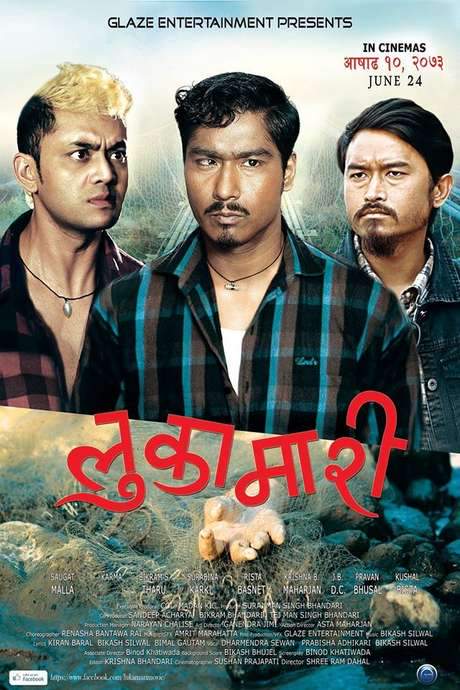
Lukamari 2016

Directed by

Shree Ram Dahal
Made by

Glaze Entertainment Pvt. Ltd.
Lukamari Plot Summary
Read the complete plot summary and ending explained for Lukamari (2016). From turning points to emotional moments, uncover what really happened and why it matters.
Lukamari, a title that translates to hide and seek, weaves a Kathmandu-set crime tale that follows a police investigation into a schoolgirl’s murder, a case tangled with the lives of the tenants in a local residence. Budhan Chaudhary [Saugat Malla] and Unique Maharjan [Karma Shakya] are two seasoned undercover investigators who, by sheer circumstance, find themselves sharing a room and a mission in the bustling valley. Each man hides a new name, a new job, and a new motive for living in the city, all while pursuing two seemingly separate murders. The pursuit begins with the girl’s disappearance and murder, which leads the investigators toward a suspiciously ailing teacher, and it intersects with another thread—the killings of two young boys—where a misplaced clue about land draws attention to a hidden location. The film introduces a playful, almost comic energy as both cops juggle their secret identities and the suspicion that grips everyone around them.
Within this crowded, lively world, the narrative introduces a cast of side characters who initially appear to be there for lighthearted moments—a priest, a group of drug-using youths, and a tea shopkeeper—but gradually these figures deepen and influence the plot. One tenant, Ragini [Rista Basnet], becomes a focal point as the two investigators observe a young girl living in the same house where they stay, while a subplot about a married woman and a handsome landlord adds romance and tension to the mix. The landlord, Kirateshwar Rai [Bikram Singh Tharu], emerges as a pivotal figure in the dynamics of the household, and the surrounding environment of Kathmandu becomes a steady backdrop for the unfolding drama. The interplay between comedy and suspicion keeps the film moving as new clues surface.
As the story advances, the two investigations reveal themselves as two threads of a single tapestry. The cops accidentally reveal their own identities to one another, and they gradually discover that their separate suspects are connected in unexpected ways. The tension escalates when the investigators realize that their prime suspect lives directly next door, blurring the line between hunter and hunted. To gain access and unearth solid proof, they enlist the landlord’s help to enter the suspect’s room, triggering a thrilling chase through the city’s narrow streets and shadowy corners. In the climactic sequence, the reasons behind the murders come to light, along with the roles of several seemingly minor characters—such as the priest—whose contributions become crucial to solving the case.
The resolution ties together the threads of both investigations and lays bare the methods of Nepalese crime fighting, all while offering a snapshot of Kathmandu’s social landscape. The film foregrounds themes of trust, deceit, and the gritty realities of city life, including unemployment, water scarcity, and prostitution, and it does so through a lens that blends humor with high-stakes suspense. Lukamari treats its audience to a story that feels rooted in its setting, anchored by dueling investigations and a cast of vividly drawn residents, and ultimately presents a careful, patient unveiling of how crime is confronted in a place where everyday life and extraordinary events collide.
Lukamari Timeline
Follow the complete movie timeline of Lukamari (2016) with every major event in chronological order. Great for understanding complex plots and story progression.
Disappearance of a schoolgirl triggers investigation
The story opens with the girl's sudden disappearance and the police rushing to establish what happened. As clues fade, fear and rumor swirl through the Kathmandu neighborhoods, setting a tense crime atmosphere. The case becomes the spark that links a broader web of people living in the same residence.
Two undercover investigators become roommates
Budhan Chaudhary and Unique Maharjan are introduced as seasoned undercover cops who, by chance, share a room and a mission. Each man guards a secret identity, a new name, and a hidden motive as they navigate the bustling city. Their unlikely partnership combines humor with mounting pressure to solve the case.
Two murder threads emerge: girl and boys
As the investigation deepens, investigators realize they are chasing two seemingly separate murders. The girl's case becomes entangled with the killings of two young boys, suggesting a single perpetrator or linked motives. A misplaced clue about land hints at a hidden location driving the mystery.
Suspicious teacher raises eyebrows
The pursuit leads investigators toward a teacher who appears unwell enough to hide something important. The suspect's health becomes a narrative thread that can blind or mislead the cops as they piece together alibis. Tension grows as more residents become intertwined.
Ragini's presence sharpens focus on the house tenants
Ragini emerges as a focal point, a young girl living in the same house where the detectives stay. The relationship dynamics inside the residence blur lines between tenant, neighbor, and potential witness. The crowded, lively neighborhood setting adds color while hiding crucial clues. Her presence raises the stakes for both investigators.
An accidental reveal of identities
In a moment of missteps, the two investigators reveal parts of their real identities to one another. The confession tightens the bond between them but also heightens risk as their true motives become exposed. This mix of trust and deception underpins the investigation's tension.
A hidden location exposed by a land clue
A clue about land ownership redirects attention to a concealed site relevant to the murders. The idea of buried property becomes a catalyst that connects seemingly unrelated threads. The search for this location drives the investigation into new streets and neighborhoods.
The landlord becomes a pivotal figure
Kirateshwar Rai, the landlord, enters the scene as a key player whose interactions shape the detectives' moves. He holds leverage over tenants and access to spaces where evidence may lie. His involvement blurs lines between witness, suspect, and ally.
They enlist help to enter the suspect's room
To obtain solid proof, the investigators enlist the landlord's aid to gain entry into the suspect's room. This marks a turning point that turns a private space into a stage for pursuit and breathless chase. The chase winds through Kathmandu's narrow streets and shadowy corners.
Climactic revelations unfold
In the climactic sequence, the reasons behind the murders come to light, along with the roles of several seemingly minor characters, including the priest. The investigators discover how the threads connect, and how trust and deceit have shaped everyone's choices. The truth redefines who was hunting whom.
Resolution ties threads and reveals crime-fighting methods
The case closes by tying together the two investigations into a single, coherent narrative. Viewers are offered a look at Nepalese crime fighting techniques and how problem-solving unfolds in a crowded city. The resolution also reflects the social landscape of Kathmandu, from unemployment to water scarcity.
Themes and tone: humor amidst suspense
Throughout, the film blends a playful energy with high-stakes suspense. The balance between comedy and danger runs through every twist, keeping characters layered and the audience guessing. The lived-in setting makes the city itself feel like a character.
Lukamari Characters
Explore all characters from Lukamari (2016). Get detailed profiles with their roles, arcs, and key relationships explained.
Budhan Chaudhary (Saugat Malla)
Budhan Chaudhary is a seasoned undercover cop who masks his true identity with a new name and job. His street-smart pragmatism helps him navigate Kathmandu's crowded, suspicious world, but his dual life strains his trust in others. He relies on instinct and careful planning to unravel the murders while keeping his own cover intact.
Unique Maharjan (Karma Shakya)
Unique Maharjan is the other veteran undercover investigator who shares a cramped room with Budhan. He is equally adept at slipping into roles, yet he also shows a softer side in the relationship web around Ragini. His secretive nature makes him a steady, sometimes morally gray, partner in the search for truth.
Ragini (Rista Basnet)
Ragini is a young woman living in the same residence, a focal point for both investigators. Her presence reveals the social textures of urban Kathmandu, including romance and tension within the landlord-tenant dynamic. She becomes a key link in the thread that ties the murders to the housing mystery.
Kirateshwar Rai (Bikram Singh Tharu)
Kirateshwar Rai is the landlord whose outward charm masks a pivotal role in the house's secrets. He becomes a potential ally who can grant access to hidden corners, yet his motives are not immediately clear. His interactions with Ragini and others push the case toward its climactic reveal.
Jaya Giri (Surabina Karki)
Jaya Giri is a resident who adds to the web of relationships in the house. She observes, interacts, and her choices ripple through the investigation's progress. Her presence helps establish Kathmandu's bustling social ecosystem that frames the crime.
Musya Sahu (Krishna Bhakta Maharjan)
Musya Sahu is another resident figure in the row of tenants whose actions and background influence the case. He represents the ordinary lives intersecting with the crime, underscoring the film's focus on trust and deception in city life. Through Musya's role, the story hints at broader social issues affecting Kathmandu.
Lukamari Settings
Learn where and when Lukamari (2016) takes place. Explore the film’s settings, era, and how they shape the narrative.
Location
Kathmandu, Nepal
Kathmandu, Nepal sits at the center of Lukamari’s story, with its crowded streets and vibrant neighborhoods forming the film's backdrop. The city’s tenants, priests, and shopkeepers interact within a single bustling residence, creating a microcosm of urban life and suspicion. Kathmandu's narrow lanes and shadowy corners drive the pace of the pursuit, balancing humor with high-stakes tension.
Lukamari Themes
Discover the main themes in Lukamari (2016). Analyze the deeper meanings, emotional layers, and social commentary behind the film.
🕵️♂️
Identity
Two seasoned undercover investigators juggle hidden identities as they share a room and a mission, blending into Kathmandu's crowded streets. The film explores how personas can mask motives and blur who is pursuing whom. The tension comes from knowing the suspects might be closer than the investigators realize.
🎭
Deception
Lukamari threads together clues through misdirection, false leads, and layered relationships. The investigators' disguises and lies complicate trust, forcing them to confront the possibility that everyone around them is playing a part. The comic energy contrasts with the looming suspense.
🔎
Convergence
Two murder cases become a single tapestry as evidence links a teacher's illness, a missing girl, and the deaths of two boys. The investigation reveals how social dynamics in Kathmandu—such as housing, landlords, and street life—interlock to uncover the truth. The climax ties disparate threads into a careful resolution.

Coming soon on iOS and Android
The Plot Explained Mobile App
From blockbusters to hidden gems — dive into movie stories anytime, anywhere. Save your favorites, discover plots faster, and never miss a twist again.
Sign up to be the first to know when we launch. Your email stays private — always.
Explore the mobile appLukamari Spoiler-Free Summary
Discover the spoiler-free summary of Lukamari (2016). Get a concise overview without any spoilers.
In the bustle of Kathmandu’s winding alleys, a city where humor and hardship walk hand‑in‑hand, the film Lukamari—a Nepali term for hide‑and‑seek—sets the stage for a game of shadows. The capital’s cramped apartments, unreliable water supply, and the constant hum of street vendors form a vivid backdrop, reminding viewers that every clue may be found amidst everyday survival. The tone oscillates between sharp comedy and taut suspense, capturing the paradox of a place where a laugh can mask a deeper unease.
Into this world step two veteran undercover agents, each cloaked in a new identity to protect the secrecy of their missions. Detective Karki arrives from the outskirts, drawn into a case surrounding the disappearance of a young schoolgirl, while Detective Singh follows a trail that hints at a darker pattern involving two missing boys. Unaware of one another’s true purpose, they end up sharing a modest room in the valley, their lives intersecting by sheer chance. Their banter and rivalry provide levity, even as each pursues a mystery that seems to echo the other’s.
Around them swirl a cast of vivid side characters: the enigmatic landlord who charms the neighborhood, the married woman whose secret liaison adds a thread of intrigue, a pious priest whose sermons mask hidden motives, a tea‑shop keeper whose stall becomes an unofficial briefing room, and a handful of restless youths navigating the city’s underbelly. Though initially presented for comic relief, each presence hints at deeper layers that may intertwine with the investigators’ pursuits, reflecting Kathmandu’s own mix of surface charm and concealed tension.
The film thrives on its cat‑and‑mouse rhythm, a relentless “seek” that mirrors the city’s own relentless pulse. By blending Nepalese police methods with social commentary—touching on unemployment, water scarcity, and the shadows of prostitution—Lukamari promises a rich, immersive experience. It invites the audience to watch the detectives weave through humor and danger, ever aware that the next hidden clue could be lurking just behind a familiar door.
Featured on this page

What's After the Movie?
Not sure whether to stay after the credits? Find out!
Check out our other apps:

SAT Sphere
Build confidence for the Digital SAT.

Mori Atlas
Discover wild places worth protecting.

Luntero
Search smarter for a home in Amsterdam.

Plot Explained
Unravel movie endings and hidden clues.

Pokechamp
Dive into Pokémon data and battle logic.

Driving Theory
Get ready for your European theory test.

Movie Dust
Plan your next cinema trip with ease.

Musemap
Find art and culture as you travel.

Selkobase
Compare credentials before committing.

Local Manual
Turn an unfamiliar country into practical next steps.

Lernavi
Compare school systems before your next move.

GymRoam
Find a workout stop wherever your plans take you.
Explore Our Movie Platform
New Movie Releases (2026)
Famous Movie Actors
Top Film Production Studios
Movie Plot Summaries & Endings
Major Movie Awards & Winners
Best Concert Films & Music Documentaries
Movie Collections and Curated Lists
© 2026 What's After the Movie. All rights reserved.
Privacy Policy