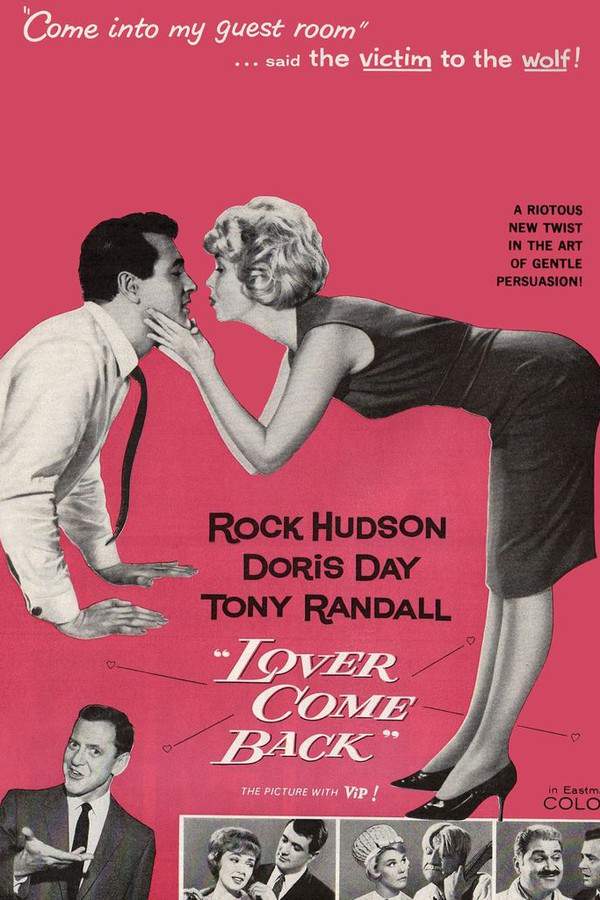
Lover Come Back 1962

Directed by

Delbert Mann
Made by

Universal Pictures
Where to Watch Lover Come Back
See current US streaming, rental, and purchase options for Lover Come Back (1962) via JustWatch.






Lover Come Back Plot Summary
Read the complete plot summary and ending explained for Lover Come Back (1962). From turning points to emotional moments, uncover what really happened and why it matters.
In a bustling Manhattan advertising agency, Jerry Webster, Rock Hudson, has carved out a meteoric rise not through traditional savvy but by slick social maneuvering: wining and dining his clients, pairing them off with glamorous dates, and turning charm into billings. His fiercest competitor is Carol Templeton, a sharp, principled force at a rival agency who has never met him yet remains deeply wary of his methods. Played by Doris Day, she sees through the noise and quietly reports his tactics to the Ad Council, setting off a high-stakes game of cat and mouse across the industry. Jerry deflects trouble with his usual poise, even when he slips a charismatic chorus girl named Rebel Davis into the mix to sweeten the council’s view of him.
Rebel, a striking figure in her own right, is promised a path to commercial work in exchange for her cooperation, and Jerry hatches a scheme around a supposed product called VIP. He arranges shoots to promote VIP, yet keeps the real plan under wraps, believing the whole thing will fade into the background. The company president, Pete Ramsey, powers the notion that the ads will be broadcast, forcing Jerry to improvise on the fly. To salvage the situation, he orchestrates a bold lie: he bankrolls a Nobel Prize–winning chemist to dream up a real product, and, crucially, he leverages the ruse by pretending to be the chemist himself whenever Carol tries to snatch the account away, turning her into an unwitting participant in a game of deception, wining, dining, and frolicking at the beach as if she’s been confiding in Dr. Linus Tyler, the brilliant mind behind VIP.
The chess move pays off when the ruse comes to light and Carol, appalled, reports Jerry again—this time for promoting a product that does not exist. But Jerry arrives at the Ad Council hearing with VIP in hand, delivering generous samples of a mint-flavored candy that Tyler has supposedly created. The candy’s intoxicating effects spark a whirlwind turn of events: Carol, who has little tolerance for alcohol, ends up sharing a one-night liaison with Jerry in a Maryland motel, complete with the surprise of a marriage license.
Carol ultimately has the marriage annulled, and Jerry faces new leverage from liquor-industry representatives who offer a tempting payoff to pull VIP off the market. Rather than surrender, he negotiates a deal: VIP’s backers will channel 25% of their $60 million annual advertising expenditures to Carol’s firm, and he destroys a signed confession he has that would look like a real formula. With New York in his rearview, he departs for the San Francisco branch, only to be called back nine months later to seal a new chapter in their story—remarrying Carol in a hospital maternity ward just before she gives birth to their child.
This satirical look at the advertising world blends ambition, ethics, and romance into a brisk, lively farce, where a single product can upend careers, marriages, and reputations. The film skewers how easily perceptions can be manipulated, how quickly alliances shift when money and power are involved, and how fate can intervene just as quickly as a clever ruse. Throughout, the central dynamic between the tireless schemer Jerry and the principled Carol drives the narrative forward, exposing the costs of chasing success at any price while leaving room for a surprising, if reluctant, reunion that hints at a more complicated future for both of them.
Lover Come Back Timeline
Follow the complete movie timeline of Lover Come Back (1962) with every major event in chronological order. Great for understanding complex plots and story progression.
Jerry's rise on Madison Avenue
In a Manhattan advertising agency, Jerry Webster has achieved success not through hard work or intelligence but by wining and dining his clients and setting them up on dates with attractive women. This ruthless but effective approach cements his status as the top ad executive on Madison Avenue. It also foreshadows the ethical compromises he will continually test.
Carol confronts Jerry and Rebel is deployed
Carol Templeton, Jerry's equal at a rival agency, is disgusted by his unethical tactics and reports him to the Ad Council. To blunt the charge, Jerry sends Rebel Davis, a comely chorus girl, to seduce the council members. The cunning move shows his willingness to manipulate situations to protect his position.
VIP shoots ordered by the firm
Jerry arranges shoots featuring Rebel for VIP, a fictitious product, hoping they'll never air. Yet the company's president, Pete Ramsey, unexpectedly orders the footage broadcast on television. This ironic twist forces Jerry to conjure a real-sounding product at speed.
Bribing the chemist to create VIP
To manufacture a real-sounding product, Jerry bribes Nobel laureate Dr. Linus Tyler to create VIP. He sees no scruples in paying for a miracle to save his account. The plan hinges on Tyler's scientific credentials to lend legitimacy to the nonexistent product.
Impersonation leads to a working romance
Carol mistakes Jerry for the chemist Linus Tyler and, to steal the account, he pretends to be Tyler. As 'Tyler' he wines, dines, golfs, and frolics with Carol, who unknowingly enjoys the fringe benefit of the deception. The con runs through beaches and golf courses as their bond tightens.
Carol uncovers the truth and reports again
Carol eventually uncovers that Jerry is not the chemist and exposes him again to the Ad Council, this time for promoting a product that does not exist. Her outrage marks a turning point as she doubles down on the fight against his schemes. The Ad Council braces for another showdown.
VIP debuts at the hearing with samples
Jerry arrives at the hearing with VIP, the real mint-flavored candy Tyler created. He provides many free samples to everyone there, including Carol. The generous distribution softens resistance and props up VIP as a legitimate product.
VIP intoxication and the Maryland motel night
VIP turns out to be intoxicating, each piece having the same effect as a triple martini. Its extreme effects lead to a one-night stand between Carol and Jerry in a Maryland motel, complete with a marriage license. Their bizarre union grows from the candy's spell as much as from their rivalry.
Annulment of the marriage
Carol has the marriage annulled, unable to accept the consequences of their impulsive union. The fallout shakes both their careers and egos as they navigate the scandal. The result leaves them professionally wary of one another.
Liquor industry pressure and the 25% deal
Representatives from the liquor industry visit Jerry, offering lucrative pay to pull VIP off the market and destroy the formula. Jerry negotiates a counteroffer that gives Carol's firm 25% of its $60 million annual advertising expenditures. He then burns a confession that he has just signed, which the reps mistake for the actual formula.
Confession burn and departure from New York
Jerry convinces the liquor reps to deliver the money to Carol's firm and then burns a signed confession, which they mistake for the real formula. The ruse extinguishes the immediate threat while cementing his control over the deal. He uses the moment to slip away from New York.
Move to San Francisco
With the market secured, Jerry leaves New York to work in his company's San Francisco branch. The relocation signals a strategic retreat and a fresh start away from the headlines of his romance with Carol. It also sets up the possibility of a future reencounter with his rival.
A late remarry in the hospital
Nine months later, Jerry is called back to remarry Carol in a hospital maternity ward, just before she gives birth to their child. The ceremony binds them once more, hinting at a complex family future despite their public battles. The strange arc closes with a personal stake that mirrors the professional games they've played.
Lover Come Back Characters
Explore all characters from Lover Come Back (1962). Get detailed profiles with their roles, arcs, and key relationships explained.
Jerry Webster (Rock Hudson)
A charismatic but unscrupulous Madison Avenue ad executive who wins clients through charm and manipulation. He fabricates schemes, impersonates others, and treats people as means to an account, revealing a self-serving ego that drives the narrative. His evolving relationship with Carol complicates his cynical approach to business and romance.
Carol Templeton (Doris Day)
Jerry’s equal and rival, a principled and shrewd advertising exec who disapproves of his tactics. She reports him to the Ad Council, then becomes entangled in a complicated romance when she is drawn into Jerry’s ruses. Her sharp intelligence and professional poise drive much of the plot and her eventual decision on love and ethics.
Rebel Davis (Edie Adams)
A comely chorus girl recruited to seduce Ad Council members for a sham campaign. She cooperates for a promised role in commercials, only to become part of Jerry’s larger deception. Her role exposes the gendered dynamics of showbiz as a tool for marketing and manipulation.
Dr. Linus Tyler (Jack Kruschen)
A Nobel Prize-winning chemist bribed by Jerry to create VIP, the supposed real product. He becomes the unlikely catalyst for the scheme and the mistaken identity that fuels the romance plot. His involvement highlights how science and innovation can be folded into marketing deception.
Lover Come Back Settings
Learn where and when Lover Come Back (1962) takes place. Explore the film’s settings, era, and how they shape the narrative.
Time period
1960s
Set in the early 1960s, the story mirrors the era’s booming television advertising and glamorous corporate culture. It captures the cutthroat competition of Madison Avenue, where image and persuasion trump hard work. The period vibe emphasizes witty banter, social polish, and the rise of brand-driven consumerism.
Location
Manhattan, New York City, Maryland, United States, San Francisco, California, United States
The film centers on Manhattan’s fast-paced Madison Avenue advertising world, where high-stakes campaigns and social charm drive success. Key scenes unfold in a glossy office environment, ballrooms, beaches, and hotel rooms that showcase the era’s consumer culture. The narrative also spans a Maryland motel for a pivotal one-night encounter and a hospital maternity ward, before circling back to the San Francisco branch of the same agency.
Lover Come Back Themes
Discover the main themes in Lover Come Back (1962). Analyze the deeper meanings, emotional layers, and social commentary behind the film.
🎭
Deception
Deception drives the plot as Jerry fabricates schemes, impersonates others, and treats people as means to an account, revealing a self-serving ego that drives the narrative. Carol’s discovery of the ruse tests trust and integrity within a professional rivalry that blurs personal and business lines. The film uses humor to explore how easily appearances can be manufactured in advertising and romance.
💘
Romance
Love develops through calculated risk and dangerous liaisons, as the duo’s contentious dynamic turns intimate after a vow-fulled faux chemistry. The narrative tracks how attraction and ambition collide, creating a complicated marriage that survives deception, pride, and industry pressure. The romance acts as both a motive and a consequence of the characters’ professional games.
💼
Ethics
The plot scrutinizes the moral boundaries of advertising—bribery, fake products, and manipulation for profit. VIP’s creation and distribution expose how ethics can be bent in the name of client wins. The characters confront whether success justifies methods that deceive consumers and colleagues.

Coming soon on iOS and Android
The Plot Explained Mobile App
From blockbusters to hidden gems — dive into movie stories anytime, anywhere. Save your favorites, discover plots faster, and never miss a twist again.
Sign up to be the first to know when we launch. Your email stays private — always.
Explore the mobile appLover Come Back Spoiler-Free Summary
Discover the spoiler-free summary of Lover Come Back (1962). Get a concise overview without any spoilers.
In the gleaming high‑rise world of Manhattan advertising, every pitch feels like a performance and every client a potential lover. The metropolis hums with the clatter of typewriters, the flash of neon signs, and a relentless race to turn ideas into billboards. Within this glossy arena, Jerry Webster has built a reputation on charisma as much as on copy, turning cocktail parties into contracts and charm into cash. His effortless swagger masks a habit of bending the rules, a habit that keeps his agency’s ledgers fat while leaving a trail of dazzled clients and bewildered competitors.
Across the street, the rival agency is steered by the sharp‑tongued Carol Templeton, whose reputation rests on integrity and a keen eye for genuine talent. Though she has never met Jerry face‑to‑face, she has watched his tactics from a distance and grown wary of his penchant for smooth‑talk over substance. When a formal complaint lands on her desk, it threatens to upend Jerry’s polished image and put the delicate balance of the advertising world into flux.
Undeterred, Jerry turns to an unexpected ally: a captivating nightclub performer whose stage presence could lend the perfect sparkle to any campaign. Together they hatch a daring promotional scheme designed to deflect the growing scrutiny and restore his standing. The plan leans heavily on illusion, leveraging the performer’s allure and Jerry’s silver‑tongued negotiations to craft an ad campaign that blurs the line between reality and spectacle.
But as the venture begins to wobble, the need for a genuine breakthrough becomes clear. Jerry finds himself on the brink of a fresh, inventive product concept that could not only rescue his career but also reshape the industry’s perception of what sells. The film swirls with witty banter, fast‑paced romance, and a satirical look at the art of persuasion, inviting viewers to wonder how far charm can carry a man before he must finally back it up with something real.
Featured on this page

What's After the Movie?
Not sure whether to stay after the credits? Find out!
Check out our other apps:

SAT Sphere
Build confidence for the Digital SAT.

Mori Atlas
Discover wild places worth protecting.

Luntero
Search smarter for a home in Amsterdam.

Plot Explained
Unravel movie endings and hidden clues.

Pokechamp
Dive into Pokémon data and battle logic.

Driving Theory
Get ready for your European theory test.

Movie Dust
Plan your next cinema trip with ease.

Musemap
Find art and culture as you travel.

Selkobase
Compare credentials before committing.

Local Manual
Turn an unfamiliar country into practical next steps.

Lernavi
Compare school systems before your next move.

GymRoam
Find a workout stop wherever your plans take you.
Explore Our Movie Platform
New Movie Releases (2026)
Famous Movie Actors
Top Film Production Studios
Movie Plot Summaries & Endings
Major Movie Awards & Winners
Best Concert Films & Music Documentaries
Movie Collections and Curated Lists
© 2026 What's After the Movie. All rights reserved.
Privacy Policy