
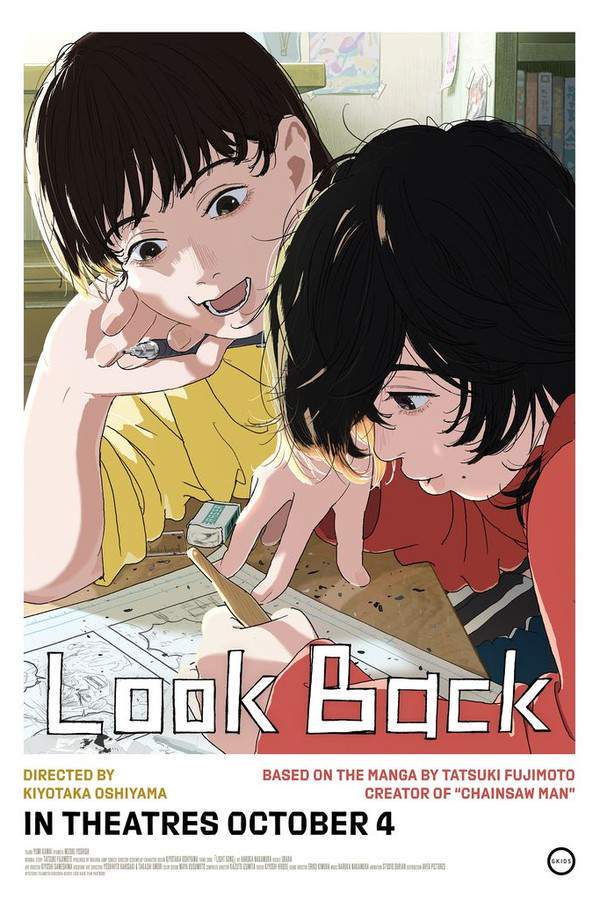
What Is Look Back About?
The premise of Look Back in 276 words, with nothing given away. The full story and the ending follow below.
Look Back is an emotionally resonant animated drama that follows Ayumu Fujino, a confident and popular young artist known for her witty, humorous four-panel comics. Content in her creative life and celebrated by classmates and teachers alike, Fujino’s world shifts when her teacher assigns her to collaborate with Kyomoto, a withdrawn classmate she has never personally met. What begins as an awkward pairing between two very different personalities soon reveals Kyomoto to be a far more technically gifted artist than Fujino ever imagined.
Set against the quiet rhythms of school life and the intimate spaces of notebooks and sketchbooks, the film captures the passionate, sometimes obsessive world of young creators chasing their craft. The story leans into the textures of drawing — the scratch of pencil on paper, the late nights spent refining a single panel, the quiet thrill of seeing one’s work in print. Its visual style balances the warmth of everyday moments with the intense focus of artists lost in their work, creating a tender and nostalgic atmosphere.
At its heart, the film explores the complicated bond between two artists whose rivalry slowly transforms into a meaningful friendship. Where Fujino is bold and outgoing, channeling humor and personality into her work, Kyomoto is shy and precise, pouring her feelings into detailed illustrations of the world around her. As they begin to create together, their differences become complementary rather than conflicting, and their shared passion for manga draws them into each other’s orbits.
Gentle, introspective, and quietly moving, Look Back is a love letter to the creative process and the people who inspire us to keep drawing, writing, and reaching for something larger than ourselves.
What Happens in Look Back?
The complete story of Look Back, from the first scene to the last, in 837 words (about 4 minutes). Spoilers throughout. Names in the text link to 2 cast member pages.
Spoilers ahead
Ayumu Fujino, portrayed by Yumi Kawai, is a spirited elementary school student who possesses a natural talent for drawing manga. She spends her days publishing yonkoma (four-panel comics) in her school’s newspaper, where she deeply enjoys the praise and admiration she receives from both her classmates and her teachers. However, her confidence is shaken when her teacher requests that she share one of her comic strips with Kyomoto, played by Mizuki Yoshida. Kyomoto is a shut-in struggling with severe social anxiety who harbors a secret longing to draw manga herself.
While Fujino initially agrees to the request with some reluctance, she is soon hit with a shocking discovery: Kyomoto is an exceptionally skilled background illustrator. Kyomoto’s ability to create intricate, professional-grade scenic artwork far surpasses Fujino’s own technical skills. Consumed by an intense feeling of envy and a desperate need to be the best, Fujino becomes obsessed with surpassing Kyomoto. This drive leads her to isolate herself, alienating her family and friends as she pours every waking moment into improving her art. Despite a full year of rigorous effort and visible improvement, Fujino finds that she still cannot meet Kyomoto’s high standards. Ultimately, feeling defeated, she gives up on drawing entirely and attempts to rekindle her social life.
Years later, as her class prepares to graduate from middle school, Fujino is given the task of delivering Kyomoto’s diploma to her home. Upon entering the house, Fujino discovers stacks of sketchbooks. In a moment of impulsivity, she draws a mocking yonkoma aimed at Kyomoto, but the paper accidentally slips under the door of Kyomoto’s room. Though Fujino tries to flee in remorse, Kyomoto emerges from her room. Instead of anger, Kyomoto reveals that she is actually a massive fan of Fujino, having closely followed her work in the school paper all along. Flattered by this sudden idolization, Fujino lies and claims she stopped drawing only because she intends to enter professional contests. This interaction reignites Fujino’s creative spark, and she decides to pick up her pen once again.
Throughout high school, the two form a bond, and Fujino invites Kyomoto to collaborate with her. Their joint effort results in a winning contest entry. The two become close friends, and Fujino uses a portion of their prize money to take Kyomoto on a trip around town. They continue creating manga under the collective pen name “Kyo Fujino”, earning high praise for their one-shots. Kyomoto expresses deep gratitude to Fujino for providing the motivation she needed to finally step out of her shell. Following graduation, they are offered a serialization deal with Weekly Shōnen Jump, but Kyomoto chooses to decline the offer to pursue a formal art education at the Tohoku University of Art and Design.
Fujino is deeply upset by this decision but continues her career alone, publishing a manga titled Shark Kick under the name Kyo Fujino. While the series becomes a massive success—spanning eleven volumes and receiving an anime adaptation—the adult Fujino feels a void in her life. She feels unfulfilled without Kyomoto’s presence, leading her to struggle with a rotating door of assistants.
Tragedy strikes on January 10, 2016, when a man claiming that Tohoku University plagiarized his work carries out a mass murder with a pickaxe. Kyomoto is among the victims. Devastated by the loss, Fujino places Shark Kick on hiatus and returns to her hometown for the funeral. While alone in Kyomoto’s house, Fujino is consumed by guilt, convincing herself that she indirectly caused Kyomoto’s death by encouraging her to pursue art. In a fit of despair, she tears up the mocking comic she drew years prior. A small scrap of that paper slips under Kyomoto’s door and seemingly travels through time to the day the two first met.
In this altered reality, the scrap of paper alarms Kyomoto, preventing her from leaving her room to meet Fujino. Despite this, Kyomoto still pursues her passion for art and attends Tohoku. However, when the killer arrives, this version of Fujino—who pursued athletics instead of art—physically fights and incapacitates the attacker before he can harm Kyomoto. As Fujino is taken away in an ambulance, the two meet for the first time in a manner similar to their original encounter. Back in the original timeline, a gust of wind blows a drawing—titled “Look Back”—from the alternate reality into Fujino’s view. The drawing depicts Fujino saving Kyomoto, drawn in Fujino’s childhood style.
Shocked, Fujino enters Kyomoto’s room and finds a collection of Shark Kick volumes and merchandise, discovering that Kyomoto had spent her life supporting her and voting for her in reader surveys. Overwhelmed by grief and questioning her life choices, Fujino laments that she hates drawing. It is then that she hears Kyomoto’s voice asking:
“Then, why do you draw, Fujino?”
This question triggers a flood of memories of all the joy her art brought to Kyomoto. Finally coming to terms with the tragedy, Fujino decides to return to her work and continue drawing manga, taping Kyomoto’s yonkoma above her workstation as a permanent source of inspiration.
Look Back Timeline: Every Key Event in Order
15 key events in the order they happen, from “Elementary School Manga Star” to “'Then, Why Do You Draw, Fujino?'”. 9 events name a place, across 4 locations.
- 1
Elementary School Manga Star
Ayumu Fujino enjoys a modest fame at her elementary school for the yonkoma manga she publishes in the school paper. She revels in the praise of her peers and teachers, believing herself to be a naturally gifted artist. Her talent defines her happy, carefree days as a young creator.
Where:Elementary school
- 2
A Fateful Assignment
Fujino's teacher asks her to hand one of her strips over to Kyomoto, a shut-in classmate with severe social anxiety who longs to draw manga. Reluctantly, Fujino agrees, only to discover that Kyomoto is a professionally skilled background illustrator. Kyomoto's scenic artwork proves far superior to Fujino's own, shattering her sense of superiority.
Where:Kyomoto's house
- 3
A Year of Obsessive Practice
Consumed by envy, Fujino throws herself into improving her art skills in hopes of surpassing Kyomoto. Her single-minded obsession alienates her friends and family as she draws relentlessly. Despite a year of dedicated effort and visible improvement, she fails to meet Kyomoto's standards.
- 4
Fujino Gives Up Drawing
Defeated by her inability to match Kyomoto's skill, Fujino decides to quit drawing altogether. She rekindles her social life and returns to spending time with those she had pushed away. Her creative ambitions appear to be behind her for good.
- 5
The Graduation Day Errand
When the class graduates from middle school, Fujino is tasked with delivering Kyomoto's diploma since Kyomoto does not attend. Entering Kyomoto's house alone, she discovers piles of sketchbooks filled with years of diligent, passionate work. The sheer volume of drawings hints at the quiet dedication behind Kyomoto's talent.
When:Middle school graduation day Where:Kyomoto's house
- 6
The Mocking Yonkoma Slips Under the Door
Finding a slip of paper, Fujino draws a yonkoma mocking Kyomoto, but it inadvertently slips under the door of Kyomoto's room. Panicked, Fujino tries to flee, but Kyomoto recognizes the artwork and comes out to meet her. To Fujino's astonishment, Kyomoto reveals she is a devoted fan who has been following her manga in the school paper all along.
Where:Kyomoto's house
- 7
A Spark Reignited
Flattered by Kyomoto's enthusiastic idolization, Fujino claims she quit drawing because she plans to submit manga to contests. On her way home, however, she finds her creative spark genuinely reinvigorated by the encounter. She resolves to start drawing again in earnest.
- 8
Drawing Together as 'Kyo Fujino'
Through high school, Fujino invites Kyomoto to draw manga with her, and their joint one-shot wins a contest. Having become friends, Fujino uses part of the prize money to take Kyomoto on a trip around town. They continue creating under the shared pen name 'Kyo Fujino,' submitting multiple one-shots that receive high praise. Kyomoto thanks Fujino for giving her the motivation to come out of her shell.
When:High school years
- 9
Diverging Paths
After graduating, the two are offered a chance to be serialized in Weekly Shōnen Jump. However, Kyomoto declines the offer because she wishes to pursue a formal art education at Tohoku University of Art and Design. Upset by this decision, Fujino chooses to continue her manga career without her.
When:After high school graduation
- 10
The Success of Shark Kick
Working alone as Kyo Fujino, Fujino creates the manga Shark Kick, which becomes very popular. The series publishes eleven collected tankōbon volumes and even receives an anime adaptation. Despite this outward success, the adult Fujino feels unfulfilled without Kyomoto and cycles through assistants as a result.
Show the other 5 events of Look Back Hide the last 5 events
- 11
The Attack at Tohoku
On January 10, 2016, a man who accused Tohoku University of plagiarizing his work commits a mass murder on campus with a pickaxe. Kyomoto is among the casualties of the horrific attack. Fujino is left devastated when she receives the news.
When:January 10, 2016 Where:Tohoku University of Art and Design
- 12
Grief and Guilt
Fujino puts Shark Kick on hiatus and returns home to attend Kyomoto's funeral, eventually entering Kyomoto's house alone. Convinced that she indirectly led Kyomoto to her death by inspiring her to pursue an art career, she deems her own art to have no value. In despair, she tears up the mocking yonkoma she drew all those years ago.
Where:Kyomoto's house
- 13
An Alternate Timeline
A scrap of the torn yonkoma slips under Kyomoto's door, and time seemingly travels back to the day the two first met. In this altered reality, Kyomoto is too alarmed by the scrap to exit her room, so the two never meet, though she still develops an interest in art and attends Tohoku. When the killer arrives, this reality's Fujino, who pursued athletics instead, physically incapacitates him before he can hurt Kyomoto.
When:The day the two first met (alternate timeline) Where:Kyomoto's house
- 14
'Look Back'
In the alternate timeline, Kyomoto draws a yonkoma titled 'Look Back' depicting Fujino saving her, rendered in Fujino's childhood style. A gust of wind blows the strip out of the room and into the view of Fujino back in the original timeline. Shocked by the drawing, Fujino enters Kyomoto's room and finds multiple tankōbon and merchandise of Shark Kick, along with survey support, proving Kyomoto never stopped looking up to her.
Where:Kyomoto's room
- 15
'Then, Why Do You Draw, Fujino?'
Still despairing over her life choices, Fujino complains that she hates drawing, only for Kyomoto's voice to ask, 'Then, why do you draw, Fujino?' She remembers all the times her manga made Kyomoto happy and finally comes to terms with her death. Renewed with purpose, Fujino decides to return and continue drawing manga, taping Kyomoto's 'Look Back' yonkoma above her workstation.
Where:Kyomoto's house
Who Are the Main Characters in Look Back?
2 characters, among them Ayumu Fujino and Kyomoto: who each one is and the part they play in the story. Every profile links to the actor’s page.
- AF
Ayumu Fujino
Played by Yumi Kawai
Ayumu Fujino is an ambitious elementary schooler passionate about drawing manga. Initially confident in her abilities, her envy of Kyomoto's talent drives her to improve at the cost of her social relationships. Throughout the film, she evolves from a competitive artist to someone who values friendship and creative expression.
- 🎨 Artist
- 👩🎓 Student
- K
Kyomoto
Played by Mizuki Yoshida
Kyomoto is a shy, talented illustrator who struggles with severe social anxiety. Despite being a reclusive shut-in, her skills in creating scenic artwork greatly impress Fujino. As the story unfolds, her character highlights themes of inspiration and the impact of mentorship in the artistic community.
- 🏠 Shut-in
- 🎨 Illustrator
Where and When Is Look Back Set?
Look Back is set in Tohoku University of Art and Design (2010s). Here is why the time and place matter to the story.
When
2010s
The movie takes place in the 2010s, a decade marked by rapid advancements in technology and a growing interest in digital art and manga. This period saw a cultural shift where young artists began exploring various forms of expression, enhancing their skills while grappling with societal pressures and personal challenges.
Where
Tohoku University of Art and Design
Tohoku University of Art and Design is a prestigious institution known for fostering artistic talent and creativity. It offers various programs that help aspiring artists refine their skills and gain a deeper understanding of artistic expression. This university plays a pivotal role in the story, serving as the dream destination for Kyomoto.
- 🏫 University
- 🎨 Art School
What Are the Themes of Look Back?
3 ideas the story keeps returning to, among them Friendship, Artistic Pursuit and Loss.
-
01
Friendship
The theme of friendship is central to the story, highlighting the bond that develops between Fujino and Kyomoto. Despite their competitive nature, they find strength in their relationship, motivating each other to pursue their artistic dreams. Their journey illustrates how friendship can inspire growth and acceptance.
-
02
Artistic Pursuit
Artistic pursuit is a significant theme, showcasing the dedication and challenges that come with the desire to create. Fujino's obsession with surpassing Kyomoto emphasizes the pressures artists face, while the eventual acceptance of one's artistic journey reflects the importance of passion and self-discovery in art.
-
03
Loss
The theme of loss resonates deeply, particularly with the tragic fate of Kyomoto. Fujino's journey through grief illustrates how losing someone can impact one's creative spirit and life choices. The narrative explores the idea of carrying memories and the emotional weight that comes with loss.
How Does Look Back End?
The last act of Look Back and what it means, in 361 words. The ending lands as bittersweet. Big spoilers: read the plot summary first if you have not seen it.
The final act, in full
Look Back concludes with Fujino gradually coming to terms with Kyomoto’s death and learning how to move forward in life. After losing her close friend to a tragic act of violence, Fujino is overwhelmed by grief and despair. In a moment of deep sadness, she visits Kyomoto’s home and finds a comic strip she had drawn when they first became friends. Filled with guilt and sorrow, she tears it up, blaming herself for what happened. As she does, a single panel slips under Kyomoto’s door and somehow travels back in time to when Kyomoto was about to go out and meet Fujino. In the altered timeline, Kyomoto still goes to art school and faces the same dangers, but this time, Fujino arrives just in time to save her from a crazed attacker. Despite her rescue, the two friends are faced with the harsh reality that Kyomoto’s life is still fragile and threatened by the same dangers. However, in this new version of events, Fujino promises to support Kyomoto and even hopes to work with her in the future. Later, Kyomoto draws a comic about Fujino saving her, and this scene is reflected in the original timeline—showing how Fujino’s hope and efforts to change the past helped shape her feelings and memories. In her grief-stricken state, Fujino finds herself in Kyomoto’s room again, realizing that her imagined rescue was a manifestation of her pain. Amidst the chaos, she is reminded of what their friendship truly meant to her—her reason for continuing to create manga. Recognizing that Kyomoto wouldn’t want her to be consumed by sorrow, Fujino decides to return to her work, embracing the hope that she can carry on her friend’s legacy. The story ends on a poignant note, with Fujino back at her drawing table, symbolizing her coming to accept the loss and find the strength to move forward. The ending emphasizes that while grief is a powerful force, it shouldn’t define or destroy a life. Instead, through acceptance and remembering loved ones, one can find the courage to go on, even after profound tragedy. This blend of realism and hope gives the story a bittersweet but ultimately uplifting conclusion.
What Kind of Film Is Look Back?
Bittersweet in tone, with variable pacing and a complex story, going by the plot summary.
- Tone
- Bittersweet
- Pacing
- Variable
- Story
- Complex
- Intensity
- High
- Ending
- Bittersweet
A deeply affecting animated drama about two young artists whose creative bond transcends time, exploring how we carry the people we have lost through the art we make.
- melancholic
- nostalgic
- haunting
- reflective
- intimate
- heart-wrenching
- grief and loss
- artistic passion
- creative partnership
- coming of age
Content notes: mass murder, death of a friend, survivor's guilt, graphic violence, traumatic grief.
Quiz
How well do you remember Look Back? Test yourself on the story.
