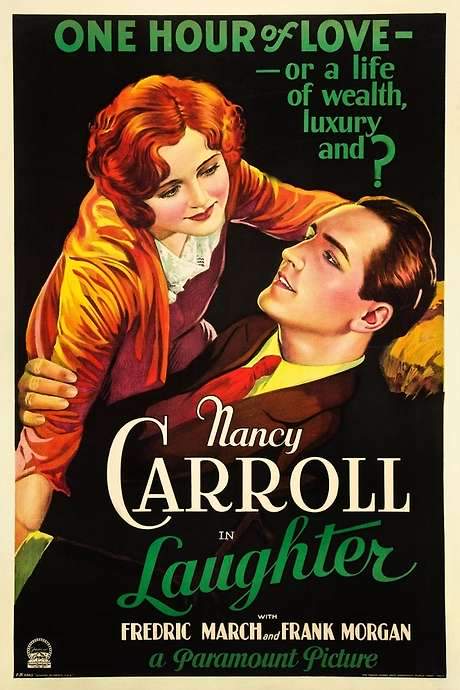
Laughter 1930

Directed by

Harry d'Abbadie d'Arrast
Made by

Paramount Pictures
Where to Watch Laughter
See current US streaming, rental, and purchase options for Laughter (1930) via JustWatch.

Artiflix
4K
Amazon Prime Video Free with Ads
HD
Tubi TV
SD
Amazon Video
SD Streaming availability powered by 
Laughter Plot Summary
Read the complete plot summary and ending explained for Laughter (1930). From turning points to emotional moments, uncover what really happened and why it matters.
Peggy Nancy Carroll Gibson is a Follies dancer who forsakes her carefree attachments in order to marry a millionaire. Her elderly husband, Frank Morgan C. Mortimer Gibson, is a well-meaning bore, and Peggy soon finds his conventional world stifling. Seeking something livelier than the dull routine of married life, she begins looking for entertainment elsewhere while still bound by marriage.
About a year after the wedding, three major developments unfold almost simultaneously: Peggy’s former lover, Paul Lockridge, Fredric March, a witty composer and pianist, returns from Paris and offers companionship as a diversion from her stuffy life; Ralph Le Sainte, Glenn Anders, a young sculptor who is still in love with Peggy, plans his suicide in a mood of bitterness; and Mortimer’s daughter Marjorie, Diane Ellis, returns from schooling abroad. Marjorie is soon paired with Ralph, and the romance that develops between them runs in parallel with the adult affair between Peggy and Paul, painting a portrait of longing, wealth, and the trouble those forces can cause in a household.
Ralph and Marjorie’s escapades bring considerable trouble for Mortimer, while Paul implores Peggy to go to Paris with him, declaring:
You are rich—dirty rich. You are dying. You need laughter to make you clean.
But Peggy refuses, torn between the security of wealth and the lure of genuine happiness. When Marjorie plans to elope with Ralph, Peggy exposes the sculptor as a fortune hunter; distraught, Ralph takes his own life. In the wake of these upheavals, Peggy confesses her unhappiness to Gibson, and ultimately decides to leave behind the stifling life she once thought would bring her contentment. She joins Paul and—amid laughter and the promise of Paris—begins a new chapter.
Laughter Timeline
Follow the complete movie timeline of Laughter (1930) with every major event in chronological order. Great for understanding complex plots and story progression.
Peggy's ambition: marry a millionaire
Peggy, a Follies dancer, sets her sights on marrying a millionaire and leaves behind her carefree lifestyle. Her pursuit of wealth shapes her choices and future relationships. This early decision foreshadows the conflicts to come as she navigates love and security.
Peggy marries Mortimer Gibson
Peggy marries the elderly broker C. Mortimer Gibson, hoping his wealth will secure her future. Mortimer is well-meaning but dull, and Peggy soon finds life with him unstimulating. Her sense of emptiness grows as she seeks excitement elsewhere.
One year after the marriage: Paul returns
A year after the marriage, Paul Lockridge returns from Paris. He is a composer who still loves Peggy and offers companionship as a distraction from her staid life. Peggy reunites with him, reigniting their lingering romance.
Ralph Le Saint contemplates suicide
Ralph Le Saint, a young sculptor who remains in love with Peggy, descends into bitterness and plans his own suicide. His despair underscores the tangled emotional web surrounding Peggy and the others.
Marjorie returns from schooling abroad
Mortimer's daughter Marjorie returns from schooling abroad, bringing new energy and the potential for fresh romantic entanglements. Her arrival coincides with the evolving relationships around Peggy.
Peggy and Paul begin an affair
Peggy rekindles a romantic affair with Paul as the other strands of the story unfold. The adult relationship mirrors the shifting loyalties and desires within the household. The affair intensifies the emotional tensions already at play.
Ralph and Marjorie pursue their romance
Ralph and Marjorie begin their own romance, which brings trouble to Mortimer and strains the household further. Their escapades highlight the consequences of pursuing passion without regard for others.
Paul pleads to take Peggy to Paris
Paul pleads with Peggy to go to Paris with him, arguing that wealth should be paired with laughter and freedom. Peggy refuses, choosing to stay and face the consequences of her choices. The moment underscores her commitment to staying within her established life for the time being.
Marjorie plans to elope; Peggy exposes Ralph
Marjorie plans to elope with Ralph, but Peggy uncovers Ralph's true motive as a fortune hunter. Peggy reveals his deceit, undermining the fragile romance and shifting the balance of power among the adults.
Ralph's suicide
Dejected by the exposure and the collapse of his plans, Ralph commits suicide. The tragedy deepens Mortimer's troubles and adds weight to Peggy's ongoing moral conflict about wealth, love, and happiness.
Peggy confesses unhappiness to Gibson
Peggy confesses her unhappiness to Gibson, admitting that her pursuit of wealth and surface romance has failed to bring fulfillment. The admission marks a turning point in her understanding of love and security.
Peggy joins Paul in Paris
Peggy decides to join Paul in Paris, choosing laughter, companionship, and a fresh start over her previous ambitions. She leaves Mortimer behind to begin a new life with Paul and a chance at genuine happiness.
Laughter Characters
Explore all characters from Laughter (1930). Get detailed profiles with their roles, arcs, and key relationships explained.
Peggy Gibson (Nancy Carroll)
Peggy is a Follies dancer who marries a wealthy but dull broker, seeking security yet growing restless with a life of routine. She longs for entertainment and authentic affection, leading her into intimate entanglements with Paul and, subsequently, Ralph. Her actions reveal a craving for laughter and connection over propriety or material comfort. By the end, she confesses her unhappiness to Gibson and chooses to join Paul in Paris.
Paul Lockridge (Fredric March)
A composer and pianist who returns from Paris and is in love with Peggy. He offers companionship as a diversion from Peggy's stifling life and urges her toward a life of laughter in Paris. Paul embodies romance and spontaneity, challenging Peggy to choose authenticity over security. His insistence on leaving for Paris with Peggy drives the film toward its hopeful, liberating conclusion.
Ralph Le Sainte (Glenn Anders)
A devil-may-care young sculptor in love with Peggy, he marries passion to habit and plans his own dramatic exit from life. Peggy exposes him as a fortune hunter, which shatters his pride and leads to his suicide. His presence catalyzes the conflict that tests Peggy's loyalties and Mortimer's patience. He represents the destructive side of desire when money and affection intertwine.
C. Mortimer Gibson (Frank Morgan)
Peggy's elderly husband and a well-meaning yet stifling broker who embodies wealth without joy. His stodgy routine and material security stand in contrast to Peggy's craving for laughter and romance. His life is unsettled by his daughter Marjorie's romance and by Peggy's infidelities, pushing him toward a crisis point. He remains a patient, conflicted figure whose world is challenged by the newer generation's desires.
Marjorie Gibson (Diane Ellis)
Mortimer's daughter, who returns from schooling abroad and becomes involved with Ralph. Her romance with Ralph adds another layer of complication to the marital tension and exposes the perils of matching love with money. She serves as a catalyst for the entanglements that drive the story toward its dramatic turning points. Her presence highlights the global, cosmopolitan backdrop of the plot.
Winslow (Charles Halton)
Gibson's secretary, a minor but present figure within the household. He provides the institutional backdrop of the wealthy couple's life and helps move the plot through the day-to-day functioning of their world.
Benham (Leonard Carey)
Gibson's butler, another minor but essential member of the household staff. He underscores the upper-class milieu and daily routines that Peggy seeks to escape.
Laughter Settings
Learn where and when Laughter (1930) takes place. Explore the film’s settings, era, and how they shape the narrative.
Location
New York, Paris
The action centers on Peggy’s glamorous life as a Follies dancer, hinting at a New York city stage world. A year into marriage, the plot moves toward Paris, where Peggy seeks laughter and escape from a stuffy, wealthy life. Paris serves as the ultimate backdrop for the lovers’ choices, contrasting Mortimer's formal wealth with the couple's desire for freedom. The film blends high-society settings with the joie de vivre of the Parisian scene.
Laughter Themes
Discover the main themes in Laughter (1930). Analyze the deeper meanings, emotional layers, and social commentary behind the film.
💔
Love vs Wealth
Peggy’s marriage to a wealthy but dull husband highlights the clash between financial security and emotional fulfillment. Her pursuit of affection leads her back to Paul and to the entanglement with Ralph, revealing the hollowness of wealth without companionship. The narrative uses these romances to critique a society that equates status with happiness. In the end, Peggy chooses love and laughter over a life of comfort.
🎭
Escape
Laughter acts as the emotional escape hatch for Peggy and Paul, a counterpoint to the rigid routine of Mortimer's world. The pursuit of merriment drives the plot—from the Broadway-style milieu to the Parisian freedom they seek. The title itself frames the film as a satire on adult disillusionment and the need for joy. Their final move to Paris marks a redemption through shared humor rather than money.
⚖️
Consequences
The entanglements expose the moral complexities of high society: deception, desire, and the cost of pursuing pleasure. Ralph's plan to exploit Peggy ends in tragedy when he commits suicide after being exposed. Peggy's own confession catalyzes a break from the old life, suggesting that truth and accountability can lead to freedom, even at the cost of security.

Coming soon on iOS and Android
The Plot Explained Mobile App
From blockbusters to hidden gems — dive into movie stories anytime, anywhere. Save your favorites, discover plots faster, and never miss a twist again.
Sign up to be the first to know when we launch. Your email stays private — always.
Explore the mobile appLaughter Spoiler-Free Summary
Discover the spoiler-free summary of Laughter (1930). Get a concise overview without any spoilers.
In the glittering world of the Ziegfeld Follies, Peggy Gibson stands out as a celebrated beauty who makes a deliberate choice to trade the spotlight for security. Marrying the older, wealthy C. Morton Gibson, she steps into a life of luxury, hoping that comfort will satisfy her restless spirit. However, the transition from the stage to the quiet corridors of a mansion proves more jarring than anticipated, as the vibrant rhythm of her former life gives way to a suffocating stillness. She soon discovers that wealth provides many things, but it does not necessarily offer the joy or vitality she craves.
As the monotony of her marriage sets in, Peggy finds herself surrounded by men who represent the roads she did not take. There is Ralph Le Saint, a moody sculptor and longtime friend whose artistic temperament contrasts sharply with the staid predictability of her husband. More significantly, the arrival of Paul Lockridge, a witty pianist returning from Paris, reignites a spark of spontaneity she thought she had long extinguished. Paul sees through the gilded surface of her life, offering not just companionship but a vision of an existence filled with the one thing her current world lacks: genuine laughter.
The domestic atmosphere grows even more complex with the return of Gibson’s daughter, Marjorie, from her schooling abroad. Her presence introduces a new dynamic to the household, entangling the lives of the adults in unexpected ways. As these personalities converge, the mansion transforms into a landscape of longing and conflicting desires. Peggy stands at a crossroads, torn between the safety of her gilded cage and the uncertain allure of a life that promises vitality over riches, forcing her to question what she is willing to sacrifice for a chance at true happiness.
Movies with Similar Twists and Themes
Uncover films that echo the narrative beats, emotional arcs, or dramatic twists of the one you're exploring. These recommendations are handpicked based on story depth, thematic resonance, and spoiler-worthy moments — perfect for fans who crave more of the same intrigue.


Featured on this page

What's After the Movie?
Not sure whether to stay after the credits? Find out!
Check out our other apps:

SAT Sphere
Build confidence for the Digital SAT.

Mori Atlas
Discover wild places worth protecting.

Luntero
Search smarter for a home in Amsterdam.

Plot Explained
Unravel movie endings and hidden clues.

Pokechamp
Dive into Pokémon data and battle logic.

Driving Theory
Get ready for your European theory test.

Movie Dust
Plan your next cinema trip with ease.

Musemap
Find art and culture as you travel.

Selkobase
Compare credentials before committing.

Local Manual
Turn an unfamiliar country into practical next steps.

Lernavi
Compare school systems before your next move.

GymRoam
Find a workout stop wherever your plans take you.
Explore Our Movie Platform
New Movie Releases (2026)
Famous Movie Actors
Top Film Production Studios
Movie Plot Summaries & Endings
Major Movie Awards & Winners
Best Concert Films & Music Documentaries
Movie Collections and Curated Lists
© 2026 What's After the Movie. All rights reserved.
Privacy Policy