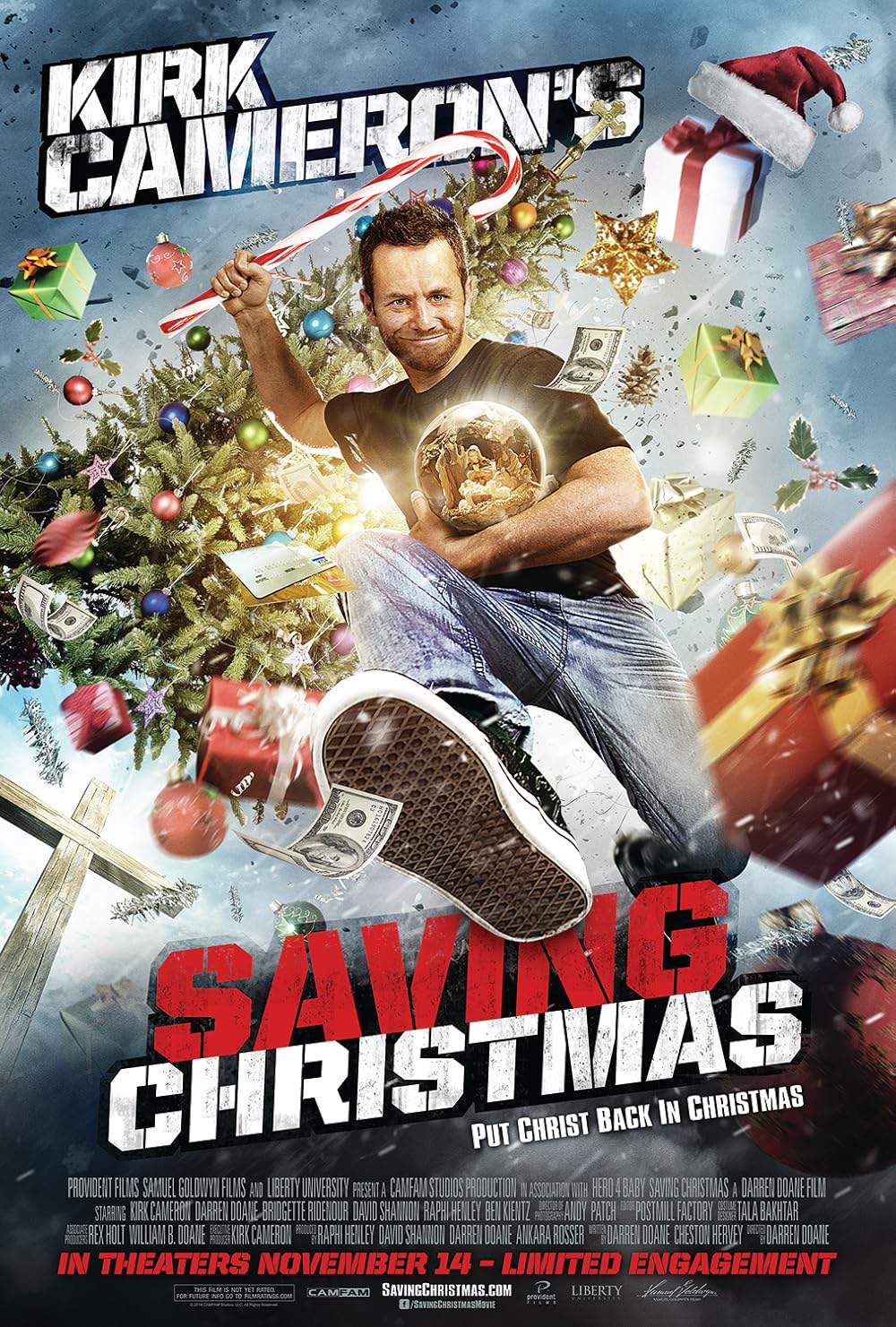
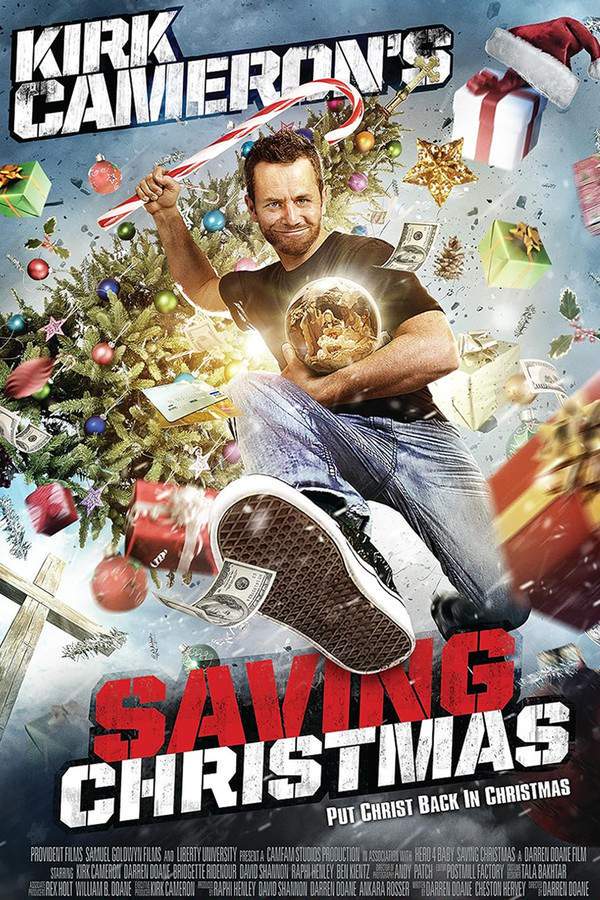
Kirk Cameron's Saving Christmas 2014
Made by

Samuel Goldwyn Films
Where to Watch Kirk Cameron's Saving Christmas
See current US streaming, rental, and purchase options for Kirk Cameron's Saving Christmas (2014) via JustWatch.

Pluto TV
SD
Fandango At Home
SD
Google Play Movies
SD
YouTube
SD Streaming availability powered by 
Kirk Cameron's Saving Christmas Plot Summary
Read the complete plot summary and ending explained for Kirk Cameron's Saving Christmas (2014). From turning points to emotional moments, uncover what really happened and why it matters.
In a framing sequence, Kirk Cameron—as himself—addresses the audience from beside a fireplace, explaining his love of Christmas. Cameron goes on to express his views on the contemporary celebration of Christmas, which include his beliefs that atheists have tried to “take the holiday away” and that Santa Claus is a Christian. Cameron also criticizes fundamentalist Christians who have politicized the holiday by tying the celebration to Pagan traditions and making accusations that the holiday has become too tied to materialism.
The film switches to its main narrative, in which Cameron attends a Christmas party at his sister’s house. There, he notices that his brother-in-law, Christian, is not celebrating like the other guests. When asked why, Christian tells Cameron that he feels the holiday has become too commercialized and consumerist, and that he feels uncomfortable with what he believes are Pagan elements of contemporary Christmas celebration. Cameron tells Christian that he is wrong and recites the story of the Nativity, which is depicted in cartoon form. Meanwhile, two guests at the party discuss conspiracy theories.
Christian complains that several elements of Christmas, most notably Christmas trees, are not biblical in origin. Cameron tells him that Christmas trees were God’s idea since God created trees. He also says that each tree represents a Christian cross; breaking the fourth wall, Cameron encourages the audience to visualize a cross every time they see a Christmas tree. Cameron further addresses several other concerns Christian has about the historicity of the holiday, including its date and the role of the Three Wise Men. Cameron ties the Nativity directly to the crucifixion, saying that baby Jesus’ swaddling cloth was a foreshadowing of his burial shroud, and claims that the gifts of frankincense and myrrh were used to treat dead bodies in a form of primitive embalming. Cameron encourages Christian and the audience to place nutcracker dolls around Nativity sets to represent Herod’s soldiers during the Massacre of the Innocents.
Christian is convinced by the arguments, but then complains that Santa has replaced Jesus as the figurehead of the holiday; he further expresses discomfort over the fact that “Santa” is an anagram of “Satan”. Cameron tells Christian the story of Saint Nicholas, including a reenactment of the First Council of Nicaea in which Nicholas had supposedly violently assaulted Arius for heresy. Cameron claims that, after the council, Nicholas went out and began beating other heretics for teaching false doctrine, and that “Nicholas was ‘bad’, in a good way”. Cameron explains that St. Nicholas was the basis for Santa Claus, who was a byproduct of Nicholas’ story being diluted by secular culture. With this knowledge, Christian joyously declares that “Santa is the man”.
Reassured of Christmas’ Christian roots, Cameron and Christian return to the party. Cameron criticizes people who feel that the holiday is too commercial, saying that because God took on material form, it is appropriate to celebrate using material things through the giving of expensive gifts. Cameron explains that presents represent Jerusalem, and that Christmas is “doing what God does”, as God has given humanity many gifts. Cameron then issues a plea to the audience to make Christmas an overtly religious holiday again, “for our children”. Christian, as a gift to his wife, organizes a hip hop dance to symbolize his love of Christmas, set to “Angels We Have Heard on High”. Cameron, Christian, and all the party guests breakdance in an extended musical sequence. Cameron then tells everyone to feast and suggests the audience organize the best dinner possible for Christmas, but not to forget it is a celebration of God.

Coming soon on iOS and Android
The Plot Explained Mobile App
From blockbusters to hidden gems — dive into movie stories anytime, anywhere. Save your favorites, discover plots faster, and never miss a twist again.
Sign up to be the first to know when we launch. Your email stays private — always.
Explore the mobile appMovies with Similar Twists and Themes
Uncover films that echo the narrative beats, emotional arcs, or dramatic twists of the one you're exploring. These recommendations are handpicked based on story depth, thematic resonance, and spoiler-worthy moments — perfect for fans who crave more of the same intrigue.


Featured on this page

What's After the Movie?
Not sure whether to stay after the credits? Find out!
Check out our other apps:

SAT Sphere
Build confidence for the Digital SAT.

Mori Atlas
Discover wild places worth protecting.

Luntero
Search smarter for a home in Amsterdam.

Plot Explained
Unravel movie endings and hidden clues.

Pokechamp
Dive into Pokémon data and battle logic.

Driving Theory
Get ready for your European theory test.

Movie Dust
Plan your next cinema trip with ease.

Musemap
Find art and culture as you travel.

Selkobase
Compare credentials before committing.

Local Manual
Turn an unfamiliar country into practical next steps.

Lernavi
Compare school systems before your next move.

GymRoam
Find a workout stop wherever your plans take you.
Explore Our Movie Platform
New Movie Releases (2026)
Famous Movie Actors
Top Film Production Studios
Movie Plot Summaries & Endings
Major Movie Awards & Winners
Best Concert Films & Music Documentaries
Movie Collections and Curated Lists
© 2026 What's After the Movie. All rights reserved.
Privacy Policy