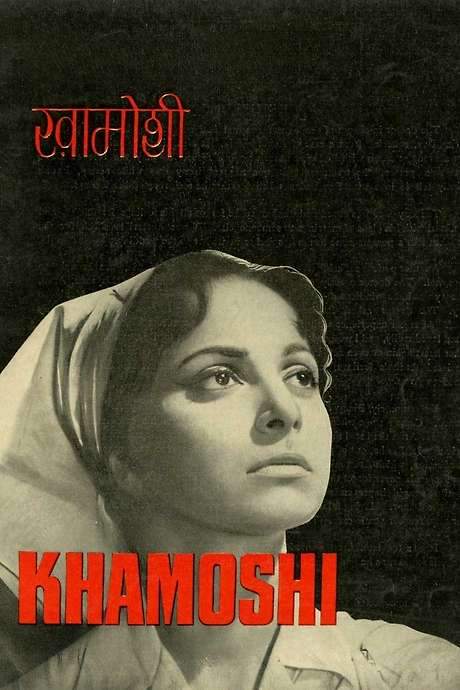


Where to Watch Khamoshi
See current US streaming, rental, and purchase options for Khamoshi (1969) via JustWatch.

Streaming availability powered by 
Khamoshi Plot Summary
Read the complete plot summary and ending explained for Khamoshi (1969). From turning points to emotional moments, uncover what really happened and why it matters.
Dr. Colonel Saab Nazir Hussain is the head of the psychiatry ward in a hospital, a steady presence who has seen war-torn minds and fragile recoveries pressed into the same quiet hallways. In this ward, Nurse Radha Waheeda Rehman tends to her patients with meticulous care, yet her heart bears a wound that she cannot quite seal. She is still nursing the ache of a civilian patient, Dev Kumar Dharmendra (Patient #24) whom she helped heal, but who left the hospital, leaving behind an ache that colors every corner of the ward and every cautious interaction with new souls who arrive seeking calm.
Into this tense, delicate world arrives Arun Choudhury Rajesh Khanna, a writer and a poet who steps into the ward with a storm of acute mania. His distress follows a painful rejection from his lover, Sulekha Snehlata, a singer whose voice had once offered him solace but could not alter the course of his heartache. Initially, Radha is wary and refuses to take him in, trying to hold professional boundaries firm and clear. Yet, the pull of compassion, the calling to tend a mind in turmoil, eventually moves her to relent and offer Arun a chance at care.
As Radha attends to Arun, the nurse’s professional calm becomes a mirror for her own tangled feelings. In the quiet between treatments and conversations, she revisits her memories and shares a story from her own past: how she cared for injured brave army soldiers when she was posted in Ladakh during the Sino-Indian war of 1962. The recollection is vivid, a reminder of duty under fire and the humanity that persists even in the hardest times. This memory is not just a backdrop; it drapes itself over every moment she spends with Arun, coloring her tenderness with a longing that worries even her, a worry that she might be repeating a familiar, dangerous pattern.
Over time Arun responds to treatment and Slowly, the mania eases; he seems to be moving toward recovery. Yet Radha’s connection to him deepens in ways that feel more than professional. The line between caregiver and patient begins to blur, and Radha’s emotions grow more complicated—so much so that the protection she once maintained around her own heart begins to falter. The strain of this dual role begins to weigh on her mind and she slips into a state of emotional strain herself.
Irony arrives with a quiet, almost cruel twist: Radha ends up being admitted to the same ward, to the same room, as she watches the labels and doors that once defined boundaries close in on her. Colonel Sahab observes the change with a heavy resignation, realizing that he had always seen a devoted nurse in her, and that the woman inside the nurse—tender, fallible, and human—had been hidden behind a disciplined exterior for too long. The transformation is complete enough to feel like a fracture, yet the work of healing still has miles to go.
Amid the professional and personal tremors, Arun makes a hopeful promise: he will wait for her recovery, staying by her side in the quiet vigil that the ward affords. The narrative thus threads a delicate balance between care and longing, duty and desire, and the enduring question of whether healing can truly happen when the healer’s own heart is laid bare. The story holds a mirror to the enduring impulse to care for others even as the care we offer is, at times, the care we most need ourselves.
Khamoshi Timeline
Follow the complete movie timeline of Khamoshi (1969) with every major event in chronological order. Great for understanding complex plots and story progression.
Dev Kumar leaves, Radha's heartbreak begins
Nurse Radha, who has fallen in love with Dev Kumar, is heart-broken when the civilian patient is cured and leaves the hospital. Her inability to keep her heart separate from her professional duties foreshadows the emotional storms to come. Colonel Sahab, head of the psychiatry ward, notes the tension already bubbling in the ward.
Arun Choudhary arrives as a patient
Arun Choudhary, a writer and poet, is admitted with acute mania after being rejected by his lover Sulekha. Initially, Radha refuses to take care of him, but she eventually relents and agrees to supervise his care. The arrival of a volatile new patient shifts the ward dynamics.
Radha begins caring for Arun
Radha starts caring for Arun, setting aside her earlier reluctance. As she tends him, she starts to reminisce about her own past and moments that shaped her. The care scene deepens the emotional tension between her professional duties and personal feelings.
Flashback to Ladakh and 1962
During her care, Radha recounts her postings in Ladakh during the Sino-Indian War of 1962, where she tended injured army soldiers. The memory reveals the source of her compassion and the bravery she associates with care. The flashback adds a weighty backdrop to her present vulnerability.
Arun gradually cures, Radha remains involved
Arun gradually recovers from his manic episode, responding to Radha's treatment. Yet Radha's emotional involvement with him remains intense and unresolved. The improvement in Arun's condition contrasts with Radha's creeping emotional instability.
Radha's emotional derangement surfaces
Radha's emotions spiral into derangement, blurring the boundary between caregiver and lover. She struggles to maintain professional distance as her feelings for Arun deepen. The situation destabilizes the ward and foreshadows an imminent personal crisis.
Radha is admitted to the same ward room
Ironically, Radha is admitted to the same room of the ward that she once cared for Arun in. The role reversal forces her to confront her own vulnerabilities from a patient’s perspective. The change heightens the tension between her duties and desires.
Colonel Sahab's realization
Colonel Sahab expresses regret that he always saw a devoted nurse in Radha and failed to see the woman inside her. He begins to understand the depth of her struggle and the complexity of her emotions. The realization marks a turning point in how the staff perceives her.
Arun vows to wait for Radha's recovery
Arun promises to wait for Radha's recovery, showing loyalty and understanding despite the chaotic turn of events. He offers patience and supportive words as he remains under care. The pledge becomes a fragile anchor amid emotional turmoil.
Boundary tensions rise in the ward
The ward's atmosphere grows tense as personal longing interferes with clinical routine. Colleagues monitor Radha's condition and debate the boundaries between care and affection. The narrative tightens around the question of who should be cared for and how.
Radha's ongoing crisis and staff reflection
Radha's inner crisis deepens, prompting quiet conversations among the staff about duty, desire, and control. The line between professional responsibility and personal vulnerability becomes increasingly blurred. The hospital environment reflects and amplifies her turmoil.
A suspended future
Arun's pledge to wait for Radha's recovery lingers as the last note of the story, leaving their relationship suspended in the balance. The audience is left with a sense of cautious hope amid emotional turmoil and unresolved questions. The ending emphasizes the fragile boundary between care and affection.
Khamoshi Characters
Explore all characters from Khamoshi (1969). Get detailed profiles with their roles, arcs, and key relationships explained.
Nurse Radha
A compassionate nurse whose heartbreak over Dev's departure pushes her toward blurred professional boundaries. Her romantic involvement with patients drives the central emotional conflict, and she is haunted by memories of her wartime service in Ladakh. As the story unfolds, her feelings destabilize her, culminating in a personal crisis within the ward.
Dev Kumar (Mr. Dev)
A civilian patient whose recovery initially anchors Radha's hope and affection. His leaving the hospital triggers Radha's emotional turmoil and underscores the fragility of boundaries between caregiver and patient.
Arun Choudhury
A writer and poet suffering from acute mania after being rejected by his lover. His creative vulnerability and emotional intensity create tension with Radha, while his eventual cure allows a brief moment of hope for their mutual longing.
Dr. Colonel Saab
A World War II veteran physician who heads the psychiatry ward. He serves as a paternal figure for the ward and regrets not recognizing the woman behind the nurse's devotion, as he observes Radha's turmoil from a professional distance.
Sulekha
A singer and Arun's former lover whose rejection drives his mania. Her presence represents the romantic rival and the emotional stakes in Arun's arc.
Khamoshi Settings
Learn where and when Khamoshi (1969) takes place. Explore the film’s settings, era, and how they shape the narrative.
Time period
1960s
The story unfolds mainly in the 1960s within the hospital ward. It interweaves memories of the Sino-Indian War in 1962 and glimpses of World War II through Colonel Sahab's past, suggesting a layered timeline of memory and healing that informs present events.
Location
Hospital Psychiatry Ward, Ladakh
The primary setting is a hospital's psychiatry ward where patients with mental health issues are cared for. The ward operates as a clinical space focused on assessment and treatment, often dealing with emotional crises. Radha's memories of serving injured soldiers in Ladakh during the 1962 Sino-Indian War anchor the space in a broader history of conflict and healing.
Khamoshi Themes
Discover the main themes in Khamoshi (1969). Analyze the deeper meanings, emotional layers, and social commentary behind the film.
💔
Love vs Duty
Radha's heart-driven emotions collide with her professional responsibilities as a nurse. Her attraction to Dev and later Arun disrupts clinical boundaries and tests her ability to care impartially. The narrative uses romance within a care setting to explore how personal longing complicates healing.
🧠
Mental Health
Arun suffers from acute mania triggered by romantic rejection, while Radha's emotional derangement exposes the fragility of the caregiver's own mental state. The hospital environment frames treatment, restraint, and empathy as central to both patient and caretaker journeys. The film probes how memory and psyche influence behavior.
🎖️
War Memory
The story ties personal trauma to historical conflict, with Colonel Sahab's WWII service and Radha's Ladakh memories from the 1962 war. These memories shape characters' identities and inform their capacity for compassion and trauma processing. The hospital serves as a hinge between individual healing and collective history.

Coming soon on iOS and Android
The Plot Explained Mobile App
From blockbusters to hidden gems — dive into movie stories anytime, anywhere. Save your favorites, discover plots faster, and never miss a twist again.
Sign up to be the first to know when we launch. Your email stays private — always.
Explore the mobile appKhamoshi Spoiler-Free Summary
Discover the spoiler-free summary of Khamoshi (1969). Get a concise overview without any spoilers.
In the hushed corridors of a psychiatric ward, the steady presence of Colonel Sahab looms like a quiet sentinel. As the head of the department, he has witnessed countless fractured minds and the fragile hope that flickers between the sterile walls. His ward is a place where vulnerability is both the ailment and the medicine, a setting that breathes a subdued, introspective mood, punctuated by the soft rustle of charts and the muted beeps of monitors.
Nurse Radha moves through this world with meticulous care, her hands steady even as her heart carries the lingering ache of a departed civilian patient, Dev Kumar. The memory of his departure haunts her, coloring every interaction with a gentle wariness. Yet beneath the professional composure lies a deeper well of empathy forged during a stark chapter of her past—caring for wounded soldiers amid the rugged heights of Ladakh during the 1962 Sino‑Indian war. Those memories surface as quiet reflections, imparting a resilient yet tender spirit to her bedside manner.
The arrival of Arun Choudhury, a poet‑writer whose mind is ablaze with acute mania after a painful romantic rejection, disturbs the ward’s fragile equilibrium. His presence is a storm of brilliance and desperation, and Radha initially recoils, intent on preserving her professional boundaries. However, the pull of compassion proves stronger than restraint, and she allows herself to become his caretaker, setting the stage for an intricate dance between healer and patient.
As treatment begins, the ward becomes a quiet stage for subtle shifts—Radha’s inner conflict mirrors Arun’s turbulent thoughts, and the echo of past wars blends with present emotional battles. The atmosphere remains charged with unspoken longing, duty, and the ever‑present question of whether one can truly mend another while bearing one’s own hidden scars.
Movies with Similar Twists and Themes
Uncover films that echo the narrative beats, emotional arcs, or dramatic twists of the one you're exploring. These recommendations are handpicked based on story depth, thematic resonance, and spoiler-worthy moments — perfect for fans who crave more of the same intrigue.



Featured on this page

What's After the Movie?
Not sure whether to stay after the credits? Find out!
Check out our other apps:

SAT Sphere
Build confidence for the Digital SAT.

Mori Atlas
Discover wild places worth protecting.

Luntero
Search smarter for a home in Amsterdam.

Plot Explained
Unravel movie endings and hidden clues.

Pokechamp
Dive into Pokémon data and battle logic.

Driving Theory
Get ready for your European theory test.

Movie Dust
Plan your next cinema trip with ease.

Musemap
Find art and culture as you travel.

Selkobase
Compare credentials before committing.

Local Manual
Turn an unfamiliar country into practical next steps.

Lernavi
Compare school systems before your next move.

GymRoam
Find a workout stop wherever your plans take you.
Explore Our Movie Platform
New Movie Releases (2026)
Famous Movie Actors
Top Film Production Studios
Movie Plot Summaries & Endings
Major Movie Awards & Winners
Best Concert Films & Music Documentaries
Movie Collections and Curated Lists
© 2026 What's After the Movie. All rights reserved.
Privacy Policy