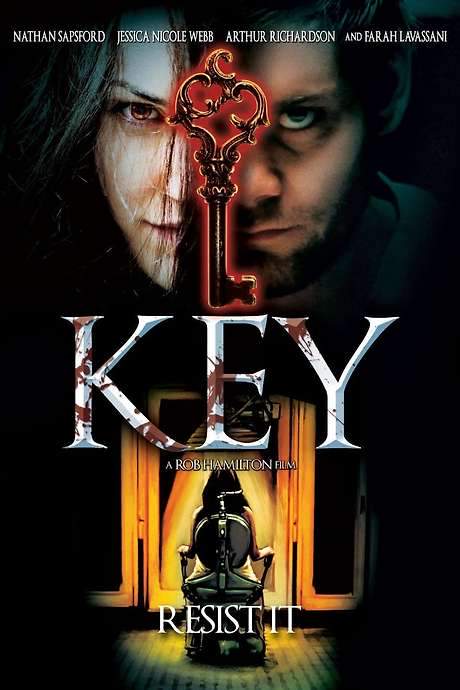
Key 2011


Directed by

Rob Hamilton
Made by

Where to Watch Key
See current US streaming, rental, and purchase options for Key (2011) via JustWatch.









Key Plot Summary
Read the complete plot summary and ending explained for Key (2011). From turning points to emotional moments, uncover what really happened and why it matters.
The film opens with a stark, controlled challenge: a closed room, reinforced security, and a high-stakes examination for a coveted post at a prestigious company. Inside, nine candidates convene as an Invigilator explains the ground rules and the clock begins its 90-minute countdown. The room is sealed, the candidates must not speak to the Invigilator or to security, they may not leave, and they may not spoil their paper—intentionally or accidentally. The tension thickens when a blank sheet appears, minus any question, and one candidate is instantly disqualified for having scribbled the name of God on the page. The others stand in bewilderment, realizing that the challenge will be solved not by brute force, but by teamwork and clever deduction.
Deputy Jones, portrayed by Steve Brian, sits outside the room as the door is locked, while the nine contenders—each with a distinct professional identity—quietly prepare to navigate the impossible task ahead. The candidates introduce themselves and reveal their backgrounds to strip away bias: a Criminal Lawyer, a Professor, a Psychologist, an Optic Engineer, a Scientist, an MBA Graduate, a Business Consultant, and a Journalist. The sense of unity is tempered by the sting of rivalry as the group agrees to work within the rules and to use their diverse expertise to decipher the hidden question.
The group immediately turns to collaborative problem-solving, drawing on each member’s field to piece together clues. They test different approaches by manipulating light, analyzing bodily fluids, coordinating with fire sprinklers, and using glass fragments—each tactic designed to extract meaning from the room’s puzzling setup. Inevitably, tensions flare: the Optic Engineer is eliminated after tearing the paper, and the Criminal Lawyer begins to undermine the others by targeting the MBA Graduate and the Business Consultant, under the mistaken belief that manipulating the field will secure victory for himself. The Journalist strikes with force, seizing on the moment of chaos to disrupt the process and speed the path to a conclusion.
As the pressure mounts, the Psychologist—a figure who has inside knowledge of the firm’s culture—finds herself being pressed for answers about the “question,” and the invader-like scrutiny escalates. Time presses on, and the lawyer’s grip on the situation weakens. Yet the Professor remains steady, deftly managing crises and recovering the medicine the lawyer needs to avoid a dangerous decline. In a moment of cunning, the Lawyer wrests the guard’s revolver and issues a final warning to leave the room, escalating the peril. The Journalist reacts swiftly, and a shot is fired; the room is thrown into chaos as the Scientist exits and the Professor improvises a ruse to maintain control of the situation.
Amid the jolts of fear and adrenaline, the tension shifts from violent action to strategic maneuver. The Lawyer’s bold move is met with counterplay, and the room’s dynamics pivot on trust, deception, and the quick-witted responses of the survivors. The Journalist appears to be struck down, only for it to become clear that the bullet was a dummy—a ploy that reveals how easily appearances can mislead under pressure. The Invigilator arrives again, calm and composed, and ultimately offers a final verdict: the Professor has proven to possess the traits the company values—crisis management, composure under strain, and a cool, principled approach to leadership.
In the closing moments, the Invigilator declares that he does not ask any more questions; instead, the room’s contestants demonstrated their innate capabilities and how they perform under pressure when confronted with an unknown ordeal. The CEO’s ultimate decision crowns the Professor as the new leader, signaling that the winner is determined not by a single moment of luck, but by the sum of demonstrated skills—intellect, resilience, teamwork, and the ability to live up to a demanding, real-world standard.
The film closes with a quiet, confident note: the mission of the challenge was not to trap or trick the contenders, but to reveal what they could do when confronted with a crisis, and which among them would best guide the company forward. The Professor steps into the role with poise, and the Invigilator’s final affirmation underscores a theme that reverberates beyond the room: leadership comes from mastery of crisis, clarity of thought, and a proven capacity to navigate pressure with integrity.
Key Timeline
Follow the complete movie timeline of Key (2011) with every major event in chronological order. Great for understanding complex plots and story progression.
The locked-room exam begins
The Invigilator locks the room and the nine candidates are informed they are competing for a prestigious post, with a 90-minute timer and four conditions that disqualify any attempt to cross the bridge. The rules forbid talking to the Invigilator or Security, leaving the room, or spoiling the paper, setting a tense framework for the challenge.
Blank paper and first disqualification
The contenders discover the paper is blank, lacking any question. One candidate is instantly disqualified for writing God's name, and the group realizes they must solve the puzzle collectively instead of relying on a direct prompt.
Forming a diverse team
They introduce themselves by profession—Criminal Lawyer, Professor, Psychologist, Optic Engineer, Scientist, MBA Graduate, Business Consultant, and Journalist—aiming to put aside caste and biases. They commit to leveraging each other’s expertise to uncover the unknown question and to manage crises.
Using science and observation to infer the question
The group begins testing the room and clues, using methods like lights, bodily fluids, fire sprinklers, and glass fragments to decipher potential hints. They organize a collaborative approach rather than hoarding information.
Optic Engineer eliminated
The Optic Engineer tears the paper, violating the rules and sealing his fate. The others conclude he is no longer a viable candidate and remove him from the group’s dynamic.
Betrayal within the ranks
The Criminal Lawyer betrays the MBA Graduate and the Business Consultant, attempting to steer the survivor toward his own victory. The move disrupts the balance and heightens tension among the remaining contestants.
Tensions erupt as the Journalist intervenes
In response to the betrayal, the Journalist strikes the Lawyer, triggering a tense confrontation as rivals vie for control. The room grows more volatile while the true question remains unsolved.
Medicinal crisis and the Journalist's action
The Lawyer's need for hourly medication intensifies the crisis, but the Journalist disposes of the medication, worsening the Lawyer's condition and escalating the stakes for everyone involved.
Psychologist's coercion and intervention
The Lawyer targets the Psychologist to extract the answer, torturing her for information. The Psychologist later speaks with the Invigilator to halt the aggression and protect the team, introducing a glimmer of hope.
Professor's steadfast leadership
The Professor remains firm through every crisis, recovers the medicine, and uses wit to stabilize the group, effectively protecting the Lawyer at key moments and guiding others toward a potential solution.
The revolver twist and the dummy bullet
The Lawyer steals the guard's revolver and issues a final warning to vacate. He fires at the Journalist as the Scientist exits, but the Professor pretends the shot struck home, and the room discovers the round is a dummy bullet with no real harm.
Invigilator's arrival and verdict
The Invigilator arrives and congratulates the Professor, declaring that no questions were asked. The success comes from the candidates' traits, teamwork, and crisis management rather than a direct test prompt.
Appointment of the Professor
In the closing moment, the Invigilator, joined by the CEO, appoints the Professor as the winner and the preferred candidate for the post, sealing the outcome of the selection process.
Key Characters
Explore all characters from Key (2011). Get detailed profiles with their roles, arcs, and key relationships explained.
Deputy Jones (Steve Brian)
A security figure who enforces the rules of the room and maintains order under pressure. He behaves as a steady presence, prioritizing protocol and clear communication. His restrained demeanor helps keep the evaluation fair and controlled.
Samantha Revell (Farah Lavassani)
A participant who contributes calm, analytical thinking to the group. She uses observations and reasoning to interpret clues and support the team's strategy. Her measured approach helps stabilize tense moments and guide discussion.
Bud Exley (Noah James Butler)
A practical contestant who brings pragmatic problem-solving to the room. He navigates competing claims and resource constraints with a grounded, opportunistic mindset. His input helps the team test hypotheses and prioritize actions.
Morgue Assistant (Sam Forrest)
An ensemble member whose quiet presence and observant nature contribute to the group dynamics. He observes others closely and provides calm, practical checks during evolving strategies. His role underscores the value of careful perception in high-stakes puzzles.
Key Settings
Learn where and when Key (2011) takes place. Explore the film’s settings, era, and how they shape the narrative.
Location
Closed examination room, Prestigious Company Building
A sealed examination room inside a prestigious company houses nine candidates under strict rules. The space is locked and monitored by an invigilator and security, creating a tense, controlled arena. Time-pressured collaboration elevates problem solving as the contenders pool their professional skills to reconstruct the missing question via teamwork.
Key Themes
Discover the main themes in Key (2011). Analyze the deeper meanings, emotional layers, and social commentary behind the film.
⏱️
Crisis Management
Under extreme time pressure, the group must coordinate across conflicting specialties to reconstruct the missing question. Leadership emerges as professors and journalists wrestle for control while others adapt. The scenario tests decision-making, composure, and strategic communication. The theme highlights how crisis leadership can guide a group to cohesion under stress.
🗝️
Betrayal Dynamics
Allegiances prove fragile as self-interest surfaces: the Criminal Lawyer manipulates others, causing distrust within the team. Small betrayals rearrange the hierarchy, forcing candidates to re-evaluate who to rely on. The room becomes a pressure cooker where loyalty shifts as cracks appear in the group. The analysis shows collaboration often hinges on detecting hidden motives.
⚖️
Moral Dilemma
Ethical lines blur as the group weighs manipulation against the greater good. The psychologist uses dialogue to calm and recalibrate, while the journalist's ruthless tactics threaten to derail the mission. A simulated gunshot demonstrates how violence can sway decisions within a confined space. The theme probes where personal ethics end and survival instinct begins.
🤝
Teamwork
Despite diverse backgrounds, the candidates learn to leverage each other's strengths. The Professor's methodical approach, the Journalist's assertiveness, and the Scientist's experimental mindset combine to solve the enigma. Trust and cooperation triumph as the invigilator rewards collective traits over individual bravado. The film closes with the Professor's leadership being recognized.

Coming soon on iOS and Android
The Plot Explained Mobile App
From blockbusters to hidden gems — dive into movie stories anytime, anywhere. Save your favorites, discover plots faster, and never miss a twist again.
Sign up to be the first to know when we launch. Your email stays private — always.
Explore the mobile appKey Spoiler-Free Summary
Discover the spoiler-free summary of Key (2011). Get a concise overview without any spoilers.
In the sterile corridors of a metropolitan hospital, routine meets the uncanny when a forensic pathologist uncovers an inexplicable object lodged inside a corpse. The discovery—a small, rust‑stained key—appears almost as a deliberate clue, whispering of secrets that the dead could not keep. The meticulous world of autopsies and lab reports, usually governed by cold logic, is suddenly unsettled by this solitary metal mystery.
Martin Revell, a methodical yet inquisitive examiner, has built his career on parsing the silent testimony of bodies. His reputation rests on a blend of scientific rigor and an almost compulsive need to understand every anomaly. When the key emerges from the stomach of a man who seemed to have taken his own life, Martin’s professional curiosity transforms into a personal fixation, pulling him deeper into questions that stretch beyond the morgue’s white walls.
The film’s tone walks a tightrope between clinical precision and mounting unease, casting the hospital’s hushed spaces as both sanctuary and labyrinth. As Martin follows the faint trail suggested by the key, the environment shifts subtly—ordinary procedures take on a shadowed significance, and the line between objective analysis and subjective obsession begins to blur. The key itself becomes a metaphorical lock, hinting at hidden motives and unseen forces that tug at the edges of his sanity.
Against a backdrop of restrained lighting and an undercurrent of dread, Martin’s pursuit invites viewers into a world where every detail could be a breadcrumb, and every revelation threatens to erode the fragile equilibrium of his mind. The narrative teases a conspiracy that is felt more than seen, promising a descent into paranoia that challenges both his expertise and his grip on reality.
Featured on this page

What's After the Movie?
Not sure whether to stay after the credits? Find out!
Check out our other apps:

SAT Sphere
Build confidence for the Digital SAT.

Mori Atlas
Discover wild places worth protecting.

Luntero
Search smarter for a home in Amsterdam.

Plot Explained
Unravel movie endings and hidden clues.

Pokechamp
Dive into Pokémon data and battle logic.

Driving Theory
Get ready for your European theory test.

Movie Dust
Plan your next cinema trip with ease.

Musemap
Find art and culture as you travel.

Selkobase
Compare credentials before committing.

Local Manual
Turn an unfamiliar country into practical next steps.

Lernavi
Compare school systems before your next move.

GymRoam
Find a workout stop wherever your plans take you.
Explore Our Movie Platform
New Movie Releases (2026)
Famous Movie Actors
Top Film Production Studios
Movie Plot Summaries & Endings
Major Movie Awards & Winners
Best Concert Films & Music Documentaries
Movie Collections and Curated Lists
© 2026 What's After the Movie. All rights reserved.
Privacy Policy