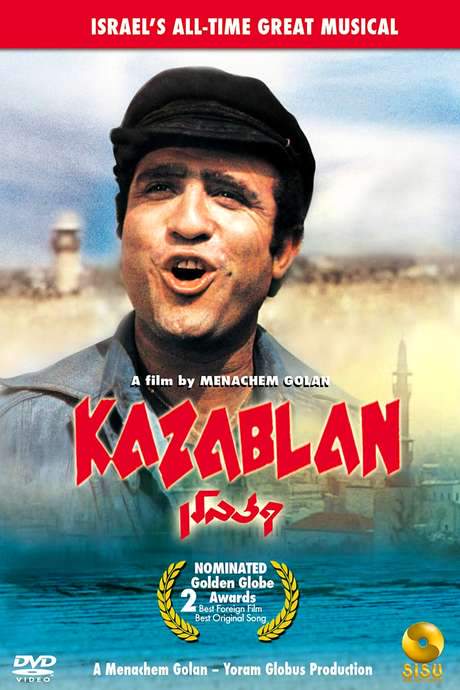
What Is Kazablan About?
The premise of Kazablan in 315 words, with nothing given away. The full story follows below.
In the cramped, aging housing blocks of Jaffa, a mosaic of old‑world immigrants and their descendants creates a vivid, bustling backdrop where tradition and modernity clash in equal measure. The narrow streets pulse with the sounds of market stalls, prayer calls, and the occasional outburst of youthful bravado, all underscored by an ever‑present sense that the neighborhood is teetering on the edge of change. The city’s plans to raze these homes loom like a distant storm, prompting residents to rally around a shared vision of preservation that feels both hopeful and precarious.
Kazablan moves through this world with a swagger earned from years of survival. A former army soldier whose past honors are hidden beneath a tough exterior, he now commands a close‑knit crew that patrols the night‑shifted alleys, their presence both a source of security and tension. Beneath his confident façade lies a deep‑seated resentment, a quiet yearning for respect that colors every interaction and fuels his role as an unofficial guardian of the community’s pride.
When Rachel steps onto the scene—a young woman balancing the expectations of her father and step‑mother—her quiet strength becomes an unexpected catalyst. Her tentative bond with Kazablan ignites whispers across the courtyard, drawing the attention of Yanush, an Ashkenazi shoe‑store owner whose own sense of honor feels challenged by the budding romance. Their connection hints at the fragile possibilities of bridging cultural divides, even as old grievances simmer beneath the surface.
Amid these personal currents, the neighborhood’s collective fight against demolition intensifies. Funds are raised, hopeful chants rise, and a shared determination begins to reshape the streets. Yet the very effort that unites them also becomes a source of suspicion, leading to legal entanglements that place Kazablan under scrutiny. As the community watches, he must navigate accusations and prove his loyalty, all while the rhythm of Jaffa continues to pulse with both tension and the promise of belonging.
What Happens in Kazablan?
The complete story of Kazablan, from the first scene to the last, in 834 words (about 4 minutes). Spoilers throughout. Names in the text link to 3 cast member pages.
Spoilers ahead
In a dilapidated housing complex in Jaffa, a tapestry of newcomers and old-timers from Europe and the Middle East weaves together daily life, where quiet routines are often interrupted by the loud energy of youth and pride. At the heart of the story is the elderly fisherman Moshiko Bebeuf, Moshiko, whose steady presence anchors the neighborhood as all the strands of the community begin to pull in different directions. Dominating the street’s mood is Yosef Siman-Tov, known to everyone as Kazablan. A child refugee from Morocco, he has built a rough, tight-knit crew—the Jama’a—whose midnight strolls and early morning noises rattle the nerves of residents and set the clock for a clash of cultures, honor, and survival.
From the start, the tension centers on Mr. Feldman, a Polish immigrant who sits at the crossroads of power in the complex. His daughter Rachel, a beacon of youth and grace, becomes the target of Kazablan’s insistence that she greet him with a morning blessing, a ritual that sparks inevitable friction with her father and stirs lingering questions about belonging, pride, and the meaning of respect. The moment is underscored by the stirring, familiar chorus of Kol HaKavod, a sound that marks both triumph and intimidation as the neighborhood negotiates who gets to define honor.
As the city council declares plans to demolish the aging immigrant housing, the residents refuse to yield. They convene to raise funds to reinforce and renovate their homes, a collective act that becomes a mini-revolution of communal agency; the air hums with a hopeful, defiant tune in Democracy. Kazablan’s gang, sensing the shifting balance of power, warns Mr. Feldman to mind where the money goes, hinting at the fragility of trust in a neighborhood on the edge of change.
One evening, Rachel encounters Janus, a local cobbler who loves her though the age gap between them is stark. Janus’s advances are rebuffed, but the moment ignites trouble when Kazablan intervenes to protect Rachel, forcing Janus to retreat and sending the Jama’a into a chorus that betrays their presence with the song Ma Kara. The incident leaves Kazablan battered, a wound that will echo through the next days and shape the town’s judgments. He seeks solace at Madame Rosa’s nightclub, where the community breathes life into the night with the song Jaffa, a reminder of the ties that bind and the forces that pull apart.
Mr. Feldman’s perception of Kazablan begins to shift after the Saturday lunch at his home. The tension eases as Rachel and her stepmother persuade the elder Feldman to join the meal, where Kazablan’s genuine humanity emerges—his war hero backstory, and the medal he earned saving a wounded commander on the battlefield, headlining a quiet truth that challenges the older man’s preconceptions. The shared meal becomes a turning point, and the two families glimpse a possibility of reconciliation. The day continues with a road trip to Jerusalem, a symbolic journey that tests loyalties: when Janus reappears to offer a different path for Rachel, Feldman refuses, and the pair return with the sense that the neighborhood’s future is still up for grabs. In the aftermath, Janus steals a money box that had been central to the residents’ fundraising, tipping the balance toward suspicion and fear.
Back in Jaffa, Kazablan finds himself in custody as the investigation unfolds. The police bring in an old comrade from the army, Josh, the very officer he saved on the battlefield, turning the investigative moment into a clash between past loyalties and present prejudices. The Jama’a respond by redoubling their efforts to renovate the neighborhood, bringing in engineers and workers, and challenging the demolition orders with practical proof of structural stability. The community’s renewed spirit—their hands-on work, their resolve—begins to shed light on the true thief as the investigation lurches forward.
Even as Kazablan denies the theft and his fingerprints surface on the hidden box, the truth remains tangled until a confrontation with Janus reveals the deceit. In a tense confrontation at Janus’s shop, Kazablan confronts the man and, with a final act of force, retrieves the stolen money, exposing Janus’s guilt before the neighborhood. The arrest of Janus, confirmed by the arriving officers, restores a fragile balance and leads to a crucial realization: the people were quick to judge and slow to see the value that Kazablan had brought to their community.
The denouement brings the community full circle. Josh’s invitation to Kazablan becomes a symbol of earned trust rather than mere compliance, and the Jama’a’s renovation of the neighborhood stands as a testament to collective resilience. The film closes with a circumcision ceremony for a baby in the neighborhood, a poignant ritual naming the child after Kazablan and honoring him as the godfather and hero of Jaffa—a living emblem of what it means to belong, to fight for one’s place, and to be welcomed home. The final hymns echo the triumph of community over prejudice, and the screen lingers on the idea that honor, once rightly understood, can lift up an entire neighborhood.
Kazablan Timeline: Every Key Event in Order
13 key events in the order they happen, from “Kazablan's morning confrontation in Jaffa” to “The ceremony and Kazablan's legacy”. 13 events name a place, across 13 locations.
- 1
Kazablan's morning confrontation in Jaffa
In the dilapidated housing complex in Jaffa, Kazablan and the Jama'a harass residents and demand that Rachel greet him. The scene opens with their noisy routines and the crowd-pleasing song Kol HaKavod. Mr. Feldman watches with disdain as he asserts that there is no true sense of honour here.
When:Morning Where:Jaffa, dilapidated housing complex
- 2
Janus, Rachel and the tense shop encounter
Rachel visits Janus, the Hungarian cobbler, to repair her shoes. Janus, who loves Rachel, tries to woo her, but Kazablan blocks her path and presses for acknowledgment. Feldman watches with contempt as the moment passes, and Rachel greets Kazablan, which briefly eases the tension.
When:Late morning Where:Janus's cobbler shop, housing estate
- 3
Municipality targets the neighborhood
The Tel Aviv-Jaffa municipality announces plans to demolish the immigrant housing due to dilapidation. In response, residents hold a meeting to raise funds and reinforce the neighborhood, determined to stay. The collective resolve is accompanied by the song Democracy.
When:Afternoon Where:Housing complex meeting room
- 4
Warning over the neighborhood fund
Kazablan and the Jama'a pass the assembly and issue a warning to Mr. Feldman that the neighborhood's money might vanish before it can be used. The moment foreshadows the tension between the reformers and the traditional power structures.
When:Evening Where:Outside the meeting location
- 5
Night walk, attack and refuge
Rachel walks home from school with Janus following; Kazablan intervenes to protect her from Janus. Later, Janus's employees ambush Kazablan, leaving him bruised. He seeks solace at Madame Rosa's nightclub where his friends gather, as the Jama'a sing Ma Kara.
When:Evening Where:Streets of Jaffa; Madame Rosa's nightclub
- 6
Feldman confronts Kazablan at the club
The next day, Feldman confronts Kazablan at the club, urging him to let Rachel go and seek someone more suitable. Kazablan responds that he will consider it, while the club's owner offers quiet consolation and a reminder of the social tensions between communities.
When:Afternoon Where:Madame Rosa's nightclub
- 7
The Saturday lunch and a revelation
On Saturday, Rachel invites Kazablan to lunch at Feldman's home; Mr. Feldman initially refuses to join, treating Kazablan as a gangster. During the meal, Kazablan notices the hidden money box and moves it for safety. He reveals that he is a war hero who saved his commander, a fact that softens Feldman's prejudice; they then drive to Jerusalem in a car provided by the Jama'a.
When:Saturday noon Where:Feldman family home
- 8
Janus steals the box
After the Jerusalem trip, Janus arrives to press for Rachel's hand and, in the process, steals the money box from Feldman's home. This move intensifies the community's suspicion of Kazablan and strains Rachel's trust.
When:Afternoon Where:Feldman home
- 9
Kazablan's arrest and Rachel's doubt
Upon returning, Kazablan is arrested for the missing money; Feldman and neighbors hastily accuse him, while Rachel believes in his innocence. Feldman slaps Rachel for defending him, prompting her to flee to the beach in fear.
When:Evening Where:Jaffa streets and beach
- 10
The interrogation and Josh's wisdom
Kazablan is interrogated by Josh, his former army commander who he saved in battle. The exchange is tense, but Josh urges him to ignore past invitations and focus on moving beyond resentment.
When:Evening Where:Police station
Show the other 3 events of Kazablan Hide the last 3 events
- 11
Jama'a renovation and municipal reprieve
While Kazablan awaits his fate, the Jama'a organize the neighborhood’s renovation, bringing trucks, materials, an architect and an engineer. An engineer convinces municipal inspectors that the buildings are now stable and there is no reason for demolition.
When:Days after Where:Neighborhood renovation site
- 12
Final confrontation and public vindication
Josh continues the investigation and Kazablan refuses to confess until he confronts Janus in his shop. The box is revealed to contain the stolen money, clearing Kazablan and leading to Janus's arrest. The community realizes their hasty judgment and acknowledges Kazablan as a hero.
When:Evening Where:Janus's shop
- 13
The ceremony and Kazablan's legacy
The film closes with a circumcision ceremony for a local couple's son, who is named after Kazablan, honoring him as the neighborhood godfather and hero. The scene emphasizes unity and acceptance among the neighborhood's diverse communities.
When:Ending Where:Neighborhood circumcision ceremony
Who Are the Main Characters in Kazablan?
7 characters, among them Kazablan (Yehoram Gaon), Moshiko Bebeuf (Aryeh Elias) and Mr Feldman (Polish immigrant): who each one is and the part they play in the story. 4 of them link to the actor’s page.
- K(
Kazablan (Yehoram Gaon)
Played by Yehoram Gaon
A Moroccan-born immigrant who leads the Jama'ah and oscillates between street bravado and a desire for belonging. His war hero past, pride, and volatile temper complicate his relationships with Rachel and the neighborhood. Through his choices, the film examines how identity is crafted in a multicultural city.
- 🪪 Immigrant
- 🧭 Identity
- 💥 Gang leader
- MB
Moshiko Bebeuf (Aryeh Elias)
Played by Arieh Elias
An elderly fisherman who anchors the story with his quiet wisdom. He acts as a guiding voice amid the chaos of the housing conflict, offering perspective on tradition and community. His presence frames the neighborhood as more than a battleground for pride.
- 🪝 Elder
- 🧭 Wise elder
- 🧭 Navigator
- MF
Mr Feldman (Polish immigrant)
Played by Yehuda Efroni
A head of the housing complex who emphasizes honor and order. His initial mistrust of Kazablan reflects the broader tensions between European and immigrant communities. The character's arc moves toward understanding as the truth about the money theft unfolds.
- 🧑💼 Patriarch
- 🧭 Authority
- 🧱 Old-world values
- R(
Rachel (Efrat Lavie)
Played by Efrat Lavie
The daughter of Mr Feldman, she becomes the focal point of Kazablan's affection. Caught between family duty and love, she believes in Kazablan's innocence and pushes the community toward empathy. Her perspective drives the narrative toward reconciliation.
- 💖 Lover
- 🧭 Loyalties
- 🕊️ Bridge-builder
- J(
Janus (Yossi Gerber)
A Hungarian cobbler who loves Rachel and becomes entangled in the neighborhood's conflict. He pushes his own interests, culminating in the theft that frames Kazablan and escalates the tension. His actions catalyze the climactic unmasking and the community's reckoning.
- 💼 Rival
- 🗝️ Thief
- 💬 Manipulator
- J(
Josh (Misha Ashrov)
Kazablan's former army commander who returns as the investigating officer. His encounter with Kazablan in custody forces both of them to confront loyalty, memory, and the value of true friendship. He ultimately helps reveal the truth and clear Kazablan's name.
- 🎖️ Authority
- 🧭 Advisor
- 🕊️ Reconciler
- MR
Madame Rosa
Owner of the night club where Kazablan seeks refuge and where community life pulses. The club functions as a social hub in a tense urban landscape, highlighting nightlife as a space for relief and connection. Her presence marks the story's urban heartbeat.
- 🎶 Nightlife
- 🏢 Local hub
- 🎭 Patron of culture
Where and When Is Kazablan Set?
Kazablan is set in Jaffa and Tel Aviv (1960s). Here is why the time and place matter to the story.
When
1960s
Set in the early years of the Israeli state, the story reflects the influx of immigrants shaping urban life in Jaffa. The period is marked by social tensions between old and new arrivals and the struggle to preserve housing amidst redevelopment threats. It captures a moment when communities fought to redefine identity in a rapidly modernizing city.
Where
Jaffa, Tel Aviv
A dilapidated housing complex in Jaffa serves as the film's center, where new and old immigrants from Europe and the Middle East share crowded spaces. The neighborhood is alive with market stalls, small shops, and a local nightclub, reflecting a melting pot of cultures. The residents band together in the face of municipal redevelopment plans, testing their sense of home and belonging.
- 🏘️ Immigrant housing
- 🌆 Urban life
- 🤝 Multicultural community
- 🎶 Neighborhood culture
What Are the Themes of Kazablan?
4 ideas the story keeps returning to, among them Identity, Unity and Conflict & Justice.
-
01
Identity
Kazablan's Moroccan roots collide with a desire to belong in a diverse city. He leads a rough street crew while longing for acceptance from neighbors like Mr. Feldman and Rachel. The romance with Rachel and his war hero past complicate how others label him, forcing a reckoning with loyalty and self-worth. The film uses his journey to explore how identity is crafted in a multicultural city.
-
02
Unity
Despite tensions, the neighborhood mobilizes to save their housing, gathering funds and resources for renovation. The Jama'ah transitions from a source of fear to a catalyst for communal effort and resilience. The community's willingness to work together against demolition signals a broader message of solidarity across cultural lines. The arc emphasizes that collective action can redefine a neighborhood's future.
-
03
Conflict & Justice
A theft of money archived by the box fuels suspicion against Kazablan, testing his innocence and forcing him to fight for his name. Josh, Kazablan's former army commander, questions loyalties but ultimately protects him, revealing the complexity of trust. The true thief, Janus, is revealed in a climactic confrontation, restoring Kazablan's reputation. The events underscore how quick judgments can shape destinies in a tight-knit community.
-
04
Redemption
After the truth comes to light, the neighbors recognize Kazablan's courage and the debt they owe him. The circumcision ceremony at the end cements his role as godfather and hero, symbolizing acceptance and reconciliation. The story closes on a note of communal respect, showing that love, loyalty, and courage can overcome prejudice.
What Kind of Film Is Kazablan?
Hopeful in tone, with steady pacing and a moderate story, going by the plot summary.
- Tone
- Hopeful
- Pacing
- Steady
- Story
- Moderate
- Intensity
- Medium
- Ending
- Happy
A spirited and hopeful community drama that balances energetic tension with a resilient, heartwarming spirit as a neighborhood and a misunderstood hero fight for their home and honor.
- defiant
- hopeful
- communal
- resilient
- nostalgic
- energetic
- community
- prejudice
- redemption
- class conflict
Quiz
How well do you remember Kazablan? Test yourself on the story.