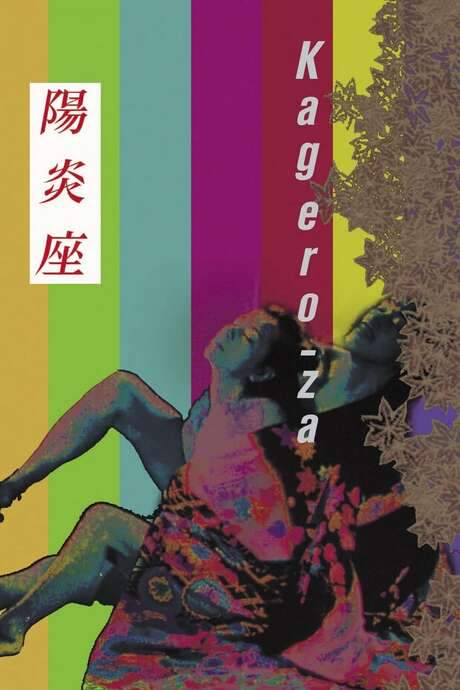
Kagero-za 1981


Directed by

Seijun Suzuki
Made by

Cinema Placet
Where to Watch Kagero-za
See current US streaming, rental, and purchase options for Kagero-za (1981) via JustWatch.



Streaming availability powered by 
Kagero-za Plot Summary
Read the complete plot summary and ending explained for Kagero-za (1981). From turning points to emotional moments, uncover what really happened and why it matters.
In 1926 Tokyo, a Shinpa playwright named Matsuzaki, Yûsaku Matsuda, meets a stunning married woman whose name he never learns. After two chance encounters, they share a night together, only to discover that the room belongs to Shinako, Michiyo Yasuda, the wife of his patron, Baron Tamawaki. The moment twists from a private, almost reckless flirtation into a web of social tension and hidden loyalties that will reshape every character involved.
As the story unfolds, Matsuzaki learns a chilling truth about Tamawaki: he has two wives. His first wife was Irene, a German woman he fell in love with while studying abroad. To feel secure in Japan, he had her hair dyed black, and they returned as a Japanese woman named Ine. Yet Tamawaki’s ambitions do not stop at color or disguise; he later weds Shinako, a count’s daughter, a union he secured with money and status. The complex arrangement casts long shadows over every encounter, and Matsuzaki’s perception of love and obligation grows confounding and urgent. On the stairs outside a hospital, Matsuzaki speaks with Ine, a moment charged with memory and missed chances, though by then Ine should already have breathed her last within her hospital room.
A thread pulls Matsuzaki toward Kanazawa when he receives a letter from Shinako, inviting him to meet and promising a fourth rendezvous that could be life-threatening. Tamawaki also heads toward the same destination, pressing Matsuzaki to consider suicide with Shinako as a final act that would seal their fates. The chase becomes a perilous pursuit of truth, loyalty, and the boundaries of desire, as Matsuzaki makes a desperate escape and arrives at a peculiar theater called Kageroza.
Inside that strange venue, Shinako and Iwaki pursue him, while children perform a stage show about monsters. The performance abruptly shifts from fiction to a personal reckoning: the monsters on stage mirror Irene’s forgotten tragedy, and Shinako steps into the spotlight to voice her anger at being cast as a perpetual second choice. She recounts her own affair with Matsuzaki as a calculated act of revenge against the life that was not hers to claim. The line between stage play and real life blurs, and the theatre itself feels like a pressure cooker where hidden histories surface with terrible clarity.
When the theater collapses, the crowd erupts as news spreads that a body has been found in the pond following a double suicide. The immediate interpretation points to the intertwined fates of Iwaki and Shinako, yet Matsuzaki clings to his belief that Shinako might still be alive. Amid the festive aftermath and the echo of distant music, a quiet, eerie tension lingers: the sense that the truth resides not just in what happened, but in how the living choose to face what they have done.
In the final moments, Matsuzaki reaches a secluded, enigmatic room where Shinako awaits. He bows to his own waking self, acknowledging the confluence of consequence and reflection that has guided their lives. The two sit back-to-back, a visual and emotional convergence that suggests a shared, unresolved fate. The lines between creator and creation, between guilt and confession, between love and possession, are finally drawn in the intimate space where memory and desire press up against reality.
- Tamawaki, Katsuo Nakamura
- Shungo Matsuzaki, Yûsaku Matsuda
- Shinako, Michiyo Yasuda
- Ine, Eriko Kusuta
- Irene (not separately linked to an actor in the provided cast)
Kagero-za Timeline
Follow the complete movie timeline of Kagero-za (1981) with every major event in chronological order. Great for understanding complex plots and story progression.
Matsuzaki's first meeting with a beautiful married woman
Matsuzaki, a Shinpa playwright in 1926 Tokyo, meets a beautiful married woman whose name he does not know. This chance encounter begins a dangerous, intimate connection that challenges his sense of morality. The meeting hints at a web of secrets surrounding wealth, marriage, and desire.
The night they spend together and a room's ownership revealed
After two more chance encounters, they spend the night together. Matsuzaki soon learns that the room she uses belongs to Shinako, the wife of his patron Baron Tamawaki. The revelation ties their liaison to the powerful social circle around Tamawaki.
Tamawaki's polygamy is exposed
Matsuzaki discovers that Tamawaki has two wives, complicating loyalties and desires. He learns Irene, a German woman, became Ine after dyeing her hair black, and Shinako is Tamawaki's second wife, chosen for wealth. The backstory underscores the cost of status and control.
Ine on the hospital stairs
Matsuzaki meets Ine on the stairs in front of the hospital and speaks with her. The exchange reveals the hidden life of Tamawaki's household and its consequences for Irene/Ine. The moment foreshadows the tragedy looming over their world.
Ine dies in her hospital room
Ine is said to have taken her last breath in her hospital room. Her death intensifies the sense of loss and the costs borne by those entangled with Tamawaki. Matsuzaki remains unaware of Shinako's deeper motives at this point.
Shinako's letter invites Matsuzaki to Kanazawa
Matsuzaki receives a letter from Shinako saying she will wait for him in Kanazawa. The invitation promises a painful test of love, loyalty, and personal risk. He resolves to hurry toward the city to meet her.
Matsuzaki travels to Kanazawa for the rendezvous
Matsuzaki hurries to Kanazawa to meet Shinako, aware that their fourth rendezvous would be life-risking. The journey heightens the tension between desire and duty. He approaches the promised meeting with a mix of fear and longing.
Tamawaki goes to Kanazawa to force Matsuzaki's hand
Tamawaki also heads to Kanazawa and urges Matsuzaki to commit suicide with Shinako. This coercive move reveals the brutal pressures of his control and the deadly stakes of their affair. The city becomes a stage for manipulation and desperation.
Matsuzaki escapes to Kageroza Theater
Matsuzaki escapes and arrives at the strange theater called Kageroza. Shinako and Iwaki follow him into the venue, drawn by the spiraling tension between lovers and fate. The location shifts the drama from private rooms to a public, folkloric space.
The onstage play mirrors Irene's tragedy
Children perform on stage as the play about monsters unfolds, suddenly becoming Irene's story of torment for being a wife kept in the shadows. Shinako also appears on stage to express resentment at being a second wife and to reveal her own revenge on Matsuzaki. The performance collapses the line between fiction and reality.
The theatre collapses and a body is found
The Kagerouza theatre collapses, and villagers cry out that a body has been found in the pond after a double suicide. The victims are Iwaki and Shinako, though Matsuzaki believes Shinako may still be alive. The disaster deepens the mystery surrounding their fates.
Final revelation: Shinako alive and the vow before her
As festival music reverberates, Matsuzaki finds Shinako in a mysterious room, suggesting a liminal space between life and memory. He bows to his real-world self, and they sit back-to-back, symbolizing a reconciliation of identities. The ending ties together the theater's fiction with Matsuzaki's reality.
Kagero-za Characters
Explore all characters from Kagero-za (1981). Get detailed profiles with their roles, arcs, and key relationships explained.
Shungo Matsuzaki (Yūsaku Matsuda)
A Shinpa playwright who becomes entangled with a married woman, pulling him into a tangled web of desire and social obligation. His pursuit of personal truth collides with the rigid constraints of wealth and status. He flees to Kanazawa to escape scandal, only to be drawn deeper into the Baron's schemes. Caught between art, love, and duty, he faces a precipice where choices may define his fate.
Shinako (Michiyo Yasuda)
Tamawaki's wife and a count's daughter who resents being the second wife. She manipulates circumstances to assert control within the marriage and carries a fierce sense of grievance. Her affair with Matsuzaki is driven by revenge and a desire to upset the balance of power, a path that leads toward a tragic, irreversible conclusion. She embodies the tension between social elegance and raw desperation.
Tamawaki (Katsuo Nakamura)
A powerful Baron with two wives, who wields wealth and influence to shape relationships for his own ends. He reveals a calculating mind, engineering circumstances to preserve his status and control others. His insistence on a life free from scandal catalyzes the lovers' conflict and drives the plot toward a dramatic reckoning. His world is a theatre of privilege where mercy is scarce.
Ine (Eriko Kusuta)
Tamawaki's first wife who began life as Irene, a German woman forced to dye her hair black and live as Ine to fit into Japanese society. She endures a life of subjugation and secrecy, gradually fading from the public gaze as her status and voice decline. Her presence on the stairs and within the hospital underscores the human cost of a merciless social order. Her fate hints at the consequences of hiding truth behind appearances.
Kagero-za Settings
Learn where and when Kagero-za (1981) takes place. Explore the film’s settings, era, and how they shape the narrative.
Time period
1926
The events take place in the mid-1920s Japan, a period marked by modern anxieties and traditional obligations among the elite. Urban life in Tokyo exposes the clash between money-driven power and personal desire. The setting around Kanazawa and the theatre underscores a transient, fate-driven atmosphere where characters confront consequences of their actions. This era intensifies themes of reputation, gender roles, and social maneuvering.
Location
Tokyo, Kanazawa, Kagerou-za Theatre, hospital
The story unfolds mainly in Tokyo during 1926, with crucial scenes in Kanazawa. Key locations include the Kagerou-za Theatre, a place where personal lives and performance collapse into one dramatic narrative. Hospitals and inns appear as quiet backdrops to the characters’ most intimate choices, highlighting the social costs of wealth and marriage. The theatre itself serves as a mirror where reality and illusion converge.
Kagero-za Themes
Discover the main themes in Kagero-za (1981). Analyze the deeper meanings, emotional layers, and social commentary behind the film.
💔
Forbidden Love
Love defies the rigid codes of wealth and marriage. Matsuzaki and Shinako pursue a relationship that society deems taboo, testing loyalties and personal honor. Their affair exposes how power and money shape possibility, even as true affection remains fragile. The pursuit culminates in tragedy, blurring the line between passion and ruin.
💼
Power & Wealth
Aristocracy and patronage determine who can demand obedience and who must settle for shadows. Tamawaki uses wealth to orchestrate marriages and control others, revealing the corrosive influence of status. The plot shows how money can silence truth, fuel jealousy, and justify drastic actions. The social machinery of wealth is both protective and predatory.
🎭
Identity & Masks
Theatre and life mirror each other as characters wear roles to survive their world. The stages of Kagerou-za reflect the disguises people keep in public and private spheres. Irene/Ine’s transformation signals how identity can be constructed and erased by circumstance. The narrative suggests that performance ultimately exposes the fragility of self against fate.

Coming soon on iOS and Android
The Plot Explained Mobile App
From blockbusters to hidden gems — dive into movie stories anytime, anywhere. Save your favorites, discover plots faster, and never miss a twist again.
Sign up to be the first to know when we launch. Your email stays private — always.
Explore the mobile appKagero-za Spoiler-Free Summary
Discover the spoiler-free summary of Kagero-za (1981). Get a concise overview without any spoilers.
In the restless heart of 1926 Tokyo, the glittering world of Shinpa theatre pulses with ambition and reverence for tradition. Young playwright Shungo Matsuzaki balances the demands of his craft with the intricate etiquette of a city still finding its modern voice. The streets hum with jazz, electric lights, and whispered gossip, while the stage offers a sanctuary where illusion and truth constantly collide. Within this vibrant yet precarious environment, every encounter feels charged with possibility, and the line between performance and lived experience blurs beneath the neon glow.
When Shungo is drawn into a fleeting liaison with a striking, unnamed woman, the encounter swiftly spirals into something far more unsettling. The woman, married to the influential Baron Tamawaki, exudes a haunting elegance that suggests she may be more than a mere mortal presence in his life. The baron himself—a patron whose own domestic life is layered with secrecy—maintains connections to two wives: the enigmatic Ine, a woman whose past is disguised beneath altered appearances, and Shinako, a count’s daughter whose marriage to the baron hints at a complex web of status and desire. A lingering suggestion that the mysterious lover could be the lingering spirit of one of these women adds a spectral tension that permeates Shungo’s every thought.
Against this backdrop, the enigmatic theater known as Kageroza becomes a crucible for the characters’ hidden motives. Its dim corridors and surreal staging echo the inner turmoil of those who wander its halls, while youthful performers reenact age‑old myths that mirror the adult world’s unresolved passions. The atmosphere is simultaneously lush and claustrophobic, inviting Shungo to question the nature of his own creations, the weight of social expectation, and the thin veil that separates love from obsession. In a city where every whispered promise carries the weight of history, the playwright finds himself poised at the edge of a story that may ultimately reveal more about himself than any script could ever convey.
Movies with Similar Twists and Themes
Uncover films that echo the narrative beats, emotional arcs, or dramatic twists of the one you're exploring. These recommendations are handpicked based on story depth, thematic resonance, and spoiler-worthy moments — perfect for fans who crave more of the same intrigue.
Featured on this page

What's After the Movie?
Not sure whether to stay after the credits? Find out!
Check out our other apps:

SAT Sphere
Build confidence for the Digital SAT.

Mori Atlas
Discover wild places worth protecting.

Luntero
Search smarter for a home in Amsterdam.

Plot Explained
Unravel movie endings and hidden clues.

Pokechamp
Dive into Pokémon data and battle logic.

Driving Theory
Get ready for your European theory test.

Movie Dust
Plan your next cinema trip with ease.

Musemap
Find art and culture as you travel.

Selkobase
Compare credentials before committing.

Local Manual
Turn an unfamiliar country into practical next steps.

Lernavi
Compare school systems before your next move.

GymRoam
Find a workout stop wherever your plans take you.
Explore Our Movie Platform
New Movie Releases (2026)
Famous Movie Actors
Top Film Production Studios
Movie Plot Summaries & Endings
Major Movie Awards & Winners
Best Concert Films & Music Documentaries
Movie Collections and Curated Lists
© 2026 What's After the Movie. All rights reserved.
Privacy Policy