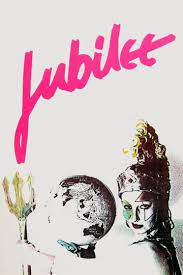
Jubilee 1979

Directed by

Derek Jarman
Made by

Cinegate
Where to Watch Jubilee
See current US streaming, rental, and purchase options for Jubilee (1979) via JustWatch.


Streaming availability powered by 
Jubilee Plot Summary
Read the complete plot summary and ending explained for Jubilee (1979). From turning points to emotional moments, uncover what really happened and why it matters.
Queen Elizabeth I Jenny Runacre [is transported] by the occultist John Dee, who commands Ariel from The Tempest to bring her into the film’s present day. She lands in a ruined, mid-1970s Britain, moving through crumbling streets and a city that feels hollowed out by social and urban decay. The surrounding world is populated by a loose, aimless group of nihilists—mostly young women—whose lives are as fragmentary as the city around them, and among them are the provocatively named Amyl Nitrate, Bod, Chaos, Crabs and Mad, each contributing to a mood that is as anarchic as it is disenchanted. Amyl Nitrate, Toyah Willcox leads a squat-based scene where history is taught in a way that glorifies radical violence, even as she reminisces about a past life in ballet, a juxtaposition that foreshadows the film’s ongoing tension between artifice and cruelty, performance and peril.
In this volatile milieu, an early set piece introduces Sphinx and Angel, two incestuous bisexual brothers who loom over the group’s dynamics with a charged, unsettling presence. The narrative’s momentum is propelled by the disturbing act Bod commits: she, a sex-hating anarchist, has just strangled and killed Queen Elizabeth II, stealing her crown in a capricious street robbery. The act marks a brutal, destabilizing turn in a film already shimmying between fantasy, satire, and raw aggression.
From the squat, the action spills into a café where Crabs drifts toward a younger musician named Kid, Mad rips up postcards, and Bod launches a crude assault on a waitress using a bottle of tomato sauce. Bod then makes contact with the impresario Borgia Ginz, a character who embodies the crossover between show business and political opportunism. When Ginz enters the scene, Amyl’s presence is already clear, and the pair’s meeting unfolds with a sense of theatricality and menace; Borgia Ginz introduces a new axis of power, and his ambitions—turning abandoned spaces into musical venues—signal a rot the city is already chewing on. Jack Birkett appears here as the impresario, linking the persona to its on-screen presence.
Ginz’s arrival reveals a broader plan: to convert the derelict Westminster Cathedral and Buckingham Palace into performance spaces, a bold, brazen fusion of culture and desecration that mirrors the gang’s escalating trespasses. The group’s progress is punctuated by violence as well as music, with Mad, Bod and Crabs asphyxiating a one-night stand named Happy Days with red plastic sheeting, and Bod throttling an androgynous rock star named Lounge Lizard—a brutal interruption to a world where gigs and glamour seem within reach only to slip away again.
The story threads a violent rhythm through Westminster Cathedral’s disco milieu, where Kid and a policeman clash in a feverish altercation. As Kid makes a television debut, Viv—a former artist who is drawn into the gang’s orbit—joins Sphinx, Angel and the male members on a visit to Max, an ex-soldier at a bingo hall. The city’s policing and morality collide in a frenzy of brutality, claiming Sphinx, Angel and Kid in a cascade of violent police action. In the wake of these deaths, revenge becomes a driving force: Bod and Amyl execute a calculated assault to castrate the policeman who begins an affair with Crabs, while the other officer—now a target of Bod’s bombing—meets a fiery end at his own doorstep.
As the violence peaks, Ginz leads the four women away to Dorset, a reclusive, right-wing aristocratic enclave that he regards as “the only safe place to live these days.” The move marks a surreal pivot from urban decay to a pastoral, almost nostalgic refuge, and it culminates in a recording contract that promises a future amid a social order the film insists is already broken. The crew’s journey is juxtaposed with Dee, Ariel, and Elizabeth’s attempts to interpret the signs of anarchic modernity around them, and the film closes on a strange, poignant return to a sixteenth-century sensibility, a dreamlike respite that juxtaposes Elizabeth’s spectral presence with the era’s own myths and dreams.
Throughout, the film maintains a detached, observational tone, letting its shocking events unfold with a chilly, almost documentary clarity. The characters drift through a world that treats violence as spectacle and performance as a currency, and the narrative never shies away from the uncomfortable collisions between history, rebellion, and the commodification of art. The result is a provocative, fragrantly transgressive tableau in which power, sexuality, and identity collide across time, leaving the viewer to weigh the costs of cultural decay against the lure of spectacle and music.
Jubilee Timeline
Follow the complete movie timeline of Jubilee (1979) with every major event in chronological order. Great for understanding complex plots and story progression.
Elizabeth I arrives in 1970s Britain
John Dee uses Ariel to transport Elizabeth I to present-day London. She emerges into the shattered Britain of the 1970s and begins to survey the decayed city. She witnesses the violent, anarchic mood of a society in flux.
Squat introduction to the nihilist circle
Elizabeth is introduced to a squat full of aimless young women, including Amyl Nitrate, Bod, Chaos, Crabs and Mad, with Sphinx and Angel the incestuous brothers nearby. Amyl delivers a provocative history lesson that valorises violent behavior and scandalous figures. The scene establishes the rebellious, anarchic tone of the group.
Bod murders the Queen
Bod, a sex-hating anarchist, strangles Queen Elizabeth II in a street robbery and steals her crown. The act epitomizes the group's contempt for established authority and the crown’s symbolic power. The crime sets in motion the film’s brutal power dynamics.
Group hits a café; Kid and Bod collide with violence
The group moves to a cafe where Crabs meets a young musician named Kid. Mad tears up postcards while Bod attacks a waitress with tomato sauce. Bod also contacts impresario Borgia Ginz to start building opportunities.
Amyl performs for Ginz; property schemes begin
At a meeting with Ginz, Amyl Nitrate performs a pastiche of Rule Britannia, shocking the impresario and signaling a fusion of performance and provocation. Ginz is shown expanding into property management, purchasing abandoned spaces to transform into venues.
Viv meets Max; new romantic ties form
Sphinx and Angel begin a relationship with Viv, a young former artist, and take her to meet Max, an ex-soldier. The interactions broaden the crew’s circle and deepen the film's themes of desire and power.
Kid signs with Ginz’s label
Crabs arranges for Kid to see Ginz, and Kid’s band is auditioned and signed under the name Scum. Sphinx and Angel press Kid to resist, but he laughs off their warnings.
Ginz buys iconic venues for his empire
Ginz expands his empire by purchasing Westminster Cathedral and Buckingham Palace, converting them into musical venues. The city’s sacred and royal spaces become commercial stages for a new subculture.
Murder spree and a rock star's death
Mad, Bod and Crabs asphyxiate Happy Days, one of Crabs’s lovers, with red plastic sheeting. They then break into the flat of Lounge Lizard, an androgynous rock star, where Bod throttles him to death.
Disco clash in Westminster Cathedral
A disco session in Westminster Cathedral triggers a fight between Kid and a policeman. Tensions escalate as the space becomes a stage for violence rather than worship.
TV debut and the blood-soaked aftermath
After Kid’s TV debut, Viv and the three males visit Max’s bingo hall, where violent police activity leads to the deaths of Sphinx, Angel, and Kid. The violence marks a turning point for the group and their relationship to authority.
Vengeful strikes against the police
The gang exacts revenge on the two policemen: one is castrated to death by Mad and Amyl, and the other is killed by Bod with a petrol bomb at his doorstep after an affair with Crabs. The act enforces a brutal retribution arc.
Escape to Dorset and a recording contract
Ginz takes the four women to Dorset, presenting it as the only safe place to live, and signs a recording contract with the gang. The retreat signals a pivot toward professionalized, commodified rebellion.
From anarchic modernity to a sixteenth-century dream
Dee, Ariel, and Elizabeth interpret the signs of anarchic modernity around them, then undertake a pastoral return to the sixteenth century at the film’s end. The trio seeks a nostalgic escape from the present through historical illusion.
Jubilee Characters
Explore all characters from Jubilee (1979). Get detailed profiles with their roles, arcs, and key relationships explained.
Amyl Nitrate (Toyah Willcox)
A fearless ringleader within the group, Amyl Nitrate lectures others about history and channels it into violent, anarchic acts. She wields charisma to mobilize the group and revels in a rebellious femininity. Her presence anchors the group’s ideological extremes and performative chaos.
Bod
A sex-hating anarchist who escalates violence within the circle. Bod revels in cruelty, strangling a monarch-like symbol and driving the gang’s most brutal actions. Her impulsiveness and ferocity push the group toward increasingly dangerous acts.
Sphinx (Jack Birkett)
One of the incestuous brothers, Sphinx is flamboyant and enigmatic, contributing to the group’s provocative dynamic. His presence adds a layer of theatrical perversity and subversive charm to the unfolding chaos.
Angel (Ian Charleson)
The other incestuous brother, Angel participates in the group’s complex relationship web and volatile interactions. His role emphasizes themes of sexuality, performance, and boundary-pushing behavior within the subculture.
Kid (Jordan)
A young musician drawn into the scene, Kid embodies the lure of fame and the lure of commercial opportunities. His band’s discovery by a promoter marks the intersection of art and exploitation within the countercultural milieu.
Viv (Jenny Runacre)
A former artist who becomes entwined with the male and female members of the group. Viv represents the artistic impulse within the chaos and participates in exchanges that reveal the era’s entanglement of art, sexuality, and power.
Max (Karl Johnson)
An ex-soldier who navigates the violent world around the group. Max’s experiences in the violent public sphere echo the film’s meditation on war, authority, and the erosion of social order.
Elizabeth II
The reigning monarch who becomes a symbol of the old order. Bod’s brutal act of killing Elizabeth II and stealing the crown serves as a stark turn in the film’s critique of power and spectacle.
Queen Elizabeth I
A figure who appears only through the Elizabethan frame of reference and the film’s mythic past, underscoring the collision of eras that drives the ending’s nostalgia-filled return.
Jubilee Settings
Learn where and when Jubilee (1979) takes place. Explore the film’s settings, era, and how they shape the narrative.
Time period
1970s
The bulk of the action takes place in a shattered 1970s Britain, a period of social unrest and urban decay. The film juxtaposes the grim city streets with pop-cultural spectacles and anarchic acts. Toward the end, there is a surreal, nostalgic return to the sixteenth century, framing the present-day chaos with Elizabethan echoes.
Location
Britain (1970s), Westminster Cathedral, Buckingham Palace, Dorset, a London squat
The story unfolds in a decaying Britain during the 1970s, moving through derelict city streets, squats, and damaged landmarks. Westminster Cathedral and Buckingham Palace are repurposed as venues, reflecting a collapse of tradition and authority. The journey also traces a pastoral return to Dorset, offering a brief contrast to the urban chaos.
Jubilee Themes
Discover the main themes in Jubilee (1979). Analyze the deeper meanings, emotional layers, and social commentary behind the film.
🌀
Nihilism
A group of aimless young women embody a nihilistic impulse, drifting through a world where rules are meaningless and violence becomes a form of expression. Amoral thrill-seeking, impulsive acts, and a shrug at authority define their way of life. The film uses this nihilism to critique societal collapse and the hunger for sensation.
🏚️
Commercialization
Authority and spaces are commodified as Westminster Cathedral and Buckingham Palace are turned into music venues by impresarios like Ginz. The film satirizes how power and property are exploited for entertainment and profit, eroding symbols of tradition. This shift intensifies the sense of chaos and moral ambiguity that drives the plot.
⏳
Time Juxtaposition
Elizabethan imagery and figures intermittently intrude into a modern, anarchic Britain, creating a tension between past grandeur and present decay. The narrative threads a surreal dialogue between eras, highlighting how history lingers while societal structures crumble. The ending’s return to a past era reinforces the cycle of nostalgia and disillusionment.

Coming soon on iOS and Android
The Plot Explained Mobile App
From blockbusters to hidden gems — dive into movie stories anytime, anywhere. Save your favorites, discover plots faster, and never miss a twist again.
Sign up to be the first to know when we launch. Your email stays private — always.
Explore the mobile appJubilee Spoiler-Free Summary
Discover the spoiler-free summary of Jubilee (1979). Get a concise overview without any spoilers.
In a London that glitters with a mischievous blend of the everyday and the enchanted, the Protector—a steadfast guardian with a quiet determination—receives an unexpected companion: a charismatic corgi whose boundless optimism turns every street corner into a stage. Together they set out on a quest that wends through bustling markets, echoing tube stations, and moonlit rooftops, all the while searching for the missing crown of the Queen, a symbol of history that has slipped into the city’s secret folds.
The city itself feels alive, humming with a soundtrack that weaves together brass‑filled street buskers, choral whispers from ancient churches, and sudden bursts of theatrical song. This musical tapestry underscores a tone that is as playful as it is poignant, allowing moments of comedy to sit comfortably beside quieter beats of reflection. Every alley and park bench becomes a canvas for the duo’s growing friendship, inviting the audience to feel the pulse of a place where the ordinary is constantly nudged by the extraordinary.
At the heart of the adventure lies the dynamic between the Protector and his four‑pawed ally. Their rapport is built on mutual trust: the guardian’s measured resolve balances the corgi’s exuberant curiosity, and together they navigate a series of whimsical challenges that test both courage and compassion. The journey also introduces a colorful cast of Londoners whose lives intersect with the pair’s mission, each encounter adding a splash of drama, a hint of fantasy, or a note of humor to the unfolding story.
Through its seamless mix of drama, fantasy, comedy, and music, the film paints a heartfelt portrait of determination and friendship. It invites viewers to wander alongside its heroes, feeling the suspense of a royal mystery while celebrating the simple joy of partnership in a city that never ceases to surprise.
Movies with Similar Twists and Themes
Uncover films that echo the narrative beats, emotional arcs, or dramatic twists of the one you're exploring. These recommendations are handpicked based on story depth, thematic resonance, and spoiler-worthy moments — perfect for fans who crave more of the same intrigue.







Featured on this page

What's After the Movie?
Not sure whether to stay after the credits? Find out!
Check out our other apps:

SAT Sphere
Build confidence for the Digital SAT.

Mori Atlas
Discover wild places worth protecting.

Luntero
Search smarter for a home in Amsterdam.

Plot Explained
Unravel movie endings and hidden clues.

Pokechamp
Dive into Pokémon data and battle logic.

Driving Theory
Get ready for your European theory test.

Movie Dust
Plan your next cinema trip with ease.

Musemap
Find art and culture as you travel.

Selkobase
Compare credentials before committing.

Local Manual
Turn an unfamiliar country into practical next steps.

Lernavi
Compare school systems before your next move.

GymRoam
Find a workout stop wherever your plans take you.
Explore Our Movie Platform
New Movie Releases (2026)
Famous Movie Actors
Top Film Production Studios
Movie Plot Summaries & Endings
Major Movie Awards & Winners
Best Concert Films & Music Documentaries
Movie Collections and Curated Lists
© 2026 What's After the Movie. All rights reserved.
Privacy Policy