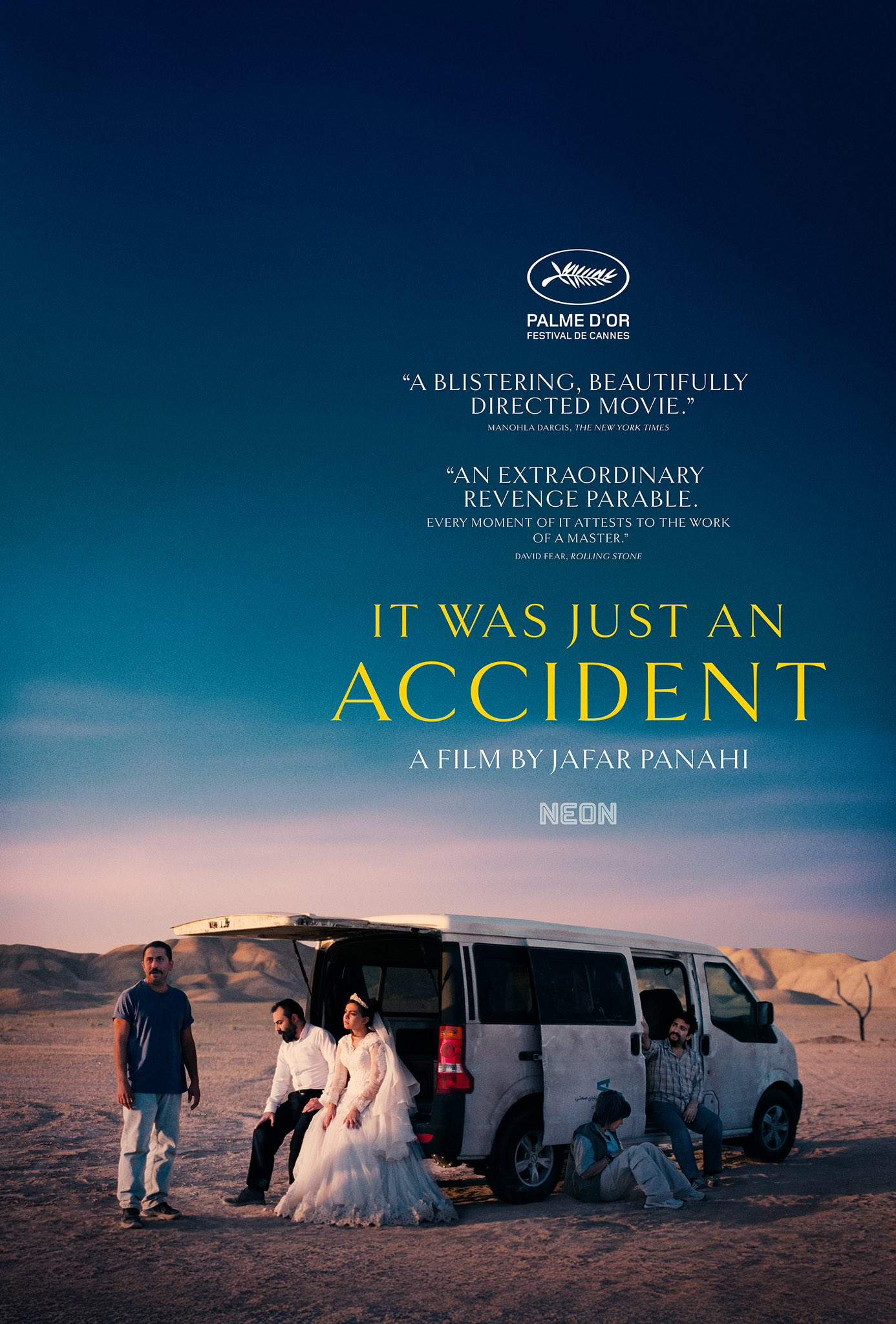
It Was Just an Accident 2025


Directed by

George Hashem Zadeh
Made by

Jafar Panahi Film Productions
Where to Watch It Was Just an Accident
See current US streaming, rental, and purchase options for It Was Just an Accident (2025) via JustWatch.









It Was Just an Accident Plot Summary
Read the complete plot summary and ending explained for It Was Just an Accident (2025). From turning points to emotional moments, uncover what really happened and why it matters.
One night, a man with a prosthetic leg drives home with his wife and daughter, only to hit and kill a dog. To repair his car, he visits a nearby garage where Vahid Vahid Mobasseri recognizes him from the distinctive sound of his prosthetic leg after he speaks to his mother on the phone. The next day, Vahid trails the man, abducts him, and tries to bury him in the desert. He tells him that he recognized his voice and stumbling walk as that of Eghbal ([Ebrahim Azizi]), his former tormentor in an Iranian prison. The man denies being Eghbal and begs not to be killed, insisting that the scars on his leg are recent, unlike Eghbal’s.
Doubting the man’s identity, Vahid places his unconscious body into the van and visits Salar George Hashemzadeh at a bookshop. Salar refuses to help identify the man but directs him to a photographer named Shiva Mariam Afshari, who is in the middle of taking wedding photos of Goli and Ali, an engaged couple to be married the next day. Reluctant to assist, Shiva recognizes the smell of the man as that of Eghbal but remains unsure due to the fact that they were blindfolded during their torture. Goli reveals she was also tortured by Eghbal but cannot confirm his identity, so they seek out Hamid Mohamad Ali Elyasmehr, Shiva’s former partner, and drug the captive before plugging his ears.
Hamid instantly identifies the man as Eghbal after touching his legs and urges killing him immediately, but Vahid and Shiva restrain him, wanting a formal testimony first. At that moment, a cellphone rings from the man’s body. Vahid answers and hears the man’s daughter, who says that her pregnant mother has fainted. The group visits the man’s house and drives his daughter and her mother to a hospital, where the mother gives birth to a son.
Frustrated, Hamid, Goli, and Ali decide to leave Vahid and Shiva behind. The remaining two drive the man to a quiet location at night, tie him to a tree, wake him, and demand a confession. The man initially again claims mistaken identity, but then concedes that he is Eghbal, arguing that his actions were justified for the good of the Iranian regime and that killing him would only make him a martyr. Vahid and Shiva recount the torment they endured and tell him that his wife has given birth to a son. Shiva insists that Eghbal apologize, and after a tense exchange, he relents and apologizes, claiming he was only trying to make a living. Vahid then frees Eghbal and drives away with Shiva.
Later, Vahid and his mother prepare the van for his sister. A white car, similar to Eghbal’s, enters the area as Vahid moves through the house to retrieve something. The familiar squeak of Eghbal’s prosthetic leg grows louder, approaching the scene.
It Was Just an Accident Timeline
Follow the complete movie timeline of It Was Just an Accident (2025) with every major event in chronological order. Great for understanding complex plots and story progression.
Accident and garage encounter
A man with a prosthetic leg drives at night with his wife and daughter and accidentally hits and kills a dog. He goes to a nearby garage for repairs, where a mechanic named Vahid recognizes him by the distinctive sound of his prosthetic leg during a phone call to his mother. This early incident sets the stage for a hidden past to surface.
Desert kidnapping and revelation
The next day, Vahid shadows the same man, abducts him, and attempts to bury him in the desert. During this capture, Vahid tells him that he recognizes his voice and his stumbling walk as that of Eghbal, a former tormentor. The confrontation makes it clear that a long-buried past is at stake.
Denial and plea for life
The captive denies any identity as Eghbal and begs Vahid and his companions not to kill him. He points out that his leg scars are recent, arguing they are not consistent with the torments allegedly suffered by Eghbal. The group deliberates on how to proceed rather than acting on impulse.
Search for identity through Salar
Vahid and Shiva seek answers by visiting Salar, a bookshop owner, hoping to confirm the man’s identity. Salar refuses to help identify the stranger but points them toward Shiva, a photographer who might recognize him. The exchange shifts the investigation from action to testimony.
Shiva’s cautious recognition
Shiva senses that the man bears Eghbal’s scent, yet cannot be sure due to the torture they endured blindfolded. Goli confirms she was also tortured by Eghbal, reinforcing the possibility but underscoring the uncertainty. They decide to seek out Hamid for a definitive identification.
Hamid’s quick verdict and danger
Hamid, Shiva’s former partner, identifies the captive as Eghbal after touching his legs and immediately demands his execution. Vahid and Shiva restrain him, insisting they first hear the captive testify. The tension tightens as the possibility of a confession hangs in the balance.
Phone call to the house
A cellphone embedded with the man rings, revealing his daughter on the other end who explains that his pregnant wife has fainted. The group drives the man's wife and newborn son to a hospital, where the mother gives birth, tying the case to a new life as a tangible consequence.
Fading alliance
Frustrated, Hamid, Goli, and Ali decide to abandon Vahid and Shiva, leaving the two to pursue the truth with the captive. The shift in reliance places greater responsibility on Vahid and Shiva to elicit a confession. The group’s unity fractures at a critical moment.
The quiet confrontation
Vahid and Shiva drive the man to a secluded location, tie him to a tree, and wake him to demand a confession. At first he again claims mistaken identity, but he gradually confesses that he is Eghbal and argues that his actions served the regime’s aims. The two recount their torture to him, seeking accountability.
Apology and release
The captive finally apologizes after a tense exchange in which Vahid and Shiva reveal the pain they endured. Accepting the apology, Vahid frees him and drives away with Shiva, closing the confrontation on a restrained but uncertain note. The act seems to neutralize a direct threat for the moment.
Foreshadowing at the homestead
Later, Vahid and his mother prepare the van for his sister. A white car resembling Eghbal’s car appears nearby as Vahid goes inside the house to retrieve something. The sound of Eghbal’s squeaky prosthetic leg then nears, hinting that the cycle of threat may not be over.
It Was Just an Accident Characters
Explore all characters from It Was Just an Accident (2025). Get detailed profiles with their roles, arcs, and key relationships explained.
Salar (George Hashem Zadeh)
Salar runs a bookshop and becomes a touchpoint in the pursuit of identity. He refuses to help identify the captive at first but eventually points Vahid toward Shiva, playing a cautious intermediary role in a web of past tortures. His guarded nature underscores the moral ambiguity of aiding in a cycle of violence.
Eghbal (Ebrahim Azizi)
Eghbal is the man who was tortured and who stubbornly clings to his narrative of regime protection. He initially resists acknowledging his identity and only confesses after being confronted with the victims’ memories. His complicity is framed by a defense of his actions as a necessity for survival.
The Groom (Majid Panahi)
The Groom appears in the wedding pictures, representing ordinary life before the violence breaks into the present. His engagement underscores the fragile continuity of personal milestones against political terror.
Vahid (Vahid Mobasseri)
Vahid is an Azerbaijani auto mechanic who recognizes the voice and leg markings of Eghbal. He orchestrates the abduction and becomes a catalyst for the moral reckoning that unfolds, torn between vengeance and restraint.
Shiva (Maryam Afshari)
Shiva is a photographer who documents a wedding while unwittingly guiding the search for the truth. She recognizes the scent and the possibility of identity, yet remains cautious due to the trauma shared by survivors. Her insistence on accountability propels the final confrontation.
Golrokh (Hadis Paak Baten)
Golrokh reveals her past torture and becomes a witness to the brutality of Eghbal. Her presence layers the narrative with personal memory and the demand for recognition of suffering.
Hamid (Mohammad Ali Eliyas Mehr)
Hamid is Shiva’s former partner who erupts with a desire for immediate vengeance. He represents the instinct to end violence through force, clashing with Vahid and Shiva’s more wary approach toward justice.
The Little Girl (Delmaz Najafi)
The captive’s daughter and the human link to the consequences of the violence. Her presence marks the cost of the conflict on innocent family members and adds urgency to the desire for a safe future.
Eghbal's Wife (Afsaneh Najm Abadi)
Pregnant wife of Eghbal, she embodies the personal stakes and the hope for new life amid fear. Her experience underscores the theme of birth and renewal after darkness.
It Was Just an Accident Settings
Learn where and when It Was Just an Accident (2025) takes place. Explore the film’s settings, era, and how they shape the narrative.
Location
Iran, Desert
The story unfolds across urban Iran and a desolate desert setting where a confrontation occurs. Key locations include a small automobile workshop, a bookshop, a hospital, and a family home, all grounding the plot in everyday spaces that become stages for violence and reckoning. The desert sequence amplifies the tension, serving as a stark backdrop for the confrontation between past torment and present choices.
It Was Just an Accident Themes
Discover the main themes in It Was Just an Accident (2025). Analyze the deeper meanings, emotional layers, and social commentary behind the film.
🩹
Trauma
The film centers on the enduring scars of torture and captivity, seen through the survivors who must confront their past. Vulnerability and memory collide as the abducted man is forced to face what he did not endure alone. The act of bearing testimony becomes a contested path toward closure and accountability.
🤔
Identity & Guilt
Questions of who a person truly is drive the drama: the line between victim and perpetrator blurs as Eghbal insists on his own justification. The victims struggle with recognizing the man under the mask of fear and power, testing whether guilt can be absolved by rationalization. The audience is left to weigh responsibility against circumstance.
🕊️
Mercy & Forgiveness
Moments of mercy punctuate the cycle of violence, as Vahid chooses restraint over revenge and frees Eghbal after he confesses. The possibility of forgiveness tests the limits of justice, especially when past torment is admitted but still afresh for the survivors. The film meditates on whether mercy can heal or merely delay retribution.

Coming soon on iOS and Android
The Plot Explained Mobile App
From blockbusters to hidden gems — dive into movie stories anytime, anywhere. Save your favorites, discover plots faster, and never miss a twist again.
Sign up to be the first to know when we launch. Your email stays private — always.
Explore the mobile appIt Was Just an Accident Ending Explained
Unravel the ending of It Was Just an Accident (2025) with our detailed explanation. Understand the final scenes, character fates, and unresolved questions.
Vahid finally drags the trembling man into a remote clearing, ties him to a tree, and forces him to listen as the victims lay out every detail of the torture they endured. The prison‑camp rhythm of the shovel, the prosthetic‑leg click, the scarred wounds on the shins – each piece matches what the survivors remember of Eghbal, the “peg‑leg” intelligence officer who broke their bodies and spirits. When Vahid mentions that his wife has just given birth, the captive’s composure cracks; he stages a feigned innocence at first, but then, almost defiantly, admits he is indeed Eghbal, the very monster they have hunted.
Shiva, who has been quietly watching, can no longer contain herself. She strikes him with a shovel, demanding that he own his crimes instead of hiding behind ideology. Under the relentless pressure, Eghbal’s façade collapses and he bursts into a raw, broken confession – “I’m sorry.” The apology is not a clean absolution, but the first moment his self‑justifications drown in the weight of the victims’ testimony. Vahid, refusing to become a killer, slides a penknife to Eghbal so he can free himself, then he and Shiva drive away, leaving the man to decide his own fate.
The next morning, as Vahid helps his sister prepare a wedding trousseau, a white car pulls up outside his house. He hears the familiar, squeaky footstep that once signaled the terror of the secret police. The sound pauses, then recedes. Whether it is Eghbal’s car pulling away, a phantom of Vahid’s trauma, or a hint that the former torturer has chosen to walk away, the scene suggests that revenge would not have healed anyone, but a forced confession can at least begin the process of confronting the past. The film closes on the ambiguous echo of the footsteps, underscoring that the road to redemption is uncertain, and the scars left by oppression linger long after the gunfire stops.
It Was Just an Accident Spoiler-Free Summary
Discover the spoiler-free summary of It Was Just an Accident (2025). Get a concise overview without any spoilers.
In a cramped, sun‑baked garage on the outskirts of an unnamed Iranian town, Vahid spends his days coaxing rusted engines back to life. He is a skilled mechanic of Azerbaijani heritage, haunted not only by the weight of his workbench but by memories of a dark past that still echo in the clatter of tools. When a weary driver rolls in with a broken car, a fleeting sound— the distinctive clack of a prosthetic limb— triggers a shiver of recognition that pulls Vahid back into the shadows of his imprisonment.
The film settles into a tense, almost claustrophobic atmosphere where ordinary routine collides with the lingering specter of state‑sanctioned cruelty. Eghbal, the man whose limp and voice Vahid believes he has heard again, represents a fragment of that trauma, a figure who may or may not be the very officer who once inflicted unspeakable pain. As Vahid wrestles with the thin line between vengeance and doubt, he draws together a small, uneasy coalition of fellow survivors—each carrying their own scars and lingering questions about the truth. Their shared mission feels both urgent and absurd, a quiet descent into a world where every clue is riddled with ambiguity.
Through dimly lit streets, cramped apartments, and the muted hum of a city that seems to hold its breath, the group navigates a maze of half‑remembered details and uneasy alliances. The tone balances stark realism with a lingering surreal edge, inviting the audience to feel the weight of unresolved trauma while hinting at the dangerous lengths people will go to confirm a lingering suspicion. The story teeters between the ordinary and the uncanny, leaving viewers to wonder whether the pursuit of justice will finally silence the past—or simply awaken something far more unsettling.
Movies with Similar Twists and Themes
Uncover films that echo the narrative beats, emotional arcs, or dramatic twists of the one you're exploring. These recommendations are handpicked based on story depth, thematic resonance, and spoiler-worthy moments — perfect for fans who crave more of the same intrigue.


Featured on this page

What's After the Movie?
Not sure whether to stay after the credits? Find out!
Check out our other apps:

SAT Sphere
Build confidence for the Digital SAT.

Mori Atlas
Discover wild places worth protecting.

Luntero
Search smarter for a home in Amsterdam.

Plot Explained
Unravel movie endings and hidden clues.

Pokechamp
Dive into Pokémon data and battle logic.

Driving Theory
Get ready for your European theory test.

Movie Dust
Plan your next cinema trip with ease.

Musemap
Find art and culture as you travel.

Selkobase
Compare credentials before committing.

Local Manual
Turn an unfamiliar country into practical next steps.

Lernavi
Compare school systems before your next move.

GymRoam
Find a workout stop wherever your plans take you.
Explore Our Movie Platform
New Movie Releases (2026)
Famous Movie Actors
Top Film Production Studios
Movie Plot Summaries & Endings
Major Movie Awards & Winners
Best Concert Films & Music Documentaries
Movie Collections and Curated Lists
© 2026 What's After the Movie. All rights reserved.
Privacy Policy