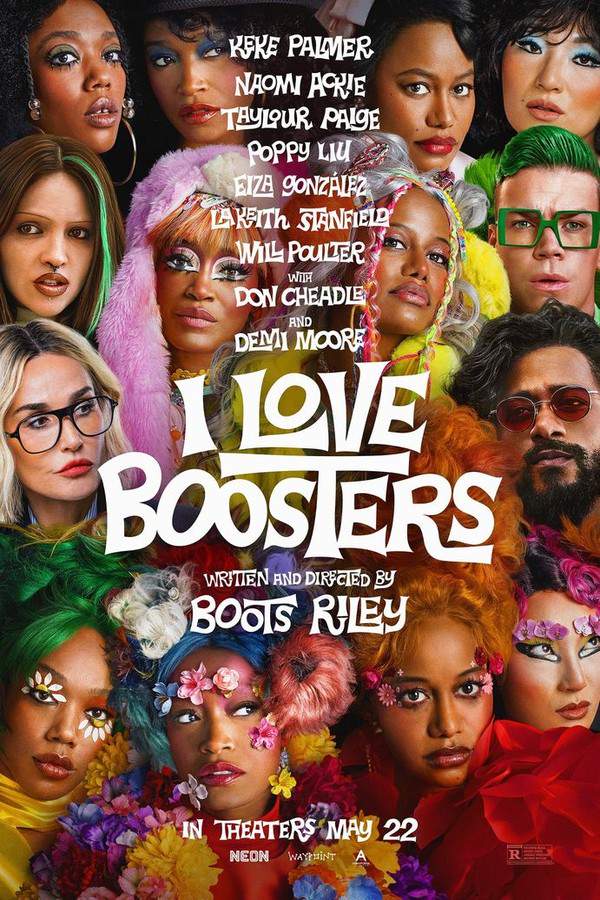
I Love Boosters 2026

Directed by
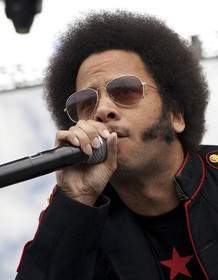
Boots Riley
Made by

Annapurna Pictures
Where to Watch I Love Boosters
See current US streaming, rental, and purchase options for I Love Boosters (2026) via JustWatch.







I Love Boosters Plot Summary
Read the complete plot summary and ending explained for I Love Boosters (2026). From turning points to emotional moments, uncover what really happened and why it matters.
The film opens with Corvette, played by Keke Palmer, in the glow of a club where desire collides with risk. She leads a man back to her apartment, but the encounter quickly shifts from seduction to a sharper, colder purpose: Corvette is a “booster,” someone who steals high-end clothes and sells them at a steep discount. The time-worn thrill of the score is tempered by a glimmer of something more ambitious in Corvette’s eyes, and the man’s initial annoyance gives way to a reluctant agreement to buy a pair of shoes. What starts as a routine hustle ignites a spark that goes beyond the next payday.
Corvette’s world centers on The Velvet Gang, a tight-knit trio built around her and two best friends, Sade, portrayed by Naomi Ackie, and Mariah, played by Taylour Paige. The three women operate from a squat in an abandoned fast-food restaurant, channeling their street savvy into fashion heists and rapid escapes. Corvette harbors a personal dream that stretches beyond the thrill of the grab: a serious desire to design fashion that speaks with its own voice. The film threads in a strange, haunting motif—the sight of a colossal ball of trash rolling toward Corvette, a surreal image that will recur as a symbolic forecast of the world closing in on her ambitions.
Their next movement brings them to Metro Designers, a store chain owned by the fashion titan Christie Smith, wonderfully embodied by Demi Moore. Christie is no naive target; she recognizes The Velvet Gang’s fingerprints all over the chain’s thefts and dismisses the trio with chilling contempt, calling them “low class urban bitches.” The trio executes a distraction using an orchestrated brawl and the help of Stevie, a white employee whose role in keeping them under the radar becomes crucial. The encounter sharpens the tension between the glamour of high fashion and the brutal arithmetic of exploitation behind the scenes.
A pivotal turn comes when Sade invites Corvette to a seminar led by the enigmatic Dr. Jack, a self-help guru brought to life by Don Cheadle. The seminar hints at a pyramid-like scheme that lures people with the promise of empowerment, but the real draw is the sense that these characters are trying to climb higher than their given stations. The stakes rise when a second heist is planned at a different Metro Designers location. This time, Mariah’s risk-taking—she attempts to hold her breath so she can pass as light-skinned—creates a distraction that lets Corvette smash a window and strip the mannequins of their outfits. The sequence blends audacity with a critique of colorism and representation that threads through the entire narrative.
Christie’s world is a skyline of power—her offices sit in a tilted skyscraper on the San Francisco Bay, with a harried assistant named Jamie in constant tow. A key moment of the story glimpses what Christie is truly selling: a $100,000 suit, a status symbol that conceals labor, pressure, and control. Corvette’s attempt to slip into Christie’s office through an espresso cart reveals a tense cat-and-mouse dynamic; Corvette names herself as the CEO of the espresso company in a bid to charm the room, but Christie remains cool and unimpressed, underscoring the adversarial distance between them.
At Metro Designers, two employees, Violeta, played by Eiza Gonzalez, and Mansion, played by Najah Bradley, express their frustrations about wages. They press the store’s manager, Grayson, about pay, but the manager dismisses their appeal, insisting the company is about delivering “an experience” rather than fair compensation. The store becomes a hub for new alliances as Corvette, Sade, and Mariah sign on to work there, and Corvette discovers a dress in the window that turns out to be one of her own designs—Christie has stolen it.
The plot thickens as the group learns more about the so-called “Pinky Ring Guy,” a mysterious figure who radiates danger and allure. The man is a complex presence on a screen in one of the store’s rooms, a rumor brought to life that hints at a dangerous, otherworldly power. The Velvet Gang’s plans intensify, and a larger theater emerges: the fashion world as a battlefield where the clothes themselves become currency. When the group tests a mysterious device aboard a proposed heist, Violeta identifies it as a situational accelerator with a deconstruction setting. The device can mutate materials—turning fabrics into gold or cubic zirconium, or even deconstructing an object back to its raw elements. The ethical weight of such power ripples through the crew, especially when Mariah is literally deconstructed by the device in a startling demonstration of its potential—and its risk.
The trio’s effort to infiltrate a high-profile fashion show hinges on a staged protest organized by Violeta, and Pinky Ring Guy’s help as a model in the show becomes crucial. Inside the venue, a chorus of characters from the public-facing world appears on screens: Dr. Jack’s followers, and figures like the Crying Black Mother, portrayed by Kara Young; the Based Young Dude; and an Upstanding Community Member, played by Jason Ritter. When pressed about the suits, the crowd reveals that the outfits are more than costumes—they are skins that reflect the industry’s demand for control. Corvette wants to deconstruct them to strip away Christie’s exploitation, while Sade sees a chance to monetize the power for her children’s future.
A dramatic chase erupts as the Velvet Gang splits to pursue their plan. Corvette and Sade grab the suits and sprint from the fashion show, pursued by the police as Corvette uses the device to morph a police car into a futuristic, weaponized vehicle of escape. A chase roars through a mall, with Sade driving the van up an escalator and out a window, then Corvette leverages the device again to hop between China and San Francisco with help from Jianhu’s cousin, as authorities close in on both sides of the globe. The team’s momentum culminates at the fashion show and a clandestine stockpile of Christie’s garments in a warehouse, where they deconstruct the clothes and accelerate the resulting materials into a full-blown strike.
The finale ties the personal with the political. Strikes against Christie’s company and the factory conditions become public, leading to the cessation of sandblasting and a reassessment of hours and pay. Jianhu returns to China, bringing the good news that her mother’s cancer has been reversed by the deconstruction process that reversed the damage done to the fabric, and the workers reveal themselves to the public through the broader use of the power they uncovered. Corvette, Sade, and Mariah establish a community center to sell clothes and to support workers’ rights, turning their hustle into a catalyst for lasting change. The Velvet Gang’s victory feels both personal and societal, aligning fashion with justice.
In a quiet, final moment, Corvette is drawn once more to the pinky-ring demon who has haunted her journey. Pinky Ring Guy, in a reveal that echoes the film’s themes of power and humanity, admits he is a soul-sucking demon, but he believes that a real connection with Corvette could redeem him. She declines, choosing independence and integrity over a relationship that would compromise her autonomy. As the scene settles, the recurring image of the giant trash ball returns, shrinking at her feet—an emblem of the confidence and certainty she has earned. The film closes on Corvette’s steady resolve to shape her own future, with the Velvet Gang cemented as a force for workers’ rights and creative expression.
I Love Boosters Timeline
Follow the complete movie timeline of I Love Boosters (2026) with every major event in chronological order. Great for understanding complex plots and story progression.
Club start: Corvette's booster hustle
The film opens with Corvette at a nightclub, using charm to lure a man back to her apartment. She reveals she isn't after sex, but to sell stolen clothing as a booster. The encounter ends with the man buying a discounted pair of shoes, hinting at the criminal world she inhabits.
Formation of The Velvet Gang and the squat
Corvette teams with her best friends Sade and Mariah to form The Velvet Gang, a trio of boosters who steal from high-end stores. They squat in an abandoned fast-food restaurant, which serves as their base of operations. A mysterious man with a pinky ring appears and unsettles Corvette whenever he's around.
First Metro Designers heist with a distraction
The Velvet Gang targets Metro Designers, using an orchestrated fight as a distraction and enlisting a white woman named Stevie to help avoid detection. While staff are distracted, they swipe clothes from the racks and slip away with the goods. The heist foreshadows Christie Smith's hostility toward them.
Sade invites Corvette to Dr. Jack seminar
Sade invites Corvette to a self-help seminar led by Dr. Jack, hinting at a pyramid scheme and bigger hustles beyond theft. The event broadens the gang's exposure to public spectacle and mass influence. The scene hints at future plot developments.
Second heist attempt and breath-hold distraction
The gang plans another Metro Designers heist at a different location and Mariah tries to hold her breath to appear light-skinned, creating a distraction. Corvette uses the chaos to break a window and steal the clothes from the mannequins. The operation shows their willingness to push boundaries.
Sneak into Christie’s office and the $100,000 suits
Corvette sneaks into Christie’s office via an espresso cart and overhears Christie talking about $100,000 suits. Christie is dismissive of Corvette, who claims to be the CEO of an espresso company to mask her presence. The moment underscores the power dynamics between Christie and the thieves.
Dress discovery and market tension
Back at Metro Designers, Corvette spots a dress that happens to be one of her own designs, realizing Christie has stolen it. The staff are unaware, increasing tension between designers and the retail chain. Corvette and friends begin to see Christie as the true adversary.
Dinner and the Pinky Ring Guy rumor
A dinner scene reveals gossip about the Pinky Ring Guy and his sexual exploits, hinting at a darker, almost demon-like presence. A friend’s tale includes an incident so intense it 'sucked her soul out,' while the Pinky Ring Guy’s face flashes with fangs. The scene blends personal drama with unsettling, otherworldly menace.
Jianhu joins: teleporter thief from China
The Velvet Gang learns of Jianhu, a Chinese worker who teleports using a device, who explains the factory's sandblasting sickness and why she fights for better conditions. She reveals the device’s origin and joins the team to take on Christie. Her involvement expands the operation beyond theft to labor rights.
Device powers: material mutation and deconstruction
Jianhu introduces the device's powers further with help from Violeta: materials can mutate into gold or cubic zirconium, and a deconstruction setting can revert fabrics to their pre-woven state. Mariah tests the deconstruction on Christie’s garments, and a cut on Jianhu’s hand heals as labor costs are countered by the device’s effects. The device proves transformative for both fashion and workers’ rights.
Infiltrating the Christie show: protesters and the suits
The gang plans to infiltrate Christie’s fashion show to steal the coveted $100,000 suits, aided by Violeta organizing protesters and Pinky Ring Guy modeling in the event. The contestants reveal that the suits are the wearers’ skins, created to be used in Christie’s propaganda. Corvette contemplates deconstructing the suits, while Sade prioritizes using them to secure her children's futures.
Chase through the mall and the cop car transformation
After infiltrating the show, the gang is pursued by police through a mall. Corvette accidentally accelerates a cop car with the device, turning it into a futuristic vehicle, and Sade drives a van up an escalator to escape. The thrilling chase demonstrates the device’s escalating power and the gang’s audacity.
Global leap: jumping between SF and China
The girls regroup and jump between San Francisco and China with help from Jianhu’s cousin, as authorities close in on their movements. The cross-continental escape heightens Christie’s threat and complicates the chase. The device’s usability extends beyond mere transport into strategic advantage.
Final strike: deconstruct and expose Christie
At the final fashion show and in a warehouse, the gang deconstructs Christie’s models’ clothes and accelerates events into a sweeping workers’ strike. Sandblasting ends and Christie’s is forced to meet the workers’ demands for fair hours and pay. The victory solidifies Corvette’s leadership and signals a new era for the labor movement.
Epilogue: futures, friendship, and the shrinking trash ball
Jianhu returns to China, reporting her mother’s cancer is gone thanks to the deconstruction of the clothes. The group opens a community center to sell clothes, and the public learns about the skin-suit workers. Pinky Ring Guy visits one last time and reveals he is a soul-sucking demon, but Corvette declines a romance, choosing independence. A vision of a giant trash ball shrinks at her feet, symbolizing newfound confidence.
I Love Boosters Characters
Explore all characters from I Love Boosters (2026). Get detailed profiles with their roles, arcs, and key relationships explained.
Corvette (Keke Palmer)
Corvette leads The Velvet Gang with charisma and bold improvisation, balancing street-smart booster schemes with a clear eye for fashion design. Her ambition to break into the world of design motivates many of the crew’s decisions, and she navigates danger with risk-taking and charm. She shows strong leadership and a readiness to challenge Christie Smith’s empire while safeguarding her friends.
Sade (Naomi Ackie)
Sade is Corvette’s best friend and the strategic backbone of The Velvet Gang. She balances loyalty with practical planning, driving the group’s schemes while keeping an eye on her kids’ futures. Her bold ideas and steady nerve help the team execute high-stakes heists with careful coordination.
Mariah (Taylour Paige)
Mariah is a core member whose loyalty anchors the group. She contributes to diversions and schemes, while carrying the weight of providing for her family. Her drive to secure a better future adds emotional depth to the group’s pursuit of justice and opportunity.
Light-Skinned Mariah (Robin Thede)
Light-Skinned Mariah represents the tension between appearance and power, using a perceived identity as a strategic tool. Her actions highlight how beauty standards intersect with status and risk within the urban fashion world. She contributes to the group’s plans while wrestling with personal and societal pressures.
Christie Smith (Demi Moore)
Christie is the fashion magnate behind Metro Designers, a symbol of corporate power and exploitative commerce. Her dismissive attitude toward Corvette underscores the class divide, while her control over production and pricing drives the film’s conflict. She embodies the systemic greed the Velvet Gang seeks to challenge.
Dr. Jack (Don Cheadle)
Dr. Jack runs a self-help seminar that veers into a pyramid-scheme vibe, drawing crowds with promises of empowerment while raising questions about manipulation. He embodies the blend of charisma and hidden motives that critique wellness culture and the wealth gap. His presence adds a surreal, almost cult-like layer to the story.
Violeta (Eiza González)
Violeta is a savvy ally who helps coordinate protests and exposes labor concerns within Christie’s empire. She recognizes the potential of the teleportation device for collective action and uses it to connect fashion with workers’ rights. Her involvement marks a shift from theft to organized advocacy.
Mansion (Najah Bradley)
Mansion is a Metro Designers employee who embodies the everyday worker’s perspective within the fashion system. Their experiences reflect the pay struggles and job pressures that fuel broader discontent. Mansion’s presence adds realism to the workplace dynamics in the narrative.
Pinky Ring Guy (LaKeith Stanfield)
Pinky Ring Guy is a mysterious, soul-sucking demon whose presence injects a surreal danger into Corvette’s world. He embodies a dangerous allure and a questionable morality that both entices and threatens the group. His true nature is revealed gradually, complicating relationships within the crew.
Stevie (Rachel Walters)
Stevie is the white store employee used as a distraction to help the gang avoid detection during their heists. Her role highlights how appearances and nonchalant behavior can be exploited in a world of high-stakes theft. She represents the ordinary people drawn into the spectacle of the fashion industry’s drama.
I Love Boosters Settings
Learn where and when I Love Boosters (2026) takes place. Explore the film’s settings, era, and how they shape the narrative.
Time period
Contemporary
Set in modern-day urban America with speculative tech elements. The narrative traverses stylish city spaces, a high-tech fashion world, and a distant factory, highlighting present-day concerns about workers’ rights and exploitation. The blend of realistic urban life with science-fiction twists, like teleportation devices, gives the story a near-future feel while keeping it grounded in today.
Location
San Francisco Bay Area, San Francisco, China, Metro Designers stores, Christie’s fashion show, abandoned fast-food restaurant
The story unfolds across the San Francisco Bay Area, centering on the high-end Metro Designers stores and Christie’s fashion show. It also shifts to a Chinese factory and a hidden Velvet Gang hideout in an abandoned fast-food restaurant. The film moves between sleek urban interiors and industrial sites, with key action spanning San Francisco locales and international connections.
I Love Boosters Themes
Discover the main themes in I Love Boosters (2026). Analyze the deeper meanings, emotional layers, and social commentary behind the film.
💪
Solidarity
Solidarity drives The Velvet Gang as Corvette, Sade, and Mariah unite against a powerful fashion empire. The trio’s bond grows beyond mere theft, aiming to protect their communities and support workers’ rights. Their plans gradually shift from individual gains to collective action with real social impact. The story suggests that unity can empower people to challenge entrenched systems.
🧬
Identity
Identity is tested through the film’s costumes and transformations, including deconstructing and even skin-like disguises. The characters grapple with appearances, race, and how others perceive them within a fashion-driven world. The existence of Light-Skinned Mariah and the concept of skin-like suits deepen questions about authenticity and agency. The narrative uses these elements to explore how identity can be performed, coveted, or weaponized.
🏭
Industry
The movie sharpens its critique of the fashion industry’s exploitation, from sandblasting denim to unsafe factory conditions. Workers and their families become central to the conflict, highlighting the human cost behind luxury clothing. The heists and revelations reveal how profit margins hinge on labor practices and corporate indifference. The climax ties consumer fashion to real-world labor rights struggles.
🪄
Technology
Technology acts as both tool and threat: a teleportation device moves clothes and people across borders, while a situational accelerator mutates materials and reveals hidden costs. The devices enable spectacular set-pieces but also expose ethical questions about control and profit. The film uses these sci-fi elements to critique who wields tech power in modern capitalism. In the end, technology becomes a catalyst for reform when communities repurpose it for workers’ rights.

Coming soon on iOS and Android
The Plot Explained Mobile App
From blockbusters to hidden gems — dive into movie stories anytime, anywhere. Save your favorites, discover plots faster, and never miss a twist again.
Sign up to be the first to know when we launch. Your email stays private — always.
Explore the mobile appI Love Boosters Ending Explained
Unravel the ending of I Love Boosters (2026) with our detailed explanation. Understand the final scenes, character fates, and unresolved questions.
The ending of I Love Boosters culminates in a vibrant act of rebellion that prioritizes collective well-being over personal gain. The central conflict resolves during Christie Smith’s high-stakes fashion show, where the protagonists—Corvette, Sade, Mariah, and the factory worker Jianhu—deploy stolen sci-fi technology to dismantle the mogul’s empire. While the group initially unites for profit, the stakes shift when Corvette discovers Christie stole her dress designs, tempting her to prioritize revenge. However, in a crucial moment of clarity, she heeds Sade’s reminder that the struggle is bigger than her individual grievances; it is about the livelihood of Jianhu’s fellow factory workers and the unionization efforts spearheaded by a character named Violeta. By using the device to accelerate the union’s formation and deconstruct the fashion line, the heroes secure a victory that goes beyond simply humiliating the antagonist, effectively sparking a global movement for workers’ rights.
This triumph is underscored by the exposure of the film’s more surreal antagonists, revealing the depth of the systemic corruption the characters are fighting. Dr. Jack, previously thought to be a mere pyramid scheme leader, is unveiled as a willing agent of Christie’s oppressive system, tasked with manufacturing conflict within working-class communities. In a striking visual metaphor, he and his cohorts literally shed their skin to reveal their duplicitous nature, symbolizing how those in power often present a false face to manipulate the public. Similarly, the enigmatic Pinky Ring Guy, a demon who consumes souls, represents the ultimate trap of self-interest. He offers Corvette a romantic escape that would free him from his demonic nature, but she recognizes that accepting would mean abandoning her friends. By rejecting him, she cements the film’s thematic stance that true fulfillment comes from solidarity rather than selfish desires or supernatural shortcuts.
The film concludes by grounding these high-concept elements in a poignant emotional reality for its lead character. Throughout the movie, Corvette is visually hounded by a giant, metaphorical wrecking ball representing her overdue bills and past mistakes—a burden she could previously only run from. In the aftermath of the heist, having embraced her community and helped instigate real change, the ball miraculously shrinks small enough for her to pocket. This final image serves as the ultimate thesis of I Love Boosters: when individuals choose to fight for one another and build a union, the crushing weight of their personal struggles becomes manageable. The heroes may not have stripped Christie of her wealth, but they have stripped her of her power over them, finding a happier ending in the strength of their chosen family.
I Love Boosters Spoiler-Free Summary
Discover the spoiler-free summary of I Love Boosters (2026). Get a concise overview without any spoilers.
In a world where high fashion serves as both obsession and opportunity, Corvette and her best friends Sade and Mariah navigate life as “The Velvet Gang” — a crew of professional shoplifters who turn designer theft into an art form. Squatting in an abandoned fast food restaurant while dreaming of bigger things, Corvette harbors quiet ambitions in fashion design that extend far beyond her life of boosted merchandise. The streets and clubs become her runway, where every encounter holds the potential for a sale or a new scheme.
The trio’s attention turns toward Christie Smith, a cutthroat fashion titan whose empire casts a long shadow over the industry. From her tilted skyscraper headquarters in the San Francisco Bay Area, Christie built Metro Designers into a phenomenon — a chain where the color scheme shifts monthly and every detail serves a calculated aesthetic. Her dismissive attitude toward those she deems beneath her creates friction that simmers beneath the surface, and Corvette feels the sting of that contempt firsthand when their worlds briefly collide.
Working within Christie’s stores by day while plotting against her empire by night, the women find themselves joined by unexpected allies and surrounded by strange occurrences. Corvette experiences visions of a giant trash ball rolling toward her, while a mysterious man with a distinctive pinky ring triggers inexplicable sensations whenever their paths cross. Meanwhile, disgruntled employees and community voices hint at deeper tensions within Christie’s meticulously crafted world — tensions that may finally be reaching a breaking point.
As schemes take shape and unlikely alliances form, the line between opportunism and something more meaningful begins to blur. The crew’s individual motivations — from financial necessity to creative dreams to desires for justice — weave together into a plan that could shake the foundations of an industry built on image and exploitation. What starts as a simple operation grows into something none of them quite anticipated.
Featured on this page

What's After the Movie?
Not sure whether to stay after the credits? Find out!
Check out our other apps:

SAT Sphere
Build confidence for the Digital SAT.

Mori Atlas
Discover wild places worth protecting.

Luntero
Search smarter for a home in Amsterdam.

Plot Explained
Unravel movie endings and hidden clues.

Pokechamp
Dive into Pokémon data and battle logic.

Driving Theory
Get ready for your European theory test.

Movie Dust
Plan your next cinema trip with ease.

Musemap
Find art and culture as you travel.

Selkobase
Compare credentials before committing.

Local Manual
Turn an unfamiliar country into practical next steps.

Lernavi
Compare school systems before your next move.

GymRoam
Find a workout stop wherever your plans take you.
Explore Our Movie Platform
New Movie Releases (2026)
Famous Movie Actors
Top Film Production Studios
Movie Plot Summaries & Endings
Major Movie Awards & Winners
Best Concert Films & Music Documentaries
Movie Collections and Curated Lists
© 2026 What's After the Movie. All rights reserved.
Privacy Policy