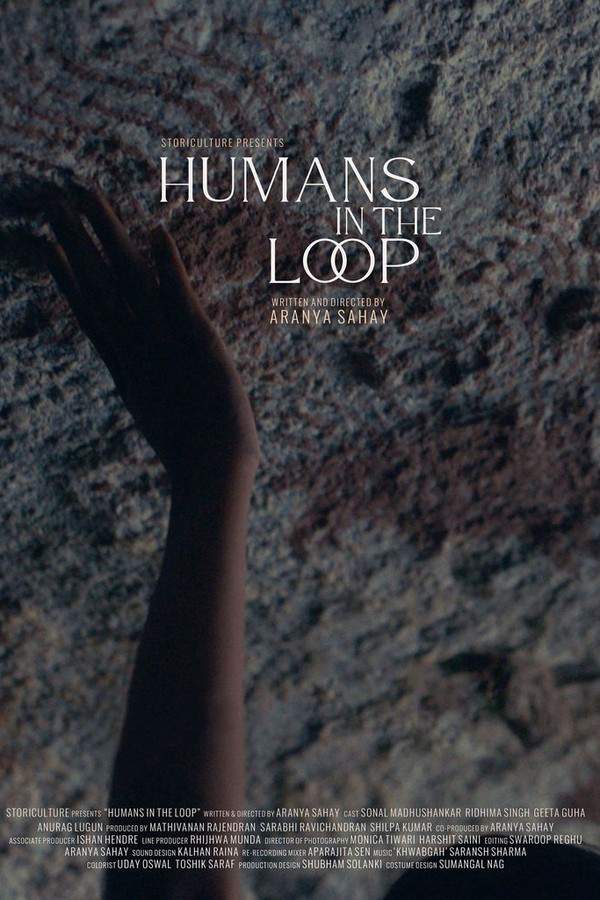


Where to Watch Humans in the Loop
See current US streaming, rental, and purchase options for Humans in the Loop (2025) via JustWatch.


Streaming availability powered by 
Humans in the Loop Plot Summary
Read the complete plot summary and ending explained for Humans in the Loop (2025). From turning points to emotional moments, uncover what really happened and why it matters.
Nehma, Sonal Madhushankar, an Adivasi woman of the Oraon community, returns to her native village in Jharkhand from Ranchi, bringing her daughter Dhaanu and infant son Guntu after the breakdown of her dhuku marriage (live-in relationship). To support her family, she takes up a job at a local data-labelling centre, where workers annotate images and videos to train artificial intelligence systems for international clients. Soon, she notices a troubling gap between the rigid categories demanded by the AI and the ecological wisdom of her own community, a clash that forces her to rethink how technology categorizes life and labor in a world that is not so neutral after all.
Dhaanu, her daughter, struggles to adjust to the family’s new life in the village, missing the urban world she left behind, and she even makes a futile attempt to escape from the village, hoping to reclaim something of the life she once knew. The film invites us to sit with those tensions—the pull between a familiar, land-rooted way of living and the lure of a broader, more modern horizon—without smoothing over the human cost of such transitions.
Humans in the Loop is a social film that happens to be about AI: with its firm focus on indigenous women’s labour and the mother-daughter bond, it argues that the ethics of AI cannot be separated from questions of caste, gender, and geography. The narrative suggests that intelligence—whether human or machine—bears the imprint of its teachers, and that when those teachers are invisible, uncredited, or culturally misunderstood, the knowledge that is transmitted risks reproducing that absence. In portraying the quiet infrastructure of work that sustains cutting-edge technology, the film raises important questions about who benefits from AI and whose voices are left out of the loop, all while deeply grounding its message in the lived realities of a community navigating tradition, resilience, and change.
Humans in the Loop Timeline
Follow the complete movie timeline of Humans in the Loop (2025) with every major event in chronological order. Great for understanding complex plots and story progression.
Return to the Oraon village after the breakdown
Nehma returns from Ranchi to her Oraon village in Jharkhand with her daughter Dhaanu and infant Guntu after the breakdown of her dhuku marriage. They face the challenge of restarting family life in a community that may not fully accept them. The return marks the start of a new, uneasy chapter for the family.
Nehma takes a job at a local data-labelling centre
To support her family, Nehma begins working at a local data-labelling centre where she labels images and videos for AI training. The role exposes her to the global reach of technology and the steady grind of repetitive tasks. The work also plants the seed of critical awareness about how people behind the labels are unseen yet essential.
The AI gap: rigid categories vs ecological wisdom
Nehma notices a troubling gap between the rigid categories demanded by the AI system and the ecological wisdom of her community. She realizes that the labels fail to capture local knowledge, practices, and lived realities. This prompts a growing critique of the technologies that rely on those classifications.
Dhaanu struggles to readjust and misses the city
Dhaanu, Nehma's daughter, struggles to adjust to life back in the village and longs for the urban world she left behind. She reconnects with family life while feeling out of place in the rural setting. Her longing intensifies the emotional strain within the household.
Dhaanu's futile escape attempt
Dhaanu makes a futile attempt to escape from the village, illustrating the pull between two worlds. Her attempt underscores the fragility of belonging and the pressures to find a place that fits her aspirations. The scene pushes the family to confront the gaps between urban memory and rural reality.
Humans in the Loop and the ethical frame
The film uses AI as a lens to pose questions about ethics, caste, gender, and geography. It argues that the ethics of AI cannot be separated from who teaches the intelligence and whose knowledge is valued. When teachers are invisible or misunderstood, the resulting intelligence mirrors that absence in its judgments.
Intelligence bears the imprint of its teachers
Nehma reflects on how intelligence, artificial or otherwise, carries the imprint of its teachers. She considers how local knowledge and memory should inform the systems that train AI. The realization deepens the sense that education and representation matter in technology.
Labelling work exposes global-local power dynamics
The repetitive labelling tasks reveal power dynamics between global AI clients and local workers. Nehma witnesses how distant demand shapes the labor conditions and the spaces where knowledge is produced. This dynamic highlights the extractive frame of modern AI workflows.
Cultural misalignment deepens the conflict
A tension emerges between the ecological wisdom of the Oraon community and the rigid needs of AI categorization. The friction shows that supposed universal labels fail to accommodate local practices and environments. The conflict invites viewers to question what is lost when diversity is compressed into standardized classes.
Family bonds under pressure
Nehma and Dhaanu navigate the strain of their disrupted lives while trying to stay connected. The mother-daughter relationship reveals resilience, care, and moments of tenderness amid uncertainty. Their bond becomes a map for how communities endure technological and social change.
Invisible teachers and representation in AI
The film argues that intelligence depends on teachers who are invisible, uncredited, or culturally misunderstood. When those teachers are overlooked, the knowledge they transmit tends to be missing or misused within AI systems. The narrative uses this premise to critique how representation shapes algorithmic outcomes.
A call to integrate local contexts in AI ethics
The conclusion invites viewers to recognize that AI ethics cannot be separated from local context, memory, and social structures. It urges a more inclusive approach that centers indigenous knowledge and lived experience in technology development. The film leaves viewers with a demand for accountability and representation in AI.
Humans in the Loop Characters
Explore all characters from Humans in the Loop (2025). Get detailed profiles with their roles, arcs, and key relationships explained.
Nehma (Sonal Madhushankar)
An Adivasi Oraon woman who returns to her native village with her daughter and infant son after the breakdown of her marriage. She works at a local data-labelling center to support her family and becomes increasingly aware of the gap between AI categories and her community's ecological wisdom. Her resilience drives her to question the ethics of digital labor and the social structures around it.
Dhaanu
Nehma's daughter, a teen who longs for the urban world she left behind. She struggles to adjust to village life and makes a futile attempt to escape at one point.
Guntu
Nehma's infant son, a symbol of the next generation navigating two knowledge systems and the complexities of modern life. His presence foregrounds the stakes of caregiving and memory in the story.
Humans in the Loop Settings
Learn where and when Humans in the Loop (2025) takes place. Explore the film’s settings, era, and how they shape the narrative.
Time period
Contemporary (early 2020s)
Set in the present era, the story unfolds amid the rise of AI technologies and data labeling. It reflects current debates over automation, digital labor, and how global tech economies touch rural communities. The timeframe situates intimate family drama within a wider conversation about access and representation in AI.
Location
Jharkhand village, India
A rural village setting in Jharkhand, home to the Oraon community. It features farms, markets, and communal spaces that sustain everyday life and reinforce traditional ties. The village's landscapes contrast with the urban data-lab environment Nehma leaves for work, underscoring the clash between ecological knowledge and modern AI labor.
Humans in the Loop Themes
Discover the main themes in Humans in the Loop (2025). Analyze the deeper meanings, emotional layers, and social commentary behind the film.
🤖
AI Ethics
The film frames AI as a social system, not a neutral technology. It shows how data labeling relies on human judgment, often from marginalized communities, and how rigid categories can erase ecological knowledge. The story argues that ethics of AI cannot be separated from questions of caste, gender, and geography. By exposing the biases encoded in training data, the film invites viewers to reexamine who teaches AI and whose knowledge is valued.
🌾
Indigenous Labor
Nehma's work at a data-labelling center highlights the precarious nature of digital labor for Indigenous women. It reveals how work within global AI supply chains replicates social hierarchies rooted in caste and regional geography. The film foregrounds the dignity, resilience, and knowledge of Oraon women as they navigate modernization. The lack of recognition for their labor mirrors the wider invisibility of Indigenous contributions.
👩👧
Family & Identity
The mother-daughter relationship anchors the narrative, exploring intergenerational tension between rural belonging and urban aspirations. Dhaanu's longing for the city collides with the village's rhythms and responsibilities. The film treats family as a site where ethics, memory, and survival are negotiated. Through Nehma and Dhaanu, it questions what it means to belong and to be seen.
🗺️
Geography & Power
Geography maps social power, with the Oraon village situated at the margins of a global tech economy. The story shows how location conditions access to work, education, and voice in the AI discourse. It argues that intelligence is shaped by its teachers—often invisible and uncredited.

Coming soon on iOS and Android
The Plot Explained Mobile App
From blockbusters to hidden gems — dive into movie stories anytime, anywhere. Save your favorites, discover plots faster, and never miss a twist again.
Sign up to be the first to know when we launch. Your email stays private — always.
Explore the mobile appHumans in the Loop Ending Explained
Unravel the ending of Humans in the Loop (2025) with our detailed explanation. Understand the final scenes, character fates, and unresolved questions.
When Nehma returns home from the data‑labeling center she finds that both of her children have vanished. Panic drives her and Roshan into the forest, where, after a frantic search, they spot Dhaanu emerging onto the road with the baby Guntu. In the confrontation Dhaanu vents a mixture of anger, fear and yearning that Nehma cannot fully grasp, but the sight of her daughter alive, clutching the phone her father had given her, is enough to shatter the mother’s despair.
Through the footage Dhaanu captured on her phone, Nehma discovers that her daughter has begun to notice the forest’s quiet wonders—birds tracing patterns in the sky, an ancient tree that seems to hold the memory of their ancestors, and even a trail of porcupine quills that lead them back to safety. The porcupine, an animal that once befriended Nehma as a child, reappears symbolically as a guardian in the woods, suggesting that the land remembers kindness and can guide the lost.
Seeing Dhaanu’s tentative connection to the environment, Nehma realizes that the world she has been trying to protect for her children is not a prison but a place where they can claim an identity that blends both tradition and the possibilities of technology. She apologises for not having understood her daughter’s needs, returns the phone, and allows Dhaanu to keep speaking with her father. When asked whether she will return to Ranchi, Dhaanu shakes her head—she is not ready to leave the forest that now feels like home.
The film closes with the two women standing together in the trees, the AI‑trained “digital child” humming in the background of Nehma’s work, and the porcupine’s silent presence in the underbrush. It suggests that a balance between the natural world and the machines we build is possible, but only if the voices of those who live in the margins are finally heard and respected.
Humans in the Loop Spoiler-Free Summary
Discover the spoiler-free summary of Humans in the Loop (2025). Get a concise overview without any spoilers.
In the verdant hills of Jharkhand, Nehma, a resilient single mother from the Ora on tribe, returns to the village that shaped her childhood, bringing along her bright‑eyed daughter Dhaanu and infant son Guntu. The landscape is a tapestry of dense forests, rippling streams, and modest homes, where ancient rituals coexist with the hum of satellite dishes and mobile towers. Here, the world feels both timeless and suddenly tethered to a global network that reaches far beyond the mountains.
To make ends meet, Nehma takes a job at a modest data‑labeling centre—a quiet hub where locals annotate images and videos that will train artificial‑intelligence systems for distant clients. The work is methodical, its screens flashing a cascade of categories that demand crisp, uniform definitions. As she learns the rhythm of this digital labor, Nehma can’t help but sense a dissonance: the rigid taxonomies required by the AI clash with the fluid, relational knowledge passed down through generations of her people.
At home, the family’s new rhythm reveals its own tensions. Dhaanu, accustomed to the pace and possibilities of city life, finds the village’s slower cadence both alien and alluring, her curiosity tugging at the edges of comfort. Guntu, still an infant, absorbs the world’s sounds—birdsong, distant machinery, whispered lullabies—in ways that hint at adaptability and wonder. Their relationships become a quiet study in how belonging and identity are negotiated when tradition meets technology.
The film settles into a contemplative tone, weaving moments of quiet labor, whispered conversations, and the natural soundtrack of the hills into a portrait of modern India’s under‑examined intersections. It invites viewers to consider how intelligence—whether human or artificial—is shaped by the hands that teach it, and how those hands carry histories of caste, gender, and geography that can’t be erased by code alone.
Featured on this page

What's After the Movie?
Not sure whether to stay after the credits? Find out!
Check out our other apps:

SAT Sphere
Build confidence for the Digital SAT.

Mori Atlas
Discover wild places worth protecting.

Luntero
Search smarter for a home in Amsterdam.

Plot Explained
Unravel movie endings and hidden clues.

Pokechamp
Dive into Pokémon data and battle logic.

Driving Theory
Get ready for your European theory test.

Movie Dust
Plan your next cinema trip with ease.

Musemap
Find art and culture as you travel.

Selkobase
Compare credentials before committing.

Local Manual
Turn an unfamiliar country into practical next steps.

Lernavi
Compare school systems before your next move.

GymRoam
Find a workout stop wherever your plans take you.
Explore Our Movie Platform
New Movie Releases (2026)
Famous Movie Actors
Top Film Production Studios
Movie Plot Summaries & Endings
Major Movie Awards & Winners
Best Concert Films & Music Documentaries
Movie Collections and Curated Lists
© 2026 What's After the Movie. All rights reserved.
Privacy Policy