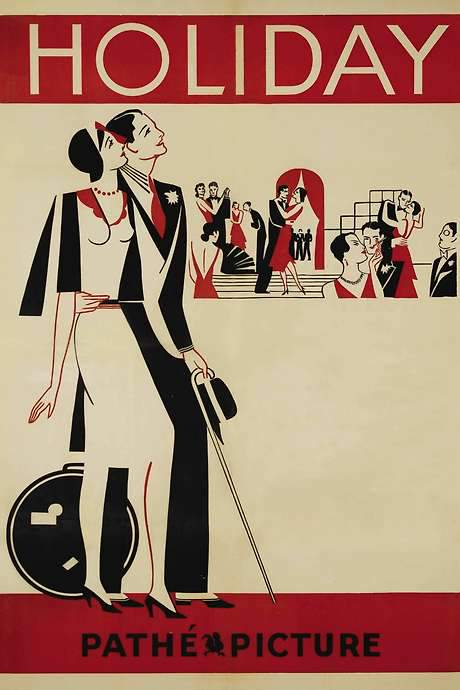
Holiday 1930

Directed by

Edward H. Griffith
Made by

Pathé Exchange
Where to Watch Holiday
See current US streaming, rental, and purchase options for Holiday (1930) via JustWatch.

Artiflix
4K
Fawesome
HD
Mometu
HD
Tubi TV
SD
Amazon Video
SD Streaming availability powered by 
Holiday Plot Summary
Read the complete plot summary and ending explained for Holiday (1930). From turning points to emotional moments, uncover what really happened and why it matters.
Johnny Case is a self-made man who has spent years building his life and career. He is about to marry Julia Seton, a woman he met on holiday in Lake Placid, only to discover she hails from an extraordinarily wealthy family—the younger daughter of banker Edward Seton. The news unsettles him, yet it also sparks a quiet tension between love, independence, and the pull of responsibility.
In the days that follow, Johnny is drawn to the Setons’ world not just through Julia but also through Linda, Linda Seton, the vivacious elder sister, and the sisters’ younger brother, Ned Seton, a man whose spirit has been ground down by his father’s demand for obedience. Johnny’s charm meets their complexity, and the house on Park Avenue becomes a stage for a collision between a man seeking meaning outside work and a family that measures worth by status and wealth. The father, who is known simply as Mr. Seton, becomes wary of Johnny’s avowed plan to take a long holiday from employment to search for life’s deeper purpose, even as he quietly tests Johnny’s work history before any engagement is sealed.
As the New Year approaches, the elder Seton, Edward Sr., arranges an opulent engagement party for the public eyes, a spectacle that contrasts sharply with Linda’s earlier wish to host a smaller, more intimate gathering for her sister and the man she has come to care about. The tension brews at the stairwell and the ballroom, where appearances clash with genuine feeling. On New Year’s Eve, Linda’s refusal to descend to the party scene becomes a flashpoint: Julia, ever practical and dutiful, sends Johnny to fetch her, and the two stumble upon Linda with Ned in the “playroom”—the mansion’s lone space that feels the most real and human, a place where laughter and truth briefly intersect with the absurdity of wealth. There, Professor Nick Potter and his wife Susan Potter join the impromptu gathering, and the moment stretches into something warm and imperfect, a reminder that human connection can flourish even in a gilded maze.
The morning after, another conversation unfolds. Mr. Seton offers Johnny a job at the family bank, and Johnny candidly shares his plan for a two-year hiatus from work. Julia reacts with a mix of disbelief and alarm at the possibility of delaying their life together for a quest that seems almost reckless to her. Yet Johnny’s desire for freedom remains—an insistence that life’s meaning cannot be bought or scripted by the bank ledger. As the couple weighs their options, Julia’s resolve to marry on terms she can control clashes with Johnny’s longing to explore a life unbound by duty.
Linda returns to her sister with a newly clear sense of self. She visits the Potters again, hoping to soften the rift, only to learn that Julia has turned Johnny down in a way that leaves little room for compromise. The telegram that follows crystallizes the moment: Julia has rejected the proposed arrangement. Linda’s own emotions surface anew, and she confronts the truth about love, loyalty, and family expectations. The spark of rebellion catches fire in her, and she resolves to break away from her father’s stifling influence, perhaps for good. Ned, tethered to the Seton name but starved for breath, remains as a hinge in the decision, and Linda promises to return for him—yet leaves him behind as she follows her heart toward a future beyond wealth’s gate.
With the path now open, Linda joins Johnny and the Potters in their plans to escape to Europe or wherever the road may lead. The family’s shipbound voyage becomes a literal and symbolic crossing, a test of whether freedom can coexist with affection and obligation. The Potters arrive at the ship, saddened by Johnny’s initial decision to pursue the safe, stable job, but Johnny himself arrives with a changed mind, ready to embrace possibility rather than predictability. The mood shifts as they celebrate the shift in fate. In the ship’s hallway, Johnny attempts a back flip, a flourish that ends in a stumble, just as Linda arrives and steps into the scene. He catches her gaze, she takes his hand, and the two share a kiss that signals a new, hopeful direction for both of them, a moment that rewrite both their futures and the expectations of the world they come from.
The tale unfolds with a gentle, observant eye on the tension between freedom and belonging, between love’s pull and life’s demands. It explores how a self-made man’s dream of meaning can clash with an established family’s rules, and how a determined woman’s courage can carve a path toward independence without severing the ties that truly matter. Throughout, the ensemble of characters—the witty, loyal Nick Potter and his perceptive wife Susan; the steadfast Setons and their complicated loyalties; and Johnny and Linda, each finding a way to balance desire with responsibility—creates a textured portrait of ambition, affection, and the quiet rebellion that can accompany both. The final kiss is not simply a romantic gesture; it is a declaration that life’s richest reward may lie in choosing a future that honors both who you are and whom you love.
Holiday Timeline
Follow the complete movie timeline of Holiday (1930) with every major event in chronological order. Great for understanding complex plots and story progression.
Johnny reveals his plan for a long holiday
Jonathan 'Johnny' Case, about to marry Julia Seton, meets Julia's sister Linda and Ned Jr. and confides his intent to take a long holiday from work to search for the meaning of life. This meeting introduces Johnny to the rich, meddling Seton clan and hints at the cultural contrast between Johnny's self-made practicality and their opulent security.
Seton family plans an extravagant New Year's Eve engagement party
Edward Seton Sr. pushes for an opulent New Year's Eve engagement celebration, despite Julia's promise to Linda of hosting a smaller party. The family dynamics and expectations of wealth loom large as the engagement approaches. The Park Avenue mansion becomes the arena for the impending union.
New Year's Eve playroom gathering with Nick Potter and Susan
On New Year’s Eve, Linda refuses to come downstairs. Johnny goes to fetch her and finds her with Ned Jr. in the mansion’s ‘playroom’ alongside Professor Nick Potter and his wife Susan. The scene captures a rare, human moment of warmth and spontaneity amid the Formals and proprieties of the party.
Johnny offered a bank job; travel plans questioned
Mr. Seton offers Johnny a position at his bank, and Johnny reveals his plan to take a lengthy holiday. Julia is appalled by the suggestion of postponing the couple’s life together. The moment tests whether Johnny’s dream can coexist with the Seton family’s expectations.
Johnny’s attempted kiss and Linda’s rebuff
During the New Year celebrations, Johnny tries to kiss Linda, treating their closeness as a private moment. Linda gently rebuffs him, reminding him that she will soon be Julia’s sister-in-law. Johnny leaves in a brooding mood as the party resumes its formal course.
Linda confesses love but vows secrecy
After the party, Linda tells her brother that she has fallen in love with Johnny but will keep her feelings to herself to protect Julia and the family’s plans. The confession hints at a growing rift between personal desire and family duty. The moment foreshadows Linda’s push toward independence.
Linda learns of Europe trip and Johnny’s plan to join
Linda visits the Potters, who are packing for a voyage to Europe with Johnny in mind. A telegram arrives confirming Julia has turned Johnny down, complicating the love triangle. Linda returns home hoping to sway Julia, but the rift widens instead.
Johnny proposes a two-year bank job compromise
Johnny arrives with a compromise: he will work at the Seton bank for two years and quit if he is unhappy. Mr. Seton accepts this arrangement, and Julia and her father begin planning the couple’s honeymoon in minute detail. The terms threaten Johnny’s freedom and spark his growing reluctance to marry on such terms.
Johnny pleads to marry now and travel Europe
Having agreed to the two-year plan, Johnny comes to a painful realization that the arrangement will be an encumbrance on his freedom. He begs Julia to marry him that very evening and travel to Europe together instead. Julia refuses, and Johnny leaves to meet the Potters and sail.
Julia’s realization and Linda’s resolve to gain independence
Seeing Julia’s relief at Johnny’s decision, Linda pushes Julia to admit she does not truly love Johnny. With that truth dawning, Linda renounces her father’s stifling influence and proclaims her own independence. The moment marks a turning point for Linda and the start of a more autonomous path.
Linda declares independence and invites Ned to join
Inspired by Johnny’s example, Linda renounces her father’s control and proclaims her independence. She asks Ned to go with her, but he cannot, and she promises to return for him. This moment solidifies Linda’s rebellious stance and desire for personal freedom.
The Potters and Johnny prepare to sail; Johnny reverses his plan
The Potters arrive at the ship, saddened that Johnny had initially decided to take the bank job. Johnny arrives, revealing that he could not go through with it. They cheerfully celebrate as the group moves toward their voyage together.
Final shipboard kiss seals Johnny and Linda’s connection
During the voyage, Johnny, mid-back flip in the ship’s hallway, falls to the floor. Linda arrives, and he takes her hand, pulling her down beside him as they kiss. The moment seals their reconciliation and signals a future together beyond the Seton expectations.
Holiday Characters
Explore all characters from Holiday (1930). Get detailed profiles with their roles, arcs, and key relationships explained.
Johnny Case (Robert Ames)
A self-made man who prizes freedom over conventional success. He plans a long holiday to search for the meaning of life rather than settle for a safe career. He is witty, earnest, and unafraid to challenge wealth-driven social norms.
Linda Seton (Ann Harding)
Julia’s vivacious elder sister who seeks autonomy within a rigid social world. She falls for Johnny but cares deeply about her sister’s happiness and family loyalties. She champions Johnny’s plan and ultimately chooses a path of independence from her father’s expectations.
Julia Seton (Mary Astor)
A wealthy heiress torn between her love for Johnny and her father's expectations. She agrees to a highly controlled engagement but ultimately prioritizes social security and family duty over romantic vulnerability. Her actions illuminate the pull of duty in privileged circles.
Edward Seton
The patriarch and banker whose wealth provides security but who struggles to balance affection with control. He orchestrates an elaborate New Year’s Eve engagement and evaluates Johnny’s history before offering terms. His stance embodies the expectations of upper-class authority.
Nick Potter (Edward Everett Horton)
A quirky, liberal-spirited professor and Johnny’s friend who brings warmth and humor to the narrative. He and his wife Susan act as a foil to aristocratic life, illustrating alternative ways of living beyond mere social status. He helps illuminate the possibility of a life less bound by convention.
Ned Seton (Monroe Owsley)
Julia’s younger brother, an alcoholic whose spirit has been crushed by paternal control. His fragile presence underscores the emotional costs of wealth-driven dominance and catalyzes Linda’s resolve to seek independence. He embodies the human consequences of a rigid social order.
Holiday Settings
Learn where and when Holiday (1930) takes place. Explore the film’s settings, era, and how they shape the narrative.
Time period
Late 1920s to early 1930s
The story is rooted in a late Jazz Age milieu, where wealth and social ritual define daily life. A lavish New Year’s Eve engagement party sits at the heart of the social calendar for the Setons. The era’s emphasis on appearances and propriety shapes the conflicts around love, work, and personal freedom.
Location
Lake Placid, New York, Park Avenue Mansion, New York, Transatlantic ship bound for Europe
The action moves from the holiday setting in Lake Placid to the opulent Park Avenue mansion that anchors the Seton family. The house represents old-money prestige and social rules that frame the characters’ choices. Later, the narrative shifts to a transatlantic ship bound for Europe, signaling a move from private interiors to a broader, freer horizon.
Holiday Themes
Discover the main themes in Holiday (1930). Analyze the deeper meanings, emotional layers, and social commentary behind the film.
🕊️
Independence
Linda embodies a pursuit of personal autonomy within a restrictive social framework. She supports Johnny’s quest for meaning, even as she navigates loyalties to family and sister. Her stance highlights a quiet rebellion against wealth-driven expectations. The arc suggests that true happiness may require choosing a path of self-determination over conformity.
💰
Wealth vs Freedom
Johnny’s outsider status tests whether wealth is a safeguard or a constraint on living authentically. The Seton fortune offers comfort but enforces obligations that limit choice. Johnny’s two-year bank plan is a practical compromise that reveals how money can both enable and shackhe opportunities. The tension critiques a culture that equates security with happiness.
💞
Love vs Duty
Romantic feelings collide with family loyalty as Johnny loves Linda while Julia’s propriety complicates their choices. Linda’s affection is real, but she prioritizes her sister’s welfare and the family’s expectations. Julia’s struggle exposes how affection can be entangled with obligation to a wealthy, controlling lineage. The ending reframes love within the boundaries of personal freedom.
🧭
Paths and Choices
The central tension revolves around choosing between a conventional life and a freer, more uncertain future. New Year’s Eve plans and the voyage to Europe crystallize key turning points for the characters. The resolution emphasizes that personal values should guide decisions, even when they defy social expectations. The film hinges on decisive, values-driven choice rather than mere romance.

Coming soon on iOS and Android
The Plot Explained Mobile App
From blockbusters to hidden gems — dive into movie stories anytime, anywhere. Save your favorites, discover plots faster, and never miss a twist again.
Sign up to be the first to know when we launch. Your email stays private — always.
Explore the mobile appHoliday Spoiler-Free Summary
Discover the spoiler-free summary of Holiday (1930). Get a concise overview without any spoilers.
In the glittering world of Park Avenue, a self‑made entrepreneur named Johnny Case stands at a crossroads. After years of building his career on his own terms, he is poised to marry Julia Seton, a woman he met by chance during a winter getaway. Their romance takes an unexpected turn when Johnny learns that Julia comes from an immensely wealthy banking dynasty, a revelation that threatens to upend his fiercely independent outlook and forces him to weigh love against the pull of traditional expectations.
The Seton family unfolds like a meticulously arranged tableau of privilege and pressure. Linda Seton, the charismatic elder sister, exudes a free‑spirited confidence that both intrigues and unsettles Johnny, while her younger brother Ned Seton bears the quiet weight of a father’s exacting standards. At the helm, Edward Seton—referred to as Mr. Seton—presides over a legacy built on financial power, subtly testing Johnny’s suitability for a life that might demand conformity. The household’s opulent gatherings and carefully curated appearances create a backdrop where personal desire constantly bumps up against inherited duty.
Adding texture to the scene are the Potters, an off‑beat couple whose easy camaraderie offers a contrasting lens on the Setons’ polished world. Nick Potter and his wife Susan provide a touchstone of sincerity amid the grandiose settings, hinting at alternative ways of living that resonate with Johnny’s yearning for a deeper purpose beyond the ledger.
Against this elegant yet tension‑charged canvas, Johnny Case wrestles with a bold, almost reckless plan to pause his career and seek meaning on his own terms. The film teases the delicate balance between freedom and belonging, inviting viewers to wonder whether the allure of wealth can ever truly coexist with an unbridled search for personal fulfillment, and what sacrifices love and ambition may demand.
Movies with Similar Twists and Themes
Uncover films that echo the narrative beats, emotional arcs, or dramatic twists of the one you're exploring. These recommendations are handpicked based on story depth, thematic resonance, and spoiler-worthy moments — perfect for fans who crave more of the same intrigue.



Featured on this page

What's After the Movie?
Not sure whether to stay after the credits? Find out!
Check out our other apps:

SAT Sphere
Build confidence for the Digital SAT.

Mori Atlas
Discover wild places worth protecting.

Luntero
Search smarter for a home in Amsterdam.

Plot Explained
Unravel movie endings and hidden clues.

Pokechamp
Dive into Pokémon data and battle logic.

Driving Theory
Get ready for your European theory test.

Movie Dust
Plan your next cinema trip with ease.

Musemap
Find art and culture as you travel.

Selkobase
Compare credentials before committing.

Local Manual
Turn an unfamiliar country into practical next steps.

Lernavi
Compare school systems before your next move.

GymRoam
Find a workout stop wherever your plans take you.
Explore Our Movie Platform
New Movie Releases (2026)
Famous Movie Actors
Top Film Production Studios
Movie Plot Summaries & Endings
Major Movie Awards & Winners
Best Concert Films & Music Documentaries
Movie Collections and Curated Lists
© 2026 What's After the Movie. All rights reserved.
Privacy Policy