
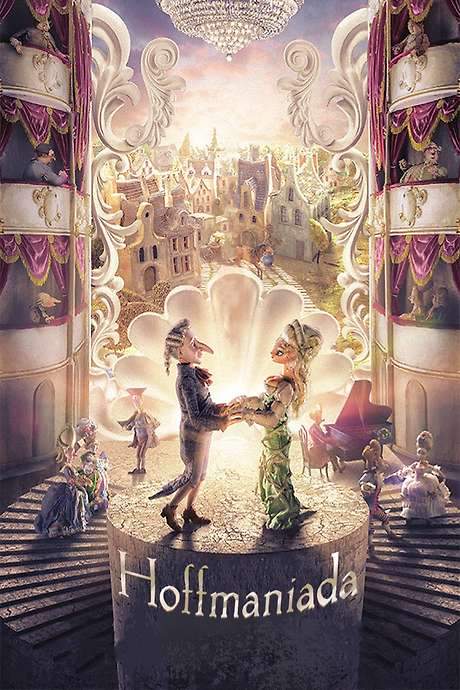
What Is Hoffmaniada About?
The premise of Hoffmaniada in 273 words, with nothing given away. The full story follows below.
In a delicately rendered world where the mundane and the marvelous coexist, Ernst Hoffmann drifts between two selves: a diligent government clerk in a quiet town and a fervent creator of operas, tales, and fantastical visions. By day he sifts through legal documents and gives music lessons, while night unfurls a boundless interior landscape populated by submerged kingdoms, sword‑clad dramas, and ethereal ballets that pulse with his own creative longing. The film’s visual language mirrors this duality, blending the crisp, orderly interiors of early‑19th‑century bureaucracy with sumptuous, dream‑laden set pieces that seem to materialize straight from the pages of his manuscripts.
The tone is lyrical and introspective, inviting the audience to feel the gentle tug between duty and desire. Hoffmann’s inner world is portrayed as a living theatre, its characters and motifs shimmering on the edge of his consciousness, ready to spill over into his ordinary existence. This interplay creates a sense of wonder without abandoning the grounded realities of his everyday responsibilities, suggesting that imagination can be both a refuge and a catalyst for transformation.
As his stories begin to echo through his waking life, the film poses a quiet question: how far can a single mind venture when the borders between reality and invention become porous? Ernst Hoffmann stands at the heart of this meditation, embodying the restless yearning of an artist who longs to see his work—especially the opera Undine—take shape on a grand stage. Around him, the atmosphere hums with the promise of unseen realms, offering a rich, immersive portrait of a creator whose every breath reverberates with the possibility that art might just reshape the world he inhabits.
What Happens in Hoffmaniada?
The complete story of Hoffmaniada, from the first scene to the last, in 838 words (about 4 minutes). Spoilers throughout.
Spoilers ahead
In this lyrical fantasy-drama, the protagonist Ernst Hoffmann, a young lawyer, musician, and writer, dwells between two intertwined dimensions: the orderly reality of a small town and the boundless, dream-filled world of his own novels and operas. By day he pores over legal papers in a quiet office and gives music lessons, while by night he crafts magical stories and operas, secretly hoping to see his own work, the opera Undine, brought to the grand stage. As Hoffmann delves deeper into his imagination, the line between dream and reality grows increasingly thin, and the worlds he creates begin to push back against the constraints of ordinary life.
Soon, the imagined worlds intrude with a vivid urgency. Hoffmann finds himself stepping inside the very adventures he wrote about, where underwater journeys, sword fights, and ballet-filled theater performances become real experiences rather than mere figments of his imagination. The film unfolds as a richly layered voyage in which the author’s creations come to life and invite him to live out the dramas he once only described on the page. This is not simply a escape into fantasy; it is a journey in which the author must confront the mysterious forces that shape his thoughts and his desires.
As the narrative progresses, Ernst Hoffmann encounters a troupe of fantastical and perilous figures drawn from his own stories. He becomes the titular character Anselm, a role that draws him into a romantic labyrinth spanning different moments in his life. In these encounters, he meets Olympia, a beautiful, yet ethereal presence who captivates him; Serpentine, a snake-girl who embodies a darker, more dangerous allure; and Veronica, a worldly and refined woman whose charm adds another layer to Hoffmann’s quest for love and meaning. The romance is not simple or straightforward; it is tempered and complicated by the magical forces at work around him, and by the shadowy figures who seek to control or disrupt his path to happiness.
Central to this otherworldly drama are the unsettling powers of Coppelius, a seasoned merchant and faker, and Paulman, a watchmaker whose creations blur the boundary between life and mechanism. These characters wield a sorcery that challenges Hoffmann’s intentions and tests his faith in his own imaginings. The figure of Sandman—the dreamy, elusive student who is obsessed with Olympia—adds another layer of longing and danger, illustrating how desire and illusion can intertwine with artistry and ambition.
Into Hoffmann’s orbit also come the wise Lindhorst, a royal archivist exiled from Atlantis who becomes a patron and mentor to the writer and his literary persona. Lindhorst’s presence lends a sense of ancient mystery to the tale, hinting at larger scales of existence and history beyond the small-town settings. The relationship between reality and fantasy intensifies as these guides, antagonists, and muses collide, shaping Hoffmann’s choices and his sense of self.
The film’s dreamlogic intensifies when transformations and magical clashes disrupt Hoffmann’s efforts to pursue love. A striking turn of events sees a figure—resembling Lindhorst—take the form of a Fire-Salamander, an embodiment of the uncanny forces arrayed against Hoffmann’s plans to court Serpentina. This surreal shift underscores the peril and wonder at the heart of Hoffmann’s odyssey: to navigate desire, art, and fate when the very fabric of reality is pliant, responsive, and sometimes hostile. As rival plots take shape and the dangers grow more pronounced, Hoffmann must confront threats that arise not only from external forces but from the depths of his own imagination.
Throughout the story, love and magic become inextricably linked. The melodrama of Hoffmann’s personal desires intersects with the fantastical machinery of the worlds he has created, producing a tapestry in which romance is tempered by risk, beauty, and wonder. The narrative does not shy away from peril, yet it moves toward a hopeful, harmonious resolution in which the strands of love, art, and fantasy are woven together. By the end, the enchantment that has braided Hoffmann’s life with the fates of Olympia, Serpentina, and Veronica is resolved in a way that feels both earned and uplifting, leaving behind a sense of wonder and a recognition that art can momentarily reshape the boundaries of reality.
The film features a notable ensemble of performers who bring these vivid characters to life: Anvar Libabov, Aleksey Petrenko, Vyacheslav Polunin, Natalya Fisson, Pavel Lyubimtsev, Vladimir Koshevoy, Aleksandr Shirvindt, and Anna Artamonova. Their performances anchor the dreamlike spectacle in human emotion, lending weight to Hoffmann’s fragile, dazzling journey and grounding the story in a shared human longing for beauty, meaning, and connection.
The result is a story that ambitiously blends romance, fantasy, and theatrical spectacle. It invites the audience to linger on the edges of dream and waking life, to feel the pull of legendary figures and conjured realms, and to witness how imagination can illuminate the deepest corners of the human heart. It remains, at its core, a meditation on how a single creative mind negotiates love, ambition, and the seductive lure of worlds that may be too magical to exist, yet are real enough to change a life.
Hoffmaniada Timeline: Every Key Event in Order
15 key events in the order they happen, from “Ernst Hoffmann's double life” to “Resolution: love and magic harmonize”. 15 events name a place, across 13 locations.
- 1
Ernst Hoffmann's double life
During the day, Ernst Hoffmann sits behind legal papers in his office and gives music lessons at night, balancing two careers. He inhabits a small-town ordinary reality while nurturing magical dreams in his stories. The divide between his two worlds begins to blur as his imagination grows more vivid.
When:Daytime Where:Office and music room in a small town
- 2
Dreaming of Undine and stage ambitions
At night, he composes magical stories and operas, dreaming of seeing his opera Undine on the big stage. He imagines transporting himself into the world of his fantasies. This dream-life foreshadows the merging of dreams and reality that follows.
When:Night Where:Dream world / backstage of opera
- 3
Blurred lines between dream and reality
As the story unfolds, Ernst could no longer distinguish between dream and reality. The borders between his imagined adventures and the real town begin to blur. He becomes increasingly caught in the fantastical events he once only wrote about.
When:Throughout the film Where:Between the real town and dream world
- 4
Ernst becomes Anselm, the romantic student
Ernst transforms into the titular student Anselm featured in a romantic film within his imagination. This alter ego lets him encounter heroines in different times of his life. The line between author and character becomes central to his journey.
When:Early in the dream sequence Where:Imaginary film world
- 5
First encounter with Olympia
In the dream world, Ernst meets Olympia, a beautiful clockwork automaton and daughter of Paulman. She embodies a radiant but soulless charm that haunts his desires. The encounter marks the beginning of his voyage through magical dangers.
When:First encounter Where:Dream world / theatre
- 6
Second love: Serpentina the magic snake-girl
Following Olympia, Ernst encounters Serpentina, a magical snake-girl who captivates his heart. The romance complicates his pursuit of Olympia and adds peril to his journey. The dream world intertwines with danger as magical intrigues unfold.
When:Second encounter Where:Dream world
- 7
Third love: Veronica the elegant heiress
A third figure, Veronica, a posh woman, enters Ernst's fantasies, representing another facet of his desires. The trio of heroines showcases the volatility of his emotions within the dream world. The adventures continue as he navigates these romantic meetings.
When:Third encounter Where:Dream world
- 8
The sorcery of Coppelius and Paulman
Coppelius and the watchmaker Paulman use sorcery to influence Ernst's path, heightening danger around his dreams. The old merchant and the mechanic threaten to derail his aspirations and pull him deeper into the fantasy. Their magical interference intensifies the stakes of the journey.
When:During the magical events Where:Dream world / magical realm
- 9
Sandman and Olympia obsession
The Sandman, a dreamy student, becomes obsessed with Olympia, complicating Ernst's relationships and pushing the plot toward conflict. This obsession intensifies the tension between dream and reality. It foreshadows the entanglements that will challenge Ernst.
When:During the fantasy sequence Where:Dream world
- 10
Fire-Salamander and resistance to Serpentina
A Fire-Salamander appears and resists Ernst's attempts to woo Serpentina, escalating the magical stakes of the pursuit. The creature embodies resistance and danger within the enchanted world. This episode marks the turning point where fantasy enforces consequences for desire.
When:During the perilous sequence Where:Magical realm
Show the other 5 events of Hoffmaniada Hide the last 5 events
- 11
Atlantis exile and patronage by Lindhorst
The wise royal archivist Lindhorst, exiled from Atlantis, patrons Ernst and his literary hero Anselm. He acts as a guide within the dream narrative and anchors the story to mythic heights. His involvement deepens the connect between Ernst's two lives.
When:During the dream sequence Where:Atlantis exile / royal archives
- 12
Underwater excursion
One of Ernst's adventures includes an underwater excursion, a perilous journey through submerged realms. The scene showcases the vivid, otherworldly imagery of his tales. It underscores the dream-reality fusion at the heart of the film.
When:During the adventures Where:Underwater realm
- 13
Duels and battles in fantasy
The imagination features a sword-fight that tests Ernst's courage and resolve. The clash emphasizes the risks of blending fiction with life. It propels the narrative toward crucial confrontations between characters and forces of magic.
When:During the dream sequence Where:Fantastical battleground
- 14
Ballet at the theatre
A ballet performance at the theatre unfolds within Ernst's dream world, combining artistry with magical spectacle. The scene links his love for storytelling with stagecraft and spectacle. It mirrors the operatic dream he longs to present to the world.
When:During the dream sequence Where:Theatre
- 15
Resolution: love and magic harmonize
By the end, love and magic are intertwined and happily resolved, bringing closure to the enchanted adventures and the tension between Ernst's two lives. The dream settles into a coherent ending that reconciles fantasy with reality. The protagonist emerges with a renewed understanding of his identity and creative power.
When:Ending Where:Ending in both worlds
Who Are the Main Characters in Hoffmaniada?
8 characters, among them Ernst Hoffmann, Olympia and Serpentina: who each one is and the part they play in the story.
- EH
Ernst Hoffmann
A young lawyer, musician, and writer who straddles the ordinary reality of a small town and the extraordinary worlds of his own tales. By day he handles legal papers and gives music lessons; by night he composes operas and dreams of staging them. As his imagination encroaches on his life, he struggles to separate dream from reality while his creations threaten to step into the real world.
- 🎭 Dreamer
- 🧠 Imaginative
- 🕵️♂️ Duality
- O
Olympia
A soulless clockwork automaton who captivates Hoffmann in his first fantasy. She embodies beauty without emotion, highlighting the tension between humanity and mechanism. Her presence drives Hoffmann’s fantasy life and the peril that accompanies an unfeeling ideal.
- 🤖 Automaton
- 💫 Enchantment
- 🌀 Cold Beauty
- S
Serpentina
A magical snake-woman who appears as one of Hoffmann’s romantic encounters. She embodies danger and allure, testing Hoffmann’s ideals and propelling him through perilous adventures. Her allure intertwines love with the magical, shaping the fate of the dream world.
- 🐍 Creature
- 💘 Romance
- 🪄 Enchantment
- V
Veronica
A posh, stylish figure Hoffmann meets across the romantic arcs of his life. She represents a refined facet of fantasy and desire, illustrating how beauty and society can complicate a storyteller’s path. Her presence reinforces the storytelling theme and the theatre of appearances.
- 💃 Romance
- 🎭 Drama
- 🪄 Charm
- C
Coppelius
An old merchant and sorcerer who uses illusion and deceit to tempt and entrap Hoffmann. He embodies the darker side of artistic pursuit, where cunning and magic blur into fraud. His schemes push Hoffmann toward dangerous confrontations between art and reality.
- 🪄 Trickery
- 🗝️ Mystery
- 🧭 Temptation
- S
Sandman
A dreamy student who increasingly becomes part of Hoffmann’s fantasies, ultimately turning into a Fire-Salamander. He represents the dream impulse to escape reality while resisting Hoffmann’s attempts to woo Serpentina. The character blurs the line between dream figure and living creature.
- 🕊️ Dreamer
- 🔥 Transformation
- 🐉 Fantasy
- P
Paulman
A watchmaker and mechanic figure who represents rational craft and technical skill. He stands as the counterpoint to Hoffmann’s magical imagination, anchoring the mechanical aspects of the fantasy world. His work grounds the fantastical elements in skilled, tangible creation.
- 🛠️ Engineer
- 🧠 Mechanic
- 👓 Rational
- L
Lindhorst
A wise royal archivist exiled from Atlantis who patrons Hoffmann and his literary hero Anselm. He provides guidance and a bridge between reality and myth, anchoring the story with age-old wisdom. Lindhorst’s presence ties Hoffmann’s life to a larger, mythic history.
- 📜 Archivist
- 🏛️ Mentor
- 🧭 Atlantis
Where and When Is Hoffmaniada Set?
Hoffmaniada is set in Small town, Imaginary fairy-tale realms and Atlantis. Here is why the place matters to the story.
Where
Small town, Imaginary fairy-tale realms, Atlantis
The narrative centers on a small town where Hoffmann works by day and teaches music by night, while his nights spill into magical realms born from his own stories. The fantasy sequences feature underwater journeys, sword-fights, and theatre ballets, blending seamlessly with everyday life. Atlantis is referenced as a distant mythic origin tied to a wise archivist who guides the mythic elements of the tale.
- ❄️ Fantasy
- 🎭 Drama
- 🪄 Magic
What Are the Themes of Hoffmaniada?
3 ideas the story keeps returning to, among them Dream vs Reality, Love and Magic and Art and Creation.
-
01
Dream vs Reality
The film blurs the line between Hoffmann’s ordinary existence and the vivid worlds he crafts. As his fantasies invade daily life, the boundaries between fiction and reality become increasingly porous. The protagonist must decide what to accept as true when dreams begin to shape his fate.
-
02
Love and Magic
Romantic encounters with Olympia, Serpentina, and Veronica span different times and realities, illustrating how desire can be both enchanting and perilous. Magic influences relationships, turning affection into a profound, and sometimes dangerous, force. The interplay of enchantment and manipulation drives the story’s emotional arc.
-
03
Art and Creation
Ernst’s triple life as a lawyer, musician, and writer places art at the center of his world. The boundary between creator and creature dissolves as Hoffmann’s dreams threaten to overtake his life. The theatre, opera, and magical imagery become arenas where art, power, and survival intersect.
What Kind of Film Is Hoffmaniada?
Whimsical in tone, with variable pacing and a complex story, going by the plot summary.
- Tone
- Whimsical
- Pacing
- Variable
- Story
- Complex
- Intensity
- Medium
- Ending
- Happy
A whimsical and surreal journey that blends the mundane reality of a struggling artist with the magical dreamscapes of his own imagination, culminating in a hopeful and romantic resolution.
- dreamlike
- magical
- fantastical
- romantic
- adventurous
- mysterious
- duality of reality
- artist's imagination
- romantic fantasy
- literary adaptation
Quiz
How well do you remember Hoffmaniada? Test yourself on the story.


