
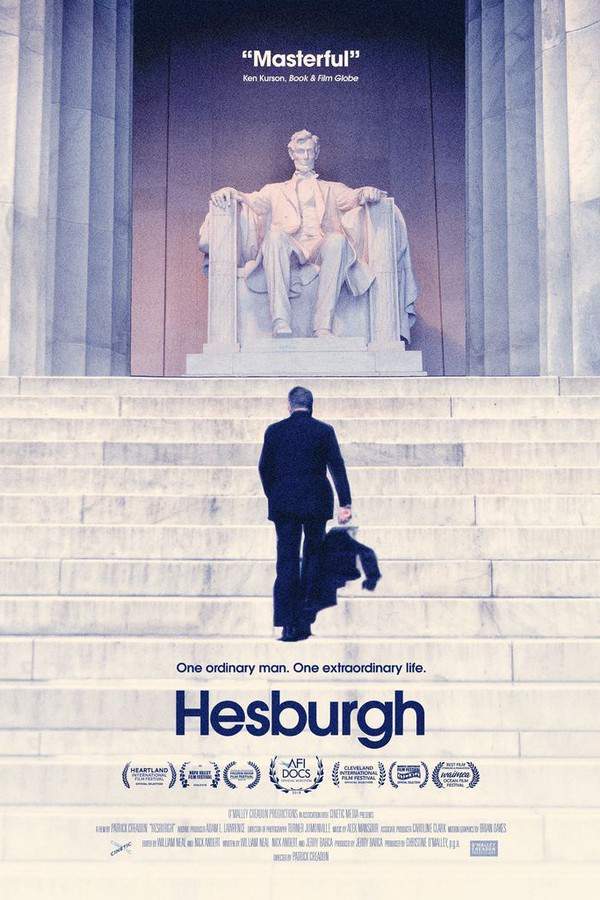
What Happens in Hesburgh?
The complete story of Hesburgh, from the first scene to the last, in 703 words (about 3 minutes). Spoilers throughout.
Spoilers ahead
Along with archival footage, Hesburgh consists of dozens of interviews with friends and family members as well as prominent figures such as Speaker of the US House of Representatives Nancy Pelosi, former chair of the U.S. Commission on Civil Rights Mary Frances Berry, former U.S. Senator Alan K. Simpson, journalist Ted Koppel, former Secretary of Defense Leon Panetta, and university presidents Fr. Edward Malloy and Fr. John I. Jenkins.
The film begins with Hesburgh’s early life, showing that he had felt called to the priesthood from the age of six. He wanted to be a military chaplain after being ordained a priest in 1943, but instead he was sent to get his doctorate and return to Notre Dame to teach and serve as a chaplain to returning World War II veterans on campus. In 1952, he was appointed president of the university at the age of 35.
Much of the documentary focuses on Hesburgh’s tenure as president and his work both on and off campus. His 35 years in office saw Notre Dame’s enrollment, faculty, and endowment increase dramatically as he transformed the school previously known only for its football team into a prestigious, coeducational academic institution.
President Dwight D. Eisenhower named him to the National Science Board in 1954, and he was the Vatican City’s representative to the International Atomic Energy Agency. At conferences, delegates from the United States and the Soviet Union did not want to speak with each other, but they trusted Hesburgh, and he became friends with both sides and tried to bridge the divide in an effort to defuse the nuclear arms race.
Hesburgh details a number of examples of his commitment to freedom of expression. Several times he was chastised by Catholic Church leadership at the Vatican for these views; he refused Cardinal Alfredo Ottaviani’s demand to censor an essay by John Courtney Murray on freedom of religion, and in 1967 he led the International Federation of Catholic Universities in publishing the Land O’ Lakes statement saying Catholic universities should be free from the Church’s authority.
In 1956, he was named to the US Commission on Civil Rights, which researched racial inequality in the South facilitated by Jim Crow laws. The committee spent two years gathering information despite stiff opposition from local leaders like George Wallace, but when it was time to write a report, the commission, which included both African Americans and segregationists, disagreed on the contents. Again, Hesburgh used his ability to build bridges between adversaries; he invited the members to Land O’ Lakes, Wisconsin, where they fished and bonded as friends, soon afterwards finishing a report recommending strong civil rights legislation. The film continues to follow Hesburgh’s involvement in civil rights through the next few presidential administrations; it says he was disappointed by John F. Kennedy’s politically motivated sluggishness on legislation but impressed by Lyndon B. Johnson’s savvy that led to the passage of the Civil Rights Act of 1964.
In the late 1960s, he caused controversy by taking a hard-line stance against student protests against the Vietnam War at Notre Dame with a policy that would suspend or expel students if they didn’t disperse a disruptive protest within 15 minutes. This led president Richard Nixon to see Hesburgh as a pro-war loyal ally and appoint him chair of the U.S. Commission on Civil Rights. However, sparked by the Kent State shootings, Hesburgh eventually became more vocally opposed to the war. The commission published a report critical of Nixon’s enforcement of the Civil Rights Act in 1972, and the president removed Hesburgh soon after.
The documentary then shows Hesburgh’s active post-presidency life, including when he helped welcome president Barack Obama to campus in 2009 and defended the controversial invitation. It ends with his final days, death, and funeral in 2015.
The film highlights Hesburgh’s close friendship with a number of influential people. He had a relationship with all the popes of his time, but he was personal friends with Pope Paul VI, who he asked to help release captured journalist and Notre Dame alumnus Robert Sam Anson during the Vietnam War. Margo Howard is interviewed and details Hesburgh’s long standing friendship with her mother Eppie Lederer, the writer of advice column Ask Ann Landers.

