What Is Hart's War About?
The premise of Hart's War in 326 words, with nothing given away. The full story follows below.
In the bitter winter of 1944, a group of American soldiers finds themselves thrust into a stark German POW camp, a place where the chill of the Ardennes is matched only by the cold logic of military bureaucracy. The environment is claustrophobic and unforgiving, a world where survival depends as much on wits and alliances as on the dwindling supplies that slip through barbed‑wire fences. Against this backdrop, the film balances the grim realism of wartime captivity with the simmering tension of a community forced to coexist under the watchful eye of its captors.
Thomas Hart, a newly commissioned officer thrust into the role of aide, is quickly caught in the tangled hierarchy of the camp. Though his rank should set him apart, he is assigned to the enlisted barracks, placing him shoulder‑to‑shoulder with men whose stories are etched by combat and loss. His relationship with the senior American commander, Colonel William McNamara, is strained; the colonel’s uncompromising leadership clashes with Hart’s lingering doubts about duty, honor, and survival. This dynamic creates a compelling undercurrent of mentorship‑turned‑conflict that drives Hart’s inner journey.
When a Black officer, Lincoln A. Scott, is charged with a grave offense, the camp’s fragile order is shattered. Hart, who once studied law at Yale, is called upon to serve as his defender, thrust into an improvised courtroom that feels both absurd and urgent. The trial forces the prisoners—and the audience—to confront deep‑seated prejudice, the paradox of justice behind enemy lines, and the question of whether a soldier can truly uphold the law when the world around him has collapsed into chaos.
The tone is stark yet hopeful, blending the gritty realism of a wartime prison with moments of quiet humanity that surface amidst the harshness. As alliances shift and moral dilemmas emerge, the story invites viewers to wonder how far one will go to protect a fellow soldier’s dignity when the very notion of right and wrong has been blurred by war.
What Happens in Hart's War?
The complete story of Hart's War, from the first scene to the last, in 643 words (about 3 minutes). Spoilers throughout. Names in the text link to 2 cast member pages.
Spoilers ahead
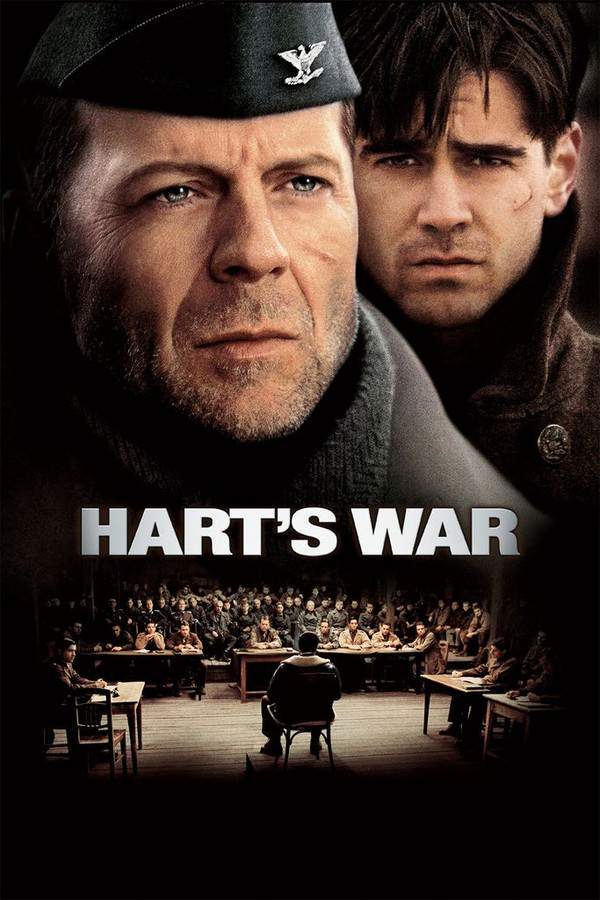
Belgium, December 16, 1944: First Lieutenant Thomas Hart, portrayed by Colin Farrell, finds himself captured by German commandos amidst the unfolding chaos of the Battle of the Bulge. After being taken to a local prison, his boots are confiscated, leaving him vulnerable and exposed in a cold cell. As the threat of frostbite and pneumonia looms, he is coerced into revealing intelligence to his German interrogator. Subsequently, he and a group of American soldiers are transported by train to a prisoner of war camp. In a dramatic turn of events, a squadron of P-51 Mustangs inadvertently attacks the train after the letters POW, obscured beneath layers of snow, are not visible. This tragic incident leads to the deaths of some POWs due to friendly fire, compelling the men to spell out POW with their bodies in a desperate attempt to avert further attacks.
Upon reaching the camp, Hart undergoes debriefing with the senior American officer, Colonel William McNamara, played by Bruce Willis. When questioned about his cooperation with the Germans, Hart denies any wrongdoing, though McNamara knows the truth, having observed Hart’s three-day ordeal with a Level 1 interrogator. Instead of allowing him the comfort of bunking with fellow officers, McNamara assigns him to the barracks for enlisted men, a decision that deepens the tension between them.
Things become even more complicated with the arrival of two Tuskegee Airmen, Second Lieutenants Lincoln A. Scott and Lamar T. Archer, who are the only Black officers in the camp. Their position is made perilous by the hostility of Staff Sergeant Vic W. Bedford, a vile racist threatening their very existence. Soon, a spike found in Archer’s bunk leads to a tragic escalation; the Germans seize Archer, executing him under the pretense of attempting to escape. Almost simultaneously, an American radio set up to receive coded messages is discovered and destroyed.
The stakes rise drastically when Bedford is later found dead, with Scott accused of his murder—a reprisal for being framed for Archer’s execution. With his legal background as a former Yale law student, Hart is tasked by McNamara to defend Scott in a court-martial that gains the consent of the camp’s commandant, Oberst Werner Visser.
As the trial unfolds, tensions flare. Visser hands Hart a manual on US Army court-martial procedures, thereby intensifying the clash with McNamara, who finds his authority questioned. On the stand, Scott delivers a poignant testimony about the grave inequities faced by Black soldiers who volunteered to serve their nation yet were met with scorn.
In a twist of fate during the trial, Hart uncovers a hidden tunnel, revealing an escape plan that McNamara discloses was intentionally crafted to distract from an impending attack on what the Allies erroneously believe to be a shoe factory. The truth soon emerges that Bedford had schemed to frame Archer and orchestrate an escape based on betrayal. Hart is horrified to learn of McNamara’s ruthless decisions, prioritizing the lives of many over the life of an individual to further their cause.
As the trial reaches its conclusion, McNamara and 34 men feign illness to evade participation, slipping away to execute their escape. In a moment of sacrifice during his closing argument, Hart asserts that he was responsible for Bedford’s death in a bid to save Scott. This revelation leads to immediate repercussions, with Visser preparing to execute Hart for his claim.
However, in a remarkable turn of selflessness, McNamara returns to the camp, choosing to accept full responsibility for Hart’s actions, even as an explosion adjacent to the camp signals the beginning of chaos. Moved by Hart’s bravery, McNamara sacrifices his own life to spare the other prisoners.
In the aftermath, Scott leads the salute to McNamara’s fallen figure. Three months later, as the German forces surrender to the Allies, the prison camp is liberated, marking an end to this harrowing chapter of their struggle.
Hart's War Timeline: Every Key Event in Order
15 key events in the order they happen, from “Lieutenant Hart Captured” to “Liberation of the Camp”. 15 events name a place, across 7 locations.
- 1
Lieutenant Hart Captured
On December 16, 1944, First Lieutenant Thomas Hart, played by Colin Farrell, is captured by German commandos during the Battle of the Bulge. Taken to a local prison, he faces the harsh reality of captivity without his boots, leaving him vulnerable to the winter cold.
When:December 16, 1944 Where:Belgium
- 2
Interrogation Begins
In his cold cell, Hart is coerced by German interrogators to reveal critical intelligence. The threat of frostbite and pneumonia adds to his desperation as he struggles to maintain his composure.
Where:Prison Cell
- 3
Transport to POW Camp
Hart and a group of American soldiers are loaded onto a train bound for a nearby prisoner of war camp. The journey takes a tragic turn due to poor visibility, as the letters POW, obscured by snow, are not seen by friendly aircraft.
Where:On the Train
- 4
Friendly Fire Incident
During the transport, a squadron of P-51 Mustangs mistakenly attacks the train. This incident results in several POWs being killed, prompting the surviving soldiers to spell out 'POW' with their bodies in a desperate plea for help.
Where:Train to POW Camp
- 5
Debriefing with Colonel McNamara
Upon arrival at the POW camp, Hart meets Colonel William McNamara, portrayed by Bruce Willis. During the debriefing, Hart denies any cooperation with the Germans, but McNamara remains skeptical due to Hart's previous ordeal.
Where:POW Camp
- 6
Tension with McNamara
McNamara decides to distance Hart from the other officers by assigning him to the barracks for enlisted men. This decision heightens the tension between Hart and McNamara, impacting Hart's ability to cope with his captivity.
Where:POW Barracks
- 7
Arrival of Tuskegee Airmen
The camp sees the arrival of Second Lieutenants Lincoln A. Scott and Lamar T. Archer, the only Black officers there. Their presence is quickly challenged by Staff Sergeant Vic W. Bedford, who exhibits open racism, threatening the safety of the newcomers.
Where:POW Camp
- 8
Execution of Archer
Following a tragic incident where a spike is found in Archer's bunk, the Germans seize him and execute him for allegedly trying to escape. This wrongful act escalates the already tense atmosphere in the camp.
Where:POW Camp
- 9
Bedford's Murder
When Bedford is later found dead, Lieutenant Scott becomes the prime suspect, accused of revenge for Archer's execution. Hart is reluctantly pulled into the situation, leveraging his legal background to defend Scott.
Where:POW Camp
- 10
Hart Takes on the Defense
With the trial set in motion, McNamara assigns Hart to defend Scott amidst rising tensions in the camp. Hart's legal expertise puts him at odds with McNamara, complicating their already fraught relationship.
Where:Military Court
Show the other 5 events of Hart's War Hide the last 5 events
- 11
Tensions During the Trial
The courtroom atmosphere intensifies as Visser hands Hart a manual on US Army court-martial procedures. The tension climaxes when Scott delivers a poignant testimony, showcasing the deep injustice faced by Black soldiers in the armed forces.
Where:Military Court
- 12
Unearthing the Escape Plan
During the proceedings, Hart discovers a secret tunnel designed for an escape. This shocking revelation reveals that McNamara intended it as a distraction while prioritizing military strategy over individual lives.
Where:POW Camp
- 13
Chaos during Final Arguments
As the trial nears its conclusion, chaos erupts when McNamara and 34 men pretend to be ill to facilitate their escape. In a climatic moment, Hart claims responsibility for Bedford's death during his closing arguments.
Where:Military Court
- 14
McNamara's Sacrifice
In a stirring moment of selflessness, McNamara returns to the camp to take the blame for Hart's assertion. His brave act occurs amid the turmoil as an explosion signals the approach of chaos nearby.
Where:POW Camp
- 15
Liberation of the Camp
Three months after McNamara's sacrifice, German forces surrender to the Allies. The liberation of the prison camp marks a significant moment of relief and hope for the surviving POWs, closing a painful chapter of their lives.
When:Three months later Where:POW Camp
Who Are the Main Characters in Hart's War?
4 characters, among them Thomas Hart (Colin Farrell), Colonel William McNamara (Bruce Willis) and Lincoln A. Scott: who each one is and the part they play in the story. 2 of them link to the actor’s page.
-
Thomas Hart (Colin Farrell)
Played by Colin Farrell
Thomas Hart is a First Lieutenant whose moral quandaries define his character. Throughout his captivity, he grapples with the consequences of his actions and is compelled to defend a fellow soldier facing severe discrimination. His growth from a coerced informant to a courageous advocate represents a profound transformation amid adversity.
- 🎖️ Soldier
- 📜 Lawyer
- ⚔️ Captivity
-

Colonel William McNamara (Bruce Willis)
Played by Bruce Willis
Colonel McNamara is a complex leader navigating the harsh realities of war and command. He balances protecting his men with the brutal necessities of military strategy, and his character arc reveals both ruthless pragmatism and unexpected heroism. His eventual sacrifice highlights the burdens of leadership and the weight of guilt in warfare.
- 🪖 Leader
- ⚙️ Strategy
- 💔 Sacrifice
- LA
Lincoln A. Scott
Lincoln A. Scott is one of the two Tuskegee Airmen in the camp, bringing to light the racial injustices faced by Black soldiers. As accusations mount against him, his courage to stand up for his rights and the rights of others shines through, making him a poignant figure in the fight against prejudice.
- ✈️ Airman
- ✊ Activist
- 🛡️ Justice
- SS
Staff Sergeant Vic W. Bedford
Vic Bedford serves as the antagonist, embodying the racism and hostility present within the military. His actions precipitate conflict that ultimately leads to tragedy. Bedford's character demonstrates the destructive power of hate, and his fate reflects the consequences of his prejudice and moral failings.
- 🪖 Racist
- 🚫 Oppressor
- 🔪 Violence
Where and When Is Hart's War Set?
Hart's War is set in Belgium and POW Camp (December 16, 1944). Here is why the time and place matter to the story.
When
December 16, 1944
The events occur during World War II, amidst the critical and brutal Battle of the Bulge. This period is marked by fierce fighting and significant military strategies as the Allies attempt to push back against German forces. The winter conditions exacerbate the suffering of soldiers, both in battle and in captivity.
Where
Belgium, POW Camp
The movie takes place in Belgium during World War II, particularly around the time of the Battle of the Bulge. This area was a critical front during the war, known for its harsh winter conditions and intense combat. The POW camp serves as a pivotal setting, illustrating the challenges faced by soldiers captured during the conflict.
- 🗺️ Location
- 🏰 Military
What Are the Themes of Hart's War?
3 ideas the story keeps returning to, among them Justice, Sacrifice and Courage.
-
01
Justice
Justice is a central theme in Hart's War, as the film grapples with moral dilemmas faced by soldiers in dire circumstances. The court-martial of Lincoln A. Scott raises questions about accountability and fairness, particularly regarding racial injustices during the war. Hart's struggle to navigate these complexities showcases the importance of integrity and honor in the midst of chaos.
-
02
Sacrifice
Sacrifice is portrayed powerfully in the film, culminating in Colonel McNamara's selfless decision to take responsibility for Hart’s actions. This theme underscores the willingness of individuals to risk their lives for the greater good of their comrades. McNamara's ultimate sacrifice serves as a testament to the bonds formed in conflict and the desperate measures taken to protect others.
-
03
Courage
Courage permeates Hart's War, reflected in both Hart's and Scott's determination to stand up against oppression and injustice. The characters face harrowing situations where they must summon inner strength to navigate their predicaments. This theme emphasizes the bravery required not just in battle, but in confronting moral challenges within a corrupt system.
What Kind of Film Is Hart's War?
Dark in tone, with steady pacing and a moderate story, going by the plot summary.
- Tone
- Dark
- Pacing
- Steady
- Story
- Moderate
- Intensity
- High
- Ending
- Bittersweet
A tense and morally complex wartime drama set in a brutal POW camp, where a young officer defends an innocent man amid pervasive racism, escalating deception, and a high-stakes escape plot.
- tense
- oppressive
- claustrophobic
- moral conflict
- grim
- somber
- prisoner of war
- racism
- military justice
- moral dilemma
Content notes: war violence, racist violence, prisoner execution, interrogation, friendly fire incident.
Quiz
How well do you remember Hart's War? Test yourself on the story.
Where to Watch Hart's War
Stream it on Amazon MX Player and Amazon Prime Video, or rent or buy it from Amazon Video and Apple TV Store. US availability and prices from JustWatch.
Stream 13
 Amazon MX Player
  Amazon Prime Video
  Amazon Prime Video Free with Ads
  Amazon Prime Video with Ads
  Fandango at Home Free
  Hoopla
  MGM Plus
  Plex
Plex  Plex Channel
  The Roku Channel
  Tubi TV
  VIX
VIX  YouTube Free



Streaming availability in the US, powered by