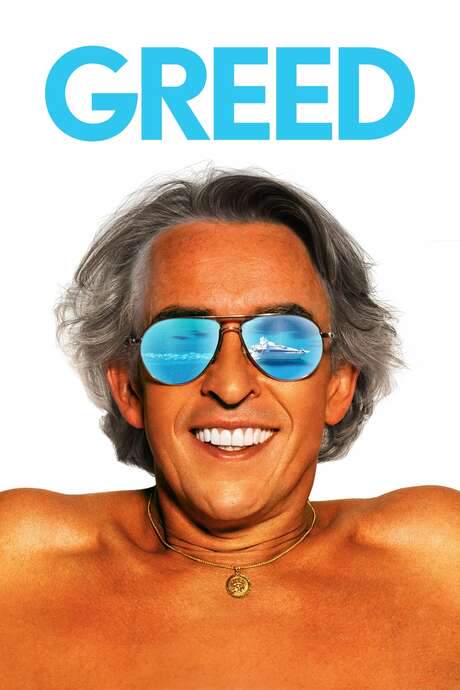
Greed 2019

Directed by

Michael Winterbottom
Made by

Film4 Productions
Where to Watch Greed
See current US streaming, rental, and purchase options for Greed (2019) via JustWatch.






Greed Plot Summary
Read the complete plot summary and ending explained for Greed (2019). From turning points to emotional moments, uncover what really happened and why it matters.
The film unfolds in a non-linear arc that traces the life of Sir Richard “Greedy” McCreadie, Steve Coogan, a billionaire fashion mogul whose dazzling public image hides a deep history of exploitation and financial ruthlessness. After a bruising government inquiry into greed and ethics in the industry, he retreats into publishing his memoirs, hiring Nick, a mild-mannered journalist, David Mitchell, to ghostwrite the story for him. As Nick digs into McCreadie’s past, the narrative flips between the glossy present and the rugged, often troubling rise that built his empire, revealing a pattern of sweatshops in Southeast Asia, aggressive tax maneuvers, and asset stripping that financed his success.
Nick’s investigation becomes a tour through memory, and the film offers a vivid look at the man behind the brand. A younger Richard McCreadie, a rebellious student at an unnamed British public school, is introduced by the actor Jamie Blackley as the youthful version of the tycoon, hinting at the foundations of the ruthless ambition that would define his adult life. The flashbacks chart his ascent through the 1970s and 1980s, when he crafts a high-street fashion empire built on aggressive expansion, savvy PR, and a willingness to bend rules when it serves profit. The story makes no attempt to flatter the figure at its center; instead, it peers into the mechanisms of power that sustain him, from peripheral loyalties to calculated public appearances, showing how wealth can grow through methods that are ethically questionable even if legally permissible.
In the present, the centerpiece of the narrative sits on McCreadie’s planned 60th birthday party—a Gladiator-themed spectacle on the island of Mykonos meant to be a triumphant moment of celebration and control. The project rapidly exposes cracks: the makeshift arena built with lax local labor, a tiger‑like sense of entitlement on display, and a crowd of celebrity guests who increasingly distance themselves from the man who has toppled many reputations. The beach nearby is crowded by a camp of Syrian refugees who refuse to leave, adding a stark counterpoint to the party’s opulence. McCreadie’s family complicates the picture too: Samantha McCreadie, Isla Fisher his ex-wife, lingers as a complicated figure of attraction and leverage; Naomi, his much younger wife, embodies the personal costs of his public life; Lily McCreadie, Sophie Cookson, and her boyfriend Fabian, Ollie Locke, film a reality‑TV show as the party unfolds; and Finn McCreadie, Asa Butterfield, his son, carries a troubling Oedipal tension and a penchant for taking dangerous risks.
Behind the glitter, Nick finds his moral compass tested as he grows closer to Amanda, Dinita Gohil, one of McCreadie’s personal assistants who embodies the human cost of the empire. Amanda’s revelations about the human price of McCreadie’s success—her own mother’s death after being forced to work in a sweatshop, and later a fire with tragic consequences—force Nick to confront the ethical weight of the portrait he’s being asked to paint. The bond between Nick and Amanda becomes a quiet counterpoint to the public spectacle, a grounded thread that keeps the film from tipping entirely into satire.
Tensions come to a head on the night of the party. McCreadie attempts to squeeze one more advantage from the event, enlisting the labor of refugees in a three-card monte scam as his own employees down tools in protest. The party’s drama escalates as Lily and Fabian navigate the reality-show angle, while Finn pilfers cocaine from Naomi and taints the arena’s atmosphere with reckless bravado. In a moment of impulsive cruelty, McCreadie stumbles into the arena and meets the lion in its cage. Amanda, driven by a mixture of anger, desperation, and a sense of justice, releases the beast, and the animal turns on McCreadie, mauling him in a drug‑fueled frenzy. Nick witnesses the brutal moment, and with Amanda’s quiet resolve, helps her slip away without detection.
McCreadie’s death triggers a swift, uneasy shift in the family’s dynamic. The public’s memory rewrites him into a legend, and Nick’s memoir begins to tilt toward a hagiography, even as the real costs of his wealth remain undeniable. Finn steps into his father’s shoes to run the business, a future that promises further duplicity rather than reform. Amanda and Nick agree to keep her role in the night’s events secret, a choice that mirrors the grim logic of the machinery that produced McCreadie’s fortune. Amanda retreats to a Leicester sweatshop, returning to the cycle of labor that the film has laid bare as the true backbone of the empire.
As the credits roll, the film shifts from narrative drama to a stark, documentary-like cadence, presenting facts about exploitation and inequality within the fashion industry. The closing minutes underscore a bitter truth: profits may glitter, but the cost is paid by workers who remain unseen and unprotected. The movie’s ambitious structure and its intertwining of personal betrayal, public spectacle, and systemic abuse invite viewers to reflect on what counts as success in a world where glamour often masks a harder, less forgiving reality.
Greed Timeline
Follow the complete movie timeline of Greed (2019) with every major event in chronological order. Great for understanding complex plots and story progression.
Richard McCreadie's rebellious rise begins at a British public school
The film introduces Richard 'Greedy' McCreadie as an outcast and rebellious student at an unnamed British public school. His sharp wit and ambition are apparent even as he clashes with authority and peers. This early attitude foreshadows his later ruthless approach to business.
Rise of a high-street fashion mogul
From these roots, McCreadie grows into a powerful high-street fashion merchant during the 1970s and 1980s. The summary notes his wealth is underpinned by ruthless exploitation and controversial practices. His public image as quick-witted and connected with celebrities masks a more dangerous reality.
Skepticism around wealth: sweatshops and malpractices
The narrative reveals that much of McCreadie's fortune rests on sweatshops in Southeast Asia, tax avoidance, and asset stripping. These revelations begin to erode his celebrated public persona as Nick investigates. The contrast between image and reality becomes a central theme.
Government inquiry and the memoir plan
After a disastrous public inquiry into the fashion industry's abuses, McCreadie decides to publish memoirs. He hires Nick, a mild-mannered journalist, to ghostwrite the book for him. This choice sets the stage for a non-linear storytelling structure driven by Nick's research.
Nick begins digging into McCreadie's past
Nick's research uncovers a complex background, and the film uses flashbacks to chart the billionaire's ascent from privilege to power. The process threatens to reveal uncomfortable truths that clash with McCreadie's self-image. Nick's growing conflict drives the moral center of the story.
Present build-up to the 60th birthday party
The focus shifts to the upcoming Gladiator-themed birthday party on Mykonos, intended as a carefree retreat for McCreadie. The party is hampered by real-world issues, like fragile constructions and untrustworthy labor. The event foregrounds the tension between spectacle and exploitation.
Arena trouble and labor tensions
Work on the Roman arena is shoddy, relying on undocumented immigrant labor, reflecting the same ethical failures the film critiques. The centerpiece fight and ceremonial lion become farcical rather than triumphant. McCreadie clings to control as preparations spiral.
Refugee camp and social pressures
A public beach near McCreadie's estate hosts a noisy makeshift camp of Syrian refugees. They are a constant reminder of the fallout from McCreadie's wealth and the politics of migration during the party period. The crowd's hostility toward the refugees reflects the wider moral conflict.
Family dynamics: Samantha, Lily, Naomi, and Finn
Samantha, McCreadie's ex-wife and public CEO, remains a central figure as he drifts toward her while married to Naomi. Lily stars in a reality show with her boyfriend, while Finn, McCreadie's son, quietly plots a more pernicious future. The family tensions mirror the ethical rot at the heart of the empire.
Amanda's moral awakening
Amanda, one of McCreadie's assistants, forms a fragile friendship with Nick while questioning working for McCreadie. She reveals that her mother died after being fired from a sweatshop, highlighting the human cost behind the empire's wealth. Her conscience drives her toward a dangerous decision.
The three-card monte and the refugees
On the night of the party, McCreadie uses a three-card monte trick to manipulate the Syrian refugees into working for him when his own staff down tools. A tense exchange sees some refugees’ relatives persuade a worker to return stolen silverware. The scene juxtaposes spectacle, coercion, and moral choice.
Cocaine, the lion, and a fatal misstep
Finn secretly steals cocaine and drugs the lion's food, an act that heightens the danger. The chaos foreshadows the tragedy to come as the party descends into lawlessness. The film ties these micro-actions to the climactic downfall.
The fatal encounter
McCreadie, drunk and desperate for control, enters the arena where he encounters the lion in its cage. Amanda suddenly releases the lion, and it mauls him in a drug-fueled frenzy. Nick witnesses the brutal death and helps Amanda escape.
Aftermath and truth-seeking
In the wake of McCreadie's death, a string of flattering eulogies follows as Nick quietly shifts toward writing a hagiography. Finn takes over the family business, signaling a repeat of the same duplicitous pattern. Amanda and Nick agree to keep her role in the death secret as the credits foreground exploitation in the fashion industry.
Greed Characters
Explore all characters from Greed (2019). Get detailed profiles with their roles, arcs, and key relationships explained.
Sir Richard McCreadie (Steve Coogan)
A billionaire fashion mogul whose charm conceals ruthless ambition and a willingness to exploit workers and dodge accountability. His public persona as a witty, quick-thinking tycoon clashes with a ostentatious private life marked by manipulation, fear, and a volatile family dynamic. He treats employees as disposable tools, and his downfall reveals the hollowness of his empire.
Nick (David Mitchell)
A mild-mannered journalist hired to ghostwrite McCreadie's memoir, Nick struggles with the moral confusion of whitewashing a criminal's life. He becomes increasingly aware of corporate exploitation and the ethical lines he must navigate. His evolving relationship with Amanda complicates his professional assignment.
Lily McCreadie (Sophie Cookson)
McCreadie's daughter, a presence in a reality‑TV show, juggling family expectations with personal ambitions. She embodies a younger generation shaped by her father's wealth but seeking her own path and autonomy.
Finn McCreadie (Asa Butterfield)
The troubled son whose Oedipal fixation on his father fuels reckless behavior, including drug use and dangerous stunts. His ambitions collide with his father's legacy, suggesting a duplicitous future for the business.
Samantha McCreadie (Isla Fisher)
McCreadie's ex-wife who remains a public figurehead in the family, navigating personal tension with her ex-husband, while maintaining influence over business and public perception.
Naomi (Keira Knightley)
The younger trophy wife who participates in the circle of McCreadie's world, highlighting themes of desire, status, and control within a wealthy dynasty.
Amanda (Dinita Gohil)
A personal assistant who confronts McCreadie's ethics and ultimately reveals the truth about the exploitation that funded the empire. Her arc connects the human costs of the fashion industry to the choices made by those in power.
Greed Settings
Learn where and when Greed (2019) takes place. Explore the film’s settings, era, and how they shape the narrative.
Time period
1970s–1980s and present day
The narrative moves between McCreadie's rise in the 1970s and 1980s and the contemporary present, where his downfall and memoir-writing form the frame. It contrasts a rebellious, privileged youth with a modern, media-saturated age of celebrity and public inquiries. The present day centers on a high-stakes birthday party and the aftermath of a government inquiry.
Location
Mykonos, Greece, Sri Lanka
The present events unfold on the glamorous island of Mykonos, where Sir Richard McCreadie hosts a gladiator-themed party that doubles as a social spectacle. The location highlights wealth, celebrity culture, and a public beach adjoining his estate that becomes a focal point for both celebration and protest. Previously, a Sri Lankan sweatshop backstory is also touched upon, illustrating the global reach and human cost behind his fashion empire.
Greed Themes
Discover the main themes in Greed (2019). Analyze the deeper meanings, emotional layers, and social commentary behind the film.
💰
Greed
The film centers on wealth as a weapon, revealing how McCreadie builds power through exploitation, tax avoidance, and morally dubious deals. Sweatshops in Southeast Asia and other shady financial practices expose the human cost behind the empire. The narrative uses the memoir project to question whether wealth justifies unethical means.
🎭
Image
Nick's task to polish McCreadie's public image highlights the gap between appearance and reality. The memoir becomes a tool of reputation management, masking cruelty with charisma. The movie probes how media, celebrity friends, and lavish parties shape reputations while truth lurks beneath.
⚖️
Power and Consequences
The pursuit of power demonstrates how control over people and resources corrupts both individuals and systems. The gladiator fantasy, the lion, and the unsafely built arena symbolize how arrogance leads to a deadly reckoning. Ultimately, the death of McCreadie exposes the fragility of his regime and the costs to workers and vulnerable communities.
🕊️
Refugees
Syrian refugees camp on the public beach, revealing the international dimensions of the fashion empire's footprint. The film juxtaposes their displacement with the opulence of the party, underscoring ethical blind spots and the marginalization of vulnerable groups. Amanda's actions connect the personal to global issues of labor, safety, and justice.

Coming soon on iOS and Android
The Plot Explained Mobile App
From blockbusters to hidden gems — dive into movie stories anytime, anywhere. Save your favorites, discover plots faster, and never miss a twist again.
Sign up to be the first to know when we launch. Your email stays private — always.
Explore the mobile appGreed Spoiler-Free Summary
Discover the spoiler-free summary of Greed (2019). Get a concise overview without any spoilers.
In the glittering world of high‑fashion, Sir Richard “Greedy” McCreadie looms as a larger‑than‑life mogul whose empire stretches from glossy runway shows to the glossy pages of glossy magazines. Fresh from a bruising public inquiry, he decides to cement his legacy with a memoir, hiring a quiet, observant journalist—Nick—to translate his self‑crafted legend onto paper. The collaboration becomes a study in contrasts: a man who thrives on bravado and a writer whose task is to sift truth from triumph, all set against the backdrop of a global industry that sparkles on the surface while hinting at darker undercurrents.
The centerpiece of the film is McCreadie’s 60th birthday, staged as a flamboyant, Gladiator‑themed gala on the sun‑kissed cliffs of Mykonos. The party promises opulent decadence—a Roman arena, celebrity guests, and a cast of family members whose loyalties sway like the Mediterranean tide. Samantha, his ex‑wife who still runs the family front, navigates a fragile alliance with the younger, striking Naomi, his trophy wife, while their children, Lily and Finn, drift through their own ambitions and resentments. Adding a sharp edge to the celebrations is Amanda, one of McCreadie’s personal assistants, whose quiet competence hides a personal connection to the very workers who stitch the luxury garments that line the billionaire’s closets.
Amid the glitter and the gaudy costumes, the narrative hums with a tone that is both satirical and uneasy, exposing the clash between extravagance and the overlooked lives that sustain it. Nick finds himself torn between the glossy veneer his subject wishes to project and the unsettling realities that surface in his research. Amanda wrestles with similar doubts, hinting at the human cost threaded through the industry’s silk and sequins. Their uneasy partnership frames a story that pulses with suspense, moral ambiguity, and a lingering question: how far will one go to preserve a legend when the foundations beneath it begin to crumble?
Featured on this page

What's After the Movie?
Not sure whether to stay after the credits? Find out!
Check out our other apps:

SAT Sphere
Build confidence for the Digital SAT.

Mori Atlas
Discover wild places worth protecting.

Luntero
Search smarter for a home in Amsterdam.

Plot Explained
Unravel movie endings and hidden clues.

Pokechamp
Dive into Pokémon data and battle logic.

Driving Theory
Get ready for your European theory test.

Movie Dust
Plan your next cinema trip with ease.

Musemap
Find art and culture as you travel.

Selkobase
Compare credentials before committing.

Local Manual
Turn an unfamiliar country into practical next steps.

Lernavi
Compare school systems before your next move.

GymRoam
Find a workout stop wherever your plans take you.
Explore Our Movie Platform
New Movie Releases (2026)
Famous Movie Actors
Top Film Production Studios
Movie Plot Summaries & Endings
Major Movie Awards & Winners
Best Concert Films & Music Documentaries
Movie Collections and Curated Lists
© 2026 What's After the Movie. All rights reserved.
Privacy Policy