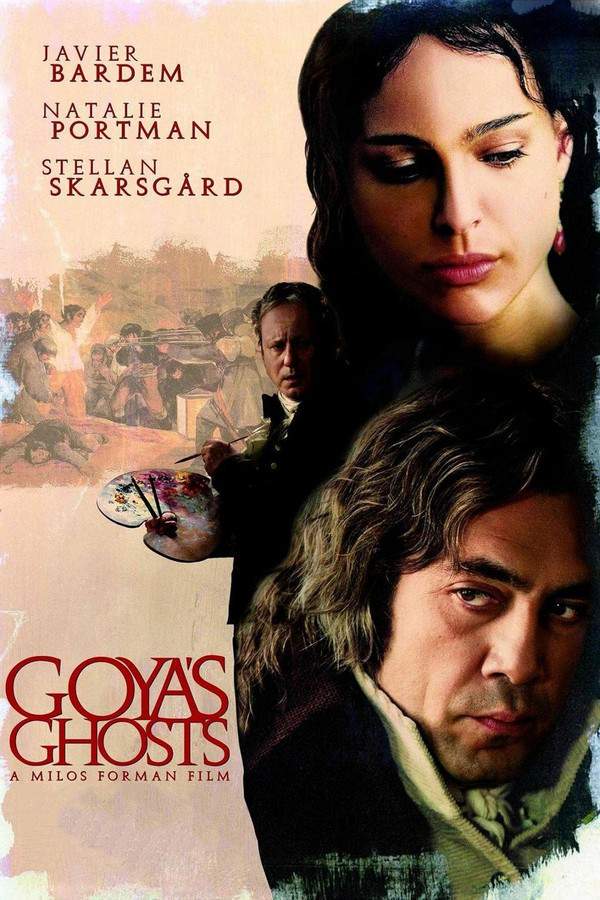
Goya's Ghosts 2007


Directed by

Milos Forman
Made by

Samuel Goldwyn Company, The
Where to Watch Goya's Ghosts
See current US streaming, rental, and purchase options for Goya's Ghosts (2007) via JustWatch.











Goya's Ghosts Plot Summary
Read the complete plot summary and ending explained for Goya's Ghosts (2007). From turning points to emotional moments, uncover what really happened and why it matters.
In the tumultuous year of 1792, Spain is gripped by the turbulence of the French Revolution. Francisco Goya, a celebrated painter, is tasked with capturing the likenesses of Spain’s elite as the Official Court Painter. Yet, his artistry becomes a point of contention for the Spanish Inquisition, which takes issue with some of Goya’s provocative works.
When Brother Lorenzo Casamares, portrayed by Stellan Skarsgård, comes to Goya’s defense, he later enlists him to paint his portrait. Lorenzo argues that Goya’s art is not malicious but merely reflects the darker aspects of humanity. He urges the Church to combat anti-Catholic sentiments more aggressively and is granted authority to intensify the Inquisition’s activities.
During the portrait sitting, Lorenzo observes a painting of Inés, the daughter of wealthy merchant Tomás Bilbatúa. Shortly thereafter, Inés is apprehended by Holy Office spies—trained by Lorenzo—for allegedly “Judaizing” by refusing to eat pork. She endures a harrowing ordeal involving torture until she confesses and is subsequently imprisoned.
Her desperate father turns to Goya for assistance. In a complex game of deception and desire, Lorenzo visits Inés in her dungeon cell, offering her a semblance of comfort, yet he is internally conflicted by his lust for her. She prays with him, embodying a moment of fragile hope.
Later at a dinner hosted by the Bilbatúa family, Lorenzo passionately defends the use of torture, claiming that innocence will be upheld by divine intervention. In contrast, Goya and Bilbatúa assert that coerced confessions do not imply guilt. In an act of retaliation, Bilbatúa subjects Lorenzo to the same torture he endorses, forcing him to confess to ridiculous claims, including that he is a monkey. As a pact for Inés’s freedom, a hefty donation is offered to the Church, but it is all in vain as the Inquisitor-General, Father Gregorio, refuses to release her.
In an abhorrent twist, Lorenzo again visits Inés under the pretense of prayer, but he commits the atrocity of raping her. Meanwhile, the document of Lorenzo’s ludicrous confession finds its way into the hands of King Charles IV, who finds it amusing yet solemnly promises to consider Inés’s plight. However, when the Holy Office comes to apprehend Lorenzo, he narrowly escapes, and Goya’s portrait of him meets a grim fate as it is burned publicly.
Fast forward fifteen years, Goya—now deaf—finds himself at the pinnacle of his artistic expression. The invasion of Spain by French forces results in the eradication of the Inquisition and the liberation of its prisoners. Lorenzo, having fled to France, has become a fervent supporter of the French Revolution, now prosecuting his former comrades in the Inquisition. This ideological shift echoes the historical character Juan Antonio Llorente, who also turned against the Inquisition.
Inés, however, languishes in a dungeon—the ravages of time have taken their toll on her sanity. After giving birth to a daughter whose fate remains unknown, she returns to find her family dead and implores Goya for aid in locating her child. Unbeknownst to her, Lorenzo is the father, and he subsequently commits her to an asylum to conceal his shame.
While on a quest for his lost daughter, Lorenzo learns from the Inquisitor-General that any child born in captivity would have likely been abandoned. As Goya sketches in a park, he encounters a prostitute named Alicia, who bears a striking resemblance to Inés. Driven by compassion, he seeks to reunite Inés with her daughter, but Lorenzo, ever fearful, attempts to persuade Alicia to leave Spain instead.
Tragedy unfolds when soldiers—under Lorenzo’s orders—raid a tavern where Goya attempts to spirit Inés away, capturing the prostitutes and putting their fates in jeopardy. Amidst the chaos, the mentally deteriorating Inés stumbles upon a newborn left behind during the raid, mistaking it for her lost child.
As the tides of war turn against the French, the British, bolstered by Spanish allies, press on. The desperate state of affairs leads to Lorenzo being caught as he attempts to escape. As Spain reinstates the Inquisition, Lorenzo faces a trial that flips their roles, with the former Inquisitor-General now urging him to repent as he is led to execution, draped in a sanbenito adorned with flames—a symbol of his eternal damnation.
On the gallows, Lorenzo notices Alicia, now beside a British officer, openly mocking him. Inés emerges from the crowd, revealing the child she believes to be their daughter—a poignant moment filled with twisted irony. Despite pleas for repentance, Lorenzo remains defiant as he meets his grim fate, the dose of justice served cold. The film concludes with a haunting image of Inés carrying his child while Goya, heartbroken yet resolute, trails behind, calling for her, and she glances back, a fleeting smile gracing her face, before walking alongside the cart bearing Lorenzo’s lifeless body.
Goya's Ghosts Timeline
Follow the complete movie timeline of Goya's Ghosts (2007) with every major event in chronological order. Great for understanding complex plots and story progression.
The Turbulent Year of 1792
Spain is deeply affected by the upheaval caused by the French Revolution, leading to widespread unrest. The political turmoil influences many aspects of society, including art, as Francisco Goya, the celebrated painter, finds himself caught in the crossfire.
Goya Becomes Official Court Painter
Goya is designated the Official Court Painter and is tasked with capturing the likenesses of elite Spanish figures. His art, however, becomes contentious as it incites the ire of the Spanish Inquisition due to its provocative nature.
Brother Lorenzo's Intervention
Brother Lorenzo Casamares intervenes to defend Goya against the criticism from the Spanish Inquisition. He suggests that Goya's art merely reflects the darker sides of humanity, arguing for a more lenient stance towards the artist.
Inés's Arrest
Shortly after Lorenzo's portrait sitting with Goya, Inés, the daughter of merchant Tomás Bilbatúa, is arrested by Holy Office spies for allegedly 'Judaizing.' Her situation quickly deteriorates as she is subjected to torture until she reluctantly confesses.
Goya is Approached for Help
Tomás Bilbatúa, desperate to free his daughter Inés from imprisonment, turns to Goya for assistance. This marks a turning point, as Goya's role transitions from a mere artist to a pivotal figure in the fight against the oppressive Inquisition.
Dinner Conflict
During a dinner hosted by the Bilbatúa family, a heated argument erupts over the use of torture by the Inquisition. Lorenzo defends these brutal practices, while Goya and Bilbatúa contend that coerced confessions are not indicative of guilt, underscoring the ethical divide between them.
Lorenzo's Torment
In a twisted act of irony, Tomás Bilbatúa turns Lorenzo's own endorsement of torture against him by subjecting him to the same brutal treatment he justifies. This ordeal forces Lorenzo to make ridiculous confessions, igniting a new understanding of his own moral contradictions.
Lorenzo's Unspeakable Act
In a horrific display of power, Lorenzo visits Inés in her cell under the guise of prayer but instead commits rape. This act further complicates the web of exploitation and manipulation surrounding their characters, deeply impacting Inés's fate.
The Fall of the Inquisition
As fifteen years pass, Goya has grown deaf and reaches the height of his artistic prowess. The French invasion leads to the disbanding of the Inquisition, allowing many former prisoners, including Inés, to finally regain their freedom.
Inés's Suffering
Inés, still trapped in her traumatic experiences, struggles with severe mental decline in the dungeon. After giving birth, she is devastated to find her family dead, driving her to seek Goya's help in locating her missing child.
Lorenzo's Deceit
To hide his shame, Lorenzo commits Inés to an asylum, blocking any chance of reconciliation between her and their child. This act of betrayal reveals Lorenzo’s willingness to sacrifice others for his own protection, encapsulating his moral decline.
Goya's Compassion
Goya encounters a young prostitute named Alicia who resembles Inés and feels compelled to help reunite Inés with her daughter. His compassion pushes him into a tumultuous situation where he risks confronting Lorenzo’s authority.
The Raid
Lorenzo orchestrates a raid on a tavern where Goya is striving to help Inés escape. The chaos leads to the capture of several prostitutes, revealing the stark danger posed by Lorenzo’s position and the reckless brutality of the times.
Lorenzo's Downfall
As the tides of war shift back against the French, Lorenzo is captured and brought to trial. He faces execution, with the former Inquisitor-General ironically urging him to repent, marking a glaring role reversal and poetic justice.
Final Moments
On the gallows, Lorenzo faces his end while Inés, now with a child she believes to be theirs, appears amidst the crowd. His defiance resonates with her anguished revelation, finalizing a cycle of tragedy and lost hopes as Goya watches, heartbroken.
Goya's Ghosts Characters
Explore all characters from Goya's Ghosts (2007). Get detailed profiles with their roles, arcs, and key relationships explained.
Francisco Goya
Goya is a conflicted artist renowned for his evocative paintings that challenge societal norms. As the Official Court Painter, he struggles to navigate the oppressive atmosphere of the Spanish Inquisition while remaining true to his artistic vision. His evolution, particularly when faced with personal loss and societal upheaval, highlights his resilience and deep compassion.
Brother Lorenzo Casamares (Stellan Skarsgård)
Lorenzo embodies the duality of faith and ambition, initially serving as a defender of Goya while secretly entangled in a web of moral corruption. His relentless pursuit of power leads to personal betrayal and tragic consequences, culminating in a downfall that forces him to confront the very ideals he once promoted. His character reflects the complexities of human nature and the capacity for both good and evil.
Inés
Inés is a tragic figure who endures profound suffering under the Inquisition's cruelty. Her resilience in the face of torture and despair highlights her inner strength and unwavering hope. As a mother seeking her child, her narrative becomes a symbol of the struggle for personal autonomy against oppressive forces.
Tomás Bilbatúa
Tomás, Inés's father, represents the desperate struggle of a parent seeking to protect his child in a cruel world. His willingness to confront the authorities showcases a father's unconditional love and the extremes to which he will go for his family. His character emphasizes the themes of sacrifice and the pursuit of justice.
Alicia
Alicia serves as Goya's muse and a parallel to Inés, embodying the complexities of femininity in a male-dominated world. Her role as a prostitute caught in turmoil reflects the societal neglect of vulnerable women. In her moments with Goya, she represents both hope and tragic loss in an era defined by violence and repression.
Goya's Ghosts Settings
Learn where and when Goya's Ghosts (2007) takes place. Explore the film’s settings, era, and how they shape the narrative.
Time period
1792, 1807
The story unfolds during 1792 amidst the French Revolution, a time synonymous with political upheaval and radical change in Europe. The film flashes forward fifteen years to 1807, marking a moment of transition where Spain faces invasion by French forces, leading to the eventual end of the Inquisition. This historical backdrop highlights the shifting moral landscape and the consequences of extremist ideologies.
Location
Spain, France
The film is set in late 18th century Spain, characterized by the clash between the traditional powers of the Catholic Church and the emerging revolutionary ideas from France. Spain is depicted as a place of tension, where the Spanish Inquisition exerts its oppressive authority. France represents a beacon of change, being home to revolutionary fervor, drawing in characters who grapple with their past allegiances.
Goya's Ghosts Themes
Discover the main themes in Goya's Ghosts (2007). Analyze the deeper meanings, emotional layers, and social commentary behind the film.
⚔️
Conflict
The film explores the conflict between art and authority, showcasing how Goya's provocative work challenges the rigid moralities imposed by the Spanish Inquisition. The power struggle between personal desires and societal obligations is a recurring theme, reflected in Lorenzo's complex moral dilemmas and Inés's harrowing plight. This tension ultimately reveals the darker sides of humanity.
🕊️
Redemption
Themes of redemption weave throughout the narrative, particularly as characters grapple with the consequences of their actions. Lorenzo's journey from Inquisitor to fugitive underscores the potential for personal transformation, though it is ultimately marred by his failings. Inés represents the hope for liberation and reunification despite the scars left by trauma.
👩🎨
Art
Art becomes a pivotal force in Goya's life, reflecting societal truths and personal tragedies. Through his eyes, the audience witnesses the power of artistic expression to capture both beauty and darkness. Goya’s paintings serve as a commentary on the political and social challenges of his time, making art an essential element of resistance and reflection.

Coming soon on iOS and Android
The Plot Explained Mobile App
From blockbusters to hidden gems — dive into movie stories anytime, anywhere. Save your favorites, discover plots faster, and never miss a twist again.
Sign up to be the first to know when we launch. Your email stays private — always.
Explore the mobile appGoya's Ghosts Spoiler-Free Summary
Discover the spoiler-free summary of Goya's Ghosts (2007). Get a concise overview without any spoilers.
Spain trembles under the weight of Napoleon’s advance, and the streets of Madrid pulse with a restless mix of fear, ambition, and fleeting beauty. The city’s grand palaces and shadowed alleys are caught in the clash between Enlightenment ideas and the ancient grip of the Spanish Inquisition, creating a world where art can be both a sanctuary and a provocation. Within this volatile landscape, the atmosphere is thick with the scent of gunpowder, whispered conspiracies, and the timeless struggle of a nation trying to define itself amid foreign conquest.
Into this turmoil steps Francisco Goya, the celebrated court painter whose brush captures the glitter of aristocratic portraiture and the stark, unsettling truths lurking beneath society’s surface. Tasked with immortalizing the elite, he finds his work increasingly examined by inquisitorial eyes that question the morality of his vision. Beside him stands Inés, the luminous daughter of a prosperous merchant whose presence ignites Goya’s creative fire and whose own fate becomes tangled with the era’s dark judgments. Watching from the periphery is Brother Lorenzo, a charismatic yet enigmatic cleric whose persuasive arguments about the role of suffering and art draw both admiration and suspicion, pulling the painter into a delicate dance of loyalty and doubt.
The film moves with a painter’s eye for color and contrast, blending the luminous optimism of artistic creation with the deep shadows of oppression and war. Its tone is simultaneously lyrical and foreboding, inviting the audience to feel the weight of every brushstroke as a moral choice. The interplay between Goya’s evolving deafness, his relentless pursuit of truth on canvas, and the looming presence of an institution that seeks to police imagination creates a tension that feels both intimate and epic.
At its heart, the story unfolds as a study of how a man’s devotion to his muse and his craft can become a conduit for larger forces—political, religious, and personal—that threaten to eclipse the very beauty he strives to preserve. As the nation teeters on the brink of upheaval, Goya, Inés, and Lorenzo find themselves bound by a fragile network of desire, duty, and the unanswerable question of what it means to bear witness to humanity’s darkest and most radiant moments.
Featured on this page

What's After the Movie?
Not sure whether to stay after the credits? Find out!
Check out our other apps:

SAT Sphere
Build confidence for the Digital SAT.

Mori Atlas
Discover wild places worth protecting.

Luntero
Search smarter for a home in Amsterdam.

Plot Explained
Unravel movie endings and hidden clues.

Pokechamp
Dive into Pokémon data and battle logic.

Driving Theory
Get ready for your European theory test.

Movie Dust
Plan your next cinema trip with ease.

Musemap
Find art and culture as you travel.

Selkobase
Compare credentials before committing.

Local Manual
Turn an unfamiliar country into practical next steps.

Lernavi
Compare school systems before your next move.

GymRoam
Find a workout stop wherever your plans take you.
Explore Our Movie Platform
New Movie Releases (2026)
Famous Movie Actors
Top Film Production Studios
Movie Plot Summaries & Endings
Major Movie Awards & Winners
Best Concert Films & Music Documentaries
Movie Collections and Curated Lists
© 2026 What's After the Movie. All rights reserved.
Privacy Policy