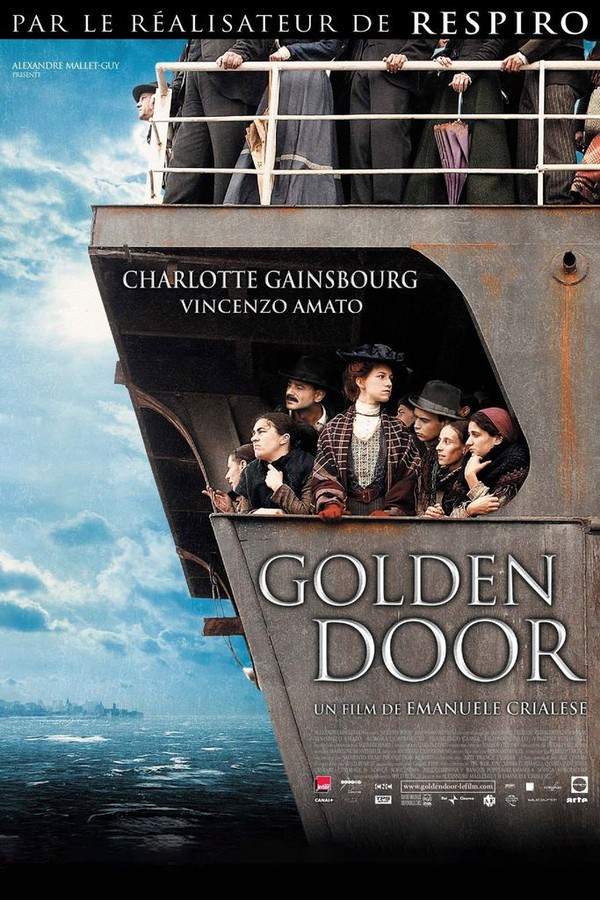
Golden Door 2007

Directed by

Emanuele Crialese
Made by

Miramax Films
Where to Watch Golden Door
See current US streaming, rental, and purchase options for Golden Door (2007) via JustWatch.

Hoopla
SD
Kanopy
HD
Amazon Video
HD
Apple TV Store
HD Streaming availability powered by 
Golden Door Plot Summary
Read the complete plot summary and ending explained for Golden Door (2007). From turning points to emotional moments, uncover what really happened and why it matters.
The film opens by tracing the hardships and hopes of the Mancuso family from a small, mountain-bound village in Sicily as the 20th century begins. The family is led by their widowed father, Salvatore Mancuso (played by Vincenzo Amato), who dreams of a vastly different life for his kin. Joined by his two sons and his aging mother, Fortunata, a village healer deeply steeped in mysticism, they decide to emigrate to the United States after interpreting a sign from God—American postcards that promise giant vegetables, milk that flows like rivers, and coins falling from the sky. This dream of a bountiful land of opportunity illuminates the tension between hopeful fantasy and the harsher realities that await them, making the audience question how much of the American dream is shared by newcomers and how much is a product of imagination.
As the family prepares to leave, the film widens its lens to the journey itself. The boat trip becomes a powerful visual metaphor: a crowded deck on one side and a sea of strangers on the other, symbolizing the old world they are leaving behind and the uncharted world they hope to enter. The voyage introduces a vivid counterpoint to their plans—the new world is not simply a blank slate; it is a place where class, status, and personal hopes collide in unpredictable ways.
On the ship, a striking presence stands out: Lucy, a red-headed British woman who travels alone. Lucy embodies both allure and independence, drawing the attention of the men with her beauty and prompting curiosity and sometimes judgment from the women aboard. Salvatore finds himself immediately drawn to her, his fascination marking the early, uneasy start of a complicated relationship. Lucy’s motives, rooted in practical concerns about entry to the United States, add a layer of complexity to their bond, underscoring a broader truth about the immigrant experience: access to a new life often hinges on compromises and social expectations that can feel incongruent with personal desire.
When the Mancuso family finally reaches Ellis Island, a third segment unfolds—the once private world of the voyage gives way to public examination. Immigrants endure a blunt, humiliating process of physical and psychological testing and questioning, a rite of passage that strips away status and background to reveal each person’s place in the new society. The hopeful transport of the ship’s earlier conversations gives way to an anxious scrutiny where merit, intellect, and even health are put under the microscope. The film emphasizes that, in this borderland, the equalizing pressure of official procedures can erase the differences that carried them across the ocean.
In this final act, the family’s dynamics undergo a quiet recalibration. A surprising transfer of power surfaces between Fortunata, the matriarch who holds generations of wisdom, and Pietro, one of Salvatore’s sons, revealing how authority can shift in a place where old loyalties and new hopes collide. Pietro conveys to Salvatore that Fortunata wishes to return home, a moment that reframes the journey not as a straightforward ascent into a brighter future, but as a question about belonging, duty, and what the family is willing to sacrifice for survival. The film leaves Salvatore facing a stark choice: stay and pursue the dream in a land that has tested his family at every turn, or honor a rooted sense of home by returning to the life they left behind.
Throughout the narrative, the film balances intimate family drama with broader social commentary. The contrast between the idealized visions of America and the often unforgiving realities immigrants faced is explored with restraint and nuance, inviting viewers to reflect on the costs of hope and the resilience required to navigate a new world. The story also probes how gender, class, and immigration laws shape personal decisions, illustrating how each character negotiates autonomy, safety, and identity in a landscape where every milestone—departure, voyage, and arrival—tests the limits of faith and perseverance.
By the end, the audience is left with a thoughtful ambiguity. The outcome is not a simple verdict of success or failure, but a meditation on what it means to reinvent life in a foreign land while honoring the ties that bind a family to its origins. The film’s quiet, contemplative tone invites viewers to weigh the allure of opportunity against the price of change, and to consider what a family sacrifices, preserves, and ultimately chooses to carry forward into a new world.
Golden Door Timeline
Follow the complete movie timeline of Golden Door (2007) with every major event in chronological order. Great for understanding complex plots and story progression.
Decision to emigrate after a divine sign
Salvatore Mancuso's family in rural Sicily receives a sign from God in the form of American postcards showing giant produce and abundance. The dream of opportunity drives them to leave, despite limited means and uncertain futures. The film uses their eager mindset to critique the unrealistic hopes many immigrants carried across the Atlantic.
Departure from Sicily and the boat scene
With heavy hearts, they depart the Sicilian coast and board a crowded vessel. A powerful visual contrasts a sea of people on the dock with those aboard, symbolizing the departure from the old world to the new. The journey marks the first steps toward an unknown future in America.
On the ship and Lucy's entrance
During the Atlantic crossing, Salvatore fixates on a striking passenger, Lucy, a red-headed British woman traveling alone. He becomes smitten, while other passengers view her as alluring yet aloof. Her presence foreshadows the complex mix of desire, dependence, and survival among immigrants.
Lucy asks Salvatore to marry for entry
Upon arrival at Ellis Island, Lucy asks Salvatore to marry her purely for administrative reasons, since a woman cannot enter the United States alone. He agrees, understanding she does not love him yet but hopes affection will grow with time. The arrangement highlights the era's gender and immigration dynamics.
Ellis Island examinations begin
The Mancuso family is subjected to extensive physical and psychological examinations required for entry. The humiliating process tests health, patience, and dignity, while forcing them to confront the bureaucracy of belonging. This phase marks a turning point from dream to a fragile qualification for entry.
Class distinctions fade during screening
During the examinations, the old class distinctions the family carried from the ship become irrelevant. The process emphasizes equal vulnerability among immigrants with no guaranteed future. The mood shifts from hopeful anticipation to anxious uncertainty about acceptance.
Pietro's muteness threatens acceptance
An inspector reveals that Pietro, Salvatore's mute son, could be sent back for lacking speech. The threat of deportation looms over the family, adding urgency to their efforts to secure permission to stay. The fear of losing the chance for a new life heightens the emotional stakes.
Fortunata's intelligence questioned
Fortunata, Salvatore's mother, is scrutinized and deemed to have insufficient intelligence. Her status as the village healer complicates the authorities' judgment of her fitness for the new world. The examinations test belief, competence, and the acceptability of an immigrant grandmother.
Transfer of power: Fortunata wishes to return home
In a quiet reversal, Pietro informs Salvatore that Fortunata wishes to return to Sicily, signaling a shift in who holds authority within the family. The revelation unsettles Salvatore and underscores how fragile family unity becomes under pressure. The moment reframes the immigrant journey as a personal and collective negotiation.
Salvatore faces a final dilemma
The film leaves audiences with a stark dilemma: should Salvatore stay and start anew in the United States or return home with his family? The choice stands as a proxy for the broader question of whether immigration's promises justify the sacrifices. The ending underscores the uncertainty that defined many real-life immigrant decisions.
Dreams versus reality of immigration
Throughout the journey, the narrative juxtaposes the idealized American dream—giant vegetables, milk in fountains, coins dropping from the sky—with the harsher realities of assimilation and gatekeeping. This contrast critiques the immigrant myth and foregrounds the costs of pursuing opportunity. The tension between fantasy and fact drives much of the emotional arc.
Ending scene and unresolved future
The final moments emphasize the Mancuso family's unresolved fate, leaving open whether they will remain in America or return to Sicily. The open-ended conclusion mirrors the broader, ongoing journeys of countless immigrants facing bureaucratic verdicts. The film closes with an emphasis on uncertainty rather than closure.
Golden Door Characters
Explore all characters from Golden Door (2007). Get detailed profiles with their roles, arcs, and key relationships explained.
Salvatore Mancuso
Patriarch of the Mancuso family, Salvatore is driven by hope and a belief in a better future in America. He leads the decision to emigrate, bearing the weight of his family’s prospects while facing the possible costs if their gamble fails. His resolve is tested by the harsh realities of immigration and the burdens of caring for elderly Fortunata and his sons.
Lucy
A striking, independent British woman traveling with the express purpose of securing entry to the United States through marriage. Her relationship with Salvatore highlights gender and class constraints of the era, as she negotiates power and autonomy within a system that privileges male authority. Her presence injects complexity into the immigrant journey.
Fortunata Mancuso
The old mother and village healer, Fortunata embodies superstition and traditional wisdom. Her mysticism anchors the family within their old homeland’s beliefs even as they depart. She influences decisions and ultimately expresses a longing to return to Sicily.
Pietro Mancuso
Salvatore’s mute son, Pietro represents vulnerability and the limits of a family’s ability to communicate under immigration pressures. His condition becomes a point of ethical concern in the voyage and at Ellis Island, and he becomes a spokesperson for the family’s fear of separation and failure.
Golden Door Settings
Learn where and when Golden Door (2007) takes place. Explore the film’s settings, era, and how they shape the narrative.
Time period
Early 20th century
The events unfold around the turn of the century, a period of mass Italian emigration to the United States. Families like the Mancusos seek land, opportunity, and a different life, often mesmerized by idealized visions of America. The era features rigid social norms and gender expectations that shape the immigrants' decisions and fate at ports and processing stations.
Location
Sicily, Italy, Ellis Island, New York, USA, Atlantic Ocean
The story begins in a rural, mountainous region of Sicily where the Mancuso family lives in poverty and dreams of a better life across the Atlantic. The voyage itself becomes a liminal space, a crossing between the old world and the new as they await entry to America. Ellis Island serves as a stark, bureaucratic gateway, where immigrants face humiliating examinations that test worthiness regardless of class.
Golden Door Themes
Discover the main themes in Golden Door (2007). Analyze the deeper meanings, emotional layers, and social commentary behind the film.
🌍
Immigration
Immigration is the spine of the narrative, showing how families abandon familiar lands for the promise of opportunity. The film contrasts idealized American myths with the harsh realities of border control, class, and labor. Characters chase a dream of prosperity while confronting cultural difference and the precariousness of their status.
💭
Dream vs Reality
The story constantly pits hopeful fantasies against grim realities. The postcard images of giant produce and easy wealth are debunked by the arduous journey and the humiliating intake process. What begins as aspiration slowly reveals itself as a blend of longing, fear, and disillusionment.
⚖️
Class & Gender
The film exposes how social class and gender expectations shape immigrant experiences. Women must navigate official constraints to gain rights, while families balance pride, necessity, and control. The power dynamics shift across generations and within the family as they confront judgment at Ellis Island.

Coming soon on iOS and Android
The Plot Explained Mobile App
From blockbusters to hidden gems — dive into movie stories anytime, anywhere. Save your favorites, discover plots faster, and never miss a twist again.
Sign up to be the first to know when we launch. Your email stays private — always.
Explore the mobile appGolden Door Spoiler-Free Summary
Discover the spoiler-free summary of Golden Door (2007). Get a concise overview without any spoilers.
In the early years of the twentieth century, a small mountain village in Sicily clings to tradition while its inhabitants stare across the sea at a promise painted in postcards: endless fields, milk rivers, and coins that fall from the sky. At the heart of this yearning is Salvatore Mancuso, a widowed father whose quiet determination fuels a daring plan to carry his two young sons and his aging mother toward a new horizon. The family’s hopes are woven together with the mystic counsel of Fortunata, a healer whose reverence for ancient rites balances the pragmatic pull of a better life.
The journey itself becomes a living tableau of hope and uncertainty. Packed onto a crowded vessel, the passengers form a moving mosaic of cultures, languages, and silent ambitions, each wave echoing the tension between the familiar past and the uncharted future. Among them, a striking red‑haired British woman named Lucy commands attention, embodying both the allure of independence and the pragmatic calculations required to secure a place in a foreign land. Her presence adds a subtle, magnetic undercurrent to the voyage, suggesting that personal desire and survival often walk hand‑in‑hand on the slippery deck of migration.
Upon reaching the towering gates of America, the film shifts to a stark, almost ceremonial assessment of who may step ashore. The atmosphere is charged with a mix of nervous anticipation and austere scrutiny, where every glance and answer may reshape a family’s destiny. Through quiet, observant storytelling, the narrative paints a world where the promise of the “Golden Door” glitters against the harsh reality of bureaucratic gatekeeping, and where the bonds of blood, faith, and tradition are tested by the very act of crossing. The tone remains contemplative, inviting viewers to feel the weight of each step toward an imagined future without revealing the outcomes that await beyond the threshold.
Movies with Similar Twists and Themes
Uncover films that echo the narrative beats, emotional arcs, or dramatic twists of the one you're exploring. These recommendations are handpicked based on story depth, thematic resonance, and spoiler-worthy moments — perfect for fans who crave more of the same intrigue.








Featured on this page

What's After the Movie?
Not sure whether to stay after the credits? Find out!
Check out our other apps:

SAT Sphere
Build confidence for the Digital SAT.

Mori Atlas
Discover wild places worth protecting.

Luntero
Search smarter for a home in Amsterdam.

Plot Explained
Unravel movie endings and hidden clues.

Pokechamp
Dive into Pokémon data and battle logic.

Driving Theory
Get ready for your European theory test.

Movie Dust
Plan your next cinema trip with ease.

Musemap
Find art and culture as you travel.

Selkobase
Compare credentials before committing.

Local Manual
Turn an unfamiliar country into practical next steps.

Lernavi
Compare school systems before your next move.

GymRoam
Find a workout stop wherever your plans take you.
Explore Our Movie Platform
New Movie Releases (2026)
Famous Movie Actors
Top Film Production Studios
Movie Plot Summaries & Endings
Major Movie Awards & Winners
Best Concert Films & Music Documentaries
Movie Collections and Curated Lists
© 2026 What's After the Movie. All rights reserved.
Privacy Policy