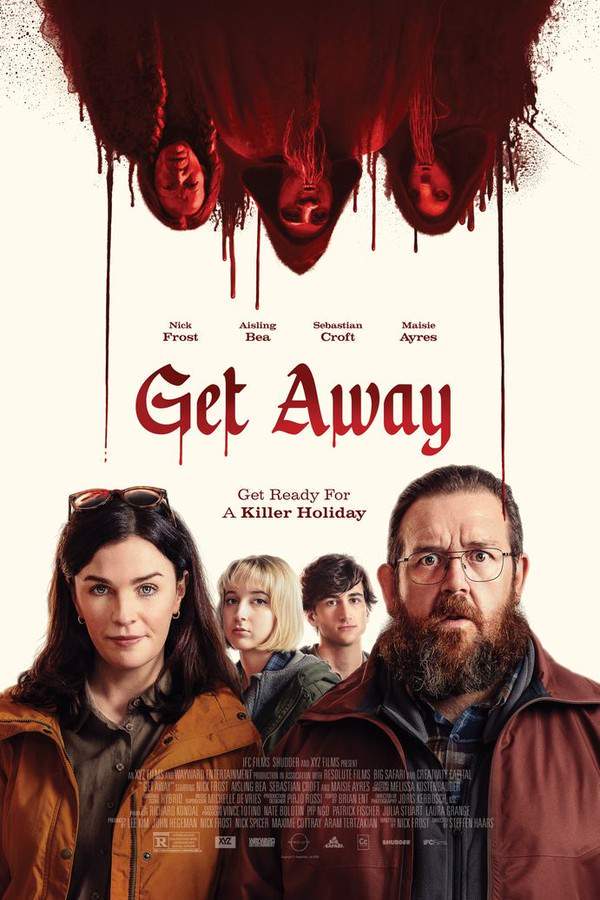
What Is Get Away About?
The premise of Get Away in 372 words, with nothing given away. The full story and the ending follow below.
The isolated Swedish island of Svalta sits far from the mainland, its rugged cliffs and mist‑shrouded woods providing a stark backdrop for a centuries‑old festival that the locals guard jealously. The community prepares for the event with a solemnity that feels both ancient and unsettling, hinting at traditions that have never fully emerged into daylight. The island’s stark beauty, with its frozen shores and wind‑swept moors, creates an atmosphere that is simultaneously captivating and unnerving—a perfect stage for a story that walks the line between folk horror and uneasy family drama.
At the heart of the film are Richard, a laid‑back father whose dry wit masks an undercurrent of anxiety; Susan, a mother whose stubborn curiosity is sparked by a personal connection to the island’s turbulent past; and their teenage children, Jessie and Sam, whose brash attitudes and sibling rivalry flavor the trip with palpable tension. The family’s dynamic feels familiar—a modern British household trying to carve out a shared experience while each member wrestles with their own doubts and desires. Their arrival coincides with the festival’s preparations, and the contrast between their casual expectations and the island’s austere rituals becomes a catalyst for both humor and dread.
Almost immediately, the Smiths sense that the locals are wary of outsiders. Stilted greetings, silent stares, and cryptic warnings from the ferry crew all suggest an unspoken rule about who may step onto Svalta’s shores during this time. As the family settles into a modest B&B, subtle oddities—disquieting glances, whispered conversations, and the occasional glimpse of masked figures—hint at a deeper, hidden current beneath the island’s picturesque surface. The tension builds not through overt threats, but through an ever‑present feeling that something in the community’s ritualistic preparation is deliberately being kept from view.
“Get Away” balances its scenic, almost lyrical portrayal of a remote Nordic landscape with a slowly tightening sense of claustrophobia and foreboding. The film invites viewers to wonder what lurks behind the islanders’ guarded customs and whether the Smiths will remain innocent visitors or become entangled in the dark heritage that the festival silently protects. The tone is a blend of eerie anticipation and dry British humor, promising a suspenseful journey that keeps the audience guessing long after the ferry departs.
What Happens in Get Away?
The complete story of Get Away, from the first scene to the last, in 892 words (about 4 minutes). Spoilers throughout. Names in the text link to 3 cast member pages.
Spoilers ahead
We are introduced to the Smith family—a quintessentially British clan about to swap city life for a coastal holiday. Father Richard, mother Susan, sister Jessie, and brother Sam appear to be a typical modern family, with the teenagers rubbing against their parents’ more measured pace. Their plan to catch a ferry to a remote island starts to feel off almost as soon as they arrive at the seaside restaurant, where the locals’ reactions run from wary to unnatural. The restaurateur and his wife warn them that the island is “forbidden” during Karantan, a superstition that is echoed by the ferry conductor and the ferry’s passengers, who stare with something more than ordinary curiosity.
When the Smiths disembark, the shoreline greets them with an uneasy silence—the kind that signals that things on the island are not as welcoming as they seem. The islanders, led by the stern elder Klara, make it clear that outsiders are not welcome. Susan’s curiosity is piqued by a buried family history—an ancestor who fought in a brutal massacre that one of Karantan’s stories claims as its center—and she wonders what truth might lie behind the island’s strict rules. Yet the locals’ hostility remains, and the family’s attempt to stay and understand what’s happening is met with mounting tension.
The plot thickens when Mats Larsson [Eero Milonoff], the owner of the bed-and-breakfast where the Smiths are staying, steps forward to invite them into the house. Mats’s warmth feels calculated, and his behavior oscillates between cordial and unsettling. The interior of the cottage is cozy and inviting, a stark contrast to Mats’s odd, almost obsessive demeanor—especially around Jessie. As Jessie begins to sense that she’s being watched, even during a private moment in her room, a sense of claustrophobic danger settles in.
That night, ominous signs intensify. Torches flare outside their home, and the Smiths discover the islanders’ troubling habit of gathering at their courtyard and leaving a chilling foreboding scene—an animal’s carcass on the doorstep that stirs fear and confusion in the family. Richard’s guarded calm and Susan’s suspicions reveal a marriage under strain, with hints of hidden experiences from Richard’s past that surface as the day’s quiet unease grows.
The islanders’ vigilance grows sharper as the Smiths explore the area. Richard and Susan notice boats from the mainland carrying coffins, a disturbing reminder that death and ritual are never far from the surface here. Jessie and Sam, too, encounter the locals’ strange hospitality—mask-wearing figures and coffins marked with ominous hints—before being pushed to leave the breakfast room. The siblings’ reactions are more defiant than their parents’, a small strand of resistance in a setting designed to break outsiders down.
A chilling moment unfolds when Jessie discovers a personal item out of place and a hidden danger behind a full-length mirror in her room, hinting at Mats’s secret life and his invasive interest in her. The elder Klara remains relentless, pressing on with a ritualistic fervor that she believes will secure the community’s future, even as younger members show signs of reluctance.
As the Karantan ritual advances, Mats is drawn deeper into the scheme. He uses a scheme involving drugged biscuits to entice the guests, seeking to satisfy a perverse appetite in exchange for delivering bodies to the community for feasting. The Smiths’ true nature is revealed in a shocking twist: they are not ordinary vacationers but a family with a history of killing, who have come to enact what they call a “slaycation.”
The chilling premise—Britain’s ostensibly ordinary family reveals itself as serial killers—unfolds with brutal clarity. The earlier hints of violence, including the restaurant beheading of a swan and a past murder by Richard, align with the present carnage as the Smiths begin to turn on the islanders with ruthless efficiency. As the islanders push back, the family’s plan to remain undetected begins to crumble. Sam and Jessie play key roles in resisting the locals and confronting the broader conspiracy at the heart of the island’s traditions.
The confrontation intensifies as Klara’s dogmatic grip on the community collides with the Smiths’ predatory pragmatism. The Smiths, in turn, uncover the island’s surveillance setup and a hidden tunnel, which give them a tactical edge in their deadly game. In a climactic turn, police involvement arrives via a mainland detective who misreads the situation, seeing the islanders as aggressors while the Smiths’ violent spree continues to unfold. The detective’s arrival barely postpones the inevitable.
In the final act, the Smiths escape into a rough, bloody relief—though not without cost. A brutal standoff leaves one of the siblings gravely wounded, and the truth about Sam’s role—revealed as a hired killer—casts a new light on the group’s dynamics and Richard’s erratic, explosive temper. Klara’s last attempt to salvage control ends in a shocking confrontation with the law, as she is shot by the police inspector, who has been chasing the truth behind the killings.
The story closes on a paradoxical note: the Smith family is alive, albeit battered and scarred, and they depart the island by speedboat with a grim, almost delirious satisfaction. What begins as a misfit holiday becomes a savage, if darkly comic, meditation on family, ritual, and the lure of violence. The island’s strange, deadly customs collide with a family’s long-buried impulses, producing a tonal blend of suspense and teeth-clenching dark humor that lingers long after the credits roll.
Get Away Timeline: Every Key Event in Order
14 key events in the order they happen, from “Plan to visit Karantan begins” to “Escape to the mainland”. 14 events name a place, across 13 locations.
- 1
Plan to visit Karantan begins
The Smiths stop at a coastal restaurant to buy ferry tickets for the island. The restaurateur warns that the island is forbidden during Karantan, and the ferry conductor and passengers give them eerie looks. The family remains determined to continue, seeing the trip as a fresh adventure.
When:Evening Where:Coastal restaurant
- 2
Ferry ride and unnerving welcome
They take the ferry to Karantan and disembark to a shore crowded with islanders who seem to watch them with dead eyes. Klara, the Svaltan elder, warns outsiders to leave. The tension hints at deeper mysteries beneath the island's surface.
When:Evening Where:Shore of Karantan island
- 3
Mats Larsson's unsettling reception
Mats greets the Smiths at the duplex cottage with a cheerful but off-kilter veneer. The interior is cozy, yet his behavior suggests something perverse beneath the surface. A chilling backstory about his mother’s beheading is implied, adding to the dread.
Where:Mats's duplex cottage
- 4
Jessie suspects surveillance
Jessie takes a bath and notices voices behind the full-length mirror in her room. She begins to sense that she is being watched, a clue to the island’s invasive rituals. The eerie discovery foreshadows the town’s sinister secrets.
Where:Jessie's room
- 5
Torches, isolation, and a warning
That night, Richard and Susan are awakened by torches outside their courtyard. The islanders gather and leave a beheaded raccoon at the doorstep, signaling a hostile welcome. The family realizes their situation on the island is far from hospitable.
When:Night Where:Smiths' cottage courtyard
- 6
Island surveillance and mainland coffins
During a stroll, Richard and Susan see the islanders keeping watch on them. They also observe boats from the mainland delivering coffins to the island, deepening the sense of ritual surrounding death. The atmosphere grows increasingly ominous.
Where:Island paths / surrounding coast
- 7
Breakfast run-ins with masked villagers
Both Jessie and Sam are confronted by unwelcome islanders at breakfast and are forced to leave. They glimpse masked figures and a coffin labeled 'English sailors' as the villagers mock their disbelief. The encounter cements the island's hostility toward outsiders.
Where:Island breakfast hall
- 8
Karantan begins and Mats's biscuits
Karantan proper begins and Mats hatches a plan to indulge his perverse impulses by baking biscuits laced with drugs. He carries them to the Smiths as a surprise, hoping to enable his control over the guests. The moment frames the community’s complicity in the festival’s grisly ethics.
When:During Karantan Where:Mats's kitchen
- 9
The Smiths reveal the 'slaycation' and kill Mats
The Smiths pretend to eat the biscuits and momentarily appear unconscious to Mats’s surprise. They reveal they are a family of serial killers on a 'slaycation' and gruesomely kill Mats, dismembering him. The shocking act confirms their dangerous, hidden identity.
Where:Mats's house
- 10
The massacre begins
With Karantan in full swing, the Smiths turn their violence on the islanders, attacking at random and decimating the community. Even the earlier threats and warnings seem trivial against the family’s cold-blooded efficiency. The island's resistance quickly crumbles.
Where:Karantan island
Show the other 4 events of Get Away Hide the last 4 events
- 11
Richard's rage and Sam's reveal
In a cruel escalation, Richard stabs Sam, breaking the façade to reveal that Sam is a hired killer. The revelation complicates the family dynamic and raises the stakes for their escape plan. The carnage intensifies as loyalties blur.
Where:Smiths' residence / island
- 12
Klara, Jessie, and the fight inside Mats's house
Klara and her son force their way into Mats's house and find Jessie dying from a gunshot wound. Richard confronts them in a brutal confrontation, and a violent clash ensues, ending with Richard losing his hand in a gun blast. The family’s ruse begins to crumble under pressure.
Where:Mats's house
- 13
Detective arrives and Klara falls
A mainland detective arrives and misinterprets the carnage as islanders attacking tourists, then shoots Klara in a misguided act of justice. The misunderstanding frays the local loyalties further and pushes the situation toward a rapid close. The Smiths brace for the consequences of the misjudged raid.
Where:Mats's house / island
- 14
Escape to the mainland
The Smiths are taken away on a speedboat back to the mainland, battered, bloodied, and exhilarated by their violent vacation. They return to normal life with the memory of their spree fueling a toxic sense of triumph. The film closes on a disturbing note about a family that finds joy in murder.
When:End Where:Mainland coast
Who Are the Main Characters in Get Away?
6 characters, among them Richard (Nick Frost), Susan (Aisling Bea) and Jessie (Maisie Ayres): who each one is and the part they play in the story. 4 of them link to the actor’s page.
-

Richard (Nick Frost)
Played by Nick Frost
The Smith family patriarch appears charmingly protective but harbors a violent past. His calm demeanor dissolves into brutal acts, and he asserts control over the family’s violent impulses. He is capable of cold calculations, and his actions culminate in shocking betrayals during the island ordeal.
- 🔪 Violent
- 🧭 Secretive
- 👨👦 Family-man
-

Susan (Aisling Bea)
Played by Aisling Bea
The matriarch who is curious and stubborn, drawn to uncover the island’s secrets while clinging to family loyalty. Her skepticism about the locals clashes with her desire to understand her ancestor’s past. She becomes a key force in challenging the island’s deadly dynamics.
- 🧭 Curious
- 🧬 Complex
- 🛡️ Protective
- J(
Jessie (Maisie Ayres)
The sister who is perceptive and bold, often questioning the islanders and the family’s intentions. She becomes entangled with Mats and plays a pivotal role in the family’s deception. Jessie’s observations drive the tension between outsiders and locals.
- 🎭 Rebellious
- 🧠 Observant
- 🫶 Cautious
- S(
Sam (Sebastian Croft)
Played by Sebastian Croft
The son who is revealed to be a hired killer, a key piece of the family’s murderous operation. He embodies a chilling efficiency and detachment that underscores the film’s bleak humor. His presence adds a dangerous dynamic to the vacation.
- 🗡️ Calculated
- 🧬 Serial-killer
- 🔍 Mysterious
- ML
Mats Larsson (Eero Milonoff)
Played by Eero Milonoff
The charming but unsettling B&B owner whose welcome mask hides voyeuristic predation and a willingness to manipulate outsiders. He uses secret tunnels and CCTV to surveil guests, foreshadowing the island’s darker undercurrents. His perverse curiosity makes him a dangerous local ally.
- 🕳️ Hidden
- 🗝️ Secret
- 🧩 Perversity
- K(
Klara (Anitta Suikkari)
Head of the Svalta community, dedicated to the Karantan ritual and its grisly traditions. She embodies dogmatic authority and fanatical devotion to the festival, driving the conflict with a relentless sense of duty. Her actions reveal how leadership can magnify violence.
- 🎭 Leader
- 🧭 Insular
- ⚖️ Dogmatic
Where and When Is Get Away Set?
Get Away is set in Svalta Island and Mainland (Contemporary, present-day). Here is why the time and place matter to the story.
When
Contemporary, present-day
The story unfolds in present-day times, with the Smith family on a vacation that collides with an insular community's age-old Karantan festival. Traditional rituals and fear clash with modern attitudes, creating tension between outsiders and locals. The setting uses familiar modern trappings (cars, phones, media) alongside archaic rites and brutal violence.
Where
Svalta Island, Mainland
The action centers on Svalta Island, a secluded community off the coast where outsiders are warned away during the Karantan ritual. Visitors arrive by ferry from the mainland, then encounter a cozy yet claustrophobic atmosphere in a duplex cottage and nearby village. The island blends tight-knit tradition with secret spaces—tunnels, watchers, and a beheaded restaurant corpse—that hint at deadlier games beneath the surface.
- 🏝️ Island setting
- 🧭 Isolation
- 🎭 Folk horror
What Are the Themes of Get Away?
3 ideas the story keeps returning to, among them Family secrets, Isolation & intrusion and Tradition vs modernity.
-
01
Family secrets
A cheerful family façade hides a brutal truth: each member participates in deadly activities, turning a vacation into a chilling example of a family noir. The film explores how outwardly normal households shield violent histories and complicity in murder. The tension arises from how far love, loyalty, and protective instincts can drive them to rationalize atrocity.
-
02
Isolation & intrusion
The remote island isolates the Smiths from the outside world, amplifying fear and suspicion. Outsiders are systematically kept at bay, with the residents controlling access through ritualized customs and surveillance. The clash between insular traditions and tourist curiosity fuels the suspense and danger.
-
03
Tradition vs modernity
Karantan rituals demand adherence and sacrifice, clashing with contemporary sensibilities and moral boundaries. The islanders' insistence on tradition tests the family’s willingness to participate in violence to survive. The tension lies in whether ancient customs can justify present-day brutality.
How Does Get Away End?
The last act of Get Away and what it means, in 287 words. The ending lands as mixed. Big spoilers: read the plot summary first if you have not seen it.
The final act, in full
In the end, it is revealed that the Smith family, who initially appeared to be normal tourists, were actually a family of serial killers. They had come to the island with the intention of repeating the brutal history of the locals’ ancestors—who once resorted to cannibalism to survive. The family’s true nature was uncovered after they drugged themselves with Matts’ cookies, which contained a sleeping agent. While unconscious, they were vulnerable and revealed their murderous side: Robert and Susan had been working together for some time to kill and hunt for their own thrill, with Jessie and Sam joining in their bloodlust. The family stabbed Matts in retaliation for his voyeurism and then turned on the remaining inhabitants, killing people at random and mimicking the island’s gruesome past.
Klara, the community leader, refused to accept the massacre and plotted to continue the tradition of sacrifice, hoping to offer the English family to their ancestors. However, her obsession blinded her to the chaos unfolding, and she was ultimately shot by Detective Forsberg, who mistook her for the true culprit. In the chaos, the family managed to escape with the help of the police, who believed them to be victims. As the dust settled, it became clear that the Smith family had successfully hidden their murderous nature by pretending to be an ordinary family. Their ability to blend in undetected allowed them to continue their pattern of hidden violence, setting the stage for their continued presence as a dangerous, untraceable serial killer family. The island was left silent, with the horrific cycle of violence repeating itself, seemingly never to be stopped. The ending underscores how appearances can be deceiving and how evil can lurk behind the most ordinary facades.
What Kind of Film Is Get Away?
Dark in tone, with steady pacing and a moderate story, going by the plot summary.
- Tone
- Dark
- Pacing
- Steady
- Story
- Moderate
- Intensity
- High
- Ending
- Mixed
A steadily paced and deeply unsettling horror-comedy that traps a family of killers in a claustrophobic community with its own dark ritual, creating a tense and sinister atmosphere punctuated by brutal violence and dark humor.
- claustrophobic
- unsettling
- darkly comic
- tense
- sinister
- paranoid
- family secrets
- cannibalism
- isolated community
- ritualistic violence
Content notes: cannibalism, murder, stalking, animal death, child endangerment.
Quiz
How well do you remember Get Away? Test yourself on the story.