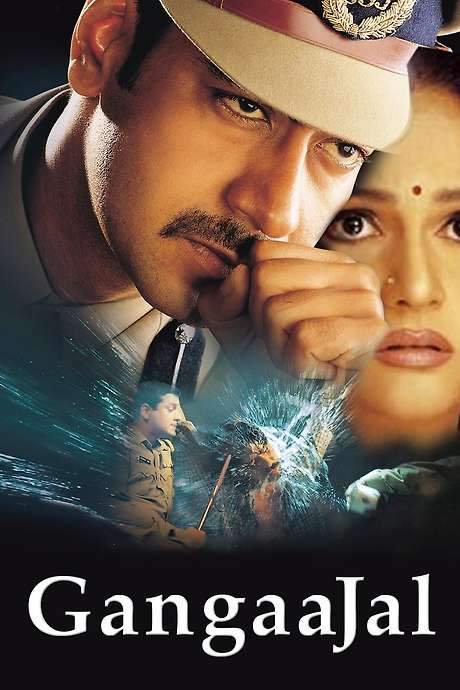
Gangaajal 2003

Directed by

Prakash Jha
Made by

Gangaajal Plot Summary
Read the complete plot summary and ending explained for Gangaajal (2003). From turning points to emotional moments, uncover what really happened and why it matters.
SP Amit Kumar arrives in Tejpur, a district wracked by crime and a police force weighed down by crumbling infrastructure, outdated weaponry, and a troubling dependence on corrupt local contractors. He quickly sees professional laxity among officers and a system where power and fear shape every investigation. The town’s stability seems to hinge on the influence of Sadhu Yadav and his son Sunder Yadav, a brutal duo who dominate through intimidation and a web of favored allies.
Early on, the police drama intensifies when Inspector Bachcha Yadav, a loyal servant of Sadhu, visits Sadhu’s hideout and encounters the infamous Nunwa. After a heated confrontation, Nunwa is killed in what is presented to the public as an encounter, a move that racks the department with tension and questions. Amit soon grasps that Nunwa’s fate is tied to Sadhu, and Bachcha is suspended as punishment. A desperate Bachcha seeks help from Sadhu, only to learn that his patron has abandoned him, leaving him exposed and vulnerable.
The case then pivots to a kidnapping: Sunder Yadav abducts a missing young woman, drawing Amit into a high-stakes pursuit. He persuades the mother of the kidnapped woman to file a complaint, hoping to press the case forward. Bachcha, sensing an opportunity to regain leverage, pressures Amit to advance the investigation. The operation culminates in a staged arrest—Sunder is lured into a factory where Amit and his team close in. A brief clash leaves Sunder in custody, and the local court soon becomes a theater of setback as the woman’s mother withdraws testimony after threats from DIG Verma, who openly supports Sadhu. With the lack of credible evidence, the judge frees Sunder, exposing a miscarriage of justice that fuels public anger and disillusionment.
In a move that shocks Tejpur, Sadhu’s men attempt to vandalize the shop of a pan vendor who testified against Sunder. Amit steps in, halts the mob, and has the attackers jailed. As the tension rises, Sunder’s henchmen collide with Bachcha’s officers, and a violent incident in the jail—acid being thrown into the eyes of rivals, a vicious act locally dubbed gangaajal—becomes a symbol of vigilante justice veering out of control. The blast of fear reverberates through the city, and Anuradha is caught in the crossfire, wounded by acid.
Gangaajal, once a phrase tied to the law, becomes a tool of extra-judicial punishment that awakens a divided Tejpur. Most officers deny involvement, yet Bachcha confesses in a letter he later abandons at Amit’s desk, revealing the depth of complicity within the system. Tragedy follows quickly: Bachcha returns home to discover Sunder has taken his wife and child hostage, and in a final clash, Sunder kills Bachcha by shooting him in the eyes. Enraged and determined, Amit issues a search warrant for Sunder and demands that Sadhu compel him to surrender. Yet political influence looms large; Sadhu backs his son through a minister, and Sunder is released on bail despite Amit’s protests. The escalation continues when Sunder disrupts a marriage, and his mother’s life ends in despair as she takes her own life after the catastrophe left in his wake.
Amit detains Sadhu and Sunder, hoping to keep them off the streets, but the fury of a grieving mob roars through Tejpur. He resists their demand for instant vengeance, insisting that law and order must prevail. The crowd’s rage, however, cannot be fully contained, and Sadhu and Sunder slip away only to stage a final, desperate confrontation at a family’s home. In a brutal turn of fate, the two fall onto a plough, their eyes pierced—killing them in a symbolic end that underscores the film’s central tension between justice and vigilantism.
Gangaajal Timeline
Follow the complete movie timeline of Gangaajal (2003) with every major event in chronological order. Great for understanding complex plots and story progression.
Amit Kumar arrives in Tejpur to confront a corrupted system
Inspector Amit Kumar arrives in Tejpur, a district wracked by crime and a police force weighed down by crumbling infrastructure. He immediately sees laxity and a system where fear and influence shape every investigation. The town's stability seems tied to Sadhu Yadav and his son Sunder, whose brutality masks the rot at the core of law and order.
Nunwa encounter and Bachcha's suspension
Bachcha Yadav visits Sadhu's hideout and encounters Nunwa, leading to Nunwa’s death in what is framed as an encounter. The incident triggers a suspension for Bachcha and deepens his loyalty test to Sadhu. He seeks help from Sadhu, only to discover that his patron has abandoned him.
Sunder abducts a missing woman; Amit acts
Sunder Yadav abducts a missing young woman, triggering a high-stakes pursuit. Amit persuades the woman’s mother to file a formal complaint to press the case forward. Bachcha pressures Amit to intensify the investigation, seeing an opportunity to regain leverage.
Factory stakeout and staged arrest
Sunder is lured into a factory where Amit and his team close in, culminating in a brief clash and Sunder’s capture. The case stalls when the woman’s mother withdraws testimony after threats from DIG Verma, who openly supports Sadhu. The judge later rules without credible evidence, freeing Sunder.
Judicial setback and miscarriage of justice
With no credible evidence, the local judge frees Sunder, signaling a miscarriage of justice that inflames public anger. The decision reinforces a perception that the system is under the influence of Sadhu and his allies. Amit vows to expose the truth despite the setback.
Vandalism attempt and Amit’s intervention
Sadhu’s men attempt to vandalize the pan vendor’s shop who testified against Sunder. Amit steps in to halt the mob and orders the attackers jailed, asserting that justice must operate within the law. The incident heightens tensions between reform-minded officers and corrupt elements.
Jail violence and the gangaajal moment
Tensions flare as Sunder's henchmen clash with Bachcha's officers, and acid is thrown into rivals’ eyes inside the jail in a brutal act locally dubbed gangaajal. Anuradha, caught in the crossfire, is wounded. The city spirals as vigilante violence circulates through the institutions.
Bachcha’s confession to Amit
Bachcha writes a letter confessing his complicity in the corrupt system and leaves it at Amit’s desk. The confession exposes the depth of institutional complicity and hints at links to Sadhu’s network. Amit is left to confront the magnitude of the rot within the department.
Bachcha’s family hostage and murder
Bachcha returns home to find his wife and child hostage, a grim consequence of the power struggle surrounding Sunder. In the final confrontation, Sunder shoots Bachcha in the eyes, killing him. The violence underscores the reach of vengeance when the system falters.
Amit detains the culprits but the crowd demands vengeance
Amit detains Sadhu and Sunder, attempting to keep them from the streets and prevent mob justice. He urges that the law must prevail, but the crowd’s fury proves difficult to quell. Sadhu and Sunder slip away, mounting a final stand elsewhere.
Final confrontation and death of Sadhu and Sunder
The final confrontation unfolds at a family's home where Sadhu and Sunder confront Amit’s pursuit. They crash onto a plough and are fatally pierced in the eyes, a brutal, symbolic end that seals the film’s tension between justice and vigilantism. The city watches as the two power brokers die in a shocking moment.
Aftermath and the divided Tejpur
Gangaajal becomes a grim symbol of extra-judicial punishment and the fault lines within Tejpur’s institutions widen. Most officers deny involvement, but Bachcha’s confession and the public mood reveal deep-seated fractures between reformers and entrenched powers. The story closes with a wary sense of the price paid for attempting to restore order.
Gangaajal Characters
Explore all characters from Gangaajal (2003). Get detailed profiles with their roles, arcs, and key relationships explained.
SP Amit Kumar (Ajay Devgn)
Amit Kumar arrives in Tejpur determined to enforce the law despite systemic decay. He embodies an ideal of integrity and perseverance, challenging lazy officers and corrupt patrons. His resolve to pursue a legitimate investigation creates friction with entrenched power. He must navigate moral dilemmas as violence and political pressure threaten to derail justice.
DIG Verma (Mohan Agashe)
Verma is a high-ranking police official who openly supports Sadhu and manipulates the investigation to protect powerful interests. His cabal against accountability reveals how political clout can derail justice. He uses threats and influence to derail witnesses and bend outcomes in favor of the powerful.
Inspector Bachcha Yadav (Mukesh Tiwari)
Bachcha is a loyal but compromised officer whose allegiance to Sadhu traps him in a web of corruption. His suspension following the Nunwa incident signals his vulnerability to patronage. His eventual downfall underscores how loyalty to criminal power can be deadly.
Sadhu Yadav (Mohan Joshi)
Sadhu is a brutal patriarch who rules Tejpur through fear and patronage. His influence extends into politicians and officers, shaping the city’s order. He views Sunder as an instrument of control and uses intimidation to maintain power.
Sunder Yadav (Yashpal Sharma)
Sunder is Sadhu’s hot-headed enforcer, abducting and terrorizing to advance his family’s grip on Tejpur. His violence catalyzes the case and exposes the costs of unchecked power. He meets a brutal end alongside his father, highlighting the collapse of their criminal regime.
Anuradha (Gracy Singh)
Anuradha is a central figure affected by the case, caught in the crossfire of violence and political games. Her experience underscores the human cost of corruption and the turmoil tearing Tejpur apart. Her presence represents the victims and the fragile line between law and danger.
Inspector Neelkanth Tiwari (Anup Soni)
Neelkanth is a frontline investigator in Tejpur, grappling with pressure from corrupt powers and the need to keep the case moving. He embodies the challenges ordinary inspectors face when institutions falter. His role highlights the tension between duty and fear within the police.
Gangaajal Settings
Learn where and when Gangaajal (2003) takes place. Explore the film’s settings, era, and how they shape the narrative.
Location
Tejpur
Tejpur is a district plagued by crime and a police force weighed down by crumbling infrastructure and corruption. The town's stability hinges on the influence of powerful patrons like Sadhu Yadav and his son Sunder, who intimidate investigators and shape outcomes. The city serves as a microcosm of justice and oppression, where fear governs every arrest and testimony.
Gangaajal Themes
Discover the main themes in Gangaajal (2003). Analyze the deeper meanings, emotional layers, and social commentary behind the film.
⚖️
Justice
Amit Kumar's effort to uphold due process unfolds amid systemic decay. The film contrasts formal law with vigilante action, showing how fear and favoritism erode justice. Power and corruption derail investigations, revealing the fragility of due process in Tejpur. Amit's persistence tests ethical boundaries as violence escalates.
🏛️
Corruption
The story presents corruption as a web linking police, politicians, and criminals. Bribes, threats, and manipulation thwart accountability and protect the guilty. The term gangaajal becomes a symbol of extrajudicial punishment born from compromised institutions. The narrative suggests that corruption functions as a systemic force rather than isolated acts.
🔥
Power
Power is wielded through fear, patronage, and control of information. Sadhu and Sunder manipulate police, legal processes, and the mob to bend Tejpur to their will. As authority buckles under influence, violence spirals, illustrating what happens when power goes unchecked.

Coming soon on iOS and Android
The Plot Explained Mobile App
From blockbusters to hidden gems — dive into movie stories anytime, anywhere. Save your favorites, discover plots faster, and never miss a twist again.
Sign up to be the first to know when we launch. Your email stays private — always.
Explore the mobile appGangaajal Spoiler-Free Summary
Discover the spoiler-free summary of Gangaajal (2003). Get a concise overview without any spoilers.
In a remote district where the heat of summer seems to melt the thin veneer of order, the streets pulse with an uneasy mix of fear and resignation. Dilapidated police stations lean against crumbling walls, and the hum of everyday life is constantly punctuated by the whisper of unseen power brokers. The town’s atmosphere feels taut, a place where the ordinary and the lawless coexist in a fragile balance, and any ripple can quickly become a wave.
Amit Kumar arrives as the new Superintendent of Police, a figure whose reputation for integrity precedes him. Trained in the rigor of the IPS, he carries the weight of an idealistic vision that the badge can be more than a symbol of authority—it can be a catalyst for genuine change. His arrival is met with a mixture of cautious hope and wary skepticism, as the local force wrestles with outdated equipment, internal complacency, and a culture that has long learned to navigate the gray zones between duty and survival.
The film’s tone is unflinching and grounded, painting the challenges of policing in a place where corruption has seeped into both the uniform and the corridors of power. As Amit begins to assess the labyrinthine network of influence that sustains the town’s turmoil, the story hints at a deeper, systemic rot that reaches beyond isolated crimes. The narrative invites the audience to feel the tension between the protagonist’s steadfast moral compass and the inertia of an entrenched system that resists reform.
Through stark visuals, hushed dialogues, and an ever‑present sense of urgency, the movie sets up a compelling clash between principle and practice. It teases the question of whether one determined officer can reshape a community mired in decay, leaving viewers poised on the edge of a story where every decision carries the weight of both justice and consequence.
Movies with Similar Twists and Themes
Uncover films that echo the narrative beats, emotional arcs, or dramatic twists of the one you're exploring. These recommendations are handpicked based on story depth, thematic resonance, and spoiler-worthy moments — perfect for fans who crave more of the same intrigue.




Featured on this page

What's After the Movie?
Not sure whether to stay after the credits? Find out!
Check out our other apps:

SAT Sphere
Build confidence for the Digital SAT.

Mori Atlas
Discover wild places worth protecting.

Luntero
Search smarter for a home in Amsterdam.

Plot Explained
Unravel movie endings and hidden clues.

Pokechamp
Dive into Pokémon data and battle logic.

Driving Theory
Get ready for your European theory test.

Movie Dust
Plan your next cinema trip with ease.

Musemap
Find art and culture as you travel.

Selkobase
Compare credentials before committing.

Local Manual
Turn an unfamiliar country into practical next steps.

Lernavi
Compare school systems before your next move.

GymRoam
Find a workout stop wherever your plans take you.
Explore Our Movie Platform
New Movie Releases (2026)
Famous Movie Actors
Top Film Production Studios
Movie Plot Summaries & Endings
Major Movie Awards & Winners
Best Concert Films & Music Documentaries
Movie Collections and Curated Lists
© 2026 What's After the Movie. All rights reserved.
Privacy Policy