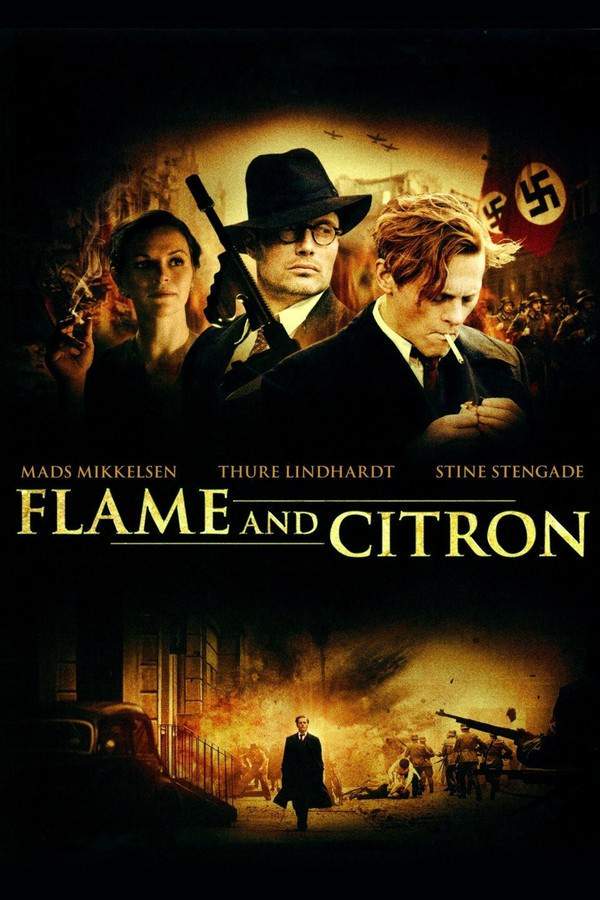
What Is Flame and Citron About?
The premise of Flame and Citron in 319 words, with nothing given away. The full story follows below.
In the waning months of World War II, Denmark lives under the heavy shadow of Nazi occupation. The streets of Copenhagen hum with a tense mixture of fear and quiet defiance, as an underground movement stitches together fragments of hope amid ever‑tightening constraints. Within this fraught landscape, a pair of young resistance fighters emerges, bound by a fierce loyalty to one another and to a cause that demands both courage and sacrifice.
Bent Faurschou Hviid, known by the code name “Flame,” moves with restless energy, his determination tempered by moments of doubt. Beside him stands Jørgen Haagen Schmith, the stoic “Citron,” whose resolve provides a steady counterpoint to Bent’s impulsive spark. Their partnership is a study in contrast—flame and citrus, heat and cool—yet each relies on the other to navigate the moral labyrinth of clandestine warfare. Together they confront the daily grind of secrecy, the strain of living double lives, and the relentless pressure of making choices that could endanger not only themselves but the very people they strive to protect.
The resistance’s network is a tangled web of contacts and hidden motives. A courier who appears in a dimly lit bar introduces an element of intrigue, hinting at the complex layers of allegiance that define the struggle. Their handler, a figure with shifting loyalties, adds another strand to the delicate balance of trust and deception that the pair must constantly negotiate. These interactions paint a portrait of an underground world where every whispered message carries weight, and where the line between friend and informant is perpetually blurred.
Against this backdrop looms the figure of the Gestapo’s chief, a symbol of the occupying force’s uncompromising grip. The atmosphere is one of perpetual suspense, a chiaroscuro of hope and peril that colors every decision. The film’s tone remains gritty and intimate, emphasizing the psychological toll of resistance work while leaving the precise outcomes of their daring endeavors to the imagination.
What Happens in Flame and Citron?
The complete story of Flame and Citron, from the first scene to the last, in 642 words (about 3 minutes). Spoilers throughout.
Spoilers ahead
Set in the aftermath of the Nazi invasion of Denmark, the film follows two young resistance fighters, Bent Faurschou Hviid (Flammen) and Jørgen Haagen Schmith (Citronen), as they operate under immense pressure and moral doubt. In a Copenhagen bar, Bent is drawn to a woman who identifies herself as Ketty Selmer, a courier carrying messages between Stockholm and Copenhagen. This encounter pulls them into a web of danger, loyalty, and shifting alliances that define their arduous campaign.
Their handler, Aksel Winther, pushes them to take out three Abwehr officers—Elisabeth Lorentzen, Horst Gilbert, and Hermann Seibold—to weaken German intelligence. Bent and Jørgen weigh the consequences: killing fellow Danes invites harsher reprisals on their countrymen, yet the mission presses forward. Winther insists he is acting under orders from the Danish government in exile, setting up a conflict between expediency and ethics that haunts every decision they make. Bent succeeds in killing Lorentzen, but he and Jørgen fail to eliminate Gilbert and Seibold, a setback that intensifies the danger around them.
A quiet, painful strain grows at home for Jørgen and his wife, Bodil, who struggle with money and secrecy. Their daughter Ann’s birthday is celebrated in a car with little money to spare, and Bodil confesses to having an affair, adding personal risk to the already fraught resistance struggle. The situation worsens as the Gestapo expands its crackdown and more resistance members are killed. Winther begins to suspect an informant, and Ketty’s true role surfaces in the shadows.
Ketty reveals to Bent that she works for Winther and for Danish army intelligence, and that Winther’s loyalties do not align with the British. The revelation destabilizes Bent’s trust and forces the resistance to reassess who can be trusted. Bent and Jørgen uncover that Winther has fled to Stockholm, and they sense they have walked into a trap; yet they manage to escape the Gestapo’s net. Their next objective shifts toward taking down the Gestapo’s favorite leader, Karl Heinz Hoffmann, and seizing control of a restaurant favored by the occupation forces, a symbolic and strategic blow.
In a tense turn, Ketty warns Bent that army intelligence wanted her near Hoffmann, hinting at the complexity of their counterintelligence operations. Bent learns from a contact named Ravnen the possible real informer’s name, and Jørgen kills Ravnen to protect the mission’s integrity. Bent visits his father, who runs a hotel and reveals that Hoffmann, his associates, and mistresses visit from time to time, foreshadowing the clash that lies ahead. Ketty arrives at the hotel in Hoffmann’s company, confirming Bent’s worst fears about her ties to Hoffmann and the lengths to which he will go to stay informed.
On the road, Bent, Jørgen, and their allies ambush two cars bearing Nazi flags, only to discover they have killed a father and wounded a child. Bent is outraged by the unintended civilian tragedy and confronts Ketty, who has since flown to Stockholm, fearing retaliation. The plan to confront Hoffmann again remains, but the situation grows increasingly perilous. The resistance group refuses offers of formal positions in the Danish Army, choosing instead to pursue direct action and political impact.
As the net tightens, Bent and Jørgen face a brutal round-up that imprisons many of their comrades. Jørgen escapes a fence but dies in a skirmish at a safe house when German forces strike with submachine guns and grenades. Bent, back at his home, takes a cyanide pill and ends his life as the Gestapo closes in. Hoffmann later rewards Ketty for helping apprehend Bent, adding a final, bleak note to the loyalty and betrayal that shaped their world, and a letter from Bent found in Hoffmann’s room reveals his inner feelings and doubts about Ketty’s fidelity. The film closes with a reflection on the legacies of Bent and Jørgen, marking their contributions and the costs they paid in the struggle against occupation.
Flame and Citron Timeline: Every Key Event in Order
15 key events in the order they happen, from “Occupation and order to attack Abwehr targets” to “Legacy and remembrance”. 15 events name a place, across 9 locations.
- 1
Occupation and order to attack Abwehr targets
After the Nazi invasion, Bent Flammen and Jørgen Citronen are ordered by their handler Winther to eliminate Abwehr agents. They debate against targeting Danes only to minimize German retaliation, but the mission proceeds as official instruction. The assignment sets the tone for the resistance's risky balancing of ethics and danger.
When:Early 1940s Where:Copenhagen, Denmark
- 2
Lorentzen killed; Gilbert and Seibold spared
Bent carries out the hit on Elisabeth Lorentzen, but fails to kill Horst Gilbert and Hermann Seibold. The resistance experiences the growing risk of exposure as their targets include German intelligence assets. The failure intensifies the pressure on Bent and Jørgen.
When:Shortly after the orders Where:Copenhagen, Denmark
- 3
Family birthday reveals hardship
Jørgen, his wife Bodil and daughter Ann celebrate Ann’s birthday in their car, highlighting their financial strain. Bodil reveals she is seeing another man, adding personal peril to their dangerous lives. The moment contrasts with the resistance’s clandestine world.
When:Evening during Ann's birthday Where:Copenhagen, Denmark
- 4
Spex urges pause for a larger plan
In a meeting with Spex from Danish Army Intelligence, they are told there will be no more attacks so a larger operation can be prepared. Bent and Jørgen decide to ignore the order and continue their activities. The disagreement underscores the tension between strategic restraint and bold action.
When:Later period during occupation Where:Copenhagen, Denmark
- 5
Gilbert is killed by Jørgen
Following the tension with Spex, Jørgen shoots and kills Gilbert, escalating the conflict with the Abwehr. Bent continues to be involved, but the resistance’s actions increase the Gestapo’s focus on them. The killing signifies a turning point in their campaign.
When:After Spex meeting Where:Copenhagen, Denmark
- 6
Robbery to support the family
That night, Jørgen robs a grocery store and brings the stolen goods to his family, attempting to ease their hardship. Bodil’s admission of seeing another man deepens the strain on their relationship. The line between resistance violence and personal desperation blurs.
When:That night Where:Local Danish towns near Copenhagen
- 7
Winther suspects informant
After several resistance members are killed by the Gestapo, Winther suspects there is an informer among them. The suspicion sets off a dangerous game of mistrust within the resistance. The stakes of betrayal become personal for Bent and Jørgen.
When:After multiple killings Where:Danish resistance network
- 8
Ketty reveals loyalty and involvement
Bent visits Ketty at her hotel and they have an intimate moment. Ketty then tells him she works for Winther and for Danish army intelligence, and that Winther is not working for the British. This revelation upends Bent’s assumptions about loyalties.
When:After the erotic encounter Where:Ketty’s hotel, Copenhagen
- 9
Ketty named informer; death order issued
In a later meeting, Winther identifies Ketty as the informer and orders her death to prevent exposure. Bent and Jørgen realize they may have been maneuvered by a web of lies. The trust between resistance members continues to erode.
When:Later stage in the plot Where:Bar/meeting room, Copenhagen
- 10
Winther escapes to Stockholm; trap realized
Bent and Jørgen search for Winther in a bar and discover that he has escaped to Stockholm, confirming that a trap has been set by the Gestapo. They manage to flee the ensuing pursuit and avoid capture for the moment. The chase exposes the danger of their networks across borders.
When:During the pursuit Where:Copenhagen and Stockholm, Denmark/Sweden
Show the other 5 events of Flame and Citron Hide the last 5 events
- 11
Plan to strike Hoffmann; ambush aborted
They decide to kill Karl Heinz Hoffmann, the Gestapo leader, and seize control of the Gestapo’s favorite restaurant. Bent aborts the plan when police approach, illustrating how close they are to discovery. The plan’s failure foreshadows the crackdown to come.
When:Planning phase; night Where:Copenhagen, Denmark
- 12
Ambush causes civilian casualties and Ketty flees
On the road, Bent, Jørgen and their group open fire on two cars bearing Nazi flags and tragically kill a father while wounding a child. Ketty flees to Stockholm fearing Hoffmann’s retaliation. The incident marks a brutal turning point in the resistance’s actions.
When:Ambush night Where:Road near Copenhagen
- 13
Round-up, Jørgen dies; Bent survives momentarily
During a general round-up of the German-allied Danish police, Jørgen leaps a fence and is shot, and later dies defending a safe house. Bent evades capture briefly but ultimately, with Gestapo closing in, his courage gives way to despair. The resistance leaders are crushed in the crackdown.
When:During the crackdown Where:Copenhagen, Denmark
- 14
Bent’s suicide and Ketty’s reward
Bent, back at his home, commits suicide with a cyanide pill as the Gestapo closes in. Hoffmann later rewards Ketty for helping capture Bent, and a letter from Bent is found, expressing his feelings and doubt about Ketty’s betrayal. The ending casts a stark light on loyalty and betrayal.
When:At the end of the crackdown Where:Bent’s home and Hoffmann’s location
- 15
Legacy and remembrance
The film closes with notes about Bent and Jørgen’s legacy, honoring their resistance work and the costs paid. Their actions are remembered in Danish history, serving as a somber reminder of the price of resistance. The narrative ends with a memorial tone that outlives the characters themselves.
When:Post-war Where:Denmark, post-war memory
Who Are the Main Characters in Flame and Citron?
6 characters, among them Bent Faurschou Hviid (Flammen), Jørgen Haagen Schmith (Citronen) and Ketty Selmer: who each one is and the part they play in the story.
- BF
Bent Faurschou Hviid (Flammen)
A devoted resistance fighter known as Flammen, Bent is fearless and deeply committed to stopping Nazi oppression. He weighs each mission to minimize civilian harm while accepting the necessity of violence. His resolve strains under personal loss and the pressure of living up to the cause, culminating in a solitary act as the Gestapo closes in.
- 🛡️ Loyal
- ⚖️ Moral conflict
- 🗡️ Courageous
- JH
Jørgen Haagen Schmith (Citronen)
Bent's partner in the resistance, Jørgen shares a fierce resolve and a willingness to risk everything for family and comrades. He is resourceful and decisive, sometimes reckless, which brings about deadly outcomes for enemies and, ultimately, his own death. He also tries to protect his wife Bodil and maintain a sense of normality for his daughter.
- ⚔️ Brave
- 💔 Loyal
- 🕯️ Tragic fate
- KS
Ketty Selmer
A courier who runs messages between Stockholm and Copenhagen, Ketty is revealed to be connected to Danish Army Intelligence and the person who helps trigger a chain of deadly events. Her loyalties shift, and her actions contribute to the eroding trust within the resistance. She flees to Stockholm and is rewarded for her role.
- 🕵️ Deception
- B
Bodil
Jørgen's wife, Bodil endures a strained marriage under the weight of her husband's dangerous work. She discovers he has another lover, reflecting the personal toll of living in wartime secrecy. Her perspective highlights the cost of resistance on family life.
- 💔 Family strain
- KH
Karl Heinz Hoffmann
A high-ranking Gestapo leader, Hoffmann embodies the brutality and efficiency of the occupiers. He becomes the primary target of the resistance’s plans and the focal point of Ketty’s information network. His presence intensifies the danger facing Bent and Jørgen.
- ⚔️ Brutality
- 🧭 Ruthless strategist
- S(
Spex (Danish Army Intelligence)
An intelligence officer who informs the resistance that there will be no more attacks and signals the need for a strategic pause ahead of a larger assault. Spex represents the political and strategic calculations that shape resistance actions.
- 🗺️ Intelligence
- 🧭 Strategic
Where and When Is Flame and Citron Set?
Flame and Citron is set in Copenhagen and Stockholm (1940s). Here is why the time and place matter to the story.
When
1940s
The events unfold during World War II when Denmark was under Nazi occupation. The era is defined by constant fear, undercover informants, and brutal crackdowns by the Gestapo. As missions escalate, the resistance fighters balance urgency with the need to protect civilians and loved ones.
Where
Copenhagen, Stockholm
Set in Nazi-occupied Denmark, the story centers on the resistance in Copenhagen, with Stockholm serving as a crucial escape and intelligence link. The urban scenes unfold in bars, safe houses, hotels, and back alleys where clandestine meetings take place. The occupation casts a constant threat of Gestapo action, shaping every risky decision.
- 🗺️ Occupied city
- 🛡️ Resistance backdrop
What Are the Themes of Flame and Citron?
3 ideas the story keeps returning to, among them Resistance, Betrayal and Moral Ambiguity.
-
01
Resistance
The film centers on ordinary Danes who become fighters against occupation. Bent and Jørgen embody dedication and courage as they carry out dangerous acts, while constantly weighing the cost of violence. Their loyalty to comrades and the cause pushes them to take risks that may invite retaliation. The narrative probes what people will endure to fight oppression.
-
02
Betrayal
Betrayal threads through relationships as Ketty Selmer is revealed to play a double role, acting as courier yet connected to intelligence and informants. Trust fractures when lines blur between ally and traitor, leading to deadly consequences. The pursuit becomes a game of cat and mouse where even friends may be targets. The ambiguity of loyalty drives much of the tension.
-
03
Moral Ambiguity
War-time violence forces characters to choose between hard-nosed pragmatism and moral restraint. The suppression of Nazi forces sometimes requires collateral harm, creating guilt and doubt. Personal loyalties collide with public duty, leaving characters to live with the consequences of their actions. The film ends by inviting reflection on what counts as victory.
What Kind of Film Is Flame and Citron?
Tense in tone, with fast pacing and a moderate story, going by the plot summary.
- Tone
- Tense
- Pacing
- Fast
- Story
- Moderate
- Intensity
- High
- Ending
- Bleak
A high-tension and bleak thriller that immerses the viewer in the morally complex and desperate world of resistance fighters, creating a constant sense of paranoia and inevitable tragedy.
- tense
- paranoid
- bleak
- suspenseful
- gripping
- morally ambiguous
- world war ii
- resistance movement
- moral compromise
- betrayal
Content notes: war violence, suicide, civilian casualties, betrayal, imprisonment.
Quiz
How well do you remember Flame and Citron? Test yourself on the story.