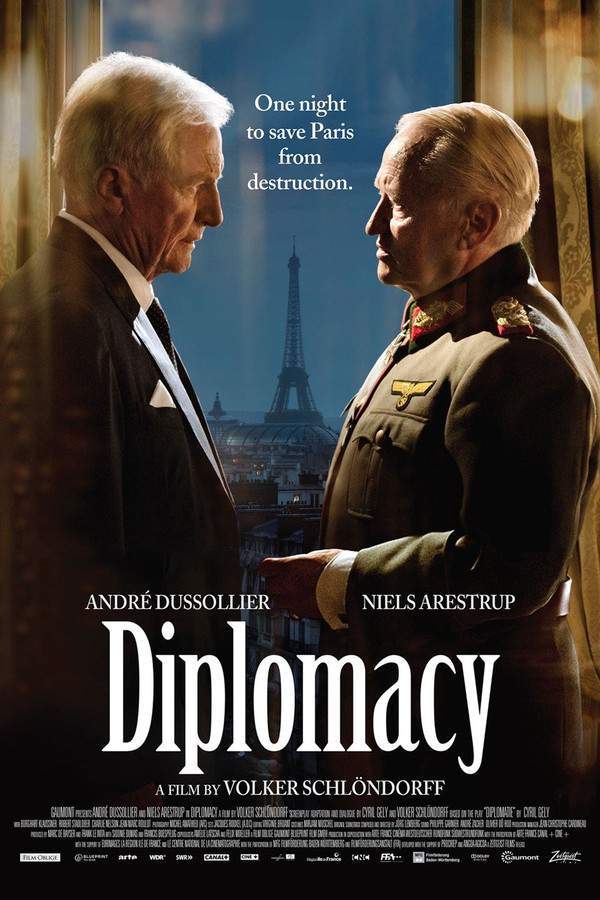
Diplomacy 2014


Directed by

Volker Schlöndorff
Made by

Zeitgeist Films
Where to Watch Diplomacy
See current US streaming, rental, and purchase options for Diplomacy (2014) via JustWatch.



Streaming availability powered by 
Diplomacy Plot Summary
Read the complete plot summary and ending explained for Diplomacy (2014). From turning points to emotional moments, uncover what really happened and why it matters.
As Allied forces push toward Paris, Adolf Hitler orders General Dietrich von Choltitz to destroy the city, turning a potential last stand into a calculated act of demolition. Choltitz responds by dispatching engineering teams to obliterate Paris’s most iconic sites and flood the Seine, a plan aimed at erasing the city’s memory even as it fights for its fate. The operation is led by Lieutenant Hegger and advised by a captured Parisian engineer, M. Lanvin. The list of targets reads like a catalog of Paris’s soul: the Eiffel Tower, the Louvre, the Place de la Concorde, Notre Dame Cathedral, and Les Invalides. The scale of destruction is framed not just in terms of concrete and stone, but in what it would mean for millions of lives caught in the crossfire of war.
Into this tense mix enters the Swedish consul, Raoul Nordling, who slips into the general’s office at the Hotel Meurice via a secret staircase once built for a famous courtesan. He speaks in practical terms about the human cost of devastation and pleads with Choltitz to spare Paris. Yet the general remains unmoved, asserting that his duty obligates him to follow orders, regardless of the personal toll it would take on the city and its people.
As Parisian streets erupt in revolt, gunfire and smoke become a daily rhythm for the people defending their home. Choltitz lays bare a chilling aspect of Nazi governance: the policy of Sippenhaft, which punishes the families of officers who disobey orders. Nordling attempts to downplay its significance, but Choltitz notes that the policy was issued at a moment when Hitler’s attention was squarely fixed on him as a promoted officer, a reminder that the dictator’s eyes—and expectations—were always watching.
In a turn that tests loyalties and calculus of courage, Nordling proposes a daring possibility: the French Resistance could try to evacuate Choltitz’s own family. He confesses a personal dilemma, admitting that he could not say with certainty whether he would choose to save his family or Paris if faced with the same choice. He argues, however, that choosing Paris would secure a longer-lasting legacy for him in history. Moved by this moral exchange, Choltitz relents and orders the halt to the demolition. An attempted ignition by Lt Hegger is prevented when Lanvin shoots him, sealing the decision to spare the city.
In the aftermath of the war, Choltitz serves a two-year prison sentence for his actions earlier in the Siege of Sevastopol. Nordling receives a medal for persuading Choltitz, but in a gesture of magnanimity, he passes the honor to the general, recognizing him—rather than the onlooker—as the true hero of the moment. The story closes on the quiet acknowledgment that the saving of Paris was not the work of a single act, but a complex web of choices, courage, and the fragile line between duty and humanity.
Diplomacy Timeline
Follow the complete movie timeline of Diplomacy (2014) with every major event in chronological order. Great for understanding complex plots and story progression.
Hitler orders Paris' destruction
With Allied forces closing in on Paris, Adolf Hitler commands General Dietrich von Choltitz to raze the city. He mobilizes engineering units to demolish iconic landmarks and even flood sections of the Seine, under Lieutenant Hegger and with input from a captured Parisian engineer named M. Lanvin. Targets include the Eiffel Tower, the Louvre, Place de la Concorde, Notre Dame, and Les Invalides.
Nordling infiltrates the German command at the Hotel Meurice
Swedish consul Raoul Nordling sneaks into the German command post at the Hotel Meurice via a secret staircase. He argues that destroying Paris will cost innocent lives and erode German credibility as the city relies on French support. Despite his plea, Choltitz remains unmoved, determined to carry out his orders.
Choltitz's resolve and the Sippenhaft warning
Choltitz is faced with Nordling's plea and the looming threat of reckoning for his actions. He acknowledges Hitler's Sippenhaft policy, which punishes the families of disobedient officers. The general insists he will fulfill his duty regardless of personal risk.
Parisians revolt against German patrols
As the standoff continues, Parisians take to the streets in revolt against the German patrols. Fighting erupts across the city, testing the occupiers' grip on Paris. The uprising adds moral pressure on the German command to reconsider.
Nordling presents a moral choice about family
Nordling proposes that the French Resistance could evacuate Choltitz's family to spare them from the coming carnage. He admits that he could not choose between saving his own family and saving Paris if placed in Choltitz's position. He suggests that choosing Paris would win him lasting recognition as a hero.
Choltitz relents and halts the demolition
Moved by Nordling's argument and the broader impulse to preserve the city, Choltitz cancels the planned demolition of Paris. The decision signals a turning point, even as the occupation still casts a shadow over the city. The fate of Paris rests on this moment of restraint.
The last-ditch attempt and Lanvin's intervention
Lt Hegger makes a final attempt to trigger the destruction despite the cancellation. Lanvin, the captured Parisian engineer, shoots Hegger to stop the plan. With the device neutralized, the city remains intact.
Germany's defeat and Choltitz's imprisonment
After the fall of Nazi Germany, Choltitz serves a two-year prison sentence for his actions during the Siege of Sevastopol. The punishment reflects the postwar reckoning with occupied-hero narratives. His case becomes a focal point in debates over duty and morality.
Nordling is honored, then passes the medal to Choltitz
Nordling is awarded a medal for persuading Choltitz, but he declines to keep it and presents it to the man who saved Paris. He frames Choltitz as the real hero of the story, elevating his courage above reputation. The gesture underlines the film's emphasis on duty over personal glory.
Choltitz's legacy and the postwar memory
In the aftermath, Choltitz's decision to spare Paris earns him nuanced recognition, while Nordling's role is celebrated as well. The film highlights how one officer's restraint altered the course of history. History remembers both men for their acts under pressure.
Paris endures; iconic landmarks survive
With Paris spared from destruction, its iconic landmarks survive the war and become symbols of resilience. The city begins to recover amid the ongoing recollection of occupation and liberation. The outcome underscores the stakes of wartime decisions.
The heroism of restraint over fire and fury
The final note contrasts heroic restraint with brutal orders, emphasizing that courage can take the form of choosing life over destruction. Nordling and Choltitz's duet of moral choices becomes the film's central message. The audience is left with a lasting sense of memory, gratitude, and the complexity of heroism.
Diplomacy Characters
Explore all characters from Diplomacy (2014). Get detailed profiles with their roles, arcs, and key relationships explained.
General Dietrich von Choltitz
A high-ranking German commander who is determined to fulfill his duty, even under the intense pressure to destroy Paris. He faces a moral moment when he must balance obedience with the potential loss of countless civilians and a city’s cultural heritage. The decision to cancel the demolition reveals his capacity for restraint and strategic calculation.
Raoul Nordling
The Swedish consul who risks his safety to negotiate with Choltitz. He understands the stakes of Paris’s destruction and uses diplomacy to sway the general, ultimately offering a moral choice that could define his legacy. His confrontation with the general exemplifies the power of persuasion in war.
M. Lanvin
A captured Parisian engineer who advises against destroying the city and acts decisively to thwart the demolition. His actions bridge practical engineering insight with moral conviction, turning the tide when Lt Hegger is stopped. Lanvin embodies civilian intelligence shaping military outcomes.
Lt Hegger
The officer in charge of the demolition plan who pushes to trigger it despite Choltitz's reluctance. He represents the obedience to orders in conflict with the broader humanitarian outcome. His downfall comes when Lanvin intervenes, ending the threat to Paris.
Diplomacy Settings
Learn where and when Diplomacy (2014) takes place. Explore the film’s settings, era, and how they shape the narrative.
Time period
1944
Set during the Allied advance on Paris in August 1944, the city faces a race against time as Nazi orders threaten to destroy its monuments. The tense moments hinge on whether the German commander will carry out a ruthless plan or be swayed by dialogue. The events encapsulate a pivotal moment in World War II, where the fate of Paris hangs on a single decision.
Location
Paris, Hotel Meurice
Paris is the central backdrop as Allied forces push toward the city while German officials evaluate turning it into a ruin. The threat centers on iconic landmarks—the Eiffel Tower, Louvre, Notre-Dame, and Les Invalides—placed at risk of demolition. The Hotel Meurice serves as a critical setting for clandestine diplomacy between Nordling and Choltitz.
Diplomacy Themes
Discover the main themes in Diplomacy (2014). Analyze the deeper meanings, emotional layers, and social commentary behind the film.
⚖️
Moral Dilemma
Choltitz is torn between obedience to higher command and the imperative to protect Paris. The film explores how duty can clash with humanity, forcing a leader to choose between two imperatives. Nordling's negotiations illuminate how personal choices can alter the course of history.
🗣️
Diplomacy
The Swedish consul uses dialogue and psychological leverage to persuade a general to spare a city. The secret stairway and tense exchanges highlight the power of words over weapons. The outcome shows how persuasion can redefine duty and honor in war.
🛡️
Courage
Lanvin stands as a quiet defender, risking his safety to countermand orders through practical action. The civilian resistance and the military officers’ decisions culminate in a moment where bravery resolves a crisis without further bloodshed. The film portrays courage as a collective, not merely a singular act.
🏛️
Heritage
The plan to demolish Paris’s landmarks threatens a shared cultural legacy. The narrative frames culture and history as vulnerable, worth protecting even when lives hang in the balance. The final act preserves Paris’s memory and its status as a symbol of resilience.

Coming soon on iOS and Android
The Plot Explained Mobile App
From blockbusters to hidden gems — dive into movie stories anytime, anywhere. Save your favorites, discover plots faster, and never miss a twist again.
Sign up to be the first to know when we launch. Your email stays private — always.
Explore the mobile appDiplomacy Spoiler-Free Summary
Discover the spoiler-free summary of Diplomacy (2014). Get a concise overview without any spoilers.
In the winter of 1944, the streets of Paris tremble under the weight of an impending catastrophe. As Allied forces close in, the city’s iconic skyline and bustling cafés become a backdrop to a dangerous command that threatens to erase centuries of culture in a single, calculated act. The atmosphere is charged with the clang of artillery and the whispered fear of citizens who sense that the fate of their beloved capital hangs by a thread.
The central figure is Dietrich von Choltitz, a German general tasked with carrying out Hitler’s destructive order. Trained in rigid obedience, he stands at a crossroads where military duty collides with the palpable humanity of a city under siege. Opposite him emerges Raoul Nordling, the Swedish Consul General whose calm demeanor and diplomatic poise mask a fierce determination to intervene. Their unlikely meeting in a shadowed office sets the stage for a high‑stakes dialogue that reverberates far beyond the walls that contain it.
The film’s tone balances the gritty realism of war with a tense, almost theatrical negotiation. Every exchange between the two men crackles with the urgency of a ticking clock, while the broader canvas of a beleaguered Paris adds layers of cultural and emotional weight. The narrative invites the audience to feel the pressure of impossible choices, the pull of conscience against command, and the fragile hope that a single conversation might tilt the balance of history.
Movies with Similar Twists and Themes
Uncover films that echo the narrative beats, emotional arcs, or dramatic twists of the one you're exploring. These recommendations are handpicked based on story depth, thematic resonance, and spoiler-worthy moments — perfect for fans who crave more of the same intrigue.



Featured on this page

What's After the Movie?
Not sure whether to stay after the credits? Find out!
Check out our other apps:

SAT Sphere
Build confidence for the Digital SAT.

Mori Atlas
Discover wild places worth protecting.

Luntero
Search smarter for a home in Amsterdam.

Plot Explained
Unravel movie endings and hidden clues.

Pokechamp
Dive into Pokémon data and battle logic.

Driving Theory
Get ready for your European theory test.

Movie Dust
Plan your next cinema trip with ease.

Musemap
Find art and culture as you travel.

Selkobase
Compare credentials before committing.

Local Manual
Turn an unfamiliar country into practical next steps.

Lernavi
Compare school systems before your next move.

GymRoam
Find a workout stop wherever your plans take you.
Explore Our Movie Platform
New Movie Releases (2026)
Famous Movie Actors
Top Film Production Studios
Movie Plot Summaries & Endings
Major Movie Awards & Winners
Best Concert Films & Music Documentaries
Movie Collections and Curated Lists
© 2026 What's After the Movie. All rights reserved.
Privacy Policy