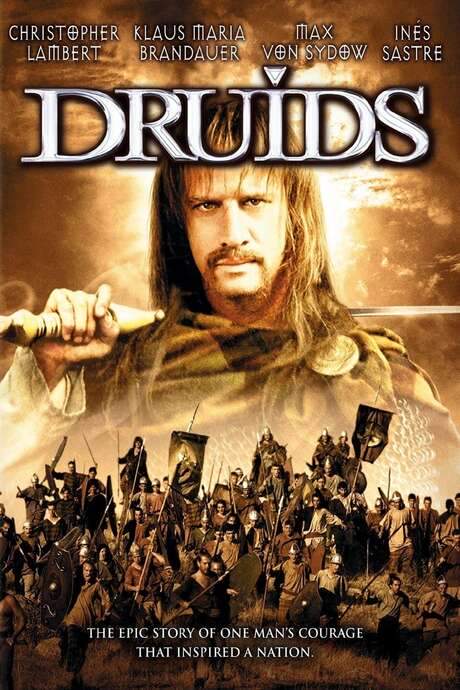
Druids 2001

Directed by

Jacques Dorfmann
Made by

Téléfilm Canada
Druids Plot Summary
Read the complete plot summary and ending explained for Druids (2001). From turning points to emotional moments, uncover what really happened and why it matters.
In 60 B.C., Gaul is a patchwork of tribes and destinies, where omens and power plays intertwine. The story opens as the druid chieftain Guttuart, Max von Sydow and his people witness a brilliant comet streak across the sky, a sign they interpret as the arrival of a new king for Gaul. Within the shimmering cavern where Celtill, the Arvernes’ chief, hosts a pivotal gathering, a drama unfurls: a disguised Roman spy fires an arrow at Celtill as he lifts a crown once worn by the old kings, hinting at Rome’s far-reaching designs. Celtill is swiftly placed under arrest by his brother Gobanittio, who seizes the moment and flees with the crown. Young Vercingetorix, the future leader the Arvernes will rally around, and the fearless Epona slip into the scene, their curiosity drawing them toward the critical chamber where destiny begins to tilt. As the boy watches, tragedy unfolds in the harsh light of the torch; Celtil’s fate is sealed, and the moment gnaws at Vercingetorix’s heart. Across the firelit hush, destiny speaks in a way a child cannot escape: Vercingetorix vows vengeance as he witnesses his uncle’s brutality and the crown’s theft, a vow that will shape the course of a continent.
Years pass, and the grown Vercingetorix takes up the burden of that oath. On a road guarded by Roman presence, Guttuart senses danger as Julius Caesar’s legion advances; terrified, Guttuart retreats while the invasion looms. The conqueror Caesar, recognizing leadership when he sees it, acknowledges Christopher Lambert as the Arvernes’ unifying voice and invites him to join in an ambitious plan to invade Britain. Back in Gergovia, the young man’s resolve hardens as he exacts vengeance for his father by eliminating Gobanittio, and Caesar’s offer now tantalizes the tribes with the prospect of shared spoils if they join the campaign overseas. The road toward Britain becomes a chessboard of loyalties and ambitions, with Vercingetorix quietly weighing a future that could redefine Gaul’s fate.
At Bibracte, the Eduens’ capital, a council of chieftains gathers to hear Caesar’s grand design. Dumnorix, wary of Rome’s long hand in Gallic affairs, remains cautious, and Caesar responds with a stark measure: he takes Dumnorix’s children as hostages to secure obedience. In a private moment, Vercingetorix and Epona reconnect, and the Roman leader reveals the very crown that started it all, posing a stark choice: Rome could crown him the king of a united Gaul, or Gaul could keep its own destiny. Vercingetorix refuses the crown, insisting that a true king must be chosen by destiny, not by conquest. The tension tightens when Dumnorix plays Rome’s game, and Caesar orders Vercingetorix to capture him after Dumnorix’s attack on a Roman garrison. In a brutal turn, Dumnorix reveals that the Romans themselves organized Celtill’s death, and two Roman officers who trail Vercingetorix kill Dumnorix. The young leader kills one of the Romans himself, and the survivor is sent back to Caesar, delivering a blunt message: Caesar has created a dangerous foe, not an ally.
With his tribe’s blessing and his own steel-willed resolve, Vercingetorix is elected as the Arvernes’ commander during the siege of Gergovia, and he unleashes scorched-earth tactics upon the Roman lines. The subsequent campaign reaches a fever pitch at Avaricum, where Caesar orders a brutal massacre of the Gallic inhabitants, a ruthless reminder of Rome’s unyielding will. Caesar then marches toward Gergovia, drawing in other Gallic factions, including the Eduens who arrive only to witness the horror that Caesar’s campaign has sown. The alliance frays, and Caesar’s forces stagger back into the Rhine, where a stark pact with the Teutons reshapes the balance of power along the Rhine frontier.
The stage shifts to Alesia, where both sides marshal an immense force. Vercingetorix is named commander-in-chief of a united Gallic army, while Caesar lands with a formidable siege array. The Romans erect formidable fortifications around the besieged city, and a race against time begins as a relief army debates its leadership and arrival. Destiny, however, moves with a stubborn hand. The Gauls order a desperate counterstroke, and Vercingetorix agrees to lead a new relief force toward the Roman perimeter, even as he recognizes the peril of united resistance against a disciplined legion. The Gauls converge, arrows and javelins hiss, and the Teutons are unleashed by Caesar’s command to strike at the heart of the siege. In the end, the Gauls are overwhelmed; the siege lines tighten, and Vercingetorix lays down his weapons and kneels before Caesar, a surrender that seals his people’s fate.
The narrative closes on a grave, almost mythic note. Guttuart’s narration recalls the brutal arithmetic of history: Vercingetorix is imprisoned in Rome, executed by order of Caesar. In the shadow of a broader political storm, Caesar himself meets his doom two years later, assassinated on the Ides of March on the steps of the Roman Senate. The film leaves us with a stark meditation on power, destiny, and the cycles of rebellion that shape nations, reminding us that the tides of history are sometimes fiercer than any single leader’s will.
- In this retelling, the legend of Vercingetorix is framed through a tapestry of loyalties, betrayals, and hard choices, where the price of leadership often comes at the cost of entire peoples. The story combines intimate, human moments—young love and family loyalties—with grand, sweeping battles that test courage, strategy, and the belief that a people might chart its own future, if only it can find a leader bold enough to trust in destiny.
Druids Timeline
Follow the complete movie timeline of Druids (2001) with every major event in chronological order. Great for understanding complex plots and story progression.
Comet omen signals a new king for Gaul
A brilliant comet streaks across the sky, interpreted by the druids as a sign of change. In a shimmering cavern, Celtill's gathering hushes as omens swirl around the gathering. The moment sets a prophecy of destiny into motion for Gaul, foreshadowing power struggles to come.
A Roman arrow and the crown theft
A disguised Roman spy fires an arrow at Celtill as he lifts a crown once worn by the old kings. Gobanittio swiftly arrests Celtill and seizes the crown, fleeing into the night. The act sows suspicion and hints at Rome’s unseen hand in Gallic affairs.
Celtill’s fate sealed; Vercingetorix vows vengeance
As the torchlight flickers, Celtill’s fate is sealed, and the crowd reels in shock. The scene deepens Vercingetorix’s resolve to avenge his father and restore Arvernes dignity. A vow of vengeance hardens the young leader’s heart against the Romans.
Years pass; Vercingetorix grows; Caesar’s threat looms
Years slip by and Vercingetorix becomes the rallying voice for the Arvernes. On a road guarded by Roman troops, Guttuart senses imminent danger as Julius Caesar’s legions push forward. Caesar’s ambition to invade Britain broadens the churning political landscape of Gaul.
Caesar invites Gaul to join the Britain campaign
Caesar recognizes leadership in Vercingetorix and extends an offer to unite the Gauls in a grand plan to invade Britain. The invitation underlines Rome’s strategy to bend Gaul to its will through shared spoils and power. The proposal plants the seeds of uneasy alliances and competing loyalties.
Gobanittio’s brutality and the lure of spoils
Vercingetorix solidifies his resolve by striking down Gobanittio to avenge Celtill. Caesar’s tempting offer of shared spoils deepens the political calculus among the Gallic tribes. The personal fates of leaders collide with grand imperial ambitions.
Bibracte council; hostages taken to secure obedience
At the Eduens’ capital, Bibracte, chieftains gather to hear Caesar’s grand design. Dumnorix remains wary as hostages are taken from his family to secure obedience. The balance of power tightens around Rome’s coercive diplomacy.
Vercingetorix and Epona reconnect; crown offer debated
In a private moment, Vercingetorix and Epona reforge their bond as Caesar presents the crown’s perverse choice: anoint him king by conquest or let Gaul choose its own path. The dialogue crystallizes the moral crossroads facing Gaul. Destiny again presses against free will.
Dumnorix’s attack and the truth about Celtill’s death
Dumnorix strikes at a Roman garrison, triggering a chain of events. Caesar demands Vercingetorix capture Dumnorix, who then reveals that Romans orchestrated Celtill’s death. Two Roman officers trailing Vercingetorix kill Dumnorix, sending a blunt message to Caesar about Gallic resistance.
Vercingetorix rises as commander at Gergovia
With his tribe’s blessing, Vercingetorix is elected commander during the siege of Gergovia. He unleashes scorched-earth tactics, weaving strategy and fury into a Gaulish counterstroke against the Romans. The war’s momentum tilts as his leadership solidifies.
Avaricum falls to Caesar’s brutal campaign
Caesar sacks Avaricum in a brutal demonstration of Roman resolve, devastating Gallic inhabitants. The massacre spreads fear through allied tribes and tests loyalties. The campaign widens the rift among Gaul’s factions as the war expands.
Alliances fray; Caesar strikes at the Rhine
Eduens arrive only to witness the carnage; alliances fray under the weight of Caesar’s campaign. The Romans retreat to the Rhine, where a direct pact with Teutons reshapes the balance of power along the frontier. The stage is set for a climactic Gallic stand.
Alesia: the united Gallic army against Rome
At Alesia, Vercingetorix is named commander-in-chief of a united Gaulish army, while Caesar lands with a formidable siege array. The Gauls launch a desperate counterstroke as the Teutons are unleashed to strike the Roman perimeter. Hope and peril collide in a battle that will redefine Gaul’s fate.
The siege tightens; Vercingetorix surrenders
The Gauls’ defense collapses under Rome’s disciplined legions; Vercingetorix kneels before Caesar, surrendering in a moment charged with tragedy and inevitability. The siege concludes with Gaul’s vow of independence broken, and Roman dominance established.
Guttuart’s closing meditation on empire
Guttuart’s narration frames history as a brutal arithmetic, where Vercingetorix is imprisoned in Rome and executed by Caesar’s hand. Caesar’s own doom arrives two years later with his assassination on the Ides of March. The film closes on a meditation about destiny, power, and the cycles of rebellion.
Druids Characters
Explore all characters from Druids (2001). Get detailed profiles with their roles, arcs, and key relationships explained.
Vercingetorix (Christopher Lambert)
A young Gaulish warrior who becomes the Arvernes’ leader after enduring personal tragedy. He evolves from a vengeful youth into a capable strategist who unites diverse tribes against Rome. His loyalty to Gaul and belief in destiny guide his decisions, even when they demand difficult compromises.
Guttuart (Max von Sydow)
A respected Druid chieftain and mentor to Vercingetorix. He offers omens, wisdom, and a long view of Gallic history, anchoring the boy’s transformation into a leader. His guidance underscores the spiritual and cultural dimensions of resistance against Rome.
Epona (Inés Sastre)
A fearless ally of Vercingetorix who stands beside him through peril and infighting. Her presence embodies courage and loyalty, contributing to the Gauls’ cohesion in the face of Roman pressure. She acts as a catalyst for Vercingetorix’s resolve to unite the tribes.
Julius Caesar (Klaus Maria Brandauer)
A brilliant, calculating Roman general who seeks to conquer Gaul and manipulate its chiefs. He uses diplomacy and force to shape Gaul’s future and sets in motion the events that test Vercingetorix’s leadership. Caesar’s ambition drives the epic conflict between Rome and the Gauls.
Cassivelaun (Denis Charvet)
A Gallic chieftain whose actions reflect the complexity of Gaulish politics and the costs of betrayal and alliance. He becomes entangled in the power struggles that shape the Arvernes’ fate. His decisions contribute to the shifting dynamics of Gaul under Roman influence.
Diviciac (Jean-Pierre Bergeron)
A Druids’ advisor and leader within the Eduens who navigates the delicate balance between Gallic unity and Roman diplomacy. He embodies the tension between tradition and pragmatism in the Gaulish world. His perspective informs key political developments in the story.
Le chef Teuton (Jean-Pierre Rives)
A formidable Teuton leader encountered in the broader conflict between Gaul and Rome. He represents the external forces that Rome contends with as it fortifies its position along the Rhine. His presence underscores the widening scope of the war.
Litavic (Yannis Baraban)
A young Gallic warrior whose participation reflects the rising generation’s role in the resistance. He embodies the vigor and idealism of Gaulish youth while facing the grim realities of war against Rome. His perspective helps illustrate the generational dimension of the conflict.
Centurion (Velimir Velev)
A Roman officer who represents the disciplined, relentless nature of Caesar’s legions. His presence highlights the contrast between Roman military efficiency and Gallic improvisation. He participates in key clashes that decide the fate of sieges and battles.
Rhia (Maria Kavardjikova)
A Gaulish figure who embodies the cultural and personal costs of war. Her interactions underscore the human stakes behind political and military decisions. She contributes to the emotional core of the story through intimate moments with the central characters.
Cassivelaun (reprise)
Note: Referenced earlier; included for completeness with actor Denis Charvet.
Druids Settings
Learn where and when Druids (2001) takes place. Explore the film’s settings, era, and how they shape the narrative.
Time period
60 B.C.
The narrative unfolds in the late Republic era when Julius Caesar is rising in power and leading campaigns in Gaul. It spans the years from the murder of Celtill to the climactic siege of Alesia, tracing Vercingetorix’s path from vengeance to unified leadership. The period is defined by shifting alliances, hostages, and brutal sieges that decide Gaul’s fate against Rome.
Location
Gaul, Gergovia, Bibracte, Avaricum, Alesia, Britain, Rhine
The film is set in Gaul during a time of intense tribal alliances and Roman expansion, moving through key sites like Gergovia, Bibracte, Avaricum and Alesia. It portrays a landscape of forests, fortifications and battlegrounds where Gallic chieftains vie for autonomy against Rome. The story also traverses the edge of Roman campaigns toward Britain, highlighting how conquest strains Gaulish unity and leadership.
Druids Themes
Discover the main themes in Druids (2001). Analyze the deeper meanings, emotional layers, and social commentary behind the film.
🗡️
Destiny
Destiny frames the rise of leadership and the rejection of a crown chosen by power alone. Vercingetorix embodies a fate-driven path, choosing unity and national fate over personal glory. The film juxtaposes Caesar’s political ambition with a Gaulish belief that true kingship is earned by destiny. The tension between predetermined fate and personal choice drives the central moral conflicts.
⚔️
War
Warfare saturates Gallic-Roman relations, from ambushes and executions to sieges and scorched-earth tactics. Strategic maneuvering, alliances, and betrayals shape the shifting balance of power. The battles at Avaricum and Alesia showcase how logistics, discipline, and tenacity decide outcomes. The narrative frames war as both a means of liberation and a mechanism of domination.
🗺️
Politics
Caesar’s diplomacy and manipulation highlight the political theater behind conquest. Hostages, rival chieftains, and shifting loyalties reveal how Rome employs sowing discord to fracture Gaul. Dumnorix and other leaders illustrate how political games can accelerate or derail unity. The plot shows that power in Gaul is as much a matter of alliances and intrigue as of battlefield prowess.

Coming soon on iOS and Android
The Plot Explained Mobile App
From blockbusters to hidden gems — dive into movie stories anytime, anywhere. Save your favorites, discover plots faster, and never miss a twist again.
Sign up to be the first to know when we launch. Your email stays private — always.
Explore the mobile appDruids Spoiler-Free Summary
Discover the spoiler-free summary of Druids (2001). Get a concise overview without any spoilers.
In the waning days of the Republic, the patchwork of Gallic tribes teeters between ancient ritual and the encroaching shadow of Rome. A blazing comet streaks across the sky, its glow read by the venerable arch‑druid Guttuart as a herald of a new destiny for the land. The omen draws the chieftains to Gergovia, capital of the proud Arverni, where the ancient customs of council and crown are about to be tested against forces that move unseen.
Amid the solemn gathering, a restless youth named Vercingetorix slips through the stone corridors with his close companion Eponia. Both carry the weight of family legacy and the fierce curiosity of a generation yearning for purpose. Their presence hints at a budding partnership, one that balances youthful daring with the solemn gravity of the tribal rites unfolding around them. The atmosphere crackles with whispered anticipation, as the cavern’s torchlight throws shadows that seem to dance with the promise of change.
The film bathes this volatile moment in a tone that is both mythic and intimate, allowing the sprawling Celtic landscape to breathe alongside the personal stakes of its characters. The druidic worldview, steeped in omens and oral tradition, collides with the pragmatic, iron‑clad ambitions of the Romans whose agents linger like ghosts in the crowd. This tension creates a palpable undercurrent of intrigue, suggesting that the path to leadership will be forged not just by bloodlines but by choices made in the flickering light of council halls.
Through sweeping vistas, rust‑stained banners, and the quiet resolve of its protagonists, the story invites the audience to wonder how destiny will shape a people on the brink of upheaval—without ever revealing the outcome, leaving the future of the young warrior and his people suspended in the echo of that comet’s trail.
Movies with Similar Twists and Themes
Uncover films that echo the narrative beats, emotional arcs, or dramatic twists of the one you're exploring. These recommendations are handpicked based on story depth, thematic resonance, and spoiler-worthy moments — perfect for fans who crave more of the same intrigue.



Featured on this page

What's After the Movie?
Not sure whether to stay after the credits? Find out!
Check out our other apps:

SAT Sphere
Build confidence for the Digital SAT.

Mori Atlas
Discover wild places worth protecting.

Luntero
Search smarter for a home in Amsterdam.

Plot Explained
Unravel movie endings and hidden clues.

Pokechamp
Dive into Pokémon data and battle logic.

Driving Theory
Get ready for your European theory test.

Movie Dust
Plan your next cinema trip with ease.

Musemap
Find art and culture as you travel.

Selkobase
Compare credentials before committing.

Local Manual
Turn an unfamiliar country into practical next steps.

Lernavi
Compare school systems before your next move.

GymRoam
Find a workout stop wherever your plans take you.
Explore Our Movie Platform
New Movie Releases (2026)
Famous Movie Actors
Top Film Production Studios
Movie Plot Summaries & Endings
Major Movie Awards & Winners
Best Concert Films & Music Documentaries
Movie Collections and Curated Lists
© 2026 What's After the Movie. All rights reserved.
Privacy Policy