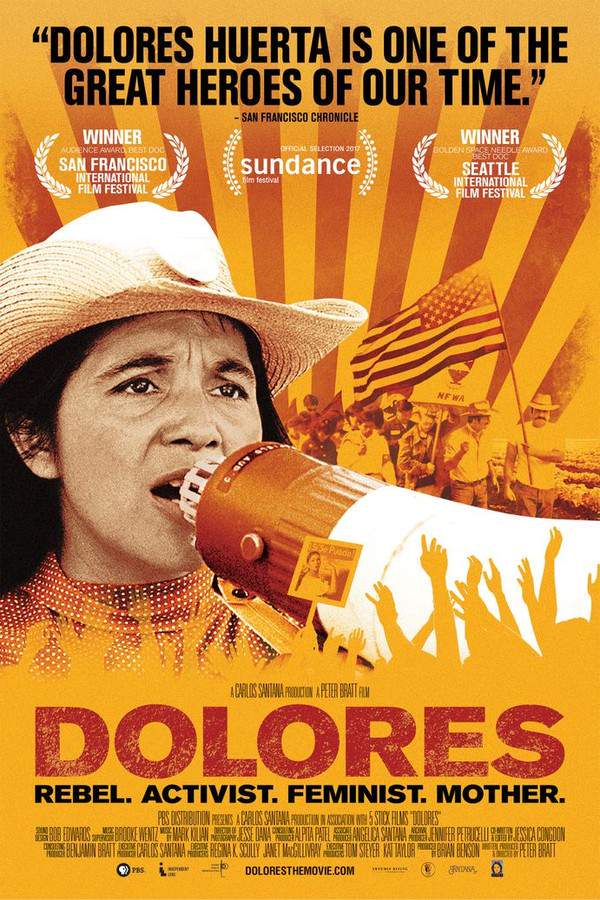
Dolores 2017


Directed by

Peter Bratt
Made by

PBS Distribution
Where to Watch Dolores
See current US streaming, rental, and purchase options for Dolores (2017) via JustWatch.








Dolores Plot Summary
Read the complete plot summary and ending explained for Dolores (2017). From turning points to emotional moments, uncover what really happened and why it matters.
This documentary traces the life of Dolores Huerta before she became the renowned activist and labor leader she is known as today. It opens in the 1940s and 1950s, painting a portrait of a young Chicana who feels out of place within the conventional expectations of her era. From an early age, she is unsettled by the world around her, witnessing police brutality and other harsh injustices that hint at a lack of true justice and equality. The film also reveals the personal strain of being a young mother, including marriages that did not last, and the sense that something more meaningful is missing in her life.
Her path toward activism begins when she crosses paths with Fred Ross, a California community organizer whose pragmatic approach to change centers on building power from within communities. Ross’s relentless focus on addressing police brutality and mobilizing ordinary people resonates with her, and she becomes deeply involved. By 1959, she leads the Stockton Chapter of the Community Service Organization, a group dedicated to helping Latino residents navigate local systems and fight for fair treatment. This period marks the emergence of her leadership and persuasion, as she learns to move crowds and influence public opinion.
As the narrative unfolds, the film highlights her strengths as a leader, organizer, and lobbyist. She is depicted rallying hundreds of community members to press legislators and press for policy changes until politicians begin to respond. It is during these early years that she is introduced to Cesar Chavez, and the two recognize a shared mission to unite farm workers and secure their rights. Together with Chavez, she helps spark the formation of the United Farm Workers of America. The documentary emphasizes the depth of commitment required to launch and sustain this movement, including the challenges of bridging diverse communities and enduring political pressure.
The later chapters focus on the personal cost of activism. To stay connected with the agricultural communities she serves, she moves her family to Delano, California, and at times must leave some of her younger children behind to shield them from the hardships of the new living conditions and the demands of the organizing work. She sacrifices much in those early years, even giving up small joys she cherished, such as listening to jazz music, to keep the mission moving forward.
Overall, the film presents a nuanced, intimate portrait of a tireless advocate who balances family responsibilities with public action. It highlights how her courage, resilience, and strategic thinking helped reshape labor rights for Latino workers and left a lasting imprint on the broader fight for social justice.
Dolores Timeline
Follow the complete movie timeline of Dolores (2017) with every major event in chronological order. Great for understanding complex plots and story progression.
Childhood awakening to injustice
Dolores Huerta grows up as a Chicano in the 1940s and 1950s, witnessing police brutality and social inequity that leave a lasting impression. She feels unsatisfied with the life of a young mother and begins to sense that real change requires action. These early experiences plant the seed for her future activism.
Search for purpose amid personal upheaval
Her marriages and eventual divorce frame a period of self-discovery as she searches for meaning beyond conventional roles. She yearns for a cause that can uplift her community. This quest steers her toward activism and public life.
Meets community organizer Fred Ross
In California, Fred Ross mentors her in organizing communities to confront injustice, with a particular focus on police brutality. His approach resonates with her experiences and ambitions. Their growing alliance sets the stage for her future leadership.
Leads Stockton Chapter of the CSO
Under Ross's guidance, Huerta rises to head the Stockton Chapter of the Community Service Organization by 1959. She mobilizes people and resources to push legislators toward change. This period showcases her talent for large-scale community action.
Advocacy through lobbying and mass action
Huerta becomes a formidable lobbyist and organizer, directing hundreds of people to pack legislators’ offices until they support key legislation. The tactic blends direct action with political engagement. Her effectiveness cements her reputation as a powerful advocate.
Introduction to Cesar Chavez
Fred Ross introduces her to Cesar Chavez, a partner who shares a vision of empowering farm workers. They recognize complementary strengths and begin exploring a collaborative path. This connection foreshadows a major labor movement.
Birth of the United Farm Workers of America
Together with Chavez, Huerta helps birth the United Farm Workers of America. The effort marks a shift from broader community organizing to targeted labor organizing for farm workers. Her involvement signals a pivotal expansion of her activism.
Relocation to Delano to connect with farms
To stay close to agricultural communities, she relocates her family to Delano, California. The move demonstrates her commitment, even as it strains her personal life. It anchors the UFW’s reach in farming regions.
Personal sacrifices for the cause
Huerta makes significant personal sacrifices, including leaving some younger children behind to endure the challenging conditions. She also gives up cherished aspects of her life, such as listening to jazz music. These sacrifices illustrate the cost of long-term activism.
A central leader in the UFW
Huerta becomes a core leader, organizer, and advocate within the fledgling UFW. The documentary highlights her tireless dedication and strategic lobbying for workers’ rights. Her work anchors the movement’s early campaigns.
Mobilizing farm workers for action
The UFW begins to organize farm workers for collective action, using boycotts, negotiations, and strikes to press for better wages and working conditions. Huerta’s leadership sustains and grows these campaigns, expanding the movement’s reach.
Legacy of early activism
Huerta’s early work lays the groundwork for the farm workers’ rights movement and the broader labor-rights landscape in California. The documentary frames her as a pivotal figure whose activism catalyzed lasting change. The film emphasizes the enduring impact of her early years.
Dolores Characters
Explore all characters from Dolores (2017). Get detailed profiles with their roles, arcs, and key relationships explained.
Dolores Huerta
A formidable labor leader and co-founder of the United Farm Workers of America. The documentary charts her early life in the 1940s–50s, where she confronts police brutality and fights for better conditions for Latino communities. It shows her relentless organizing, willingness to relocate her family for the cause, and skill at lobbying to win policy changes.
Fred Ross
A California community organizer who mentors Dolores Huerta, emphasizing grassroots outreach and direct action. The film portrays his focus on police brutality and his role in sparking Huerta's commitment to social change. His collaboration with Dolores helps set the stage for farmworker organizing and the partnership that would become the UFW.
Cesar Chavez
A key figure who joins Dolores Huerta in the effort to organize farm workers and form the United Farm Workers of America. The documentary highlights his strategic approach to union organizing and his shared commitment to improving conditions for laborers in California.
Angela Davis (Self)
A renowned activist and scholar who appears as herself, providing historical context to Dolores Huerta’s work within the broader civil rights movement. Her perspective connects labor rights to wider struggles for justice and equality.
Gloria Steinem (Self)
A prominent feminist and public intellectual who appears as herself, offering insights into Dolores Huerta’s impact on women's rights and social movement history. Her presence frames the documentary within a larger conversation about gender and activism.
Hillary Rodham Clinton (Self)
Former First Lady, senator, and 2016 presidential candidate who appears as herself, weighing Dolores Huerta’s legacy within American political life. Her comments situate the farm labor movement within the broader arc of U.S. civil rights and public service.
Dolores Settings
Learn where and when Dolores (2017) takes place. Explore the film’s settings, era, and how they shape the narrative.
Time period
1940s–1960s
Set in the mid-20th century, the documentary situates Dolores Huerta's early life amid postwar social change and civil rights ferment. It recalls police brutality, community struggle, and the push for greater equality that motivated her organizing. The period culminates in the late 1950s when she leads the Stockton chapter and helps birth the United Farm Workers of America.
Location
Stockton, California, Delano, California
The film unfolds in California's Central Valley and Bay Area, focusing on Stockton and Delano as hubs of Latino communities and labor organizing. It shows how these places became stages for community meetings, protests, and legislative lobbying. The landscape of offices filled with organizers and nearby farms highlights the living conditions and work that Dolores Huerta fought to improve. The settings illustrate how place shaped the movement's tactics and relationships.
Dolores Themes
Discover the main themes in Dolores (2017). Analyze the deeper meanings, emotional layers, and social commentary behind the film.
✊
Activism
The film traces Dolores Huerta's evolution from a concerned mother to a relentless organizer. It presents her methods—mobilizing crowds, lobbying legislators, and coordinating grassroots campaigns—as tools to challenge injustice. Through her work with Fred Ross and Cesar Chavez, the documentary shows the power of collective action in transforming communities. It also emphasizes the personal sacrifices demanded by social change.
💪
Leadership
Dolores Huerta is portrayed as a steadfast leader who navigates political, familial, and logistical obstacles to advance a cause. The narrative highlights her ability to rally people, coordinate diverse allies, and endure relocation for the movement. It shows how leadership in a marginalized community requires resilience, strategy, and moral clarity.
🌾
Labor
A central thread is the struggle of farm workers to secure fair pay, safer conditions, and recognition. The formation of the United Farm Workers of America marks a turning point in organizing labor across California's agricultural sector. The film connects farm labor to broader social justice efforts and documents the harsh realities workers faced.

Coming soon on iOS and Android
The Plot Explained Mobile App
From blockbusters to hidden gems — dive into movie stories anytime, anywhere. Save your favorites, discover plots faster, and never miss a twist again.
Sign up to be the first to know when we launch. Your email stays private — always.
Explore the mobile appDolores Spoiler-Free Summary
Discover the spoiler-free summary of Dolores (2017). Get a concise overview without any spoilers.
In a sweeping portrait of mid‑century California, the documentary invites viewers into a world where farm fields stretch beyond the horizon and bustling urban neighborhoods pulse with the quiet urgency of everyday survival. The film’s tone is both intimate and expansive, blending the grit of labor struggles with the warmth of community gatherings, all underscored by a steady rhythm that feels like a heartbeat echoing through generations. Through archival footage, personal photographs, and candid interviews, the story sets a stage that feels lived‑in, where the fight for dignity is as ordinary as the sunrise over the Central Valley.
At its core is Dolores Huerta, a young Chicana whose early years are marked by a restless sense of displacement amid the rigid expectations of the 1940s and ’50s. From the streets where she first witnesses police brutality to the quiet moments of motherhood, her narrative is woven with threads of resilience and curiosity. The film captures her internal compass pointing toward something larger than herself, hinting at a drive that will soon push her beyond the confines of domestic life and into the realm of collective action.
The journey toward activism begins when she encounters community organizer Fred Ross, whose pragmatic approach to building power from within resonates deeply. This connection propels her into the bustling corridors of the Community Service Organization, where she learns to mobilize crowds and shape public opinion. It is also here that she meets Cesar Chavez, a fellow crusader whose shared vision of labor solidarity sparks a partnership that feels both strategic and profoundly personal. Their collaboration hints at a burgeoning movement that seeks to unify disparate voices and demand equitable treatment for farm workers.
Beyond the public sphere, the documentary subtly explores the delicate balance between her relentless advocacy and the demands of family life—three marriages, eleven children, and the constant negotiation of personal sacrifice. The mood remains hopeful yet unflinching, emphasizing that the pursuit of justice often walks hand‑in‑hand with the everyday joys and challenges of home. In this way, the film paints a portrait of a tireless champion whose legacy is still felt in the interwoven fabric of social‑justice movements today.
Movies with Similar Twists and Themes
Uncover films that echo the narrative beats, emotional arcs, or dramatic twists of the one you're exploring. These recommendations are handpicked based on story depth, thematic resonance, and spoiler-worthy moments — perfect for fans who crave more of the same intrigue.
Featured on this page

What's After the Movie?
Not sure whether to stay after the credits? Find out!
Check out our other apps:

SAT Sphere
Build confidence for the Digital SAT.

Mori Atlas
Discover wild places worth protecting.

Luntero
Search smarter for a home in Amsterdam.

Plot Explained
Unravel movie endings and hidden clues.

Pokechamp
Dive into Pokémon data and battle logic.

Driving Theory
Get ready for your European theory test.

Movie Dust
Plan your next cinema trip with ease.

Musemap
Find art and culture as you travel.

Selkobase
Compare credentials before committing.

Local Manual
Turn an unfamiliar country into practical next steps.

Lernavi
Compare school systems before your next move.

GymRoam
Find a workout stop wherever your plans take you.
Explore Our Movie Platform
New Movie Releases (2026)
Famous Movie Actors
Top Film Production Studios
Movie Plot Summaries & Endings
Major Movie Awards & Winners
Best Concert Films & Music Documentaries
Movie Collections and Curated Lists
© 2026 What's After the Movie. All rights reserved.
Privacy Policy