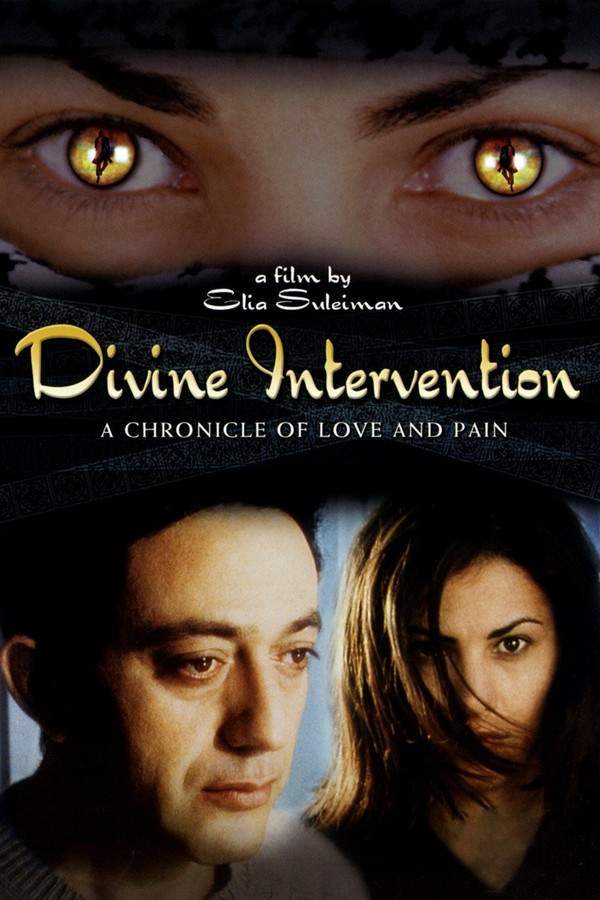
Divine Intervention 2003

Directed by

Elia Suleiman
Made by

Arab Film Distribution
Where to Watch Divine Intervention
See current US streaming, rental, and purchase options for Divine Intervention (2003) via JustWatch.


Streaming availability powered by 
Divine Intervention Plot Summary
Read the complete plot summary and ending explained for Divine Intervention (2003). From turning points to emotional moments, uncover what really happened and why it matters.
Divine Intervention unfolds as a mosaic of interconnected scenes that quietly illuminate life under military occupation, moving between the cities of Nazareth and Ramallah. The story orbits around E.S., who lives in Nazareth, and his father, who remains in Ramallah. The film opens by dwelling in Ramallah, where the daily rhythm of life is pierced by conflict: neighborly disputes, the steady presence of Israeli police, and the steady encroachment and seizure of Palestinian spaces by settlers. The atmosphere is deliberately observational, with characters able to observe one another and the world around them while their freedom to act is constrained by the occupying force. The tone remains restrained and composed, letting the images carry weight in lieu of dialogue.
- In Nazareth, a strange, stark image frames the opening: Santa Claus flees from children as gifts spill from his basket, wounded and leaning against the crumbling ruin of a Franciscan chapel perched atop Mount Fear. The scene casts a hushed, almost mythic glow over a city where joy and danger coexist in the margins.
- Back in Ramallah, E.S.’s Father drives through familiar streets and mutters curses at recognizable faces, his voice a tether to memories and grievances that color every turn of the wheel.
- Neighbors appear in quick, intimate vignettes—bickering over small, everyday concerns that nonetheless reveal larger frictions and tensions simmering beneath surface civility.
- A Palestinian couple meets in a car at the border checkpoint between Ramallah and Nazareth, their private moment echoing the film’s larger theme of restricted movement and hidden connection.
- More neighborly friction follows—slice-of-life exchanges that underline the fragility of coexistence under occupation.
- A tourist seeking directions from an Israeli policeman becomes a chilling, cruel vignette: the officer cannot help; instead, he brings out a blindfolded Palestinian prisoner from the back of his van, and the Palestinian prisoner offers three different routes. The moment exposes how ordinary interactions can be entangled with control and humiliation.
- The couple returns to the car, where a provocative act unfolds: the man (E.S.) inflates a red balloon bearing Yasser Arafat’s face and releases it near a checkpoint. An Israeli soldier moves to shoot it, but a fellow soldier halts him. In the ensuing distraction, the couple manages to slip through the checkpoint, and the balloon’s journey travels over Jerusalem, finally resting against the Dome of the Rock.
- Night drapes the couple’s car journeys once more, keeping their meetings in shadow and distance.
- A striking, surreal sequence erupts the next morning: five Israeli men perform a choreographed, dance-like drill with live weapons, firing at targets painted to resemble a Palestinian woman under the direction of a choreographer-officer. When one target fails to fall, a real Palestinian woman—dressed like the targets—emerges. The officer orders the shooting to continue, but the woman lifts the bullets from the air, gathers them into a radiant crown of thorns, and then disperses them. She uses crescent-shaped stars and rocks to strike down all but the officer. A helicopter arrives to reinforce the troops, yet the woman effortlessly destroys it by hurling a shield bearing the form of Palestine. The choreographer watches, powerless, as the miraculous figure disappears.
- The film closes on a domestic note: E.S. and his mother share a quiet moment, watching their dinner simmer and steam inside a pressure cooker, a simple, intimate ritual lingering after so much upheaval.
Divine Intervention balances stark realism with glimpses of the extraordinary, weaving together scenes of ordinary life—driving, arguing, watching, waiting—with moments that hover between myth and allegory. The result is a meditation on endurance and resistance, where voice is scarce and sight, gesture, and symbol carry the weight of meaning. The border, the checkpoints, and the shared spaces of Nazareth and Ramallah become stages for a quiet, persistent insistence on human presence despite the constraints of occupation.
Divine Intervention Timeline
Follow the complete movie timeline of Divine Intervention (2003) with every major event in chronological order. Great for understanding complex plots and story progression.
Life in Ramallah and the family dynamics
The film opens by focusing on life in Ramallah, centering on E.S.'s father and the neighbors who swirl around him. We see disputes, the presence of Israeli police at the edges, and items seemingly seized by settlers, painting a world oppressed by occupation. The atmosphere is observational, with small tensions building among residents as they go about their day.
The Father curses familiar faces while driving
The Father curses familiar faces as he drives through Ramallah's streets, an act that reveals a heavier weariness under occupation. The mundane drive becomes a canvas for memory, frustration, and the politics of daily life. The scene underscores how routine moments are tinted by conflict.
Neighbors clash over small matters
A sequence of petty disputes among neighbors unfolds, highlighting the fragility of community under stress. The bickering serves as a quiet counterpoint to the larger geopolitical forces at play. Behind each quarrel you sense the undercurrent of fear, suspicion, and survival.
E.S.'s father falls ill and is hospitalized
Suddenly, E.S.'s father becomes ill and is admitted to a hospital in Ramallah, shifting the focus toward his son’s responsibility. The family anxiously navigates the medical system while under the gaze of checkpoints and power structures. This illness marks a pivot toward the second part of the film and E.S.'s journeys between Nazareth and Ramallah.
E.S. crosses the Nazareth–Ramallah border to visit his father
With his father ill, E.S. must travel between Nazareth and Ramallah, crossing the border as he moves between home and hospital. The border checkpoint becomes a liminal space where movement is negotiated and watched. The act of crossing foregrounds the political reality that structures ordinary visits.
The Palestinian couple meets at the border
A Palestinian couple encounters each other at the border checkpoint, beginning a clandestine pattern of meetings that thread through the film. Their car conversations unfold under the watchful eyes of guards and cameras, illustrating the texture of daily life under occupation. The meetings weave romance into a landscape shaped by restriction.
Tourist asks directions; prisoner shown
A tourist asks an Israeli policeman for directions, and the officer sifts through his van to produce a blindfolded Palestinian prisoner from the back. The prisoner offers three possible routes, offering a dark moment of how authority and spectacle intersect. The scene exposes the surreal, coercive logic that governs mobility.
Balloon crossing near the checkpoint
The couple is in the car again when the man inflates a red balloon bearing Yasser Arafat's face and releases it toward the checkpoint. A soldier nearly shoots it, but a comrade intervenes, allowing the couple to slip through. The balloon drifts across Jerusalem and settles near the Dome of the Rock, turning a small act into a symbol-laden moment.
Night drive and the ongoing border life
Later that night, the couple shares a quiet car ride, continuing their furtive exchanges away from the public gaze. The intimate moment sits against the backdrop of occupation, suggesting both tenderness and danger in their relationship. The checkpoint remains a constant presence in their lives.
Morning military dance and counterpoint
The next morning, five Israeli men rehearse an elaborate, dance-like firing drill directed by a choreographer-officer. When a real Palestinian woman wearing a target's guise appears, the drill escalates into violence as bullets gather and form a crown of thorns. She rises, uses symbols of Palestine to strike back, and defeats all but the officer, challenging the illusion of control.
Supernatural resilience and helicopter confrontation
In a surreal turn, the woman demonstrates extraordinary power, disarming the bullets midflight and causing them to fall. She destroys a hovering helicopter with a shield bearing the image of Palestine, as the choreographer looks on with helpless awe. The sequence blends mythic resistance with the film's stark critique of violence.
Ending scene: dinner in a pressure cooker
The film closes with E.S. and his mother watching their dinner cook in a pressure cooker, a stark domestic image that contrasts with the earlier chaos. The quiet moment hints at endurance and the persistence of ordinary life beneath occupation. It leaves the viewer with a meditation on memory, resilience, and the cost of surveillance.
Divine Intervention Characters
Explore all characters from Divine Intervention (2003). Get detailed profiles with their roles, arcs, and key relationships explained.
E.S. (the son)
A quiet observer stretched between Nazareth and Ramallah, E.S. travels between cities as his father’s illness draws him across the border. He encounters the Woman at checkpoints, acting as a conduit for emotional exchange amid the occupation. His detachment and curiosity illuminate the human side of political conflict.
Father
E.S.'s father lives in Ramallah and falls ill, prompting a journey that exposes shared memories, grievances, and the weight of occupation. He curses familiar faces while driving, revealing the strain of everyday hardship. His hospitalization becomes a pivot for the son's movements between cities.
The Woman
A woman that the couple meets in cars at the border checkpoint, serving as a link between the two sides. Their clandestine encounters suggest longing and mutual dependence across divisions, even as surveillance and patrols loom nearby. She embodies quiet defiance within restricted space.
Neighbors
Residents in the Nazareth–Ramallah orbit engage in petty disputes and shared moments, reflecting a community under strain. Their everyday interactions provide a human texture to the political backdrop, illustrating how small conflicts persist amid larger fears.
Divine Intervention Settings
Learn where and when Divine Intervention (2003) takes place. Explore the film’s settings, era, and how they shape the narrative.
Time period
Early 2000s
The events unfold in a contemporary period marked by ongoing conflict and occupation. The absence of dialogue and the episodic, sketch-like structure anchor the narrative in a present tense rather than a historical recount. The atmosphere reflects the fragility and tension of daily life during this era.
Location
Nazareth, Ramallah
Nazareth and Ramallah are the urban backdrop for a life under military occupation. The film shifts between these two Palestinian cities, highlighting border controls that structure daily life. The settings blend religious sites, residential blocks, and checkpoints that define movement and interaction.
Divine Intervention Themes
Discover the main themes in Divine Intervention (2003). Analyze the deeper meanings, emotional layers, and social commentary behind the film.
🕊️
Occupation
The film frames life under occupation as a constant, invisible presence that shapes every gesture and exchange. Border checks, seizures, and police presence color routine moments and social interactions. The lack of dialogue emphasizes how quiet endurance replaces overt protest, underscoring resilience amid constraint.
🎭
Surrealism
The piece uses dreamlike and symbolic imagery to critique political power. Balloons bearing political imagery, choreographed gunfire, and a figure rising from bullets fuse fantasy and oppression. These sequences blur the line between performance and reality, suggesting perception itself can be a form of resistance.
💔
Relationships
Personal connections cross borders and barriers that divide the characters. E.S. and his mother, the clandestine meetings with the Woman, and neighborly friction reveal tenderness and strain amid surveillance. The private sphere becomes a site for hope, fear, and mutual dependence.

Coming soon on iOS and Android
The Plot Explained Mobile App
From blockbusters to hidden gems — dive into movie stories anytime, anywhere. Save your favorites, discover plots faster, and never miss a twist again.
Sign up to be the first to know when we launch. Your email stays private — always.
Explore the mobile appDivine Intervention Spoiler-Free Summary
Discover the spoiler-free summary of Divine Intervention (2003). Get a concise overview without any spoilers.
In the midst of an enduring conflict, a lone Israeli checkpoint becomes an unlikely crossroads where a tender, if fleeting, love story begins to emerge. Two strangers—Elia, a young man whose life is anchored in the bustling streets of Nazareth, and Manal, a woman whose world is shaped by the rhythms of Ramallah—find their paths intersecting under the watchful eyes of soldiers and the weight of history. Their connection, sparked in a place defined by division, offers a quiet counterpoint to the surrounding turmoil, suggesting that humanity can still surface even where walls dominate the landscape.
The film unfolds across the tightly knit neighborhoods of Nazareth and Ramallah, painting a portrait of everyday existence under military occupation. Routine moments—neighbors arguing over small grievances, drivers navigating familiar streets, the constant presence of checkpoints—are captured with a restrained, observational eye. Dialogue is sparse, allowing the camera’s lingering gaze and the stark visual language to convey the tension that hangs over ordinary life. The atmosphere is one of muted realism, punctuated by occasional surreal flourishes that hint at mythic resonance without breaking the film’s grounded tone.
Elia carries the weight of his community’s expectations while navigating a city where joy and danger coexist in fragile balance. Manal, in turn, embodies the resilient spirit of a people accustomed to negotiating limited freedoms and constant surveillance. Their differing backgrounds—cultural, religious, and geographical—set the stage for an encounter that feels both accidental and inevitable, a brief interlude that illuminates shared humanity amidst the fragmentation imposed by conflict.
Stylistically, the picture balances stark, almost documentary‑like realism with moments that drift into the allegorical, using symbolism—such as abandoned gifts, lingering shadows, and quiet domestic rituals—to amplify the emotional currents beneath the surface. The tone remains contemplative, inviting viewers to linger on the small gestures and quiet exchanges that reveal a persistent, stubborn hope in a world marked by division.
Movies with Similar Twists and Themes
Uncover films that echo the narrative beats, emotional arcs, or dramatic twists of the one you're exploring. These recommendations are handpicked based on story depth, thematic resonance, and spoiler-worthy moments — perfect for fans who crave more of the same intrigue.



Featured on this page

What's After the Movie?
Not sure whether to stay after the credits? Find out!
Check out our other apps:

SAT Sphere
Build confidence for the Digital SAT.

Mori Atlas
Discover wild places worth protecting.

Luntero
Search smarter for a home in Amsterdam.

Plot Explained
Unravel movie endings and hidden clues.

Pokechamp
Dive into Pokémon data and battle logic.

Driving Theory
Get ready for your European theory test.

Movie Dust
Plan your next cinema trip with ease.

Musemap
Find art and culture as you travel.

Selkobase
Compare credentials before committing.

Local Manual
Turn an unfamiliar country into practical next steps.

Lernavi
Compare school systems before your next move.

GymRoam
Find a workout stop wherever your plans take you.
Explore Our Movie Platform
New Movie Releases (2026)
Famous Movie Actors
Top Film Production Studios
Movie Plot Summaries & Endings
Major Movie Awards & Winners
Best Concert Films & Music Documentaries
Movie Collections and Curated Lists
© 2026 What's After the Movie. All rights reserved.
Privacy Policy