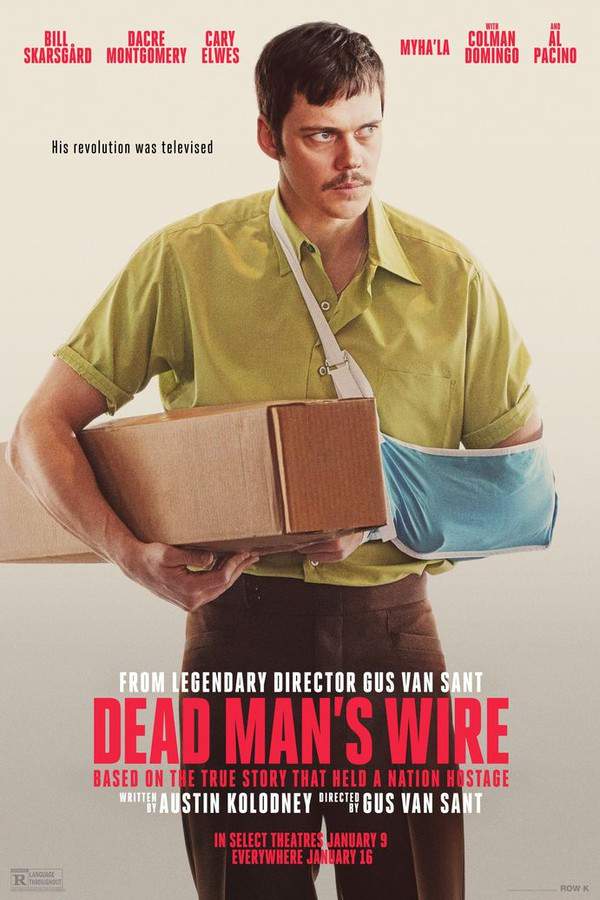
Dead Man's Wire 2026


Directed by

Gus Van Sant
Made by

Elevated Films (II)
Where to Watch Dead Man's Wire
See current US streaming, rental, and purchase options for Dead Man's Wire (2026) via JustWatch.









Dead Man's Wire Plot Summary
Read the complete plot summary and ending explained for Dead Man's Wire (2026). From turning points to emotional moments, uncover what really happened and why it matters.
On Tuesday, February 8, 1977, in Indianapolis, Tony Kiritsis arrives for an appointment with wealthy mortgage broker M.L. Hall at the Meridian Mortgage company. Tony is instead confronted by M.L.’s son, Richard ‘Dick’ Hall, who reveals that M.L. has left on vacation. Tony seizes the moment, holding Richard at gunpoint and wiring a shotgun to his neck as a dead man’s switch, convinced the Halls cheated him out of potential profit after he bought land to develop and is determined to expose them. He notifies the local police that he has taken Richard prisoner and then commandeers a police car, forcing Richard to drive them toward Tony’s home as the police and reporters close in.
Inside his apartment, Tony booby-traps the doors and windows, and ties Richard and the shotgun to his kitchen table. The building is evacuated, and Tony makes a series of escalating demands, including an apology from M.L. As news of the standoff spreads, Tony lets Richard phone his wife, and then calls local radio DJ Fred Temple, who records him explaining how desperation drove him to take drastic action. The recording becomes a linchpin for Tony’s narrative as the authorities scramble to respond.
The situation draws in the FBI, while M.L. stubbornly refuses to acknowledge Tony’s grievances or offer an apology during a tense phone exchange with Richard and Tony. The police summon Tony’s brother, Jimmy Kiritsis, and the clock ticks toward a televised outlet for a resolution. On Thursday, the plan pivots toward a nationally televised press conference that would ostensibly grant Tony immunity and forgive his debt with millions in compensation, while the authorities prepare to kill him if necessary. With Jimmy’s assurance, Tony proceeds to reattach Richard to the shotgun and proceed with the broadcast.
During the live event, Tony proclaims himself a national hero, and forces Richard to read a statement from the company before taking over the moment himself. Tony then signs documents to guarantee his demands, convinced that he has brought the Halls to justice and secured the money he believes is owed. When Richard is released, Tony fires the shotgun into the air to prove it is loaded, and is promptly arrested. Richard is reunited with his wife, while a furious Tony is taken away.
Months later, Tony stands trial and is found not guilty by reason of insanity, a verdict that unsettles the Halls and the police but garners some public sympathy. Tony asserts his sanity as he leaves the courthouse. Years pass, and Tony and Richard cross paths again at a bakery, wordlessly parting ways. An epilogue reveals that Tony was sentenced to two years in a mental institution, but served an additional eight years for refusing psychiatric treatment. Richard struggles with alcoholism in the wake of his abduction, while the company soon goes bankrupt. The story ends on a note of unresolved tension between the two men and the fragile, oscillating line between justice and desperation.
Dead Man's Wire Timeline
Follow the complete movie timeline of Dead Man's Wire (2026) with every major event in chronological order. Great for understanding complex plots and story progression.
Tony arrives at Meridian Mortgage, triggers hostage situation
Tony Kiritsis arrives for his appointment at Meridian Mortgage in Indianapolis but discovers M.L. Hall is away on vacation. He takes Richard Hall prisoner and binds him to a shotgun dead-man switch, threatening to expose the Halls' alleged misconduct. He then informs the police and hijacks a police car, driving toward his own home while reporters crowd the scene.
Richard is forced to drive Tony to his home while authorities close in
With the shotgun attached, Richard is compelled to drive Tony to Tony's apartment as law enforcement and reporters track the escalating standoff. The building is secured and Tony booby-traps doors and windows in preparation for his demands. The tension builds as the city watches.
Hostage situation intensifies inside Tony's apartment
Tony secures Richard and the shotgun at the kitchen table and booby-traps doors and windows with explosives. The building is evacuated as Tony issues his demands, including an apology from M.L. Hall. He also arranges a call to local DJ Fred Temple to broadcast his reasoning.
Radio broadcast and police plan
Fred Temple records Tony explaining the desperation that drove him to action. The police permit the recording to air while they formulate a plan.
FBI involvement; M.L. refuses to acknowledge grievances
On Wednesday, the FBI becomes involved as Tony's demands gain national attention. M.L. Hall refuses to acknowledge Tony's grievances or offer an apology during a phone exchange with Richard and Tony. The standoff drags on as authorities reassess strategy.
Jimmy Hall is summoned to the scene
Police call in Tony's brother Jimmy to try to calm him and negotiate a resolution. Tony remains obstinate as the clock ticks toward a televised resolution.
Televised press conference is arranged; Tony’s immunity offer
Authorities organize a televised press conference promising Tony immunity and a monetary settlement while secretly prepared to kill him if needed. With Jimmy's assurance, Tony agrees to participate and reattaches Richard to the shotgun.
Tony broadcasts himself as a national hero; shotgun threat remains
During the live broadcast, Tony proclaims himself a national hero and forces Richard to read a company statement. Tony signs documents guaranteeing his demands, then fires the shotgun into the air to prove it’s loaded before being arrested.
Richard is freed; Tony is arrested
Richard is released to reunite with his wife as Tony is taken into custody. The city breathes a sigh of relief as the escalating hostage crisis ends, but Tony's future remains uncertain.
Months later: trial and insanity defense
Months after the standoff, Tony is tried and found not guilty by reason of insanity. The verdict shocks the Halls and police, though there is some public sympathy for Tony's actions. He maintains his claimed sanity as he leaves the courthouse.
Years later: final encounter at the bakery
Many years pass before Tony and Richard cross paths by chance at a bakery, wordlessly passing each other and continuing on their separate lives. The uneasy history lingers beneath the surface.
Epilogue: mental institution and consequences
An epilogue reveals Tony was sentenced to two years in a mental institution, but served an additional eight years for refusing psychiatric treatment. Richard struggles with alcoholism in the wake of his abduction, and the Meridian Mortgage company eventually goes bankrupt.
Dead Man's Wire Characters
Explore all characters from Dead Man's Wire (2026). Get detailed profiles with their roles, arcs, and key relationships explained.
Tony Kiritsis (Bill Skarsgård)
A single-minded, desperate man who believes a debt is owed by a powerful company and is willing to risk everything to force accountability. His plan hinges on coercive leverage, revealing a stubborn pride and a volatile, volatile psyche. As the situation unfolds, his resolve exposes the fine line between righteous anger and reckless obsession.
Richard 'Dick' Hall (Dacre Montgomery)
A reluctant captive caught in a dangerous confrontation between an irate man and a sprawling corporate machine. He remains outwardly calm while internal fear and confusion mount, trying to navigate a rapidly escalating crisis. His experience exposes the human cost of corporate conflict and personal vendetta.
M.L. Hall (Al Pacino)
Wealthy mortgage mogul who refuses to apologize or acknowledge Tony’s grievances, embodying corporate power and stubborn denial. His stance catalyzes the conflict and tests the limits of personal responsibility within a profit-driven system. He stands as a symbol of entrenched authority and the risks of unyielding control.
Fred Temple (Colman Domingo)
A local radio DJ who becomes a crucial liaison, recording Tony’s explanation and relaying it to the public. He acts as a broker between Tony and the world, shaping the narrative while keeping lines of communication open. His role highlights the media’s function as an intermediary in a high-stakes standoff.
Jimmy Kiritsis (Daniel R. Hill)
Tony’s brother, summoned to help negotiate and manage the crisis. He serves as a steady, less volatile presence who attempts to bridge Tony and the authorities. His involvement adds a familial dimension to the power struggle and the pressure to de-escalate.
Dead Man's Wire Settings
Learn where and when Dead Man's Wire (2026) takes place. Explore the film’s settings, era, and how they shape the narrative.
Time period
February 8–11, 1977
Set in early 1970s America, the events unfold over a few days in February 1977. The timeline covers a Tuesday, a midweek standoff, and a televised confrontation that dominates the news cycle. The late-1970s context highlights a pre-digital era where live TV and radio shape public perception and outcomes.
Location
Indianapolis, Indiana, Meridian Mortgage Company
The action unfolds in Indianapolis, centered around the Meridian Mortgage Company building. The urban setting becomes a pressure cooker as a hostage crisis draws in police, the FBI, reporters, and onlookers. The city backdrop amplifies the clash between a desperate individual and a powerful corporate world.
Dead Man's Wire Themes
Discover the main themes in Dead Man's Wire (2026). Analyze the deeper meanings, emotional layers, and social commentary behind the film.
⚖️
Justice vs Greed
Tony’s actions are driven by a perceived debt to him, challenging a wealthy corporate empire. The confrontation raises questions about whether personal justice can justify drastic means. The narrative probes if integrity and accountability can be achieved through violence or manipulation. The outcome forces a reckoning between individual vendettas and systemic power.
🎥
Media Power
Live coverage turns a private vendetta into a national spectacle, amplifying Tony’s voice while scrutinizing the Halls. News outlets provide a platform that shapes public opinion and exerts pressure on authorities. The film critiques how media can legitimize actions and influence legal and political reactions. The spectacle questions where responsibility lies when the camera determines the narrative.
🧠
Sanity and Perception
Tony proclaims himself a national hero on television, blurring the line between sanity and performance. The legal system responds with an insanity defense, illustrating the fragile boundary between rational action and mental instability. The story follows the long-term impact on those involved, especially Richard, as perceptions diverge from reality. The epilogue underscores how public opinion and personal trauma endure long after the crisis ends.

Coming soon on iOS and Android
The Plot Explained Mobile App
From blockbusters to hidden gems — dive into movie stories anytime, anywhere. Save your favorites, discover plots faster, and never miss a twist again.
Sign up to be the first to know when we launch. Your email stays private — always.
Explore the mobile appDead Man's Wire Ending Explained
Unravel the ending of Dead Man's Wire (2026) with our detailed explanation. Understand the final scenes, character fates, and unresolved questions.
Tony Kiritsis turns the last stage of the hostage crisis into the public hearing he believes the Meridian Mortgage Company denied him. With Richard Hall still attached to the shotgun by the dead man’s wire, Tony faces the press, explains his grievance, and demands that the humiliation and financial pressure he experienced be recognized. The negotiated immunity agreement appears to give him a way out: he removes the wire from Hall’s neck, releases the hostage alive, and fires the shotgun into the ceiling rather than into another person. The authorities arrest him anyway, treating the promise as a device that ended the immediate threat rather than protection they intend to honor. His criminal trial does not produce an ordinary conviction. The jury finds him not guilty by reason of insanity, and he spends approximately eleven years in state psychiatric institutions. The postscript adds a strange final reversal. When officials later prepare to release him, Tony refuses to sign the required papers, resisting freedom when it is presented through another institution’s terms. He eventually returns to life outside confinement and dies in 2005, long after the broadcast siege that made his private dispute national spectacle.
The ending lets several incompatible facts remain true. Tony believes powerful lenders cornered and dismissed him, and the public performance finally forces people to hear that grievance. He also terrorizes Hall, turns the threat of an involuntary trigger into leverage, and makes another man’s body carry the risk of his demand for recognition. Releasing Hall is a meaningful choice, but it does not retroactively make the siege harmless. The broken immunity promise similarly prevents the state from occupying a simple position of moral reliability: officials save the hostage through an assurance they immediately discard, then the courts relocate the case from the language of grievance into the language of mental responsibility. Tony’s later refusal to sign release papers condenses the contradiction. Freedom is what he claimed to be fighting for, yet accepting it would require his signature beneath the authority of the same system that confined and classified him. The film therefore closes without making him either a folk hero vindicated by spectacle or a monster whose original anger can be ignored. He gets the audience he demanded, but never the uncontested meaning he wanted that audience to accept.
Dead Man's Wire Spoiler-Free Summary
Discover the spoiler-free summary of Dead Man's Wire (2026). Get a concise overview without any spoilers.
In the sweltering heat of a February morning in 1977, Indianapolis becomes the unlikely stage for a drama that will ripple through the nation’s living rooms. Tony Kiritsis, a 44‑year‑old who feels short‑changed by the promises of the American Dream, walks into the sleek offices of a powerful mortgage firm with a determination that matches the weight of his grievances. Across the polished desk sits Richard O. Hall, the composed president of Meridian Mortgage Company, whose routine day is about to be upended by a proposition that blurs the line between negotiation and catastrophe.
The film settles into a tense, almost claustrophobic atmosphere, where the ordinary trappings of corporate America clash with a desperate individual’s unsettling resolve. The notorious “dead‑man’s‑wire”—a grim device linking a shotgun to a life‑or‑death trigger—serves as a stark visual metaphor for the fragile balance between control and chaos. As word spreads, the standoff spirals into a media frenzy, turning a private dispute into a public spectacle and inviting a chorus of voices—law enforcement, journalists, and a bewildered public—each trying to parse motive from madness.
Against this backdrop, Dead Man’s Wire explores the psychology of a man pushed to the brink, the corporate indifference that fuels his fury, and the feverish buzz of a society hungry for drama. The tonal palette is gritty and urgent, punctuated by moments of stark silence that let the audience feel the weight of each breath held in the hallway. The setting—a mid‑century Midwestern city caught in the early days of live broadcast sensationalism—creates a palpable sense of unease, inviting viewers to wonder how thin the veneer of normalcy truly is when a single desperate act forces everyone to confront what lies beneath.
Movies with Similar Twists and Themes
Uncover films that echo the narrative beats, emotional arcs, or dramatic twists of the one you're exploring. These recommendations are handpicked based on story depth, thematic resonance, and spoiler-worthy moments — perfect for fans who crave more of the same intrigue.

Featured on this page

What's After the Movie?
Not sure whether to stay after the credits? Find out!
Check out our other apps:

SAT Sphere
Build confidence for the Digital SAT.

Mori Atlas
Discover wild places worth protecting.

Luntero
Search smarter for a home in Amsterdam.

Plot Explained
Unravel movie endings and hidden clues.

Pokechamp
Dive into Pokémon data and battle logic.

Driving Theory
Get ready for your European theory test.

Movie Dust
Plan your next cinema trip with ease.

Musemap
Find art and culture as you travel.

Selkobase
Compare credentials before committing.

Local Manual
Turn an unfamiliar country into practical next steps.

Lernavi
Compare school systems before your next move.

GymRoam
Find a workout stop wherever your plans take you.
Explore Our Movie Platform
New Movie Releases (2026)
Famous Movie Actors
Top Film Production Studios
Movie Plot Summaries & Endings
Major Movie Awards & Winners
Best Concert Films & Music Documentaries
Movie Collections and Curated Lists
© 2026 What's After the Movie. All rights reserved.
Privacy Policy