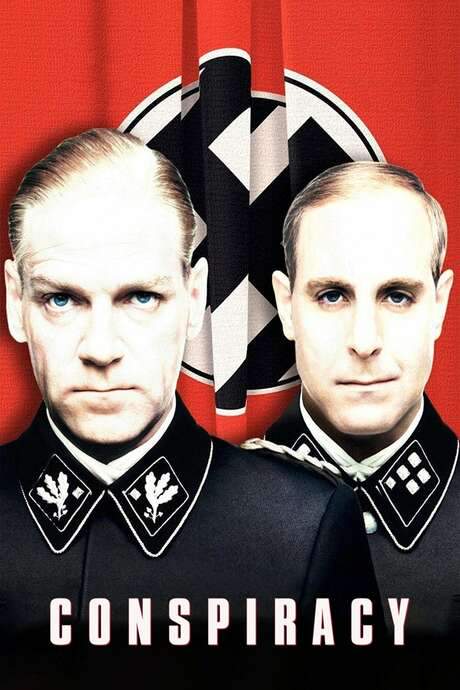
Conspiracy 2001


Directed by

Kenneth Branagh
Made by

HBO Films
Where to Watch Conspiracy
See current US streaming, rental, and purchase options for Conspiracy (2001) via JustWatch.








Conspiracy Plot Summary
Read the complete plot summary and ending explained for Conspiracy (2001). From turning points to emotional moments, uncover what really happened and why it matters.
On 20 January 1942, a high-level gathering of Nazi officials convened at a Wannsee villa, with Reinhard Heydrich presiding as chair. He carried a mandate from Reichsmarschall Hermann Göring to tackle what the regime called the “Jewish question” and to render Germany’s territories, including occupied Poland, the Ostland territories, and France, free of Jewish presence. The room brings together men drawn from different bureaus, each weighing his own interests as they listen for direction from the SS, and the mood is one of careful calibration rather than sheer bravado.
Early on, Friedrich Wilhelm Kritzinger questions the point of the exercise, arguing that the issue may already have been settled in practice. Heydrich, however, keeps the focus on policy, signaling a shift from emigration to what he calls “evacuation”—a term that, for the moment, leaves many questions unresolved and suggests a broader plan beyond immediate administrative remedies. The tension between bureaucracy and policy becomes apparent as the participants float various ideas—the idea of sterilization is weighed, and there is discussion of exemptions for mixed-race Jews who have non-Jewish grandparents. It’s clear that no single, coherent solution has been agreed upon yet; rather, the goal is to secure consensus and, above all, to obtain explicit direction from the SS.
As the meeting unfolds, Wilhelm Stuckart, a lawyer in the Reich Ministry for the Interior whom Heydrich praises, moves between caution and persuasion. His stubbornness appears to be a potential obstacle, and Heydrich privately notes the consequences of rigid positions. The tone is procedural, but the undercurrent is ominous: the officials are being asked to signal their support for a plan whose ultimate consequences are not yet spelled out in policy but are being framed with grim certainty.
The atmosphere shifts decisively when Adolf Eichmann lays out the core decision that has already been made in the higher echelons of power: the wholesale extermination of Europe’s Jewish population. He details the mechanism—gas chambers and crematoria—that will be used to carry out the plan, drawing attention to the existence of extermination camps at sites like Belzec, Sobibor, and Treblinka. The word “Final Solution” finally crystallizes in the room as a deliberate, systemic program rather than a rhetorical goal. The attendees realize that the euphemism of “evacuation” masks a planned, irrevocable genocide, and the magnitude of what lies ahead becomes painfully concrete.
Alongside Eichmann, other officials contribute concerns that reflect the various bureaucratic facets of the regime. There are questions about the public health risks in overpopulated ghettos—cholera and typhus are raised as foreseeable problems that could accompany mass removal. The meeting’s pauses and breaks become moments of counsel and intimidation, as Heydrich calls Kritzinger aside to press home the necessity of full compliance and unity in the face of such brutal policy. In a later recounting, Kritzinger shares a cautionary tale about a man consumed by hatred of his father, a parable that Heydrich interprets as a reminder that their project could lose its own humanity—though he rejects the notion that he will miss the Jews when the plan is carried out.
When the discussion resumes, Heydrich seals the outcome with a clear directive: the plan requires the quiet, secretive support of all involved and the assurance that they will maintain the confidentiality of the proceedings. The session ends with a tight, formal adjournment, and the participants depart with a chilling sense of where the conversation has led them.
In the aftermath, the film provides a brisk, almost clinical roll call of what happened to many of the men who took part. Some would die years later as the war unfolded; others were arrested and tried, or survived in various ways. Adolf Eichmann would eventually flee to Buenos Aires, only to be captured decades later and tried, ultimately meeting a death sentence in the 1960s. Reinhard Heydrich would be assassinated within months, a stark reminder that the regime’s machinery would not remain intact forever. The minutes themselves—those precise notes recording the conversation—have their own fate: among the records, a copy kept by the German Foreign Office, belonging to Martin Luther, survived when others did not, becoming a crucial historical artifact when it was recovered by the Allies in 1947.
Throughout, the film keeps a steady, restrained pace, letting the sharp, almost documentary tone carry the weight of what is being proposed and decided. The cast’s performances, including Josef Bühler, Karl Eberhard Schöngarth, and others, ground the proceedings in human detail, showing how each man contends with the pressure to align personal duties with a policy that would, in time, become one of the darkest chapters of history. The narrative never sensationalizes the events; instead, it follows the logic and the fear that propelled a system toward genocide, offering a clear-eyed view of how high-level decisions were translated into brutal, operational plans.
In the end, the Wannsee conference stands not just as a moment of policy formulation but as a chilling demonstration of bureaucratic collusion, where language is carefully chosen to obscure intent and where power consolidates around a single, horrific conclusion. The film makes no effort to glamorize or oversimplify; it presents a meticulous record of motives, doubts, and calculations, and it places a stark emphasis on the consequences that followed for millions of people, as the gears of a genocidal system began to turn with terrifying efficiency.
Conspiracy Timeline
Follow the complete movie timeline of Conspiracy (2001) with every major event in chronological order. Great for understanding complex plots and story progression.
Wannsee Conference convened
On 20 January 1942, a conference of Nazi officials is convened at a Wannsee villa and chaired by Reinhard Heydrich to discuss a 'complete solution of the Jewish question.' Heydrich has a mandate from Hermann Göring to implement the plan to clear Jews from Germany's territories and occupied lands. The atmosphere is formal, but it becomes clear that the decision-making will be guided by the SS rather than civilian policymakers.
Kritzinger questions the purpose of the meeting
Friedrich Wilhelm Kritzinger questions the purpose of the meeting, arguing the question may already be settled. Heydrich responds by shifting the discussion toward 'evacuation,' hinting at evolving policy while not yet clarifying details. The exchange shows early uncertainty about the ultimate aim.
Policy shifts from emigration to 'evacuation'
Heydrich states that policy will move from forced emigration to 'evacuation' but does not immediately spell out what 'evacuation' means. The remark signals a turning point in how the regime frames the plan, while other officials probe for boundaries. The room carries a sense that the final decisions are still being negotiated.
Sterilisation and exemptions debated
The officials discuss sterilisation and exemptions for mixed-race Jews with non-Jewish grandparents, illustrating the competing approaches considered within the bureaucratic process. The dialogue reveals the range of ideas being entertained even as the larger policy remains unsettled. The tone remains formal as the implications grow grimmer.
Break and warning to Stuckart
Heydrich calls a break and takes Wilhelm Stuckart aside to warn him about the consequences of stubbornness. He praises Stuckart earlier, signaling the delicate balance between legalistic justification and brutal policy. The moment underlines the coercive dynamics shaping the conference.
Revelation of the extermination plan
When the meeting reconvenes, Heydrich reveals that the policy had already been decided: wholesale extermination of Europe's Jewish population, to be carried out with gas chambers and ovens. The group confronts the chilling scope of the plan as the term 'Final Solution' becomes the visible aim. A sense of inevitability settles over the room.
Eichmann outlines camps and methods
Adolf Eichmann details the existence of extermination camps at Belzec, Sobibor, and Treblinka and describes the method of killing in gas chambers at sites like Auschwitz. He frames the logistics as logistical progress, aligning state machinery with mass murder. The participants recognize the administrative machinery behind genocide.
Genocide acknowledged; 'evacuation' reinterpreted
The attendees realize that the euphemism 'evacuation' really means genocide. The discussion also touches on public health concerns about cholera and typhus arising from overcrowded ghettos, showing ancillary issues tied to the plan. The atmosphere shifts from debate to grim acceptance.
Kritzinger's cautions and warnings interpreted
Kritzinger is warned about the unrealistic hopes of humane conditions, and he tells a cautionary tale about a man destroyed by hatred of his father. Heydrich later interprets this as a warning about a similar fate for them after the Jews are exterminated, though he rejects the warning. The exchange underscores the moral peril surrounding the policy.
Conclusion and secrecy
Heydrich recalls the proceedings, asks for explicit assent and support from each official, and stresses the need for secrecy before adjourning. The formal closure masks the grisly reality already decided. The officials depart with the knowledge that the plan is to be kept confidential among the inner circle.
Post-conference postscript on fates
A brief account is given of the fate of each official, with some dying during the war, others being arrested or executed, and some later acquitted. The post-conference summary underscores the grim outcomes for those who carried out the orders. It frames the Wannsee gathering as the ignition of a process, not a singular act.
Heydrich is assassinated
Reinhard Heydrich is assassinated by Czechoslovak partisans within six months of the meeting, cutting short his brutal rule in Bohemia and Moravia. The assassination illustrates the immediate blowback against Nazi leadership and a shifting momentum of the war. His death removes a key driver of the genocide blueprint.
Eichmann flees and is later tried
Adolf Eichmann flees to Buenos Aires after the war, eventually being captured and tried, and is sentenced to death in the 1960s. His capture brings the Holocaust's machinery into public view decades later. The episode demonstrates the long reach of the regime's legacy.
Wannsee minutes survive in the archives
The final card reveals that Martin Luther's copy of the Wannsee minutes, recovered by the US Army in the archives of the Foreign Office in 1947, was the only record of the conference to survive. This document becomes the sole contemporary witness to the meeting's content. The moment anchors the historical record of the Nazi decision.
Conspiracy Characters
Explore all characters from Conspiracy (2001). Get detailed profiles with their roles, arcs, and key relationships explained.
Adolf Eichmann (Stanley Tucci)
Eichmann drives the logistical planning of the Final Solution, presenting the scale and method of extermination with clinical precision. He navigates the meeting with calm efficiency, exposing the bureaucratic mindset behind genocide. His role crystallizes how technical planning can enable mass murder.
Reinhard Heydrich (Kenneth Branagh)
Heydrich chairs the meeting and asserts control, demanding explicit assent and steering discussions toward a unified policy. He uses intimidation and authority to push through the plan, showing ruthless determination. His presence binds the group to a perverse consensus.
Wilhelm Stuckart (Colin Firth)
Stuckart is the Reich Ministry for the Interior lawyer sought for opinions on policy. He is praised by Heydrich and warned about the consequences of stubbornness, illustrating the danger of bureaucratic caution. His stance reveals the tension between legal craft and moral horror.
Josef Bühler (Ben Daniels)
Bühler participates as an administrator at the meeting, mediating between officials and policy proposals. His role shows how officials weigh practical considerations against the genocidal plan. He reflects the collaborative nature of bureaucratic complicity.
Georg Leibbrandt (Ewan Stewart)
Leibbrandt contributes as a party to the discussion, representing occupied territories and administrative concerns. He embodies the global scale of coordination among Nazi offices, highlighting the systemic reach of the Final Solution.
Karl Eberhard Schöngarth (Peter Sullivan)
Schöngarth is present as a high-ranking official, reflecting the chain of command that implements the plan. His participation emphasizes how various offices align under a shared objective. The group’s agreement signals a step toward institutionalized genocide.
Martin Luther (Kevin McNally)
Luther is the Foreign Office secretary whose minutes and copies become the record of the meeting. His role underlines the international bureaucratic footprint of the plan and its documentation.
Conspiracy Settings
Learn where and when Conspiracy (2001) takes place. Explore the film’s settings, era, and how they shape the narrative.
Time period
1942
Set during World War II, the events occur in early 1942, culminating in the Wannsee Conference on 20 January 1942. The atmosphere is procedural and solemn as officials discuss 'emigration' vs 'evacuation'. The time period highlights the shift from rhetoric to planned genocide, driven by bureaucratic rationalization.
Location
Wannsee Villa, Berlin
The Wannsee Conference takes place in a villa along the Wannsee in Berlin. The setting is formal and bureaucratic, designed for a meeting among high-ranking Nazi officials. The location is used to coordinate a policy with far-reaching consequences for Europe’s Jewish population.
Conspiracy Themes
Discover the main themes in Conspiracy (2001). Analyze the deeper meanings, emotional layers, and social commentary behind the film.
🧭
Bureaucracy
The film shows how a formal bureaucratic process can enable atrocity, with minutes, offices and ranks shaping decisions. Officials debate policies in neutral tones, revealing how ordinary processes can mask extraordinary violence. The setting underscores that genocide is implemented through administrative steps rather than a single decree.
💬
Euphemism
Language like 'evacuation' is used to hide the reality of extermination. Participants weigh various euphemisms and exemptions, illustrating how words can mask intent. The dialogue demonstrates how bureaucrats compartmentalize moral horror into manageable concepts.
🕯️
Moral compromise
Officials rationalize their complicity, balancing career, fear, and personal risk. The film examines how individuals choose self-preservation over conscience in the face of genocide. The recurring tension shows how small compromises accumulate into systemic atrocity.

Coming soon on iOS and Android
The Plot Explained Mobile App
From blockbusters to hidden gems — dive into movie stories anytime, anywhere. Save your favorites, discover plots faster, and never miss a twist again.
Sign up to be the first to know when we launch. Your email stays private — always.
Explore the mobile appConspiracy Spoiler-Free Summary
Discover the spoiler-free summary of Conspiracy (2001). Get a concise overview without any spoilers.
In January 1942, a quiet Berlin suburb becomes the stage for a gathering that will echo through history. Officials from the German government, the SS, and occupied territories converge in a modest villa, each representing a distinct branch of a sprawling bureaucracy. The setting feels both intimate and unnervingly formal, a place where polite conversation masks the weight of decisions poised to reshape an entire continent. The film’s tone is deliberately restrained, employing a documentary‑like rhythm that lets the silence between words speak as loudly as the dialogue itself.
At the center of the meeting sits Reinhard Heydrich, the determined chair whose authority is both overt and subtly coercive. He steers the discussion with a calm precision that contrasts with the unease bubbling beneath the surface. Friedrich Wilhelm Kritzinger pushes back, questioning whether the issue has already been settled, while Wilhelm Stuckart, a meticulous lawyer, oscillates between caution and persuasion, embodying the internal tug‑of‑war between legalism and ambition. Adolf Eichmann brings a cold, methodical clarity to the table, outlining the mechanisms under consideration with an analytical detachment that heightens the film’s chilling ambience.
The interplay among the participants is a study in bureaucratic choreography. Every exchange is laced with subtext: the careful choice of euphemisms, the polite veneer that conceals an undercurrent of pressure, and the subtle power plays that reveal each man’s stakes within the regime. Supporting figures such as Josef Bühler and Karl Eberhard Schöngarth add further texture, their presence underscoring how a wide array of personalities must align to give shape to a collective vision. The camera lingers on nervous glances, the rustle of papers, and the restrained gestures that convey more than the spoken agenda.
Visually, the film favors muted palettes and precise framing, reinforcing its clinical, almost surgical focus on the mechanics of governance. The performances are understated yet powerful, capturing the tension between personal ambition and the weight of an emerging policy. By immersing the viewer in this tightly wound atmosphere, the story invites a deeper contemplation of how ordinary structures can be repurposed toward extraordinary—and terrifying—ends, all without ever straying from its meticulously measured, spoiler‑free presentation.
Movies with Similar Twists and Themes
Uncover films that echo the narrative beats, emotional arcs, or dramatic twists of the one you're exploring. These recommendations are handpicked based on story depth, thematic resonance, and spoiler-worthy moments — perfect for fans who crave more of the same intrigue.


Featured on this page

What's After the Movie?
Not sure whether to stay after the credits? Find out!
Check out our other apps:

SAT Sphere
Build confidence for the Digital SAT.

Mori Atlas
Discover wild places worth protecting.

Luntero
Search smarter for a home in Amsterdam.

Plot Explained
Unravel movie endings and hidden clues.

Pokechamp
Dive into Pokémon data and battle logic.

Driving Theory
Get ready for your European theory test.

Movie Dust
Plan your next cinema trip with ease.

Musemap
Find art and culture as you travel.

Selkobase
Compare credentials before committing.

Local Manual
Turn an unfamiliar country into practical next steps.

Lernavi
Compare school systems before your next move.

GymRoam
Find a workout stop wherever your plans take you.
Explore Our Movie Platform
New Movie Releases (2026)
Famous Movie Actors
Top Film Production Studios
Movie Plot Summaries & Endings
Major Movie Awards & Winners
Best Concert Films & Music Documentaries
Movie Collections and Curated Lists
© 2026 What's After the Movie. All rights reserved.
Privacy Policy