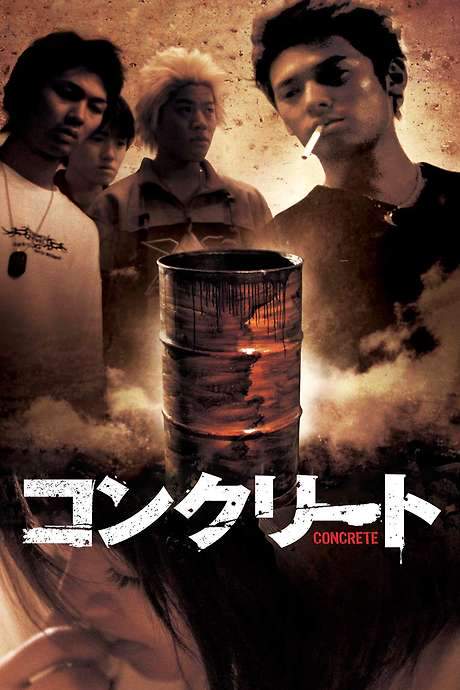
Concrete 2004

Directed by

Taku Nakamura
Made by

Benten Entertainment Inc.
Concrete Plot Summary
Read the complete plot summary and ending explained for Concrete (2004). From turning points to emotional moments, uncover what really happened and why it matters.
Tatsuo Oosugi, Sousuke Takaoka, is a troubled working-class teenager who bears the sting of his parents’ divorce and his mother’s neglect, and he slides from burnout through a string of low-paying jobs into a life of violence. He resolves to join the yakuza to raise money for a future marriage to Kayoko Matsuyama, hoping the move will change his downward spiral. Although he initially longs to quit, he is drawn into power and purpose when he’s offered the chance to lead a small gang, the Ryujin gang. From there, he recruits a circle of friends to pull off robberies and increasingly brutal crimes, eventually involving rape to appease his seniors.
One night, a high school student named Misaki, Miki Komori, is seen cycling home and is knocked down by one of the boys. Tatsuo pretends to escort her, but once Misaki tries to go home on her own, he reveals his true nature and menaces her with violence, even threatening to burn her house down if she speaks out. Misaki is subjected to rape in a hotel and then brought to the home of Takao Matsuyama, Kayoko’s brother, where the assault escalates. There, the boys inflict horrific abuses, including forcing her to lie to her parents about staying at a friend’s house, and they brutalize her with various acts.
Despite Misaki’s repeated attempts to escape—twice, including help from Takao’s mother—the group captures her again, injuring her with punishments that leave her leg burned with lighter fluid. Tatsuo even violently assaults Takao’s mother, and he lashes out at the others, warning them that sympathy for Misaki will be punished. As the abuse continues, Misaki’s body grows weak, incontinent and dehydrated, and she pleads for water. Tatsuo taunts her and delivers a fatal blow, then a barbell is dropped on her stomach. The gang pauses to relax at a sauna, during which Misaki’s last wish resonates: > stay strong.
Back at the house, they discover Misaki has died from her injuries after an unresponsive moment when a cigarette is held near her nose. To cover up the murder, Tatsuo arranges to burial by loading her body into a concrete drum from his old job and burying it in an open field. The drum becomes the site of a grim secret, later discovered by authorities.
As the investigation unfolds, the arrest of the boys follows, and a detective who knew Tatsuo before explodes with anger, calling him a “demon seed” for trying to minimize his role in Misaki’s murder, insisting he did more than claim. The location where Misaki’s body lies is transformed into a gravesite, and through a voiceover, Misaki asks listeners to consider the value of life: > how precious life is.
The film closes with a haunting image: a crying Tatsuo in a dark room, an illusion that lingers as he fails to coax a mangled bird to fly from his hand.
Concrete Timeline
Follow the complete movie timeline of Concrete (2004) with every major event in chronological order. Great for understanding complex plots and story progression.
Tatsuo joins the Ryujin gang
Driven by burnout from his low-paying jobs, Tatsuo joins the yakuza to raise money for his future marriage to Kayoko Matsuyama. He forms the Ryujin gang as a vehicle for crime and influence. He begins recruiting friends to carry out robberies and other offenses to prove himself.
Criminal activities escalate to robbery and coercion
The gang tightens its grip as they commit robberies to fund their operations and status. Tatsuo grows more confident in enforcing the gang's will and begins orchestrating violent acts to please their seniors. The line between petty crime and brutal abuse becomes increasingly blurred.
Misaki is spotted and targeted
One night, Misaki, a high school student, is seen riding home on her bike and is knocked over by one of the boys. Tatsuo pretends to help her but reveals his predatory intent, setting the stage for what follows. The encounter marks Misaki as the gang’s next target.
Misaki is taken to Takao Matsuyama's house
Misaki is brought to the home of Takao Matsuyama, a friend and Kayoko's brother, where the gang's coercion and control over her begins in earnest. The setting shifts from the street to a private residence, increasing the sense of confinement. The plan to subdue her becomes more organized.
Horrific abuse and forced deception
Inside Takao's house, the boys commit brutal acts, including inserting foreign objects and beating Misaki. They force her to lie to her parents that she is staying at a friend's house, showing a calculated attempt to erase her track. The cruelty marks a turning point in the violence.
Misaki escapes, aided by Takao's mother
Misaki manages to escape the house twice, the second time with help from Takao's mother. Each attempt underscores her resilience but also deepens the gang’s resolve to control her fate. The escape attempts heighten the peril surrounding Misaki.
Punishments escalate after escape attempts
The gang tightens its grip further as Misaki is punished after capture, including having her leg doused in lighter fluid and burned. Tatsuo also punishes Takao's mother and warns the others not to show any sympathy or assist Misaki. The violence becomes more systematic and cruel.
Misaki endures ongoing abuse and deprivation
Misaki endures repeated abuses that leave her incontinent and dehydrated. She pleads for water, but is taunted by the gang, revealing a chilling erosion of empathy. The brutality continues with little to no mercy.
Tatsuo fatally injures Misaki
In a final, brutal act, Tatsuo beats Misaki further and drops a barbell on her stomach, fatally wounding her. The gang briefly shifts focus as they process the killing. The murder marks a definitive collapse of any remaining veneer of control.
The gang retreats to a sauna after the murder
The members leave the house to relax at a sauna, momentarily disconnecting from the atrocity they have committed. Misaki lies dying or already gone ahead of them, and her last wish is to stay strong. The contrast between their detachment and her suffering is stark.
Misaki dies and the cover-up begins
Returning from the sauna, Misaki becomes unresponsive as Tatsuo tests a cigarette near her nose and she does not respond. The group decides to conceal the murder, signaling the onset of their attempt to erase the crime. The atmosphere thickens with the weight of what they have done.
Disposal of Misaki's body in a concrete drum
Tatsuo arranges a cover-up by retrieving a concrete drum from his old job and burying Misaki's body in it. The drum is then placed in an open field, an attempt to hide the evidence from the world. The grim practicality of the disposal underscores the cold calculation behind the act.
Arrests and the demon seed rebuke
Eventually all of the boys are arrested. A detective who had previously met Tatsuo angrily calls him a demon seed for minimizing his role, insisting that he killed at least one person. The interrogation lays bare the moral indictment of Tatsuo’s actions.
Gravesite and Misaki's plea about life
The site where Misaki's body is found becomes a gravesite as her voiceover asks, through the audience, whether people realize how precious life is. The moment frames the entire tragedy with a poignant, existential echo. It leaves a haunting reminder of the cost of violence.
Ending: Tatsuo's empty remorse
The film ends with an image of Tatsuo crying in a dark room, unable to make a mangled bird fly from his hand. The closure suggests his failed attempt at self-justification or redemption. It leaves the audience with a stark, unresolved sense of guilt.
Concrete Characters
Explore all characters from Concrete (2004). Get detailed profiles with their roles, arcs, and key relationships explained.
Tatsuo Oosugi
A troubled working-class teenager who turns to the yakuza to fund a hoped-for marriage. He forms the Ryujin gang, then enforces fear and obedience through brutal acts, including sexual violence, to please his seniors. His drive for money and status blinds him to the consequences of his crimes, leaving him morally hollow by the end.
Misaki
A high school student who is violently targeted by Tatsuo and the gang. She endures captivity, manipulation, and repeated abuse while trying to find a way home. Misaki's resilience shines through her attempts to escape, but she is ultimately overpowered, making her death a stark indictment of violence.
Takao Matsuyama
A friend of Tatsuo and Kayoko's brother who becomes part of the gang's activities. He participates in the crimes, yet the narrative hints at inner conflict and moments of weakness. The gang's actions are supported by surrounding family ties and loyalty, amplifying the sense of inevitability.
Kayoko Matsuyama
Tatsuo's love interest and Kayoko's brother's sister, whose relationship with Tatsuo drives his desire to secure a future. She serves as a social anchor within the group, illustrating how personal relationships intersect with crime. Her presence helps illuminate the human costs behind the gang's ambitions.
Concrete Settings
Learn where and when Concrete (2004) takes place. Explore the film’s settings, era, and how they shape the narrative.
Location
Japan
The story unfolds across contemporary Japan, following the criminal underworld within urban neighborhoods and the domestic spaces where its victims are held. Key locations include a cramped family home, a hotel used for assaults, a friend's house, a sauna, and remote fields where bodies are hidden. The settings ground a gritty, realistic portrayal of crime and its consequences in everyday environments.
Concrete Themes
Discover the main themes in Concrete (2004). Analyze the deeper meanings, emotional layers, and social commentary behind the film.
🩸
Abuse
The film centers on systemic violence and sexual assault, showing how power is exerted through fear, domination, and coercion. Tatsuo and the gang use intimidation to control victims and suppress dissent. The narrative exposes how cruelty becomes normalized within a criminal organization, culminating in a brutal murder. The quiet aftermath—police investigations and a mournful voiceover—casts a harsh light on the value of life and the damage inflicted on all involved.
⚖️
Consequences
Power and accountability are foregrounded as the story follows the detectives' outrage and Tatsuo's mounting guilt. The murder triggers investigations and social repercussions for everyone involved. The site of Misaki's death becomes a gravesite that haunts the attackers, while a detective emphasizes that there is no easy denial of responsibility. The ending suggests that crime carries an inescapable moral price.
🌱
Loss of Innocence
Misaki's vulnerability and attempts to escape lay bare the fragility of youth facing predatory crowds. The gang's violence shatters her safety, dignity, and future, transforming a high-school life into a nightmare. Even as Misaki fights for water and a moment of mercy, the brutality erases her innocence. The film frames her death as a warning about how easily innocence can be crushed by cruel power.

Coming soon on iOS and Android
The Plot Explained Mobile App
From blockbusters to hidden gems — dive into movie stories anytime, anywhere. Save your favorites, discover plots faster, and never miss a twist again.
Sign up to be the first to know when we launch. Your email stays private — always.
Explore the mobile appConcrete Spoiler-Free Summary
Discover the spoiler-free summary of Concrete (2004). Get a concise overview without any spoilers.
In a gritty, neon‑streaked Tokyo, the city’s underbelly pulses with restless energy, where low‑pay jobs and fractured families push young people toward desperate choices. The atmosphere feels heavy with unspoken tension, the streets echoing with the whispered promises of power and belonging that the night gangs offer. A somber, almost claustrophobic tone pervades, hinting at the fragile line between survival and surrender.
- Tatsuo Oosugi drifts through this world, a working‑class teenager haunted by his parents’ divorce and a mother who remains distant. He carries the weight of personal disappointment, yearning for stability and a future that seems perpetually out of reach. His restless ambition leads him to consider a place within the yakuza—a path he believes might finally give him the means to secure a life with his love, Kayoko Matsuyama.
When Tatsuo is given a chance to lead a small crew, he gathers a circle of friends whose loyalties are as volatile as the streets they roam. The gang’s early endeavors are marked by a precarious mix of camaraderie and reckless bravado, each venture testing the limits of what they are willing to do to climb the hierarchy. As the group navigates the murky moral landscape, the pull of belonging clashes with the growing awareness of the darker costs involved.
The film unfolds as a somber meditation on the search for purpose amid urban decay, balancing quiet moments of introspection with the looming presence of danger. It invites viewers to watch the fragile equilibrium between hope and desperation teeter, asking what one might sacrifice when the promise of a better tomorrow is shrouded in shadows.
Movies with Similar Twists and Themes
Uncover films that echo the narrative beats, emotional arcs, or dramatic twists of the one you're exploring. These recommendations are handpicked based on story depth, thematic resonance, and spoiler-worthy moments — perfect for fans who crave more of the same intrigue.
Featured on this page

What's After the Movie?
Not sure whether to stay after the credits? Find out!
Check out our other apps:

SAT Sphere
Build confidence for the Digital SAT.

Mori Atlas
Discover wild places worth protecting.

Luntero
Search smarter for a home in Amsterdam.

Plot Explained
Unravel movie endings and hidden clues.

Pokechamp
Dive into Pokémon data and battle logic.

Driving Theory
Get ready for your European theory test.

Movie Dust
Plan your next cinema trip with ease.

Musemap
Find art and culture as you travel.

Selkobase
Compare credentials before committing.

Local Manual
Turn an unfamiliar country into practical next steps.

Lernavi
Compare school systems before your next move.

GymRoam
Find a workout stop wherever your plans take you.
Explore Our Movie Platform
New Movie Releases (2026)
Famous Movie Actors
Top Film Production Studios
Movie Plot Summaries & Endings
Major Movie Awards & Winners
Best Concert Films & Music Documentaries
Movie Collections and Curated Lists
© 2026 What's After the Movie. All rights reserved.
Privacy Policy