
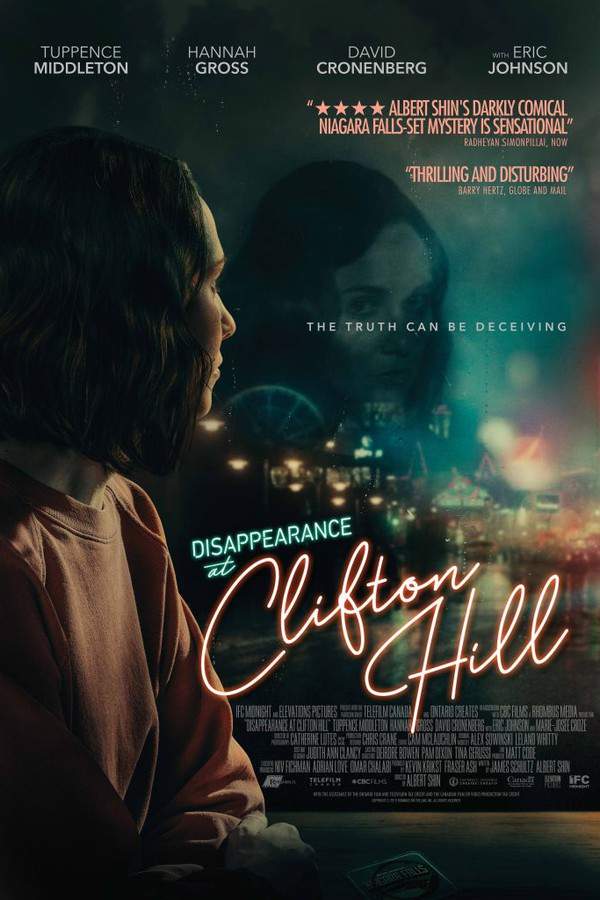
What Is Disappearance at Clifton Hill About?
The premise of Disappearance at Clifton Hill in 357 words, with nothing given away. The full story and the ending follow below.
In the shadow of the thundering Niagara Falls, a small town clings to its own myths and memories, its streets humming with the echo of tourists and the quieter, lingering whispers of the past. The towering waters serve as a constant, almost cinematic backdrop to everyday life, imbuing the scenery with a sense of both grandeur and melancholy. Within this setting, the aging Rainbow Motel stands as a modest sanctuary, its faded signage and creaking rooms a reminder of a bygone era and the families who once called it home.
Abby returns to this place burdened by a history she cannot quite escape. A young woman marked by a compulsive need to reshape truth, she carries the weight of a childhood trauma that has shaped her identity and strained her relationships. Her return is not just a homecoming but a pilgrimage toward reconciliation, as she confronts the lingering echoes of a tragedy that has haunted her for years. The motel, inherited from her mother, becomes both her refuge and the anchor that pulls her deeper into the unresolved chapters of her own story.
The town itself is steeped in layers of unspoken lore, most notably a decades‑old mystery surrounding a boy who vanished without a trace. Rumors swirl, and locals speak in half‑whispers about hidden connections and long‑forgotten secrets embedded in the community’s fabric. As Abby settles back into the motel’s rhythm, she finds herself drawn into the subtle, unsettling currents that flow beneath the tourist‑laced surface, hinting at a darkness that intertwines personal loss with the collective memory of the town.
Against the roar of the falls and the muted glow of the motel’s neon sign, the film cultivates a brooding, atmospheric tone—part noir, part psychological study. It invites viewers to feel the tension between the desire for closure and the fear of what might be uncovered, all while the relentless cascade of water reminds us that some forces are both awe‑inspiring and inexorable. In this delicate balance of place and psyche, Abby stands poised on the edge of discovery, ready to face the shadows that have long haunted both her family and the town itself.
What Happens in Disappearance at Clifton Hill?
The complete story of Disappearance at Clifton Hill, from the first scene to the last, in 585 words (about 3 minutes). Spoilers throughout.
Spoilers ahead
As Abby returns to Niagara Falls, her journey becomes a poignant reflection of childhood memories interwoven with the stark realities of her troubled adulthood. Having lived with the burden of being a compulsive liar, she grapples with the deep-rooted pain stemming from a tragic childhood incident where she witnessed the abduction of a young boy, which has forever altered her psyche. This haunting event ignites Abby’s obsession to bring the truth about the “one-eyed boy” to light.
Her homecoming to the Rainbow Motel, a place she inherited from her mother, acts as a pivotal point in her quest for justice. Abby feels a surge of protective instincts as Laure expresses her desire to sell the motel to the affluent Lake family. The thought of letting go of the cozy refuge where her mother once found comfort fills Abby with unease.
Diving deeper into the enigma surrounding Alex Moulin, Abby becomes entangled in a web of conspiracy theories and ambiguous clues. Her pursuit leads her to Walter Bell, a local podcaster who firmly believes that Alex’s death was not a suicide. The Lake family’s sinister history looms over the community, casting shadows of secrecy and suspense.
Driven by her resolve to unveil the truth, Abby manages to sneak into Charlie Lake’s office, where she stumbles upon a photograph of the Magnificent Moulins alongside their animal trainer, Beverly Mole. The menacing threats issued by Charlie spur Abby to retreat to the safety of the Rainbow Motel.
In her next bold move, Abby schemes to ensnare Beverly by appealing to her interests in casinos and providing complimentary lodgings. Gerry, Beverly’s husband, tags along, but as Abby attempts to probe for information, a quarrel at the casino results in Beverly storming off in frustration, leaving Abby disheartened.
Undeterred by her earlier setbacks, Abby daringly travels to America using her sister’s passport, hoping to attend the Magnificent Moulins’ magic show. What she encounters is deeply surreal, propelling her toward a cascade of events leading to her own unravelling. After returning home, a sudden arrest by Canadian authorities forces Abby to confront the repercussions of her relentless pursuit.
Yet, with her spirit unbroken, Abby decides to face the truth directly as she secretly infiltrates Beverly’s home. What she discovers is nothing short of shocking—Gerry, shackled and vulnerable, lies before her. Reluctantly, he reveals the sinister plot orchestrated by him and his wife to kidnap Alex, aiming to blackmail the Moulins for profit. This revelation sparks a swift response from the authorities, who capture Beverly and rescue Gerry, uncovering a trove of damning evidence in the process.
As the narrative unfolds, the case captures media attention, with Gerry’s disclosures sending tremors through the town. Despite being faced with overwhelming evidence, Charlie Lake maintains his innocence regarding Alex’s murder. Meanwhile, the Moulins exploit the media frenzy to portray themselves as innocent victims, while subtly threatening legal actions against potential libel.
Gradually, the town begins to reclaim its normal rhythm, and Abby moves on from her tumultuous experience at the motel. She embarks on a new chapter at a more prestigious venue, but fate brings her face to face with a mysterious guest sporting an eye patch. Though he bears a striking resemblance to Abby, he appears younger, yet his penetrating gaze reveals an unusual depth of insight. When he notices a newspaper featuring Charlie Lake, he cryptically asserts, > “Lake is telling the truth,” before vanishing into his room, leaving Abby to grapple with the implications of his enigmatic words in a stunned silence.
Disappearance at Clifton Hill Timeline: Every Key Event in Order
14 key events in the order they happen, from “Abby's Return to Niagara Falls” to “Encounter with the Mysterious Guest”. 7 events name a place, across 6 locations.
- 1
Abby's Return to Niagara Falls
Abby returns to Niagara Falls, a place rich with childhood memories that she has long reflected upon. This homecoming stirs a mix of nostalgia and tumultuous feelings as she confronts the stark realities of her troubled adulthood.
Where:Niagara Falls
- 2
Haunting Childhood Memory
Abby is haunted by a tragic childhood incident where she witnessed the abduction of a young boy, a traumatic event that shapes her as a person. This incident fuels her compulsive lying and results in a deep-rooted obsession to uncover the truth about the 'one-eyed boy'.
- 3
Inheriting the Rainbow Motel
Upon her return, Abby finds herself at the Rainbow Motel, a family property gifted to her by her mother. This motel becomes a central location in her journey, evoking memories of comfort and the lingering pain associated with her past.
Where:Rainbow Motel
- 4
Threat to Sell the Motel
As Abby grapples with her feelings about the motel, Laure expresses her intention to sell it to the rich Lake family. The thought of losing the iconic refuge where her mother once found solace sends Abby into a protective state, prompting her to act.
Where:Rainbow Motel
- 5
Investigation into Alex Moulin
Abby begins to untangle the mystery surrounding Alex Moulin's death, believing it to be entangled in a web of conspiracy. Her inquiries lead her to Walter Bell, a local podcaster, who shares his conviction that Alex did not take his own life.
- 6
Discovering Dark Secrets
During her investigation, Abby sneaks into Charlie Lake's office and discovers a photograph connected to the Magnificent Moulins. The ominous nature of Charlie's threats forces Abby to retreat back to the safety of her motel.
Where:Charlie Lake's office
- 7
Meeting Beverly Mole
To dig deeper into the case, Abby devises a plan to meet Beverly Mole at a casino, enticing her with complimentary stays. However, the encounter unravels into a heated argument, causing Beverly to storm off, leaving Abby disappointed but determined.
Where:Casino
- 8
Journey to America
In a bold move, Abby uses her sister's passport to travel to America and attend the Magnificent Moulins' magic show. The experience is surreal and leads her further into the complexities of her own unraveling narrative.
Where:America
- 9
Abby's Arrest
Upon returning from America, Abby is unexpectedly arrested by Canadian authorities. This incident forces her to face the consequences of her relentless pursuit of the truth, adding to her already mounting troubles.
- 10
Infiltrating Beverly's Home
Determined to uncover the truth, Abby secretly infiltrates Beverly's home and makes a shocking discovery—Gerry is shackled and reveals a horrifying plot. He discloses that he and Beverly had conspired to kidnap Alex for financial gain, revealing the dark underbelly of their motives.
Where:Beverly's home
Show the other 4 events of Disappearance at Clifton Hill Hide the last 4 events
- 11
Authorities Take Action
Following Gerry's revelations, the authorities move swiftly to arrest Beverly and rescue Gerry. This operation uncovers critical evidence that shocks the town and reignites interest in the case surrounding Alex's disappearance.
- 12
Media Frenzy
As details of the case emerge, media attention escalates, thrusting Abby into the spotlight. The Moulins attempt to manipulate the narrative, casting themselves as victims while denying any wrongdoing, creating an atmosphere of tension in the community.
- 13
Town's Return to Normalcy
In time, the town begins to reclaim its sense of normalcy despite the whirlwind of events. Abby makes her own emotional transition, moving on from the turmoil associated with the motel and preparing to start anew.
- 14
Encounter with the Mysterious Guest
While at a new and more prestigious venue, Abby meets a mysterious guest with an eye patch who resembles her. His cryptic assertion that 'Lake is telling the truth' leaves Abby perplexed and concerned about the implications of this enigmatic encounter.
Who Are the Main Characters in Disappearance at Clifton Hill?
5 characters, among them Abby (Tuppence Middleton), Charlie Lake (Eric Johnson) and Laure (Hannah Gross): who each one is and the part they play in the story. Every profile links to the actor’s page.
-

Abby (Tuppence Middleton)
Played by Tuppence Middleton
Abby is a complex character, battling her past while dealing with the consequences of being a compulsive liar. Her obsessive quest for truth and justice showcases her resilience, but her emotional turmoil reveals the deep scars left by a traumatic childhood event.
- 🧠 Compulsive Liar
- 🕵️♀️ Investigator
-

Charlie Lake (Eric Johnson)
Played by Eric Johnson
Charlie Lake is portrayed as a contentious figure with ties to a scandalous family history. His denial of involvement in Alex's murder adds layers to his character, creating an atmosphere of suspicion and tension as Abby seeks answers.
- 😈 Suspicion
- 🔒 Secretive
-

Laure (Hannah Gross)
Played by Hannah Gross
Laure serves as a friend and ally to Abby, but her intention to sell the Rainbow Motel introduces conflict. Her practicality contrasts with Abby's emotional ties to the place, representing the struggle between moving on and holding onto the past.
- ☁️ Friend
- 🏨 Businesswoman
-

Mrs. Moulin (Marie-Josée Croze)
Played by Marie-Josée Croze
Mrs. Moulin is wrapped in mystery and represents the glamorous yet potentially duplicitous world of the Magnificent Moulins. Her family's involvement in the narrative uncovers layers of deceit and the darker side of fame.
- 😮💨 Enigmatic
- 🎭 Illusionist
-

Gerry
Played by Aaron Poole
Gerry finds himself ensnared in the sinister plot conceived by his wife, Beverly. His reluctant revelation of their kidnapping scheme serves as a turning point in the narrative, shedding light on the moral decay hidden beneath the surface.
- 😟 Victim
- ⚠️ Conspirator
Where and When Is Disappearance at Clifton Hill Set?
Disappearance at Clifton Hill is set in Niagara Falls and Rainbow Motel. Here is why the place matters to the story.
Where
Niagara Falls, Rainbow Motel
Niagara Falls is a world-renowned natural wonder located on the border of Canada and the United States, famous for its breathtaking waterfalls and vibrant tourist attractions. The Rainbow Motel, inherited by Abby, stands as a nostalgic reminder of her past, symbolizing comfort amid chaos, where her mother found solace.
- 🏨 Lodging
- 🌊 Natural Wonder
What Are the Themes of Disappearance at Clifton Hill?
3 ideas the story keeps returning to, among them Truth Seeking, Mystery and Trauma.
-
01
Truth Seeking
The central theme of the movie revolves around Abby's relentless quest for truth, which is rooted in her traumatic childhood experience. As she navigates through personal demons and conspiracy theories, the theme emphasizes the importance of confronting the past to uncover hidden realities and achieve personal redemption.
-
02
Mystery
The film weaves a complex narrative rich in mystery, exploring the dark web of lies surrounding the abduction of Alex Moulin. The unfolding investigative journey reveals how secrets and hidden motives can affect a community, leading to dramatic confrontations and unexpected revelations.
-
03
Trauma
Trauma plays a significant role in Abby's character development, shaping her behavior and decisions throughout the film. The weight of her childhood incident drives her to seek closure, illustrating how unresolved issues can linger into adulthood and influence one's actions and relationships.
How Does Disappearance at Clifton Hill End?
The last act of Disappearance at Clifton Hill and what it means, in 516 words. The ending lands as ambiguous. Big spoilers: read the plot summary first if you have not seen it.
The final act, in full
The ending of Disappearance at Clifton Hill is intentionally surreal and open to interpretation, but it ultimately reveals a deeper commentary on the nature of truth and sensationalism. Throughout the film, Abby has been portrayed as an unreliable narrator, a woman haunted by her childhood trauma and prone to lying. As she investigates the mysterious disappearance of the boy she saw in her youth, the story seems to unravel into a tangled web of lies, conspiracy, and illusion.
In the climax, Abby uncovers evidence suggesting that the boy, Alex, was murdered because he threatened to expose a corrupt and abusive local family, the Lakes. The key revelation is that Alex did not die by suicide, as previously believed, but was instead murdered by the Moulins and their accomplices, who wanted to hide their involvement. Gerry confesses that he and his wife threw Alex off the cliff, confirming his murder. However, later evidence and a mysterious visitor challenge this story—specifically, a man with an eye patch who arrives at the motel and claims that Charles III, the powerful patriarch, actually saved Alex rather than harmed him.
This revelation raises the possibility that Alex survived the fall and that the whole conspiracy was based on false accusations and manipulated memories. The film suggests that Charles III may have rescued Alex from the Moulins, possibly using his influence and wealth to keep him hidden. The notion that Charles III is innocent, in stark contrast to earlier suspicions, shifts the narrative into ambiguity. The man with the eye patch hints that Alex’s survival is real and that he has returned to clear his name or perhaps to testify.
The final scene is particularly unsettling. As Abby looks at herself in the mirror and smiles, it indicates she might find some dark satisfaction in the chaos she’s created. She could be reveling in the fact that she has helped perpetuate a web of lies and that her story—regardless of its truth—has gained power. The ending suggests that Abby’s obsession with sensational stories and her own unreliability have led her into a dangerous game of deception. Instead of concluding with a clear resolution, the film leaves viewers questioning the truth of what happened, emphasizing how voyeurism and a desire for sensational crime stories can distort reality.
In essence, the ending of Disappearance at Clifton Hill is a commentary on the ways society idolizes sensational crime narratives without understanding their complexities. It underscores how storytelling can be manipulated, how people are often more attracted to shocking twists than to genuine truth, and how this obsession can lead to chaos. The movie hints that Abby, much like the audience, is complicit in this voyeurism—finding enjoyment in chaos even when it hides deeper, unresolved ambiguities about innocence, guilt, and the true nature of the events. The ending leaves us with unsettling questions: Was Alex truly murdered? Did Charles III have anything to do with his fate? Or did survival and rescue play a hidden role? Ultimately, the film reminds us that reality is often much stranger and more ambiguous than the stories we tell ourselves.
What Kind of Film Is Disappearance at Clifton Hill?
Dark in tone, with steady pacing and a complex story, going by the plot summary.
- Tone
- Dark
- Pacing
- Steady
- Story
- Complex
- Intensity
- High
- Ending
- Ambiguous
A dark and unrelenting thriller that follows a psychologically fragile protagonist's obsessive investigation into a childhood trauma, creating a tense and melancholic atmosphere of suspicion and buried secrets.
- obsessive
- haunting
- tense
- melancholic
- paranoid
- unsettling
- cold case investigation
- child abduction
- family secrets
- conspiracy theories
Content notes: child abduction, psychological trauma, confinement.
Quiz
How well do you remember Disappearance at Clifton Hill? Test yourself on the story.
