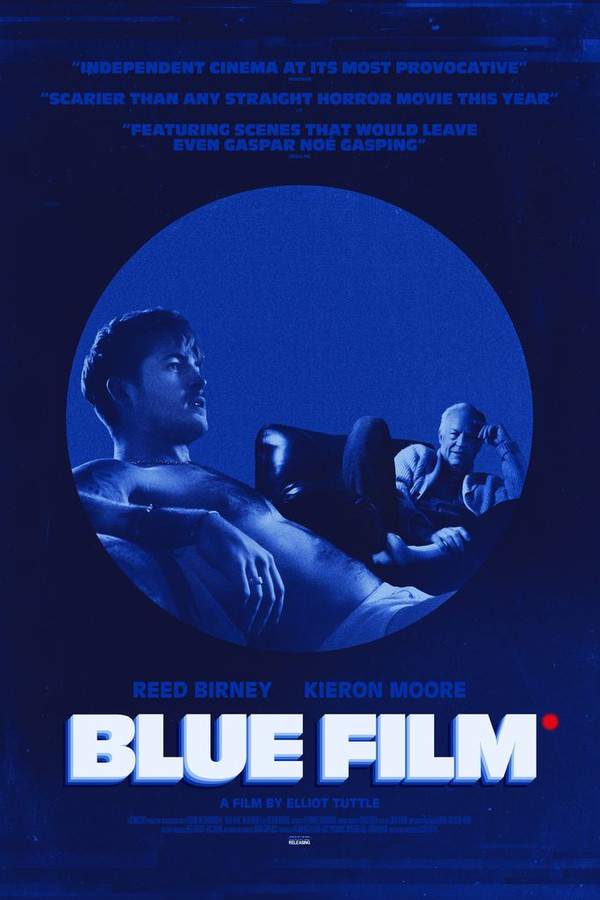
Blue Film 2026

Directed by

Elliot Tuttle
Made by

Fusion Entertainment
Where to Watch Blue Film
See current US streaming, rental, and purchase options for Blue Film (2026) via JustWatch.






Blue Film Plot Summary
Read the complete plot summary and ending explained for Blue Film (2026). From turning points to emotional moments, uncover what really happened and why it matters.
Aaron Eagle, a Los Angeles camboy who specializes in financial domination, is offered $50,000 to spend a night with one of his viewers, who answers the rental-house door wearing a balaclava to hide his identity. He sets up a camera and asks a series of increasingly personal questions. As the night unfolds, Aaron opens up with memories of being born in Bedford, Maine and describing a sexual encounter where he fulfilled a couple’s rape fantasy that inspired him to become a professional dominant. He refuses to answer a question about a tattoo above his eye reading “Diablo.” After a heated confrontation, Aaron’s client reveals that he knows Aaron’s real name, Alex McConnell; in a moment of anger, Aaron unmasks the client, exposing him as his former middle school English teacher, Hank Grant.
Hank Grant is depicted as a pederast who was arrested for attempting to assault one of his students, James Scott, intending to molest him; after a change of heart, he let the boy go and served seven years in prison. He still lives in Bedford, where he works at a supermarket, and has turned to religion in later life. He claims to have been in love with Aaron, remembering him as a lonely boy who was frequently in detention and who flew to Los Angeles to learn about what had become of him. Hank explains that he traveled to meet his former student and to understand his life’s path.
The encounter moves into explicit territory as Hank begins to perform fellatio on Aaron, but stops himself. Over beers, the two engage in a blunt conversation about the nature of perversion, and Hank shaves Aaron’s body hair, attempting to fulfill a perverted sexual fantasy until Aaron grows uncomfortable and physically stops him. The dialogue deepens as the two of them discuss hard truths and personal histories.
During their exchange, Aaron reveals that his first sexual experience involved being molested by his aunt, while Hank recalls a moment from Aaron’s past at a school talent show and asks him to sing the same song again; Aaron refuses. Hank attributes his own pedophilia to being raped by his grandfather from a very young age, with his mother’s tacit approval, lamenting that his life has been consumed by meaningless sexual urges. Aaron counters by saying he was never molested by his aunt, defends his choice to work in sex labor, and tearfully explains that his “Diablo” tattoo is connected to an ex-boyfriend, Rafael, with whom he no longer speaks.
The two engage in sex again, but Hank is unable to ejaculate, and Aaron ends up masturbating himself to completion. After they cuddle, Hank confesses that he did not truly have a change of heart when he assaulted James and that the boy managed to get away on his own.
Come morning, Hank leaves to return to Maine, giving Aaron the rest of his money along with old yearbook photos of a young Alex and Hank. Aaron showers in the rental property, singing softly to himself as the night’s turmoil settles into a quiet, unsettled memory.
Blue Film Timeline
Follow the complete movie timeline of Blue Film (2026) with every major event in chronological order. Great for understanding complex plots and story progression.
Aaron accepts the high-stakes night offer
Aaron agrees to spend a night with a viewer for $50,000. He sets up a camera and confronts a viewer who arrives at his rental house wearing a balaclava, hiding his identity. The encounter is framed as a high-stakes psychological game as much as a sexual one.
Aaron's past comes to light as he talks about his origins
During the questions, Aaron opens up about his early life, revealing he was born in Bedford, Maine. He recounts a sexual encounter involving a couple's rape fantasy that helped steer him toward becoming a professional dominant. The confession sets up the film's themes of power, vulnerability, and personal history.
The 'Diablo' tattoo question is raised
Aaron refuses to answer a question about the tattoo above his eye that reads 'Diablo.' The moment marks a boundary he won't cross in this session. The tension between truth and performance deepens as the questions continue.
The viewer is unmasked as Aaron's former teacher
After unmasking, Aaron learns the viewer is Hank Grant, his former middle school English teacher. Hank claims he knows Aaron's real name, Alex McConnell, linking the session to their shared Bedford past. The revelation turns the encounter from a game into a personal reckoning.
Hank's troubling backstory unfolds
Hank's backstory comes into focus: he is a pedophile who was arrested for attempting to assault a student, James Scott, and served seven years in prison. He now lives in Bedford and works at a supermarket, having turned to religion in later life. He says he came to Los Angeles to see Aaron and learn what became of him.
Hank's physical domination and the beer conversation
Hank begins to perform fellatio on Aaron but stops during the act as they pivot to conversation. After drinking beers, they discuss the nature of perversion and power in their dynamic; Hank shaves Aaron's body hair and fulfills a perverted fantasy until Aaron becomes uncomfortable and ends the act.
Trauma and talent show reminiscence
The two men talk about Aaron's first sexual experiences while Aaron talks about the school talent show. Aaron says he was never molested by his aunt, and Hank recalls a song Aaron performed, asking him to sing it again, which Aaron refuses. The exchange uses memory to probe guilt, artistry, and personal myth.
Hank's childhood trauma and flawed rationale
Hank attributes his pedophilia to being raped by his grandfather, with his mother's tacit approval he laments how his life was consumed by perverse urges. He articulates a grim, tragic origin that he believes explains his behavior, while avoiding explicit absolution. The scene examines the corrosive effects of trauma and the limits of self-forgiveness.
Aaron's truth about his past and the Diablo tattoo
Aaron admits he was never molested by his aunt and defends his sex work as a choice rather than exploitation. He tearfully explains that the 'Diablo' tattoo comes from his ex-boyfriend Rafael, not from any defining trauma. The truth reframes his identity within the relationship and challenges Hank's moral judgments.
The sexual encounter culminates in a personal climax
Aaron and Hank have sex, but Hank cannot ejaculate, leaving Aaron to masturbate himself to completion. The scene exposes the fragility of desire and the messy power dynamics at the center of their encounter. They share a moment of exhausted closeness before the night moves toward closure.
Hank admits there was no real remorse for James
Cuddling afterward, Hank confesses that he did not actually have a change of heart when assaulting James, and that the boy got away on his own. The admission reveals the persistence of Hank's predatory pattern and the gulf between his words and actions. Aaron processes the truth with a mix of anger, fear, and sorrow.
The departure and a lone morning
The next morning, Hank leaves to return to Maine, handing over the remaining money and old yearbook photos of Aaron and Hank. Aaron takes a shower in the rental property, singing to himself as the scene closes. The film ends on a note of unresolved history and lingering vulnerability.
Blue Film Characters
Explore all characters from Blue Film (2026). Get detailed profiles with their roles, arcs, and key relationships explained.
Hank Grant (Reed Birney)
Hank is a former middle school English teacher who served seven years in prison for attempting to assault a student. Now living in Bedford, Maine, he works at a supermarket and has turned to religion, yet his past lingers in his desires and vulnerabilities. He travels to Los Angeles to revisit an attraction to Aaron, revealing a volatile mix of care, guilt, and predatory history. The session culminates in a charged confrontation that exposes his long-buried impulses and the fragility of accountability.
Aaron Eagle (Kieron Moore)
Aaron is a Los Angeles camboy who specializes in financial domination, leveraging his online persona to explore power and intimacy. He was born in Bedford, Maine, and explains a painful past that shaped his career and boundaries, including a sexual history with a couple's rape fantasy that inspired his profession. He defends his sex work, explains the meaning behind his tattoo, and becomes entangled in a dangerous, revealing encounter with Hank. The night ends with emotional honesty and unresolved tension.
Pre-teen (Turner Beckett)
A younger version of Aaron appears in flashbacks, illustrating his early loneliness and frequent detention in Bedford. The pre-teen scenes reference Aaron's school life, detention, and a talent-show memory that anchors his later sense of self. These memories help explain his adult persona and his capacity for fascination with control and secrecy. The character serves as a memory knot that the film unthreads throughout the narrative.
Blue Film Settings
Learn where and when Blue Film (2026) takes place. Explore the film’s settings, era, and how they shape the narrative.
Location
Los Angeles, Bedford, Maine
Los Angeles serves as the immediate setting for the intimate, rented-house session where Aaron's webcam performance unfolds. Bedford, Maine, Aaron's birthplace and Hank's hometown, grounds the backstory of past abuse, imprisonment, and a chance encounter that travels cross-country. The two places highlight the collision of a public, performative life with a private, troubled past.
Blue Film Themes
Discover the main themes in Blue Film (2026). Analyze the deeper meanings, emotional layers, and social commentary behind the film.
🔒
Power Dynamics
The film centers on a private domination session, exploring how control, vulnerability, and consent intersect in sexual labor. Aaron's position as the performer and Hank's history as a figure of authority color the exchange and its boundaries. The confrontation exposes the fragility of consent within secretive, high-stakes interactions. The story uses dialogue to probe whether genuine autonomy can exist under pressure and secrecy.
🧠
Trauma & Memory
Past abuse and long-buried memories haunt both Aaron and Hank, shaping who they are and what they seek. Aaron's Bedford upbringing and Hank's prison past provide the emotional ballast that drives their connection. The narrative uses confession to surface painful histories and to question whether understanding pain can either heal or deepen harm. The film suggests that trauma can structure desire and complicate forgiveness.
🎭
Identity & Masks
The story hinges on unmasking truths—the real names, pasts, and the tattoo that links to Aaron's backstory—showing that personas can be performative as much as the acts themselves. The private encounter collapses the line between performer and person, forcing a reckoning with who they really are. Aaron's tattoo and Hank's past become signs that complicate how they see themselves and each other. The film invites reflection on authenticity versus facade in intimate encounters.

Coming soon on iOS and Android
The Plot Explained Mobile App
From blockbusters to hidden gems — dive into movie stories anytime, anywhere. Save your favorites, discover plots faster, and never miss a twist again.
Sign up to be the first to know when we launch. Your email stays private — always.
Explore the mobile appBlue Film Spoiler-Free Summary
Discover the spoiler-free summary of Blue Film (2026). Get a concise overview without any spoilers.
In the glow of Los Angeles nights, Aaron Eagle makes his living through screens, performing for anonymous viewers who pay for his presence and surrender control to his particular brand of domination. A professional cam-boy specializing in financial domination, Aaron has built his existence around transactional intimacy, where every interaction carries a price and every fantasy serves a purpose. The city offers endless opportunities for those willing to sell pieces of themselves — and Aaron has become adept at navigating the boundaries between performer and person.
When an unusually generous offer promises $50,000 for a single night with an enigmatic client, Aaron accepts, drawn by the allure of quick cash and the novelty of an in-person encounter. But from the moment he arrives at the rental house, it becomes clear that this arrangement defies the comfortable anonymity he typically maintains. The client’s face remains hidden, his questions probing deeper than any transaction should warrant, and an unsettling familiarity creeps into every exchange.
What begins as a straightforward arrangement gradually shifts into something far more complex. Throughout a long night of verbal sparring and emotional confrontation, the two men circle around a shared history neither fully anticipated. The anonymity that was supposed to protect them instead amplifies every question, every silence, and every revelation about the tangled threads connecting their lives. The camera keeps recording, but the lines between performance and truth begin to blur.
As dawn approaches, both men must reckon with what brought them to this moment — and what it means to confront a past that refuses to stay buried. The night strip away pretense, leaving only two people bound by circumstance and memory, each searching for something the other might not be willing to give.
Featured on this page

What's After the Movie?
Not sure whether to stay after the credits? Find out!
Check out our other apps:

SAT Sphere
Build confidence for the Digital SAT.

Mori Atlas
Discover wild places worth protecting.

Luntero
Search smarter for a home in Amsterdam.

Plot Explained
Unravel movie endings and hidden clues.

Pokechamp
Dive into Pokémon data and battle logic.

Driving Theory
Get ready for your European theory test.

Movie Dust
Plan your next cinema trip with ease.

Musemap
Find art and culture as you travel.

Selkobase
Compare credentials before committing.

Local Manual
Turn an unfamiliar country into practical next steps.

Lernavi
Compare school systems before your next move.

GymRoam
Find a workout stop wherever your plans take you.
Explore Our Movie Platform
New Movie Releases (2026)
Famous Movie Actors
Top Film Production Studios
Movie Plot Summaries & Endings
Major Movie Awards & Winners
Best Concert Films & Music Documentaries
Movie Collections and Curated Lists
© 2026 What's After the Movie. All rights reserved.
Privacy Policy