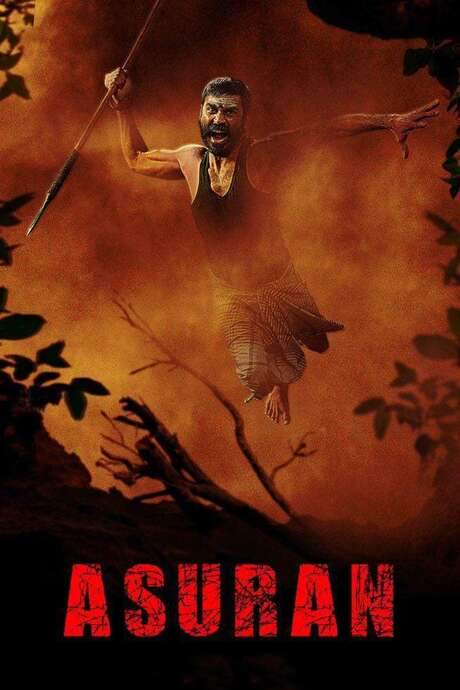
What Is Asuran About?
The premise of Asuran in 318 words, with nothing given away. The full story follows below.
In the sweltering fields of late‑1970s Kovilpatti, a tight‑knit farming community lives under the weight of an entrenched caste hierarchy. The landscape is a patchwork of dusty lanes, modest homesteads and looming estates that belong to a privileged upper‑caste class. Daily life is a fragile negotiation between survival and the unspoken rules that keep the two worlds apart, and the air hums with the unrelenting tension of land disputes and social injustice.
Sivasaami is a quiet, dignified farmer whose calm demeanor masks a deep well of perseverance. He tends his modest three‑acre plot with his wife Pachaiyamma and their children, trying to nurture hope in a place where opportunities are scarce. Their teenage son, Chidambaram, is restless and eager, hovering between youthful bravado and the weight of his family’s expectations. The family’s Dalit identity places them on the margins, yet they cling to a resilient sense of community and mutual support.
When a sudden, fatal confrontation between Chidambaram and a member of the privileged upper caste shatters the fragile balance, the family is forced onto the run. The incident thrusts Sivasaami into a role that challenges his pacifist nature: he must become the shield for his son while navigating a hostile landscape fraught with both visible and hidden threats. The chase through backroads and hidden waterways amplifies the stark contrast between the peaceful rhythms of rural life and the urgent, desperate need to stay ahead of a force determined to reassert its dominance.
The film unfolds with a raw, unflinching tone that blends gritty realism with moments of poignant humanity. It paints a vivid portrait of a family caught in the crosscurrents of caste oppression, exploring how love, duty, and the yearning for a better future can drive ordinary people to extraordinary resilience. The mood is tense yet hopeful, inviting viewers to contemplate the cost of staying true to one’s principles when everything else is stacked against you.
What Happens in Asuran?
The complete story of Asuran, from the first scene to the last, in 708 words (about 3 minutes). Spoilers throughout. Names in the text link to 9 cast member pages.
Spoilers ahead
In the late 1970s, in Kovilpatti, Sivasaami and his son Chidambaram trek along a river, carrying improvised bombs, while in a different corner of the village a woman Pachaiyamma, her brother Murugesan, and her daughter Lakshmi hide from the police.
Past: The narrator reveals the hard truth—that the man is [Sivasaami] and the boy is his son [Chidambaram]. The family, along with [Pachaiyamma], [Murugesan], and their child, lives as Dalit farmers in Thekkoor, a southern village where land and dignity clash with caste hierarchies. Sivasaami maintains a close, almost protective bond with his elder son [Vel Murugan], but his relationship with [Chidambaram] is strained and distant. Narasimhan, an upper-caste landlord from Vadakoor, wants Sivasaami’s three acres to build a factory, and the family resists selling. When [Pachaiyamma] is attacked by Narasimhan’s son, Velmurugan responds with a fierce retaliation that lands him in jail. Sivasaami pleads for Velmurugan’s release, yet Narasimhan demands a grave humiliation: Sivasaami must prostrate before every male resident of the landlord’s village as atonement. The humiliation sparks anger in Velmurugan, who strikes Narasimhan with a slipper, but the landlord’s henchmen—led by a hunter named Kariyan—strike back by beheading Velmurugan and dumping his headless body, naked, in their field. The sight leaves Pachaiyamma broken, unable to protest without the missing head as evidence, and after a year, Chidambaram is forced to kill Narasimhan in revenge. Sivasaami witnesses the act, cuts the street lights there, and, with the family, they flee into the night.
Present: Kariyan is tasked with tracking the pair and nearly brings down [Chidambaram]. Sivasaami holds his own against their pursuers, defeating them all but choosing not to kill. As the family recovers, Sivasaami explains why he spared their lives and what lay behind his past decisions.
Past (twenty years earlier): Sivasaami is introduced as a village-famous moonshine brewer and a trusted servant to Viswanathan, a powerful landlord. He helps Pandiyan, Viswanathan’s distant relative, become a mill clerk, while Sivasaami’s brother [Murugesan] and Venugopal Seshadri, a Brahmin Communist lawyer, push to reclaim their Panchami land from landlords who seized it. Sivasaami’s elder sister’s daughter, Mariyamma, proposes to him, and he accepts; the family also accepts the match. Pandiyan’s slow ascent earns Viswanathan’s trust, and he becomes the mill’s accountant. Sivasaami secretly falls in love with [Mariyamma], and when he hands her sandals to wear, Pandiyan beats her and makes her walk through the village with the sandals on her head. Sivasaami retaliates by striking Pandiyan with sandals in the middle of the village and tying him up, though Viswanathan rebukes him. Sivasaami quits brewing and joins his brother in labor organizing. One night, a meeting led by [Seshadri] and Murugan is disrupted; Sivasaami is sent to retrieve documents authorizing the gathering. When he returns, Pandiyan, Murugesan, and others are dead, and Sivasaami’s family—along with many others—are burned alive. Enraged, Sivasaami kills Viswanathan, Pandiyan, and their men. He leaves his village, and months later he is found by [Murugesan], who teaches him farming and introduces him to [Pachaiyamma], who is not receiving marriage proposals. He narrates his story, and [Pachaiyamma] comes to admire his courage. He ultimately surrenders to the court and receives a light sentence, and later marries [Pachaiyamma].
Present (continuation): [Chidambaram] is astonished by his father’s past and begins to admire him anew. Sivasaami reconciles with his wife and daughter briefly, and the family seeks help from Venugopal Seshadri to aid their case, with the lawyer agreeing to assist if they appear at court the following day. The next day, they reach the courthouse but are ambushed by Narasimhan’s men. Sivasaami reluctantly sells his land to shield his family from further attacks, but [Chidambaram] is abducted and tortured in what is a flagrant breach of their agreement. Sivasaami fights back, killing many of Narasimhan’s male relatives, while Murugesan and the villagers arrive with weapons to diffuse the situation. The villages agree to end the feud and prevent caste clashes. Sivasaami’s family stands with him in court, and he offers to go to prison in place of [Chidambaram] if needed. He tells his son to study hard and pursue a stable bureaucratic career, noting that education cannot be taken away like land or money, and he smiles softly as he steps toward the courthouse.
Asuran Timeline: Every Key Event in Order
12 key events in the order they happen, from “Sivasaami's early life as a moonshine brewer” to “Murugesan arrives; villages agree to end caste clash; Sivasaami goes to court; final lesson to Chidambaram”. 12 events name a place, across 9 locations.
- 1
Sivasaami's early life as a moonshine brewer
Twenty years before the present, Sivasaami is a village-famous moonshine brewer who becomes a trusted servant to the landlord Viswanathan. He wields influence in the village through his work and earns the landlord's confidence. This period lays the groundwork for the later clashes between tenants and landlords.
When:20 years before present Where:Thekkor
- 2
Pandiyan becomes clerk under Viswanathan; tensions rise around Panchami land
Sivasaami arranges for Pandiyan to be employed as Viswanathan's clerk, signaling a shift in power within the landlord's circle. Murugan and Seshadri plot to reclaim Panchami land from the landlords, setting the stage for a broader struggle. The simmering conflict between laborers, tenants, and landlords grows louder.
When:20 years before present Where:Viswanathan's mill estate
- 3
Sivasaami falls for Mariyamma; Pandiyan assaults her; Sivasaami retaliates
Sivasaami falls in love with Mariyamma, but Pandiyan brutalizes her, forcing her to walk with sandals on her head. Sivasaami strikes back, hitting Pandiyan in the middle of the village and tying him up, which earns him a rebuke from Viswanathan. He quits brewing and joins his brother Murugan as the tension between landlords and tenants intensifies.
When:20 years before present Where:Thekkor village
- 4
Murugan, Seshadri arrested; Pandiyan and men massacre villagers; huts burned
News arrives that Seshadri has been arrested, and Pandiyan and his men brutalize Murugan and others, while Mariyamma's family is among those burned out of their huts. The attack devastates Sivasaami's circle and deepens the vendetta against the landlords. The village burns with fear and fury as the cycle of violence escalates.
When:20 years before present Where:Thekkor
- 5
Enraged Sivasaami kills Viswanathan, Pandiyan, and their henchmen; he leaves the village
In a fit of rage, Sivasaami destroys Viswanathan, Pandiyan, and their men, ending the landlord's apparent control. He abandons the village and disappears into the countryside, seeking a new life away from Thekkor. Months later, he is found by Murugesan, who teaches him farming.
When:20 years before present Where:Thekkor and surrounding countryside
- 6
Murugesan finds Sivasaami; introduced to Pachaiyamma; farming training begins
Murugesan locates Sivasaami and teaches him farming, helping him rebuild a life apart from his past. He is introduced to Pachaiyamma, who is not receiving marriage proposals at that time. The seeds of a new family are planted as Sivasaami contemplates a future beyond vengeance.
When:20 years before present Where:Countryside near Thekkor
- 7
Sivasaami narrates his past to Pachaiyamma; she admires his sacrifice
Sivasaami shares his own story with Pachaiyamma, recounting the violence and losses that led him to this moment. Pachaiyamma is moved and admires the strength he showed for his family. The two grow closer as they bond over shared hardship.
When:20 years before present Where:Thekkor outskirts
- 8
Sivasaami surrenders to the court; receives a light sentence; marries Pachaiyamma
Sivasaami surrenders to the court and is given a light sentence, a small mercy after such a turbulent past. After serving his time, he marries Pachaiyamma, uniting two people tempered by years of struggle. This marks a quieter, domestic turn before the violence of the present erupts again.
When:20 years before present Where:Court, then Thekkor
- 9
In the late 1970s, Sivasaami and Chidambaram trek with bombs; two women and children hiding elsewhere
In the late 1970s in Kovilpatti, a man and a boy trek across a river carrying homemade bombs, hinting at violent retaliation against the landlords. In a separate part of the village, a woman, a man, and a girl hide from the police, underscoring a climate of fear. The pair's journey foreshadows the eruption of past grievances into present action.
When:late 1970s Where:Kovilpatti
- 10
Kariyan is tasked to locate Sivasaami and Chidambaram; he closes in; Chidambaram nearly killed
Kariyan is hired to find the fugitives and tracks them down, nearly killing Chidambaram in the process. Sivasaami fights off the pursuers and ultimately spares them, offering an explanation for his mercy. The confrontation marks the thinning line between mercy and revenge.
When:present Where:Kovilpatti
- 11
Sivasaami sells land to protect his family; Chidambaram abducted and tortured
To shield his family from Narasimhan's vengeance, Sivasaami reluctantly sells his land. Narasimhan's men abduct Chidambaram and torture him, violating any arrangement they had with Sivasaami. The family endures further peril as the cycle of violence threatens to consume them.
When:present Where:Kovilpatti
- 12
Murugesan arrives; villages agree to end caste clash; Sivasaami goes to court; final lesson to Chidambaram
Murugesan and the village rise to defuse the siege, and both communities agree to end the conflict to prevent a caste clash. Sivasaami tells Chidambaram to study hard and pursue a powerful bureaucratic job, insisting that education cannot be taken away. With a hopeful smile, he walks into the court, accepting what may come while protecting his family.
When:present Where:Court, Thekkor
Who Are the Main Characters in Asuran?
10 characters, among them Sivasaami (Dhanush), Chidambaram (Ken Karunas) and Pachaiyamma (Manju Warrier): who each one is and the part they play in the story. Every profile links to the actor’s page.
-

Sivasaami (Dhanush)
Played by Dhanush
A Dalit farmer and former moonshine brewer who becomes a protective patriarch for his family. He oscillates between acts of violence and restraint, guided by a complex sense of duty. His past and present choices drive the family’s fate and the community’s response to oppression.
- 🎭 Patriarch
- 🌾 Farmer
- 🧭 Moral complexity
- C(
Chidambaram (Ken Karunas)
Played by Ken Karunas
Sivasaami’s son who grows from a sheltered boy into a witness of his family’s trauma and a participant in the pursuit of justice. He navigates loyalty, courage, and the cost of rebellion.
- 🧒 Son
- 🎯 Growth
- 🛡️ Loyalty
- P(
Pachaiyamma (Manju Warrier)
Played by Manju Warrier
The matriarch and pillar of resilience who endures violence and loss while supporting her family’s hopes for safety and a stable future.
- 👩 Matriarch
- 🌾 Village resilience
- 🕊️ Hope
- V(
Viswanathan (A. Venkatesh)
Played by A. Venkatesh
A landlord whose power and greed catalyze the central feud, embodying the oppressive weight of authority in the community.
- 🏛️ Landlord
- ⚖️ Power
- 📈 Influence
- P(
Pandiyan (Nithish Veera)
Played by Nithish Veera
Viswanathan’s clerk who becomes entangled in the power struggle, illustrating how loyalty can be compromised within a corrupt system.
- 📜 Clerk
- 🤥 Betrayal
- RN
Rajesh Narasimman (Bala Hasan)
Played by Bala Hasan
An upper-caste landlord who seeks Sivasaami’s land for industrial gain and uses coercion to enforce control, igniting the cycle of retaliation.
- 🏰 Landlord
- 💪 Oppression
- M(
Murugesan (Pasupathy)
Played by Pasupathy
Sivasaami’s brother who joins the struggle for Panchami land, representing solidarity within the Dalit community and family ties that bind.
- 🫂 Brother
- 🌾 Ally
- VM
Vel Murugan (Teejay)
Played by Teejay
The elder son whose death in the past fuels the parents’ drive for revenge and shapes the family’s path forward.
- 👦 Son
- ⚔️ Tragic
- K(
Kariyan (Tamizh)
Played by Tamizh
A hunter who leads the pursuit of Sivasaami and Chidambaram in the present, embodying the encroaching danger from vested interests.
- 🕵️ Hunter
- ⚔️ Antagonist
- P(
Pechimuthu (Sentrayan)
Played by Sentrayan
One of Narasimhan’s henchmen connected to the earlier crackdown, illustrating the reach of the landlord’s forces.
- 👤 Henchman
- 🗡️ Violence
Where and When Is Asuran Set?
Asuran is set in Kovilpatti, Thekkoor and Vadakoor (Late 1970s). Here is why the time and place matter to the story.
When
Late 1970s
The story is anchored in the late 1970s rural Tamil Nadu, a period marked by agrarian struggle and caste tensions. The era emphasizes labor organizing, land disputes, and social pressures that push characters toward drastic actions. Flashbacks reveal events from roughly two decades earlier that shape present-day motivations and loyalties.
Where
Kovilpatti, Thekkoor, Vadakoor
Set in rural Tamil Nadu, the film unfolds in Thekkoor, a southern village near Kovilpatti, with nearby Vadakoor as a contrasting locale. The landscape features fields, rivers, and dusty roads where farming families live under strict caste hierarchies. The central conflict revolves around Dalit farmers resisting a powerful landlord's attempts to take their land, a dynamic that catalyzes revenge and reconciliation.
- 🏞️ Rural Tamil Nadu
- 🏘️ Village life
- ⚖️ Caste conflict
- 🌾 Agrarian society
What Are the Themes of Asuran?
4 ideas the story keeps returning to, among them Caste Conflict, Violence and Revenge and Rural Life.
-
01
Caste Conflict
Dalit oppression and upper-caste dominance drive the plot as land and dignity come under threat. The characters navigate a system where caste biases justify coercion and violence. The film shows how families resist dispossession and fight for recognition and safety.
-
02
Violence and Revenge
Violence escalates from personal slights to brutal retaliations, framing the family’s history and present danger. Sivasaami’s past acts of vengeance echo in the present pursuit, creating a cycle of harm. The narrative challenges characters to choose restraint over vendetta and to seek justice through means beyond bloodshed.
-
03
Rural Life
Agrarian life, including farming routines, moonshine brewing, and community ties, grounds the characters’ daily existence. Land, labor, and livelihood shape ambitions and fears in Thekkoor and its surroundings. The environment reflects how tradition meets modern pressures in a fragile social fabric.
-
04
Law and Justice
Legal proceedings frame the narrative as the family negotiates protection and accountability within a biased system. The courtroom and legal maneuvers expose power dynamics between landlords, lawyers, and peasants. The resolution hinges on safeguarding the family’s future and education over material gains.
What Kind of Film Is Asuran?
Dark in tone, with fast pacing and a very complex story, going by the plot summary.
- Tone
- Dark
- Pacing
- Fast
- Story
- Very complex
- Intensity
- High
- Ending
- Bittersweet
A relentless and grim saga of a family's brutal struggle against caste-based violence, characterized by fierce desperation, vengeful actions, and heartbreaking losses.
- oppressive
- vengeful
- desperate
- fierce
- grim
- heart-wrenching
- caste oppression
- violent revenge
- family survival
- land rights
Content notes: decapitation, torture, murder, systemic oppression, family trauma.
Quiz
How well do you remember Asuran? Test yourself on the story.
Where to Watch Asuran
Stream it on Amazon Prime Video, or rent or buy it from Google Play Movies and YouTube. US availability and prices from JustWatch.
 Amazon Prime Video
  Amazon Prime Video with Ads

Streaming availability in the US, powered by