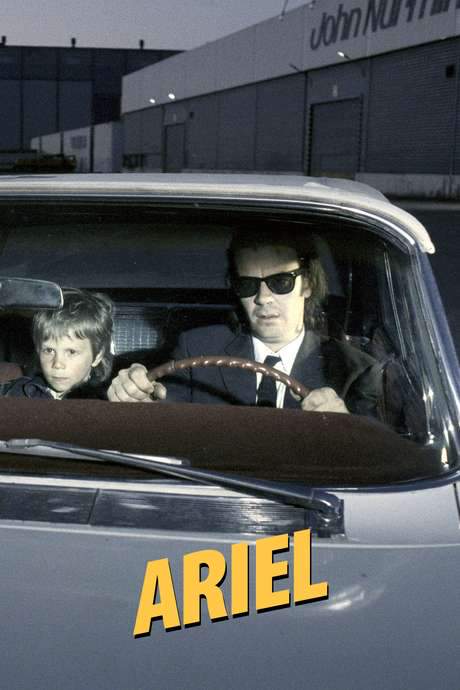
Ariel 1988

Directed by

Aki Kaurismäki
Made by

Villealfa Filmproductions
Where to Watch Ariel
See current US streaming, rental, and purchase options for Ariel (1988) via JustWatch.

Streaming availability powered by 
Ariel Plot Summary
Read the complete plot summary and ending explained for Ariel (1988). From turning points to emotional moments, uncover what really happened and why it matters.
In rural Finnish Lapland, a mining operation shutters its doors, leaving Taisto Kasurinen Turo Pajala and a slate of fellow miners suddenly without work. The withdrawal of this steady livelihood casts a pall over the region, and the film trails Kasurinen as he drifts from one precarious choice to another. In a sunlit café, the sight of a gleaming old Cadillac convertible—an echo of a vanishing era—catches his eye, and an older miner nearby offers him advice that carries a sense of fatal finality. Before Kasurinen can fully take in the gesture, the man steps into the restroom and shoots himself, leaving behind a grim instruction and a symbol of sunk costs. The Cadillac becomes a tangible dream, and Kasurinen soon finds himself in southern Finland, where luck does not follow him: he’s mugged, his life savings vanish, and the road ahead grows steeper by the day.
He finds a laboring job and a cheap bed at a nearby hostel, barely scraping by as the city hums with indifferent energy. The Cadillac remains a magnet, drawing interest from Irmeli Pihlaja Susanna Haavisto, a metermaid who is both flirtatious and perceptive. She leaves her shift early to dine with him, and their evening unfolds with a candid exchange of past hurts and stubborn resolve. In their bed, Irmeli speaks of her ex-husband, while Kasurinen opens up about his own roots in the country, and she bluntly notes, “that’s different.” The scene is intimate, rough-edged, and quietly hopeful, until the morning reveals a harsher reality.
The tranquility is shattered when Irmeli’s young son interrupts Kasurinen’s morning with a gun pressed to his face, demanding breakfast and a display of authority that unsettles the fragile trust between them. The tension peels back more layers of hardship as Kasurinen is unable to pay for his hostel bed and is forced to sleep in the car, a strip of asphalt becoming his shrinking world. Desperation grows as he sells the Cadillac to keep afloat, and he wanders through a city that feels both intimate and indifferent. In a diner, he recognizes one of his alleged tormentors from the robbery, and a chilling chase ensues. He seizes the knife the man pulls and holds him at knifepoint, but the encounter earns him an arrest for attempted armed robbery, pulling him toward a courtroom and a sentence of nearly two years.
As Kasurinen leaves the courtroom, his eyes meet Irmeli’s in a moment charged with unspoken history, a glance that threads their fates together once more. Back behind bars, his resolve hardens, and he proposes marriage to Irmeli during a prison visit; she accepts, choosing a bond that will carry him through the coming chaos. On a later visit, Irmeli brings him a birthday cake and a book with a hidden saw—a small, ominous token that foreshadows the violent turns ahead. When Kasurinen and his cellmate Mikkonen [Matti Pellonpää] escape, the two men blur the lines between crime and survival, forming a perilous alliance as they step back into the world.
Outside, Kasurinen and Mikkonen marry in name and in need, their union a quiet act of defiance against an unforgiving landscape. The two men hatch a plan to leave the country, robbing a bank to fund their escape and the future they dream of across borders. But the very promises that once offered hope—passports and safe passage—turn deadly when the men who had pledged their support stab Mikkonen in pursuit of the loot. Kasurinen shoots them dead in a brutal moment of retribution, yet the loss of Mikkonen is felt as a final, devastating cost of their journey.
The film closes on a stark, luminous image: Kasurinen, Irmeli, and her young son board a ship named Ariel, heading toward Mexico. The voyage is not a triumph but a moving away from a country and a life that offered little more than hardship, chance, and consequence. The closing frame lingers on the sea and the uncertain horizon, leaving viewers with a sense of ambiguous possibility amid the raw honesty of a man who hunted for a better future and found, instead, a difficult, stubborn truth. > thats different.
Ariel Timeline
Follow the complete movie timeline of Ariel (1988) with every major event in chronological order. Great for understanding complex plots and story progression.
Mine closes in Lapland, unemployment hits
The mine in Finnish Lapland shuts down, leaving Taisto Kasurinen without work. He faces an uncertain future as his livelihood vanishes with the mine's closure. This event sets the film's onward path as he searches for a new life away from mining.
Cadillac gift and an abrupt suicide
In a café, an older miner advises Kasurinen that there is no future in mining and hands him the keys to a 1962 white Cadillac convertible. The man then goes to the restroom and shoots himself, leaving Kasurinen with a haunting symbol and a new sense of direction. The Cadillac becomes a driving motif for the journey ahead.
Move south and get mugged
Kasurinen drives the Cadillac to southern Finland, but he is mugged along the way and his life savings are stolen. The loss forces him to confront a more precarious future outside the North. He must scramble for money and work in a new place.
New job and cheap lodging
He finds a laboring job and secures a cheap bed at a nearby hostel, beginning to rebuild his life piece by piece. The modest accommodation and back-to-work routine contrast with his earlier loss. This marks a tentative step toward stability.
Irmeli notices the Cadillac
Metermaid Irmeli is impressed by the Cadillac and flirts with Kasurinen. She quits her job to accept his dinner invitation, and they start a developing romance. They go to her home where they sleep together and compare pasts, hinting at deeper connections.
A troubling wake-up call
Kasurinen is woken by Irmeli's young son pointing a gun at him and offering him breakfast, revealing a volatile, protective side of Irmeli's life. The moment unsettles Kasurinen and deepens the complexity of their budding relationship. The dangerous domestic scene foreshadows the film's harsher turns.
Hostel eviction and selling the car
Unable to pay for the hostel bed, Kasurinen is kicked out and ends up sleeping in his car. With money tight, he reluctantly sells the Cadillac, losing the symbol of his new start. The financial strain pushes him toward precarious choices.
Diner confrontation and arrest
While in a diner, Kasurinen spots one of the men who robbed him and gives chase, grabbing the knife the man pulls on him and holding him at knifepoint. The situation escalates, and the police arrest Kasurinen for attempted armed robbery. The sequence thrusts him into the criminal justice system.
Courtroom sentence and a piercing glance
Kasurinen is sentenced to nearly two years in jail. As he leaves the courtroom, he catches the eye of a distressed Irmeli across the room, hinting at the emotional stakes of his imprisonment. The public consequences of his actions become personal.
Marriage plan during prison visits
Kasurinen proposes marriage to Irmeli during one of her visits to the prison, and Irmeli accepts, providing a beacon of hope amid confinement. The engagement ties their fates together beyond the bars. The relationship becomes more serious as they navigate separation.
Birthday cake and escape
Later, Irmeli brings him a birthday cake and a book with a saw inside it. He and his cellmate Mikkonen escape from the prison together, catalyzing a dramatic turn toward their flight from the country. The escape marks a new, dangerous chapter.
Marrying after the escape
Outside the prison, Kasurinen and Irmeli get married, solidifying their partnership as they face an uncertain future together. The ceremony signals a commitment that will be tested by subsequent choices. The newlyweds embark on a shared plan beyond confinement.
Bank robbery and a fatal betrayal
Kasurinen and Mikkonen rob a bank to fund their journey out of the country. The men who had promised them passports stab Mikkonen to grab the loot, and Kasurinen shoots the attackers, yet cannot save his friend. The heist tragedy underscores the film's descent into violence.
Ariel to Mexico
The film ends with Kasurinen, Irmeli, and her son boarding a ship named Ariel bound for Mexico, seeking a fresh start far from their past. The voyage leaves their future uncertain but symbolic of escape and renewal. The last image is of a family choosing a new path together.
Ariel Characters
Explore all characters from Ariel (1988). Get detailed profiles with their roles, arcs, and key relationships explained.
Taisto Kasurinen (Turo Pajala)
A miner from a northern Lapland town who drifts toward the city in search of a new life. He is resourceful and impulsive, driven by economic desperation yet tempered by a stubborn resilience shaped by his harsh origins. As events unfold, he navigates crime, love, and restitution on the way to a hopeful, if uncertain, future abroad.
Irmeli Pihlaja (Susanna Haavisto)
A metermaid who flirts with Taisto, quits her job for a chance at romance, and becomes a crucial ally in his quest for a new life. She reveals a past filled with personal hardships and demonstrates pragmatism and emotional intuition. Their bond deepens quickly, culminating in a prison wedding that seeds both hope and risk.
Mikkonen (Matti Pellonpää)
Kasurinen's cellmate and reluctant confidant, a man of rough edges who becomes an ally in plans to escape. He shares the cramped, tense life of prison and the duo's daring flight, but fate intervenes when violence and betrayal alter the course of their voyage.
Ariel Settings
Learn where and when Ariel (1988) takes place. Explore the film’s settings, era, and how they shape the narrative.
Time period
Late 1980s
Set in the late 1980s Finland, the film captures a period of economic transition as traditional industries fade. The urban milieu contrasts with the stark northern landscape, shaping the characters' choices. The presence of a 1962 Cadillac convertible anchors the era's aesthetics and attitudes.
Location
Finnish Lapland, Southern Finland
The story begins in a remote mining town in Finnish Lapland, where a mine closure upends livelihoods. It then moves to a southern Finnish city, revealing a contrast between northern hardship and urban life. Key locations include a harbor, a hostel, a courtroom and a ship named Ariel that becomes the route of escape.
Ariel Themes
Discover the main themes in Ariel (1988). Analyze the deeper meanings, emotional layers, and social commentary behind the film.
🚶
Escape
From a closed mine to the city, the protagonist seeks freedom from debt and past mistakes. The escape is both physical, moving across Finland, and emotional, seeking a fresh start with Irmeli. Yet every step toward safety becomes entangled with crime and risk. Escape here is a double-edged pursuit, promising a better life while inviting danger.
💘
Love
Irmeli's relationship with Kasurinen pulls him from isolation and offers a chance at belonging. Their bond grows through shared vulnerability, even as their pasts threaten to derail them. They marry in a prison visit, a gesture that fuses affection with desperation. Love acts as shelter and lure, propelling them toward a risky escape.
🔒
Crime
Criminal acts punctuate the couple's arc, from thefts to a bank robbery funded by their escape plan. The consequences—arrest, prison, and violence—raise questions about guilt and responsibility. The accomplices betray them, showing how trust fractures in desperation. The film uses crime to expose the fragility of self-determination in a harsh economy.
🛳️
Migration
Facing an uncertain future, Kasurinen and Irmeli board a ship named Ariel bound for Mexico. The voyage frames migration as both liberation and risk, a leap toward an elusive new life. The ending positions escape as a path to dignity and a chance for a fresh start beyond Finland.

Coming soon on iOS and Android
The Plot Explained Mobile App
From blockbusters to hidden gems — dive into movie stories anytime, anywhere. Save your favorites, discover plots faster, and never miss a twist again.
Sign up to be the first to know when we launch. Your email stays private — always.
Explore the mobile appAriel Spoiler-Free Summary
Discover the spoiler-free summary of Ariel (1988). Get a concise overview without any spoilers.
In the stark expanse of rural Finnish Lapland a mine’s sudden closure shatters the rhythm of a tight‑knit community, leaving its workers adrift. Among them is Taisto Kasurinen, a stoic man whose world is further unsettled by his father’s tragic suicide. With few options left in the bleak northern landscape, Taisto decides to leave the familiar snow‑covered fields for the uneasy promise of the south, carrying only the weight of loss and a lingering hope for a fresh start.
The city he arrives in hums with indifferent energy, its streets a maze of opportunities shadowed by hardship. Here, the sight of a gleaming, old Cadillac convertible becomes a quiet beacon—a relic of a vanished era that seems to whisper of a life beyond survival. Taisto takes up modest work and a cheap hostel room, learning to navigate a place where anonymity is both a shield and a cage. The film paints the urban environment with a muted, almost monochrome palette, emphasizing the grit of daily existence against a backdrop of quiet desperation.
Amid this unfamiliar world, Taisto crosses paths with Irmeli Pihlaja, a meter‑maid whose sharp humor and perceptive eyes cut through his guarded exterior. Their tentative connection blossoms over shared meals and candid conversations, revealing scars from past relationships and the stubborn resolve that keeps each of them moving forward. Though their bond is fragile, it injects a gentle warmth into an otherwise cold setting, suggesting that even in the most unforgiving circumstances, companionship can kindle a spark of hope.
The tone of the story remains stark and contemplative, balancing the bleakness of economic ruin with the resilient human drive to seek meaning. As Taisto wrestles with the disorienting shift from the familiar northern quiet to the bustling southern streets, the film lingers on his internal quest for purpose, hinting at a journey that may lead far beyond the borders of his homeland.
Movies with Similar Twists and Themes
Uncover films that echo the narrative beats, emotional arcs, or dramatic twists of the one you're exploring. These recommendations are handpicked based on story depth, thematic resonance, and spoiler-worthy moments — perfect for fans who crave more of the same intrigue.
Featured on this page

What's After the Movie?
Not sure whether to stay after the credits? Find out!
Check out our other apps:

SAT Sphere
Build confidence for the Digital SAT.

Mori Atlas
Discover wild places worth protecting.

Luntero
Search smarter for a home in Amsterdam.

Plot Explained
Unravel movie endings and hidden clues.

Pokechamp
Dive into Pokémon data and battle logic.

Driving Theory
Get ready for your European theory test.

Movie Dust
Plan your next cinema trip with ease.

Musemap
Find art and culture as you travel.

Selkobase
Compare credentials before committing.

Local Manual
Turn an unfamiliar country into practical next steps.

Lernavi
Compare school systems before your next move.

GymRoam
Find a workout stop wherever your plans take you.
Explore Our Movie Platform
New Movie Releases (2026)
Famous Movie Actors
Top Film Production Studios
Movie Plot Summaries & Endings
Major Movie Awards & Winners
Best Concert Films & Music Documentaries
Movie Collections and Curated Lists
© 2026 What's After the Movie. All rights reserved.
Privacy Policy