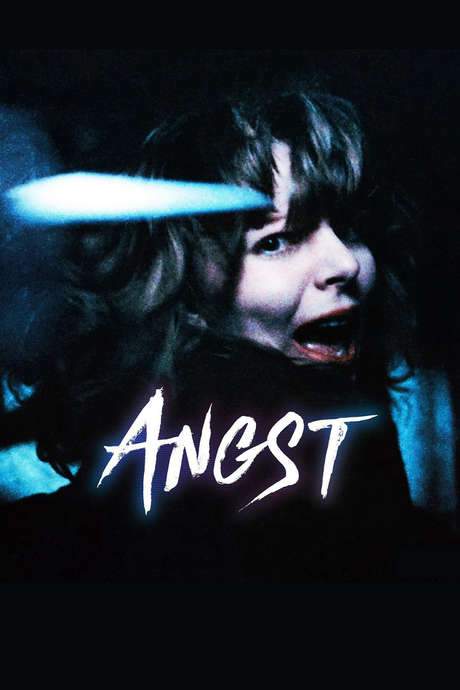
Angst 1983


Directed by

Gerald Kargl
Made by

Gerald Kargl
Where to Watch Angst
See current US streaming, rental, and purchase options for Angst (1983) via JustWatch.



Streaming availability powered by 
Angst Plot Summary
Read the complete plot summary and ending explained for Angst (1983). From turning points to emotional moments, uncover what really happened and why it matters.
An unnamed serial killer, the Psychopath, is released from prison with a cold, unsettling eagerness to see fear in his victims. His day begins in a diner, where he lingers near two girls at the counter, tempted to strike but unable to act openly in public. Later, in a tense taxi ride, he imagines killing the female driver, yet he must flee when the driver grows suspicious and stops the car.
As he escapes, he stumbles upon a house and encounters a mentally impaired Son in a wheelchair who mistakes the killer for his father. Soon, the Mother and Daughter arrive at the scene, and the killer hides himself away. The confrontation erupts quickly: he attacks, taping the [Daughter] to a doorknob and strangling the [Mother]. He then ties up the mother and drags the son to the upstairs bathroom, where he drowns him in the bathtub.
Returning downstairs, the killer finds the mother either dead or nearing death. The daughter pleads for medicine to save her mother, and the killer grudgingly complies, hoping to spare her death long enough to fulfill his grim plan. His attempts to revive her fail, and in a fit of rage he pushes the wheelchair-bound mother into a wall. He discovers the daughter attempting to escape and pursues her relentlessly. He stabs her to death, drinks her blood, and vomits on her—the blood acting as an emetic.
The killer wakes up the next morning on the daughter’s body, partially undressed and stained with blood. He decides to leave in the family’s car, taking the bodies with him in the trunk and planning to show them to his next victims to frighten them, even bringing the family’s dog along in the passenger seat. He rear-ends another car during the frantic escape, and several witnesses observe the chaos.
He returns to the diner—the same patrons from earlier are there again—and, as he feeds the dog, the police apprehend him after requesting his registration. He opens the trunk of the car for the officers to see the ghastly scene, reveling in the fear it provokes in the onlookers. The film closes with a voice-over medical record declaring that the killer was driven by a sadistic tendency rooted in an unstable childhood.
Angst Timeline
Follow the complete movie timeline of Angst (1983) with every major event in chronological order. Great for understanding complex plots and story progression.
Release and first murderous urge
Fresh out of prison, the killer fixates on killing again and feasts on the prospect of inducing fear in his victims. He stops by a diner and is tempted to attack two girls at the counter, but he restrains himself, recognizing he can't act openly in public. His mind remains focused on the fear he can provoke in others.
Taxi attempt and escape
Leaving the diner, he climbs into a taxi and weighs killing the female driver. The driver grows suspicious or cautious, and he is forced to flee when the car is stopped. The urge to kill is momentarily thwarted, pushing him to search for a new target.
Break-in at a house
While escaping, the killer comes across a house and breaks in. Inside, he encounters a mentally impaired man in a wheelchair who mistakes him for his father, increasing the danger of discovery. The intruder remains hidden as the situation grows tense.
Family arrives and hiding
The man in the wheelchair’s mother and sister arrive at the house, forcing the killer to hide. The misidentification by the disabled man creates a precarious cover for his planned actions. Tension mounts as the intruder bides his time to strike.
Daughter bound, mother killed
The killer launches his assault on the mother and sister, taping the daughter to a doorknob and strangling the mother. He shows a chilling lack of mercy and uses the daughter's position to intimidate further witnesses. The violent act reveals his brutal sadism.
The son dies in the bathroom
He binds the mother and drags the son to the upstairs bathroom, where he drowns him in the bathtub. The act demonstrates the killer’s escalating brutality and his appetite for complete control over his victims. The house cools with the weight of the crimes just committed.
Escape attempt and failed revival
The killer returns to the scene to check the mother and finds her near death or dead. The daughter pleads for her mother's medication, and he reluctantly administers it, hoping to buy time for his plan. His revival attempts fail, and in a fit of rage he pushes the wheelchair into a wall.
Dramatic kill and blood ritual
The killer corners the daughter as she tries to escape, stabbing her to death and drinking her blood. He vomits on her, the blood acting as an emetic and intensifying the grotesque scene. The act exposes his complete detachment from humanity and his thrill in fear and control.
Morning aftermath and trunk plan
He wakes up on the daughter's body, battered and covered in blood, and decides to leave with the bodies in the trunk. He also brings the living dog along in the passenger seat, intending to use the corpses to frighten future victims. The plan marks a cold, methodical next step in his spree.
Crashes and witnesses
During his frantic escape, he rear-ends another car, drawing the attention of bystanders. The crash creates witnesses to the rampage, heightening the danger and the likelihood of capture. The road becomes a stage for fear rather than anonymity.
Return to the diner
The killer returns to the diner where the same patrons linger, continuing to feed the dog as a disturbing, normal routine. The police arrive, asking for his vehicle registration, signaling that capture may be imminent. The sense of inevitability grows as tension tightens around him.
Climax: trunk reveal and resolution
He willingly opens the car trunk in front of onlookers, revealing the bodies and shattering any sense of safety. The crowd recoils as the authorities close in, and the film ends with a voice-over medical record attributing his sadistic tendencies to an unstable childhood. The final note places the violence in a tragic context, explaining his pathology.
Angst Characters
Explore all characters from Angst (1983). Get detailed profiles with their roles, arcs, and key relationships explained.
Psychopath (Robert Hunger-Bühler)
An unnamed serial killer freshly released from prison, he is driven by a sadistic urge to see fear in his victims’ eyes. He stalks victims in ordinary spaces—like diners and taxis—before choosing a house to break into. He reveals a cold, calculating demeanor, with moments of sudden, brutal rage. His stated motivation and methodical restraint mark him as a chilling, unstoppable force of violence.
Mother (Edith Rosset)
A mother living in the house with her son and daughter, she becomes a target during the killer’s rampage. She endures the chaos of an intrusion and ultimately dies as the intruder’s violence escalates. Her struggle to protect her family is cut short, underscoring the film’s brutal realism. Her fate emphasizes the collateral damage of the killer’s cruelty.
Daughter (Karin Springer)
The daughter who pleads for her mother’s medication and tries to flee, only to be drawn into the killer’s orbit of violence. She experiences fear and desperation as she confronts the intruder, ultimately becoming a victim of his brutal ritual. Her death highlights the indiscriminate nature of the killer’s wrath. Her presence marks the personal stakes of the confrontation within the house.
Daughter (Silvia Rabenreither)
Another daughter in the house who becomes entangled in the killer’s rampage. She is attacked after the mother is confronted, and her fate is sealed by the killer’s escalation. Her murder reinforces the film’s unflinching portrayal of violence within a domestic space. The scene underscores the predator’s disregard for family and life.
Son (Rudolf Götz)
A mentally impaired boy in a wheelchair living in the house. He becomes a target of the intruder’s brutality, who drags him to the upstairs bathroom and drowns him. His vulnerability exemplifies the indiscriminate cruelty of the killer and heightens the film’s sense of hopelessness.
Taxi Driver (Renate Kastelik)
A female taxi driver who becomes a potential target when the killer hops into her cab. She grows suspicious, and the driver’s vigilance forces the killer to flee rather than complete the murder. Her scene punctuates the constant threat present in everyday routines like a city ride.
Waitress (Rosa Schandl)
A waitress at the café who witnesses the tension surrounding the killer’s actions in a social space that becomes a backdrop for fear. Her presence helps anchor the film’s everyday realism, contrasting with the killer’s hidden predatory behavior.
Guest at café (Hermann Groissenberger)
A café patron who serves as a bystander in the sequences where the killer’s menace intrudes into public life. His reactions contribute to the texture of ordinary life disrupted by violence.
Guest at café (Claudia Schinko)
Another café patron who witnesses the mounting tension in a public space, reinforcing the film’s theme of ubiquitous fear in everyday settings.
Guest at café (Beate Jurkowitsch)
A further café patron whose presence amplifies the sense of shared vulnerability in public venues.
Waiter (Rolf Bock)
A policeman’s contact in a scene that anchors the killer’s murder spree in a recognizably public setting. The encounter with law enforcement adds a procedural counterpoint to the chaos.
Prison Guard (Helmut Hrdina)
One of the guards connected to the killer’s release, his presence helps contextualize the protagonist’s return to violence after imprisonment.
Prison Guard (Emil Polaczek)
Another guard present in the context of the killer’s prison background, reinforcing the backstory of imprisonment before the rampage.
Prison Guard (Adolf Hagmann)
A guard whose presence completes the depiction of the killer’s imprisonment history.
Prison Guard (Karl Riepl)
Part of the prison context surrounding the killer’s release, contributing to the narrative of returning danger.
Prison Guard (Günther Dietz)
Another guard linked to the prison setting that frames the killer’s release and subsequent actions.
Passer-by (Elisabeth Fez)
A bystander whose presence underscores the pervasiveness of fear in public spaces during the killer’s spree.
Passer-by (Paula Elkins)
Another passer-by who witnesses the chaos, adding to the film’s atmosphere of uneasy spectatorship.
Passer-by (Tennesee Gelinek)
A bystander caught in the crossfire of the killer’s presence in public spaces.
Passer-by (Vallerian Tomsich)
A bystander witness who adds to the broader social context of fear surrounding the killer.
Passer-by (Rafael Gelinek)
A member of the audience in the public scenes, reinforcing the sense that violence interrupts ordinary life.
Passer-by (Mischa Griegor)
A witness whose presence contributes to the film’s texture of everyday fear.
Passer-by (Andrea Eckelbacher)
A bystander whose actions and reactions help illustrate the public dimension of the killer’s violence.
Passer-by (Martin Kretschier)
Another onlooker in the film’s public spaces, contributing to the sense of shared fear.
Passer-by (Ursula Kretschier)
A bystander whose presence amplifies the everyday nature of danger in the story.
Passer-by (Tina Schlögl)
A bystander witness in the café street scene, adding to the collective sense of fear.
Passer-by (Walter Herzog)
A café or street bystander who bears witness to the killer’s presence.
Passer-by (Rudolf Steger)
A bystander whose reactions contribute to the film’s texture of public perception and fear.
Angst Settings
Learn where and when Angst (1983) takes place. Explore the film’s settings, era, and how they shape the narrative.
Location
Diner, Street, House, Café
The story unfolds across familiar urban spaces: a roadside diner, a city street, a quiet house where a family resides, and a bustling café. These everyday locations become stages for sudden violence, highlighting how danger can intrude into ordinary life. The house transforms into a claustrophobic battleground where the killer stages his brutal acts. By alternating between public and private spaces, the film emphasizes the fragile boundary between normalcy and horror.
Angst Themes
Discover the main themes in Angst (1983). Analyze the deeper meanings, emotional layers, and social commentary behind the film.
🔪
Violence
Angst centers on a sadistic killer who seeks to provoke fear in his victims. The violence is depicted as a ritualistic urge rather than a random act, underscored by the killer’s pleasure in observers’ reactions. The film strips glamour from the killings, presenting them in stark, clinical detail that heightens unease. Fear, power, and control emerge through the killer’s methodical brutality.
🧠
Trauma
The killer’s brutality is contextualized by a traumatic childhood, including abuse by his mother and stepfather. The narrative uses flashbacks and confessional moments to explore how early harm shapes cruel behavior. While the film invites sympathy for the motive it does not excuse the acts. Trauma is shown as a persistent force that ripples through present violence.
🌃
Fear
Fear is Weaponized as the killer’s primary tool; his acts are designed to induce terror in strangers and to provoke reactions from onlookers. The tension shifts between intimate domestic menace and public venues such as diners and streets, amplifying dread. Bystanders become part of the atmosphere of fear, illustrating how fear propagates beyond the immediate vict im. The film uses fear to critique the sensation of witnessing violence as spectacle.

Coming soon on iOS and Android
The Plot Explained Mobile App
From blockbusters to hidden gems — dive into movie stories anytime, anywhere. Save your favorites, discover plots faster, and never miss a twist again.
Sign up to be the first to know when we launch. Your email stays private — always.
Explore the mobile appAngst Spoiler-Free Summary
Discover the spoiler-free summary of Angst (1983). Get a concise overview without any spoilers.
In a bleak stretch of countryside, a recently freed prisoner walks the line between freedom and a chilling compulsion that has never truly left him. The film opens with the unsettling calm of a man who seems to measure the world in the fear he can provoke, hinting at a dark past that still haunts his every step. The atmosphere is heavy with muted dread, a place where even ordinary moments feel like they might snap under the weight of something far worse lurking just out of sight.
At the heart of the story is an isolated farmhouse where a small family tries to carve out a normal life amid the surrounding emptiness. Mother works tirelessly to keep the household together, her protective instincts heightened by the presence of her Son, who navigates the world from a wheelchair and whose gentle demeanor masks a deep vulnerability. Their Daughter, striking and full of youthful promise, adds a layer of brightness that contrasts sharply with the house’s shadowed isolation. The dynamics among them are tender yet strained, each member leaning on the others for strength while coping with the quiet pressures of their secluded existence.
When the ex‑convict arrives, his presence turns the landscape into a silent battlefield of nerves and unspoken warnings. The film’s tone shifts to a relentless, pulse‑quickening suspense, where every creak of floorboards and distant sound becomes a possible warning sign. Instead of focusing on overt violence, the narrative lingers on the psychological tug‑of‑war—how a hunter’s cold fascination collides with a family’s fragile hope. The world feels both intimate and oppressive, leaving the audience to wonder just how thin the veil between safety and terror truly is.
Movies with Similar Twists and Themes
Uncover films that echo the narrative beats, emotional arcs, or dramatic twists of the one you're exploring. These recommendations are handpicked based on story depth, thematic resonance, and spoiler-worthy moments — perfect for fans who crave more of the same intrigue.











Featured on this page

What's After the Movie?
Not sure whether to stay after the credits? Find out!
Check out our other apps:

SAT Sphere
Build confidence for the Digital SAT.

Mori Atlas
Discover wild places worth protecting.

Luntero
Search smarter for a home in Amsterdam.

Plot Explained
Unravel movie endings and hidden clues.

Pokechamp
Dive into Pokémon data and battle logic.

Driving Theory
Get ready for your European theory test.

Movie Dust
Plan your next cinema trip with ease.

Musemap
Find art and culture as you travel.

Selkobase
Compare credentials before committing.

Local Manual
Turn an unfamiliar country into practical next steps.

Lernavi
Compare school systems before your next move.

GymRoam
Find a workout stop wherever your plans take you.
Explore Our Movie Platform
New Movie Releases (2026)
Famous Movie Actors
Top Film Production Studios
Movie Plot Summaries & Endings
Major Movie Awards & Winners
Best Concert Films & Music Documentaries
Movie Collections and Curated Lists
© 2026 What's After the Movie. All rights reserved.
Privacy Policy