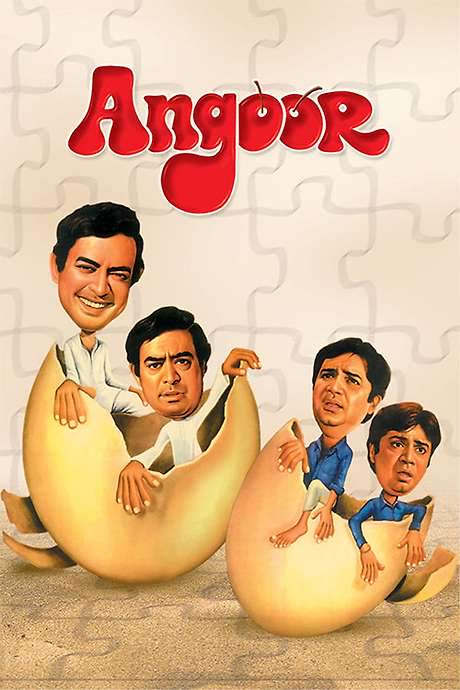


Angoor Plot Summary
Read the complete plot summary and ending explained for Angoor (1982). From turning points to emotional moments, uncover what really happened and why it matters.
Two pairs of identical twins are born and separated at birth, and the story follows how their lives drift apart and then collide again when they reach adulthood. The film keeps a steady, observant tone as it traces how identity, chance, and family ties weave their way through a single, chaotic family dynamic, inviting both humor and warmth without losing its grounded feel.
Raj Tilak, [Utpal Dutt], and his wife [Shammi] are on a journey with their twin sons, who, in a quirky twist, are both named Ashok. In a separate but parallel instinct for symmetry, the couple also adopts a second pair of twins, both named Bahadur [Deven Verma]. An unfortunate accident then splits the family apart, leaving each parent with one child from each pair, forcing two households to pivot around a new, unexpected set of parental choices and loyalties.
A few years down the line, Ashok Tilak [Sanjeev Kumar] is married to Sudha [Moushumi Chatterjee], and Bahadur [Deven Verma] is married to Prema [Aruna Irani]. The households are further filled by Sudha’s younger sister Tanu [Deepti Naval], who moves in and adds another layer of dynamic energy to the everyday routine. Into this already tangled web arrive the other Ashok, a detective-fiction aficionado, and Bahadur, a bhang-loving character, bringing fresh quirks and ambiguous intentions that blur the lines between family, friendship, and mistaken identity.
Now there are two Ashoks and two Bahadurs living in the same city, each with his own quirks, habits, and loyalties, all trying to share space, affection, and respect within a sprawling, lively household. The doubled presence creates a cascade of situations—some comic, some touching—that test patience, trust, and the resilient bonds of kinship. Balancing the needs of the two households, managing the overlapping personalities, and navigating the inevitable misunderstandings become the central rhythm of the story, driving the plot forward with a blend of humor and heart.
This crowded family saga is played out against a backdrop of ordinary life—visits to the Jeweller, interactions with the Taxi Driver, and the watchful eye of the Inspector—where tiny mishaps and big coincidences drive the action. The film remains a study in how intertwined lives, when faced with identity swaps and duplications, reveal deeper truths about each person’s place within the family circle. Through warmth, humor, and a touch of whimsy, the narrative ultimately explores whether love and belonging can endure when a perfectly ordinary life is complicated by doubles, doors that open onto new paths, and the ever-present possibility that things are not what they first seem.
Angoor Timeline
Follow the complete movie timeline of Angoor (1982) with every major event in chronological order. Great for understanding complex plots and story progression.
Birth trip: Ashoks born and named alike
Raj Tilak and his wife travel with their twin sons, both named Ashok, reflecting the father's belief that identical twins should share the same name. This unusual naming foreshadows a future where identity will blur. The event marks the beginning of a complex family saga.
Adoption of another twin pair named Bahadur
The couple ends up adopting another set of twins, whom they name Bahadur. The household thus grows with two twin pairs that mirror each other in name. This doubles the potential for identity mix-ups in the years to come.
Accident partitions the family
A misfortune divides the family, leaving each parent with one child from each twin pair. The originals and the adopted twins are split into two households that echo each other. This separation seeds ongoing confusion about who is who.
Years later: two couples, one home
Ashok marries Sudha while Bahadur marries Prema, and they all live together with Sudha's younger sister Tanu. The blended household brings together two families who carry twin legacies. Everyday life tightens around shared spaces and overlapping histories.
The other Ashok enters the scene
Into their lives arrives another Ashok, a detective-novel aficionado, whose resemblance to the first Ashok deepens the sense of déjà vu. His personality and interests clash and align with the existing family dynamics in surprising ways. The stage is set for heightened confusion about identity.
The other Bahadur follows
Shortly after, another Bahadur appears, a bhang enthusiast, adding a volatile edge to the family drama. His arrival further blurs familial lines and intensifies the existing tensions. The household braces for more unpredictable interactions.
Two Ashoks in one city
With two Ashoks present, the two look-alikes navigate who they really are and how their pasts connect, inviting mistaken identities and playful deception. Conversations and decisions become tangled as the duplicates try to assert themselves. The situation multiplies the sense of confusion across the family.
Two Bahadurs in the same city
The presence of the second Bahadur creates parallel tensions with his counterpart, as loyalties and affections become entangled. The couples must manage competing narratives about who belongs to which twin line. The dynamics grow increasingly complicated.
The professionals struggle to maintain order
The Jeweller, the Taxi Driver, and the Inspector are overwhelmed by misidentifications and the sheer number of identical players in town. Their efforts to restore normalcy highlight the strain on community trust and daily routines. The plot uses their challenges to frame the chaos caused by duplicated identities.
Encounters amid confusion
The duplicates begin crossing paths, leading to mistaken identities and a web of tangled relationships. The families observe the chaos with a mix of humor and concern as they try to discern who is who. The narrative leans into farcical situations driven by the twin paradox.
Cumulative chaos in the home
As the double presence of Ashok and Bahadur persists, the home life grows more strained and crowded. Relationships are tested as everyone contends with duplicated partners and overlapping histories. The energy in Sudha's home reflects the movie's broader playful disorder.
The situation overwhelms everyone
Ultimately the double twins prove to be more than the families and the trio of professionals can handle. The film emphasizes humor and chaos as identities blur and standpoints collide. The summary frames a setup more than a resolved ending, keeping the audience looping in the confusion.
Angoor Characters
Explore all characters from Angoor (1982). Get detailed profiles with their roles, arcs, and key relationships explained.
Sudha (Moushumi Chatterjee)
Sudha is married to Ashok Tilak and lives with her sister Tanu. When the two Ashoks and two Bahadurs appear, her household becomes chaotic. She handles the confusion with warmth, practicality, and a steady sense of family loyalty.
Raj Tilak (Utpal Dutt)
Raj Tilak is the patriarch who tries to keep order in a house that's suddenly overflowing with look-alikes. His practical approach clashes with the surreal twists of the twins' arrival. He navigates the upheaval with a mix of seriousness and humor.
Tanu (Deepti Naval)
Tanu is Sudha’s younger sister who observes and participates in the chaos. She provides a fresh, witty perspective on the escalating farce. Her presence adds another layer to the household dynamics and the evolving relationships.
Prema (Aruna Irani)
Prema is Bahadur’s wife, a patient and composed presence amid the disruptive look-alikes. She adapts to the changing household with a calm manner that helps keep the peace. Her interactions contribute to the humorous and warm tone of the story.
Ashok Tilak (Sanjeev Kumar)
Ashok Tilak is Sudha’s husband whose life is turned upside down by the appearance of a second Ashok. He remains central to the family’s stability while contending with the comic impersonations. His reactions anchor the film’s sense of normalcy amid chaos.
Bahadur (Deven Verma)
Bahadur is the other twin’s husband, known for his easygoing, somewhat mischievous nature and his fondness for bhang. His carefree attitude fuels much of the misadventure and humor. He complicates and deepens the family’s interactions as the doubles collide.
Mrs. Raj Tilak (Shammi)
Mrs. Raj Tilak is the matriarch who adds warmth and humor to the household. She participates in the domestic chaos with a practical, supportive demeanor. Her presence helps hold the family together through the twins’ antics.
Chhedilal (C.S. Dubey)
Chhedilal appears as a shopkeeper who becomes entangled in the routine of mistaken identities. His interactions with the twins push the plot forward and contribute to the comic misunderstandings. He embodies the everyday world that intersects with the farce.
Taxi Driver (Rammohan Sharma)
The Taxi Driver interacts with the family during their quests and misadventures, adding pace and mobility to the events. His encounters with the look-alikes heighten the sense of confusion in the city setting. He serves as a catalyst for several comic moments.
Office Assistant under Ashok Tilak (Arjun Chakraborty)
The office assistant works under Ashok Tilak and becomes part of the organizational backdrop against which the twins’ antics unfold. His presence hints at the broader social environment surrounding the family. He contributes to the procedural side of the plot’s humor.
Angoor Themes
Discover the main themes in Angoor (1982). Analyze the deeper meanings, emotional layers, and social commentary behind the film.
🎭
Twin Comedy
Two pairs of identical twins separated at birth collide in adulthood, triggering a cascade of mistaken identities and comic chaos. The film relies on look-alikes, timing, and disguises to generate humor. As family members switch and misinterpret signals, relationships are tested and revealed. The resulting situations highlight how truth and humor coexist in a tightly knit household.
👪
Family Bonds
Despite the chaos, family ties hold the core of the story together. Siblings and spouses navigate crowded living spaces, shared rituals, and conflicting loyalties. The humor arises from the clash between domestic routine and the unfolding farce, while affection keeps the families connected. The film uses warmth and humor to show resilience within a blended household.
🔎
Identity and Deception
The presence of two Ashoks and two Bahadurs creates ongoing identity tension, with appearances versus reality driving the plot. Characters continually question who is who, leading to misunderstandings and comic investigations. The element of deception is used to propel farce, while the inspector and other figures add a light investigative layer. Ultimately, the truth emerges through laughs and situational reversals.

Coming soon on iOS and Android
The Plot Explained Mobile App
From blockbusters to hidden gems — dive into movie stories anytime, anywhere. Save your favorites, discover plots faster, and never miss a twist again.
Sign up to be the first to know when we launch. Your email stays private — always.
Explore the mobile appAngoor Spoiler-Free Summary
Discover the spoiler-free summary of Angoor (1982). Get a concise overview without any spoilers.
In a bustling Indian city, a sudden accident tears apart the household of Raj Tilak and his wife Shammi, leaving each parent with one child from two sets of newborn twins. The strange symmetry of the situation is amplified by the fact that both pairs of boys share the same names – each pair called Ashok and Bahadur. Years later, the two families have settled into separate lives, yet the invisible thread of their shared beginnings remains taut, promising a collision of identities the moment their paths cross again.
Ashok has grown into a respectable man married to Sudha, while his counterpart, a lover of detective stories, wanders the city with his own quirks. Across the street, Bahadur lives a contented life with his wife Prema, and his twin, a carefree bhang enthusiast, brings an altogether different energy to the neighborhood. Adding to the household dynamics, Sudha’s younger sister Tanu moves in, injecting youthful chatter and fresh perspectives. The daily rhythm of the community – visits to the jeweller, rides with the amiable taxi driver, occasional inspections by the ever‑watchful police inspector – creates a vivid backdrop against which these duplicated lives begin to intersect.
The film’s tone balances gentle observation with a lively, far‑cical spirit, reflecting the timeless comedy of mistaken identities while staying firmly rooted in a modern Indian milieu. Humor arises not from grand set‑pieces but from the ordinary – a misplaced phone, a wrong‑address delivery, an accidental greeting – each moment hinting at the deeper questions of belonging, family ties, and the ways in which fate can humorously rewrite the script of everyday life. Through its warm ensemble and crisp dialogue, the story invites viewers to wonder how much of who we are is shaped by name, nurture, and the inevitable mix‑ups that accompany a world populated by doubles.
Movies with Similar Twists and Themes
Uncover films that echo the narrative beats, emotional arcs, or dramatic twists of the one you're exploring. These recommendations are handpicked based on story depth, thematic resonance, and spoiler-worthy moments — perfect for fans who crave more of the same intrigue.








Featured on this page

What's After the Movie?
Not sure whether to stay after the credits? Find out!
Check out our other apps:

SAT Sphere
Build confidence for the Digital SAT.

Mori Atlas
Discover wild places worth protecting.

Luntero
Search smarter for a home in Amsterdam.

Plot Explained
Unravel movie endings and hidden clues.

Pokechamp
Dive into Pokémon data and battle logic.

Driving Theory
Get ready for your European theory test.

Movie Dust
Plan your next cinema trip with ease.

Musemap
Find art and culture as you travel.

Selkobase
Compare credentials before committing.

Local Manual
Turn an unfamiliar country into practical next steps.

Lernavi
Compare school systems before your next move.

GymRoam
Find a workout stop wherever your plans take you.
Explore Our Movie Platform
New Movie Releases (2026)
Famous Movie Actors
Top Film Production Studios
Movie Plot Summaries & Endings
Major Movie Awards & Winners
Best Concert Films & Music Documentaries
Movie Collections and Curated Lists
© 2026 What's After the Movie. All rights reserved.
Privacy Policy