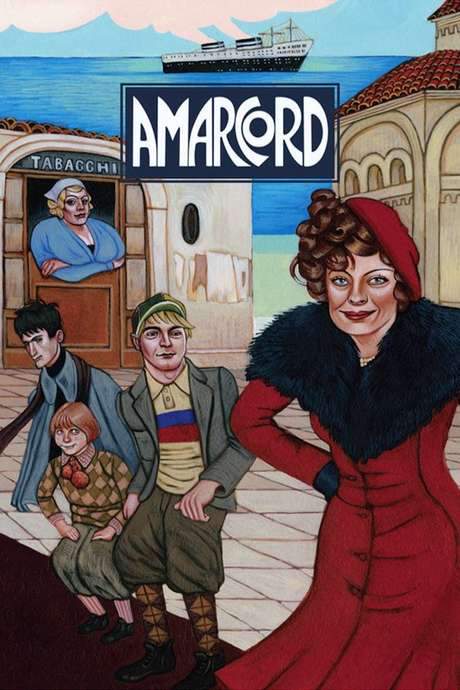
Amarcord 1973


Directed by

Federico Fellini

Where to Watch Amarcord
See current US streaming, rental, and purchase options for Amarcord (1973) via JustWatch.

Criterion Channel
HD
HBO Max
HD
HBO Max Amazon Channel
HD
TCM
HD
YouTube TV
HD
Amazon Video
HD
Apple TV Store
HD
Fandango At Home
SD
Google Play Movies
SD
YouTube
SD Streaming availability powered by 
Amarcord Plot Summary
Read the complete plot summary and ending explained for Amarcord (1973). From turning points to emotional moments, uncover what really happened and why it matters.
In Borgo San Giuliano, a village near Rimini, spring announces itself with fluffy poplar seeds drifting on the breeze, and as night falls the square fills for fogheraccia, a communal bonfire that burns the segavecchia, the effigy of an old woman. The townspeople fill the air with laughter, pranks, fireworks, and the raucous energy of a civic history lesson being delivered as part of the tradition. Against this backdrop, Gradisca, Magali Noël, becomes the crush of [Titta], Bruno Zanin, injecting a flutter of romance into a town used to routine and ritual. The atmosphere mixes merriment with the strains of the era, where the private yearnings of youth collide with the public iconography of a regime.
The school under Fascism unfolds as a tedious cavalcade of dry facts recited by instructors of varying engagement and skill. [Titta], [Bruno Zanin], and his classmates can do little more than goof off or skip class between bursts of arithmetic or dates that matter to the navigator of history. The classroom becomes a stage for small rebellions, whispered schemes, and the itch of adolescence, where confession rooms and growing curiosity share the same calendar. When confession time arrives, [Titta] avoids revealing his private moments and his budding interest in [Gradisca], choosing instead to let the priest linger on floral arrangements rather than moral specifics.
Fascist officials come for a tour, and the schoolkids are pressed into athletic routines for approval. In the chaos, Teo, Aurelio’s brother who is confined to an asylum, stands as a figure of daydreams and watchful eyes. A giant papier-mâché rendering of Mussolini’s face looms near the crowd, while a gramophone hidden in the church bell tower briefly fills the air with The Internationale before it’s shot at and silenced by gunfire. Owing to his anarchist past, [Aurelio], [Armando Brancia], is pulled aside for questioning and forced to drink castor oil, hobbling home only to be bathed by his wife, Miranda, in a haze of worry and care.
The family later spends a day with Uncle Teo, a moment that reveals both affection and the fragility of a man who oscillates between sanity and dream. Teo, in his own world, yells for companionship and companionship becomes an almost mythic pursuit. > Voglio una donna! The scene is punctuated by a sense of longing and the surreal, as Teo is gently guided back toward the asylum by those who love him.
As autumn arrives, the town gathers to greet the voyage of the SS Rex, the regime’s celebrated achievement on the sea. The crowd, half-asleep in small boats, watches as the liner glides past and capsizes their hopeful little flotilla in its wake. Titta’s grandfather drifts through thick fog that muffles house and landscape alike, and the Grand Hotel stands shuttered and inaccessible, leaving the youth to wander the terrace with imaginary partners in a fog-drenched waltz. The annual car race then becomes a doorway to another dream for Titta: the chance to win the grand prize, Gradisca, the object of his youthful devotion, as he attempts feats of strength that blur the line between bravado and tenderness.
In the town’s dimly lit shops, the tobacconist is a focal point for desire and tension. The Tobacconist, Maria Antonietta Beluzzi, is the subject of a charged exchange as she clocks the boy’s bravado and his awkward flirtation. He demonstrates his strength to lift her, but the moment is complicated by her knowing gaze and the intimate proximity of her response, which leaves him both exhilarated and unsettled before sending him on his way with a cigarette in hand.
Winter arrives with heavy snow, and Miranda nurses a sick Titta back to health, only for the family’s rhythm to be shattered when she dies, leaving a void that reshapes the boy’s world. The cycle of seasons closes with a quiet, devastating return to Gradisca’s life: a reception for her marriage to a Carabiniere. The town gathers in a careful hush, Gradisca departs with her new husband, and someone notices that [Titta] has vanished as well, his own chapter seemingly drawing to a close as the seasons turn once more.
Amarcord Timeline
Follow the complete movie timeline of Amarcord (1973) with every major event in chronological order. Great for understanding complex plots and story progression.
Spring arrival in Borgo San Giuliano
Fluffy poplar seeds drifting on the wind announce spring in Borgo San Giuliano. The townspeople greet the season as preparations begin for the year's rituals and communal events that will unfold as the weather warms.
Fogheraccia and the segavecchia
At night the villagers gather in the square for the fogheraccia, a traditional bonfire that burns the segavecchia, an effigy of an old woman. The crowd erupts with pranks, fireworks, and lewd noises while a civically minded lawyer lectures on regional history.
School life under Fascism
In school, fascist authority saturates daily life as teachers recite dry facts. Titta and his classmates drift off, skip class, or bicker while being pressed to solve problems and identify obscure historical details.
Confession and avoidance
Titta goes to confession but avoids admitting his masturbation and a failed attempt to seduce Gradisca. The priest seems more concerned with floral arrangements than the boy’s sins.
Fascist inspection and athletic displays
Fascist officials tour the town and demand that the schoolchildren perform athletic routines for their approval. The event showcases the regime’s control over youth and public life.
The bell tower gramophone and its fate
A gramophone hidden in the bell tower broadcasts The Internationale, secretly arranged to inspire the crowd. The tense moment ends when gun-crazed Fascists shoot the recording, destroying it.
Aurelio questioned for past beliefs
Owing to his anarchist past, Aurelio is brought in for questioning by Fascist officials. He endures humiliation and returns home nauseated after being forced to drink castor oil.
Uncle Teo in the asylum
The family visits Uncle Teo in the countryside asylum, hoping for a day out. Teo escapes into a tree and yells Voglio una donna!, provoking attempts to catch him with the help of a dwarf nun and two orderlies who eventually coax him back.
Autumn follows, Rex voyage and fog
Autumn arrives as villagers set out in small boats to greet the SS Rex, the regime’s celebrated liner. By midnight they are asleep, but the foghorn rouses them to watch the ship pass, its wake capsizing their boats and leaving them awed and adrift.
Foggy terrace and imagined dances
A thick autumn fog cloaks the town and the Grand Hotel. The youths wander the terrace, dancing with imaginary female partners as if the fog has erased reality.
The car race and Gradisca dream
The annual car race becomes a stage for Titta’s daydreams of winning Gradisca’s favour. He imagines a future where the prize is both the prize and a person to be won.
Tobacconist encounter
In a late-evening visit to the tobacconist, Gradisca grows aroused as Titta demonstrates strength, but she overpowers him and sends him home. She still slips him a cigarette before parting.
Miranda’s death
Winter brings heavy snow as Miranda nurses a sick Titta back to health. When spring returns, she dies of an illness, leaving Titta devastated and profoundly changed.
Gradisca’s wedding reception
The village attends Gradisca’s wedding reception to a Carabiniere. The event marks a closing chapter for Gradisca’s romance with Titta and the town’s social dynamics.
Titta disappears as Gradisca leaves
As Gradisca drives off with her new husband, someone notices that Titta has vanished as well. The film closes on this unresolved departure, with the boy’s fate hanging in the air.
Amarcord Characters
Explore all characters from Amarcord (1973). Get detailed profiles with their roles, arcs, and key relationships explained.
Titta Biondi (Bruno Zanin)
A lively, curious boy who navigates the complexities of a small town under Fascism. He leans into mischief and imagination while testing boundaries at school and in confession, all while growing feelings for Gradisca. His observations reveal both warmth and humor in adolescence amid a heavy political atmosphere.
Gradisca (Magali Noël)
An alluring, glamorous older woman who becomes the object of Titta's fascination. Her presence introduces desire and complexity into the boy's world, contrasting tenderness with a sense of danger. She embodies the town's flirtatious and capricious spirit within a society under strict rules.
Aurelio Biondi (Armando Brancia)
Titta's father, a man with an anarchist past who is questioned by authorities and forced to drink castor oil. He returns home weakened yet resolute, carrying a quiet resistance to the regime's surveillance. His ordeal highlights the dangers and collateral impact of political fear on family life.
Miranda Biondi (Pupella Maggio)
Titta's mother, nurturing and practical. She sustains the family through ordinary struggles and preserves warmth even as illness and death touch the household. Her care anchors the emotional center of the family amid social turmoil.
Teo (Uncle)
Aurelio's brother, confined to an insane asylum, who escapes during a country excursion. His frantic plea for a woman and the comic chaos around him reveal the town's tolerance for eccentricities within a rigid society. His brief moment of freedom punctuates the fragile line between confinement and imagination.
Amarcord Settings
Learn where and when Amarcord (1973) takes place. Explore the film’s settings, era, and how they shape the narrative.
Time period
1930s
The story unfolds during Fascist Italy in the 1930s, a period of state propaganda and public spectacles. Schools recite dry histories while officials tour the town and parades punctuate daily life. Symbolic elements such as the giant papier-mâché Mussolini face and the community’s rituals reveal how the era colors intimate moments and collective memory.
Location
Borgo San Giuliano, Rimini
Borgo San Giuliano is a tight-knit town beside Rimini in Italy, where life unfolds in a close community square. The film centers on seasonal rituals like the fogheraccia and the bonfire, capturing how residents come together for folklore and celebrations. The town is depicted as a microcosm where gossip, pranks, and local politics mingle with daily routines under a watchful regime.
Amarcord Themes
Discover the main themes in Amarcord (1973). Analyze the deeper meanings, emotional layers, and social commentary behind the film.
🕰️
Nostalgia
Amarcord tenderness lies in memory, as childhood summers, bonfires, and innocent mischief anchor a sense of home. The film juxtaposes playful small-town life with the encroaching gravity of fascism, preserving a personal history amid national change. Through vignettes of everyday life, it captures how memory both cushions and exposes a community under pressure.
🏛️
Authority
The regime shapes education, public rituals, and behavior, casting a long shadow over daily life. Fascist officials and school tours underscore the tension between obedience and individuality. Humor and melancholy emerge from the way power intersects with ordinary moments and private desires.
🌱
Growing Up
Titta's coming-of-age is marked by crushes, mischief, and curiosity about adulthood. He negotiates boundaries with Gradisca, tests rules at school, and confronts the tension between private desires and public duty. The film frames maturation as a local, intimate journey within a community under a stern regime.

Coming soon on iOS and Android
The Plot Explained Mobile App
From blockbusters to hidden gems — dive into movie stories anytime, anywhere. Save your favorites, discover plots faster, and never miss a twist again.
Sign up to be the first to know when we launch. Your email stays private — always.
Explore the mobile appAmarcord Spoiler-Free Summary
Discover the spoiler-free summary of Amarcord (1973). Get a concise overview without any spoilers.
In a sun‑kissed Italian seaside village that clings to the rhythms of tradition, the world feels both timeless and peculiarly rooted in a particular era. The narrow streets, pastel façades, and the ever‑present sea breeze create a dream‑like backdrop where communal rituals and whispered superstitions mingle with the lingering shadow of a stern political order. The atmosphere is drenched in nostalgia, threading together ordinary moments with fleeting, almost surreal fantasies, inviting the viewer to linger in a place that feels both intimate and theatrically vivid.
At the heart of this tableau is Titta, a restless adolescent whose curiosity drives him through the town’s tangled alleys and bustling squares. He navigates the fragile balance between the strict expectations of his father and the gentle, protective warmth of his mother, while his friends provide a chorus of mischief and camaraderie. A tender infatuation begins to surface in the form of Gradisca, a captivating figure who becomes the focal point of his youthful yearning, adding a bittersweet undercurrent to his daily wanderings. Together, they explore the fine line between innocent rebellion and the desire to belong, their laughter echoing against the backdrop of everyday life.
The village itself teems with an eclectic cast of characters—boisterous relatives, fervent loyalists, seductive women, and a handful of eccentrics whose quirks color the social fabric. Their interactions form a kaleidoscope of absurdity and humanity, where ordinary conversations can drift into the realm of the fantastical. This rich tapestry of personalities, set against the gentle ebb and flow of seasons, creates a world that feels both specific and universal, inviting the audience to savor the poetry of youth, memory, and the strange beauty hidden in the mundane.
Featured on this page

What's After the Movie?
Not sure whether to stay after the credits? Find out!
Check out our other apps:

SAT Sphere
Build confidence for the Digital SAT.

Mori Atlas
Discover wild places worth protecting.

Luntero
Search smarter for a home in Amsterdam.

Plot Explained
Unravel movie endings and hidden clues.

Pokechamp
Dive into Pokémon data and battle logic.

Driving Theory
Get ready for your European theory test.

Movie Dust
Plan your next cinema trip with ease.

Musemap
Find art and culture as you travel.

Selkobase
Compare credentials before committing.

Local Manual
Turn an unfamiliar country into practical next steps.

Lernavi
Compare school systems before your next move.

GymRoam
Find a workout stop wherever your plans take you.
Explore Our Movie Platform
New Movie Releases (2026)
Famous Movie Actors
Top Film Production Studios
Movie Plot Summaries & Endings
Major Movie Awards & Winners
Best Concert Films & Music Documentaries
Movie Collections and Curated Lists
© 2026 What's After the Movie. All rights reserved.
Privacy Policy