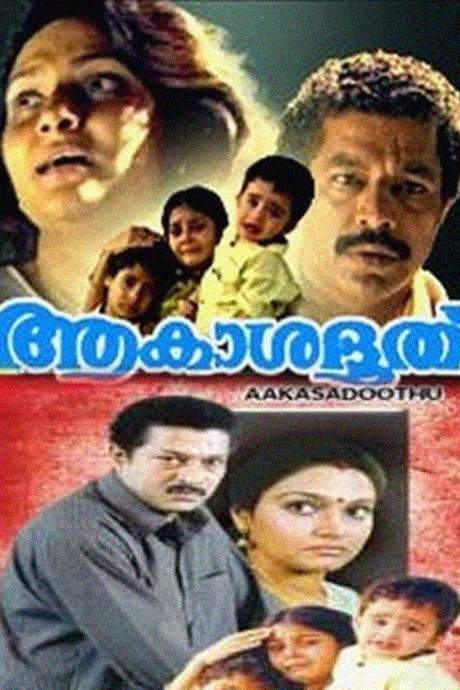
Akashadoothu 1993

Directed by

Sibi Malayil
Made by

Anupama
Where to Watch Akashadoothu
See current US streaming, rental, and purchase options for Akashadoothu (1993) via JustWatch.

Streaming availability powered by 
Akashadoothu Plot Summary
Read the complete plot summary and ending explained for Akashadoothu (1993). From turning points to emotional moments, uncover what really happened and why it matters.
Johnny Murali and Annie Madhavi are a married couple who grew up together in an orphanage, sharing a deep bond that blossomed into a lifelong partnership. They build a modest life around their four children: Meenu Seena Antony, a teenage girl; and twin brothers Rony and Tony, who are about eight years old, along with Monu, a lively toddler. Rony, who uses a wheelchair, is particularly close to his twin, and the family does their best to keep spirits high despite limited means. Johnny works as a jeep driver while Annie teaches violin, pouring care into every small moment that keeps their household afloat. The family’s happiness is frequently tested by financial strain and Johnny’s recurring drinking, which leads him to spend much of his earnings at the local toddy shop. Yet even in these rougher patches, warmth and love hold the family together.
A violent confrontation with Keshavan N F Varghese, a milk-delivery man with a grudge, begins to tear at that fragile balance. After an altercation in which Keshavan feels humiliated in front of his family, the tension simmers until a tragic day when he spots Tony riding a bicycle home. Driving with dangerous speed, he knocks Tony off the road with his van. Tony is badly injured, and the emergency room becomes a tense theater of fear and hope as the doctors work to stabilize him. Tony’s condition is serious enough to require a blood transfusion, yet when doctors search for compatible donors, they discover a shocking obstacle: Annie’s blood, though healthy in most ways, carries abnormal characteristics that render it unsuitable for transfusion.
The hospital visit becomes a turning point. After more tests, Annie is diagnosed with a late-stage leukemia, and the prognosis is bleak—only a few months to live, perhaps a year at most. The news shatters Johnny and Annie, but it also triggers a personal transformation in Johnny; the alcohol-fueled haze lifts as he steps up to become a more responsible partner and father. Despite this renewed resolve, tragedy strikes again when Johnny is fatally attacked by Keshavan while returning home with medicine for Annie. Annie is devastated by the loss, yet she resolves to shield her children from the fate she herself has faced—growing up in the shadow of an orphanage.
With her days numbered, Annie makes a heart-wrenching decision to arrange for her children to be adopted, hoping to secure them stable, loving homes. She confesses nothing of the true reason to the children, instead telling them that the money she earns from teaching isn’t enough and that she will be going to Germany, so they will go to new houses and new parents who can take care of them. Meenu senses the gravity of the situation and, though worried, supports her mother; Annie and Father Vattappara Nedumudi Venu navigate the delicate process of placing the children with adopters who can provide for them.
Monu is soon adopted by a leading Doctor Prem Prakash, a hopeful sign that even the younger child will have opportunity. Annie longs for Rony and Tony to stay together, but finding a family willing to adopt the disabled boy proves difficult. Ultimately, Tony is placed with a wealthy business family, while Meenu agrees to leave with her new parents, driven by a belief that the family’s bond must endure even if they are separated. The only child left behind is Rony, whose disability makes adoption even more urgent and complex. Throughout this period, Annie continues to support Rony from afar and to seek a secure future for him, while Father Vattappara helps shepherd the arrangements with quiet faith.
As Christmas approaches, Annie receives a doctor’s note that her days are finite. She longs to celebrate the holiday at home with all her children and orchestrates a farewell-filled plan to keep them connected. She writes a letter to Meenu, urging her to maintain contact with her brothers so their sibling bond does not fade. In a moment of poignant irony and heartbreak, she experiences a dream in which all her children appear at her door, only to awaken and confront the reality of her limited time. The next moments are marked by a quiet, trembling ritual: she prays before the Crucifix, hoping for just one more day to see her children, and senses a final, irreversible end as she witnesses real blood on the wounds of Jesus. Death comes that night, and Rony discovers her body at the quiet hour after the funeral.
The funeral scene brings together the families who have taken in the children and marks a bittersweet farewell. As the adults depart, the siblings and their adoptive families share tearful goodbyes, and Rony is prepared to be taken to the orphanage by Father Vattappara. In a final act of grace, Tony’s adoptive parents return, and Tony races to Rony, embracing him tightly. Moved by the reunion, Tony’s new parents decide to take Rony in as well, ensuring that the two brothers remain connected in the only way left to them. The film closes on this note of enduring family ties—the promise that love can bridge even tragic losses and separate paths, uniting siblings once more in the face of life’s harshest challenges.
Akashadoothu Timeline
Follow the complete movie timeline of Akashadoothu (1993) with every major event in chronological order. Great for understanding complex plots and story progression.
Johnny and Annie's upbringing and marriage
Johnny and Annie grew up together in an orphanage and eventually fell in love. They got married and started a family despite difficult circumstances. Their bond anchors a modest, hopeful life for their children.
A bustling family of four children
The couple's children are Meenu (teen), Rony and Tony (eight-year-old twins), and Monu (toddler). Johnny works as a jeep driver, while Annie teaches violin. Despite financial struggles, they share a happy life, with Rony and Tony especially close.
Johnny's drinking causes trouble
Johnny's recurring drinking leads to conflict with the local milkman, Keshavan, who is humiliated in public. The family is drawn into the tension as Johnny's temper resurges during daily life. The seeds of future revenge begin to grow.
Keshavan's plan to take revenge
Keshavan decides to exact revenge after the humiliation. He intensifies his vendetta, waiting for an opportunity to hurt Johnny's family. This plan sets the course for the tragedy to come.
Tony is knocked down by a van
One day, while Tony rides his bicycle home, a van driven by Keshavan speeds up and hits him. Bystanders rush the injured boy to the hospital. Though not in critical condition, Tony loses a lot of blood and requires transfusion.
Leukemia diagnosis and donor trouble
At the hospital, it is clear Tony needs blood, but Annie's blood sample shows abnormal characteristics and she cannot donate. Further tests reveal Annie is in late-stage leukemia with only a limited time to live. The shock prompts Johnny to reflect and respond.
Johnny reforms after the diagnosis
The news about Annie's illness jolts Johnny out of his drinking habit; he becomes more responsible and focused on caring for his family. The couple attempts to cope with the growing crisis together. Their strengthened bond gives the family a brief sense of hope.
Johnny fights and is killed
While on his way home with medicine for Annie, Johnny gets into a fight with Keshavan and is killed. Annie is devastated by the loss but resolves to safeguard the children's future. Her resolve hardens as she confronts an impossible situation.
Annie decides to place the children for adoption
Grieving yet determined to shield her kids, Annie decides to put the children up for adoption. She tells them she is going to Germany, hoping the new parents will love and care for them. The plan is kept secret from the kids while she and Father Vattappara arrange it.
Father Vattappara and the adoption details
With the priest's help, the adoptions proceed: Monu is taken by a leading doctor, Tony goes to a wealthy businessman and his wife, and Meenu is taken by a rich older couple. Rony is left unadopted as the process completes. The family structure begins to disperse as the kids are placed with new parents.
Rony waits for a home
Rony, the handicapped twin, remains the last child without an adoptive family. Annie and Father Vattappara continue to search for a suitable home for him, hoping to keep the siblings connected in spirit if not by blood.
Christmas plan and final days
Annie's doctors hint that her days are numbered. She plans a Christmas celebration at home and writes a heartfelt letter to Meenu asking her to stay in touch with her brothers. A dream of all the children visiting makes her momentarily hopeful before the reality sets in.
Annie's death
On the night before Christmas, Annie experiences a nosebleed and senses the end near. She prays for a day more to see her children and notices blood on the crucifix, signaling her passing. Later that night, Rony discovers Annie has died.
Funeral and the final farewell
At Annie's funeral, all the children and their adoptive parents gather to say goodbye. After the burial, the kids and their families part ways, with Rony about to be taken to the orphanage by Father Vattappara. The family bonds gape with loss and separation.
Reunion and the decision to take in Rony
In the emotional ending, Tony's adoptive parents return and he runs to greet Rony. The brothers embrace despite everything, and Tony's father agrees to take in Rony as well, ensuring the siblings stay connected in a new arrangement.
Akashadoothu Characters
Explore all characters from Akashadoothu (1993). Get detailed profiles with their roles, arcs, and key relationships explained.
Johnny (Murali)
A jeep driver who loves his family but struggles with alcoholism. He begins as a flawed but devoted father and husband, gradually reforming in response to Annie’s illness and the sense of responsibility it awakens. His arc culminates in tragedy, testing his commitment to his children even after redemption seems possible.
Annie (Madhavi)
A violin teacher and devoted mother who faces a terminal leukemia diagnosis with quiet courage. She anchors the family through hardship, deciding to secure her children’s futures even as she confronts her mortality. Her strength lies in keeping the family united after her death.
Fr. Vattappara (Nedumudi Venu)
The parish priest who aids in arranging adoptions and provides spiritual and practical support. His guidance is crucial in navigating the crisis and ensuring the children’s welfare after Annie’s illness. He embodies compassion and duty within the church community.
Keshavan (N F Varghese)
The local milk-delivery man whose revenge against Johnny triggers the chain of tragedy. He embodies pride and retaliation within a tightly-knit community, and his actions have lasting consequences for the family.
Meenu
The eldest daughter who confronts the truth about her mother’s illness and ultimately strives to stay connected with her siblings as they face adoption.
Tony
The twin brother who shares a close bond with Rony and faces separation as the children are placed with adoptive families. His devotion to his brother adds emotional weight to the story.
Rony
The physically handicapped twin whose resilience and dependence shape the family’s decisions about adoption and care.
Monu (Ben Kadavil Alexander)
The youngest child, a toddler whose adoption becomes part of Annie’s plan to secure a future for all her children. He represents hope and new beginnings within a broken family.
Akashadoothu Settings
Learn where and when Akashadoothu (1993) takes place. Explore the film’s settings, era, and how they shape the narrative.
Time period
1990s
The events unfold in a 1990s milieu, a period of modest modernization and social change in a small Indian town. Medical limitations and economic pressures color the family’s choices and priorities. The era provides the backdrop for illness, adoption, and acts of sacrifice that define the plot.
Location
Kerala, India
Set in a Kerala town, the story centers on a close-knit middle-class home within a church-connected community. The place features a jeep-driver husband, a violin-teaching wife, a local hospital, and a parish priest, all shaping the daily rhythms of life. The neighborhood includes social and economic struggles, which influence the characters’ decisions and relationships.
Akashadoothu Themes
Discover the main themes in Akashadoothu (1993). Analyze the deeper meanings, emotional layers, and social commentary behind the film.
👪
Family
The film centers on a family whose bonds are stretched by illness, poverty, and the fear of separating. It highlights parental sacrifice to secure a future for the children, often at personal cost. The narrative shows how love and duty keep the family together even as tragedy strikes.
⚕️
Illness
Annie’s terminal leukemia reframes the family’s actions, forcing hard choices about care and guardianship. Illness acts as a catalyst for Johnny’s transformation and for the decision to pursue adoption for the children. The portrayal treats illness with gravity, emphasizing resilience and vulnerability alike.
⛪
Faith
The church and its priest guide the family through crisis, offering spiritual solace and practical support. Faith anchors the characters, yet also frames difficult decisions like handing the children to adoptive families. Rituals and blessings provide emotional grounding throughout the ordeal.
💸
Poverty & Sacrifice
Economic strain underpins major choices, from blood donation to arranging adoptions. Sacrifice becomes a recurring response to hardship, often requiring painful, selfless acts. The narrative emphasizes generosity born from need, and how financial constraints shape futures.

Coming soon on iOS and Android
The Plot Explained Mobile App
From blockbusters to hidden gems — dive into movie stories anytime, anywhere. Save your favorites, discover plots faster, and never miss a twist again.
Sign up to be the first to know when we launch. Your email stays private — always.
Explore the mobile appAkashadoothu Spoiler-Free Summary
Discover the spoiler-free summary of Akashadoothu (1993). Get a concise overview without any spoilers.
In a modest neighborhood where the rhythm of daily life is marked by the clatter of a jeep engine and the gentle notes of a violin, a small family strives to turn scarcity into warmth. The couple grew up together in an orphanage, forging a bond that feels both timeless and fragile, and they have built a home around their four children. Their world is simple yet richly textured, a place where every shared meal and whispered lullaby carries the weight of past longing and present hope.
Johnny works as a jeep driver, his evenings often clouded by the pull of the local toddy shop, while Annie teaches violin, pouring her remaining energy into music and motherhood. Their teenage daughter Meenu shoulders the emerging responsibilities of adolescence, and the twins—Rony, who navigates life in a wheelchair, and Tony, an energetic eight‑year‑old—along with the lively toddler Monu complete the household. Despite financial strain and Johnny’s bouts with alcohol, the family’s affection cushions the hardships, weaving a tapestry of resilience and tenderness that defines the film’s intimate tone.
An unexpected clash with a neighbor, a milk‑delivery man named Keshavan, unsettles the fragile equilibrium of their lives. The encounter leads to a serious injury for one of the children, thrusting the family into a hospital setting where routine tests reveal an unsettling truth about Annie’s health. Confronted with a limited future, she is compelled to contemplate the future of her children in a way that tests the deepest currents of parental love and sacrifice.
The story unfolds with a gentle, melancholic lyricism, balancing moments of quiet domesticity with the looming uncertainty of fate. Its atmosphere is steeped in heartfelt realism, inviting viewers to feel the pull of devotion, the sting of impending loss, and the quiet courage that arises when a mother seeks the best possible path for those she holds dear. The film lingers on the universal question of what family truly means when circumstances push it beyond the walls of a single home.
Movies with Similar Twists and Themes
Uncover films that echo the narrative beats, emotional arcs, or dramatic twists of the one you're exploring. These recommendations are handpicked based on story depth, thematic resonance, and spoiler-worthy moments — perfect for fans who crave more of the same intrigue.







Featured on this page

What's After the Movie?
Not sure whether to stay after the credits? Find out!
Check out our other apps:

SAT Sphere
Build confidence for the Digital SAT.

Mori Atlas
Discover wild places worth protecting.

Luntero
Search smarter for a home in Amsterdam.

Plot Explained
Unravel movie endings and hidden clues.

Pokechamp
Dive into Pokémon data and battle logic.

Driving Theory
Get ready for your European theory test.

Movie Dust
Plan your next cinema trip with ease.

Musemap
Find art and culture as you travel.

Selkobase
Compare credentials before committing.

Local Manual
Turn an unfamiliar country into practical next steps.

Lernavi
Compare school systems before your next move.

GymRoam
Find a workout stop wherever your plans take you.
Explore Our Movie Platform
New Movie Releases (2026)
Famous Movie Actors
Top Film Production Studios
Movie Plot Summaries & Endings
Major Movie Awards & Winners
Best Concert Films & Music Documentaries
Movie Collections and Curated Lists
© 2026 What's After the Movie. All rights reserved.
Privacy Policy