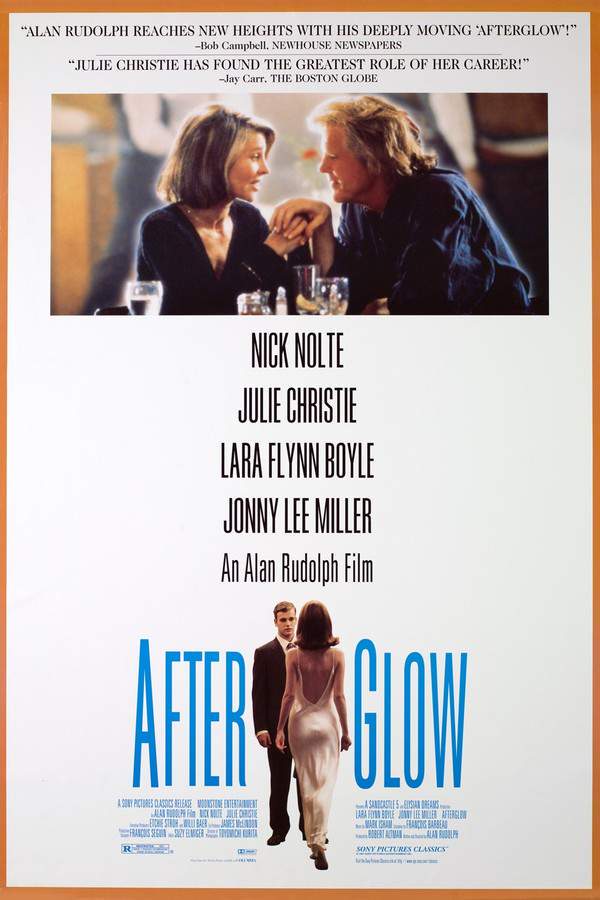
Afterglow 1997


Directed by

Alan Rudolph
Made by

Sony Pictures Classics
Where to Watch Afterglow
See current US streaming, rental, and purchase options for Afterglow (1997) via JustWatch.

Amazon Prime Video
HD
Amazon Prime Video with Ads
HD
Fawesome
HD
Hoopla
SD
JustWatch TV
HD
Amazon Prime Video Free with Ads
HD
Plex
HD
Plex Channel
HD
Pluto TV
SD
The Roku Channel
HD
Tubi TV
SD
Amazon Video
SD
Apple TV Store
HD
Fandango At Home
SD
Google Play Movies
SD
YouTube
SD Streaming availability powered by 
Afterglow Plot Summary
Read the complete plot summary and ending explained for Afterglow (1997). From turning points to emotional moments, uncover what really happened and why it matters.
In Montreal, two unhappily married couples become entangled as their private disappointments collide against the hum of a city that seems to offer both escape and consequences. The first pair centers on Lucky Mann, Nick Nolte, and his wife Phyllis Hart, Julie Christie. Their marriage has been fraying for years, especially after Phyllis reveals that Cassie, their daughter, is not Lucky’s biological child — a truth tied to a past where Phyllis bore Cassie with an actor while Lucky served in the Navy. The couple moved from California to Montreal in a tense bid to find Cassie, yet years of silence persist between them. Phyllis, now haunted by her husband’s infidelities and the recent death of her former co-star Jack Dana, spends time reevaluating her life and mortality, revisiting old films that once defined her. She and Lucky live with a quiet, almost ritualized distance: a tacit agreement to avoid sex, even as Lucky’s cheating with clients’ wives—glimpsed in the open cracks of their marriage—continues beneath the surface.
The second pair revolves around Jeffrey Byron, a corporate executive, and his wife Marianne, who yearn for a different future. Marianne longs for children and affection that Jeffrey, absorbed in his own ego, seems unable to provide. Depression shadows Jeffrey, and he wrestles with looming questions about desire and identity. Marianne, feeling emotionally starved, suggests sexual intimacy to spark life back into their union, but Jeffrey rebuffs her. The plot thickens when Marianne hires a contractor to begin work on a baby-ready room in their condo — the pick falls to Lucky Mann, linking the two troubled households through a practical coincidence. Marianne is immediately drawn to the rugged, older contractor, and that spark ignites an affair, drawing them deeper into a web of secrecy and risk.
As the affair unfolds, Jeffrey encounters Phyllis in a bar, where she has just witnessed Marianne and Lucky on a date. A magnetic pull to older companions and a flickering sense of possibility pull Jeffrey toward Phyllis, and his curiosity about life beyond conventional roles grows stronger. He has already shown a complex attraction to his older secretary Helene, hinting at a restlessness that could redefine his life. Marianne, meanwhile, finds herself irresistibly attracted to the rough-edged Lucky, while Jeffrey contemplates the boundaries of fidelity. The two couples’ trajectories collide when Jeffrey invites Phyllis to a weekend getaway at a resort. Phyllis hesitates, returns to Lucky, and then, driven by a mixture of curiosity and a hunger for meaning, joins Jeffrey. At the resort, they encounter Bernard Ornay, a powerful client, and his mistress Monica Bloom, who also take an interest in Phyllis. Ornay’s flirtation with Phyllis creates a rift with Jeffrey, threatening the thoughline of their liaisons. The weekend spins with near-misses: a potential nighttime tryst that dissolves when Jeffrey ends contact after Phyllis responds flirtatiously to Ornay’s knocks at her door. They depart the resort the following morning, tension already stitching itself into their fates.
When the two couples converge again, the bar of a hotel becomes a crucible for shared history and hidden agendas. A violent clash erupts between Jeffrey and Lucky, each man entangled in loyalties and betrayals that stretch back to older wounds. Marianne and Phyllis retreat together to the Byrons’ apartment, where Marianne drops a bomb: she is pregnant — with Lucky’s baby — unaware that Phyllis is his wife. Phyllis is startled and upset, but she conceals her own shock with a practiced composure. Jeffrey and Marianne reconcile in the glow of their uncertain future, the idea of a child binding them in a fragile bond. Meanwhile, Lucky, in a quieter moment, finds Cassie and restores a thread of connection that had long seemed severed. The reconciliation with Cassie hints at a possibility of rebuilding from fragments.
The story closes by mirroring a fate that befell Phyllis early on: Marianne, too, is poised to raise a child fathered by another man, and she tells her friend Isabel that the father is Jeffrey, not Lucky. She does not reveal this truth to Lucky, echoing Phyllis’s earlier strategy of guarding her own and Cassie’s paternity as a private truth. The final image lingers on Phyllis, in bed and crying, overwhelmed by the knowledge that Marianne will carry Lucky’s child, and by the ache of Cassie’s return home. The film settles on a quiet, bittersweet note where love, duty, and the longing for belonging collide, leaving each character to navigate a future colored by secrets kept and connections renewed.
Afterglow Timeline
Follow the complete movie timeline of Afterglow (1997) with every major event in chronological order. Great for understanding complex plots and story progression.
Phyllis reveals Cassie's paternity
Phyllis tells Lucky that Cassie is not his biological child, a revelation that shatters trust and pushes their marriage toward collapse. The admission exposes the underlying resentment and infidelity that have plagued their relationship. This rift foreshadows the couple’s eventual move to Montreal in a failed attempt to salvage something salvageable.
Cassie runs away to Montreal
Cassie runs away to Montreal, seeking distance from her fractured parents. The silence between the Manns grows heavier as they drift further apart. The act plants the seed for a long, unresolved pursuit that frames the film's narrative.
Manns relocate to Montreal to find Cassie
The Manns relocate from California to Montreal in a bid to locate Cassie. Their search keeps the family tethered to the city, where old wounds resurface with painful clarity. The move marks the beginning of a new chapter built on unresolved pasts.
Phyllis's checkup and reflections after Dana's death
Phyllis is depressed after learning that Jack Dana, the actor who fathered Cassie, recently died. She undergoes a medical checkup and spends time revisiting her old films with Dana. The reflections deepen her sense of mortality and unfulfilled desires.
Phyllis learns Lucky cheats
Phyllis discovers that Lucky cheats on her with his construction clients. The couple maintains a silent agreement to avoid sex, masking a deeper emotional rupture. The knowledge compounds the emotional distance and mutual resentment between them.
Lucky's affair with Gloria Marino
Lucky is shown cheating on Phyllis with Gloria Marino, underscoring the hollow nature of his marriage. The affair demonstrates how each partner seeks connection outside the relationship. Tensions escalate as deceit colors every interaction.
Marianne hires Lucky; Jeffrey attracted to Phyllis
Marianne Byron, desperate for children, hires Lucky to build a nursery in the Byrons' condo, bringing Lucky into her orbit. Around the same time, Jeffrey Byron is drawn to Phyllis, sensing an attraction to an older, more worldly woman. The couples’ parallel desires pull them into a dangerous entanglement.
Phyllis and Jeffrey meet at the bar
Jeffrey encounters Phyllis in a bar after she notices Marianne and Lucky on a date. An immediate spark grows for Phyllis, and Jeffrey hints at pursuing an affair with an older woman. They plan a weekend away, testing the boundaries of loyalty and desire.
Resort weekend with Ornay and Bloom
At the resort, Phyllis and Jeffrey encounter Bernard Ornay and his mistress Monica Bloom, adding friction and temptation. Ornay is drawn to Phyllis, raising the specter of a love triangle. The weekend becomes a pressure cooker for flirtation and potential betrayal.
Near-miss and departure from the resort
Phyllis and Jeffrey's flirtation teeters on the edge of infidelity as Ornay's presence intensifies the dynamic. Jeffrey ends contact after Ornay knocks on Phyllis's door, and the pair leave the resort the next morning. The emotional risk lingers despite their departure.
Bar confrontation and Marianne's pregnancy reveal
The two couples converge at the hotel bar, where Jeffrey and Lucky have a physical fight. Marianne and Phyllis return to the Byrons' apartment, where Marianne reveals she is pregnant with Lucky's child. Phyllis reacts with distress, absorbing the blow of the tangled loyalties surrounding her.
Reconciliations; Cassie and paternity truths
Jeffrey and Marianne reconcile after an evening of intense emotion, while Lucky reconnects with Cassie. The couples remain bound by secrets and competing loyalties, as the truth about paternity continues to loom over their relationships.
Isabel learns the baby's father; ending clarity
Marianne tells her friend Isabel that the baby’s father is Jeffrey, signaling she will withhold the truth from Lucky. Phyllis watches Cassie come home, crying as she contemplates the ongoing cycle of deception. The parallel to Phyllis's past decisions underscores the film’s circular tragedy.
Final scene: Phyllis's sorrow
Phyllis lies in bed crying, aware that Marianne will bear Lucky's baby and haunted by Cassie returning home. The ending mirrors Phyllis's earlier choices, emphasizing how deception reverberates through generations. The scene ends on an unresolved note of longing and ambiguity.
Afterglow Characters
Explore all characters from Afterglow (1997). Get detailed profiles with their roles, arcs, and key relationships explained.
Lucky Mann (Nick Nolte)
A rugged contractor who moved from California to Montreal in search of his daughter. He is guarded and pragmatic, often pursuing casual flings with clients while keeping his marriage emotionally distant. His default stance is self-preservation, yet he seeks reconciliation with Cassie in the end.
Phyllis Hart ( Julie Christie)
A former actress whose mortality and past fame weigh on her. She is perceptive, emotionally fragile, and drawn to older partners; her affair with Jeffrey exposes her vulnerability and longing for connection beyond a loveless marriage. She ultimately confronts the consequences of secrets and heartbreak.
Marianne Byron
A corporate executive’s wife who longs for children and affection. She is attracted to Lucky and becomes pregnant with his baby, though she does not know Phyllis is his wife. Her decision to keep or reveal paternity drives much of the film’s tension and resolution.
Jeffrey Byron
A depressed, self-absorbed corporate executive who hides insecurities behind charm. He resists Marianne’s advances at times, but pursues an affair with Phyllis and grapples with sexuality and possible suicide. His conflicts with Lucky and Marianne reveal the fragility of his ego.
Gloria Marino
Isabel’s mother and a friend of Marianne’s mother, who leads to Lucky’s affair with Marianne. She weaves connections between the couples and represents a social circle where extramarital liaisons are navigated.
Bernard Ornay
A powerful client who becomes involved with Phyllis and is connected with a larger circle of influence and secrecy. His attraction to Phyllis strains Jeffrey’s hold on Marianne and complicates business ties.
Monica Bloom
Ornay’s mistress who enters the social web around the Byron circle, adding tension and driving the romantic intrigue between the couples.
Cassie Mann
Phyllis’s daughter who ran away to Montreal as the couple’s marriage deteriorated; her eventual return signals a hopeful step toward reconciliation and healing.
Afterglow Settings
Learn where and when Afterglow (1997) takes place. Explore the film’s settings, era, and how they shape the narrative.
Time period
Late 20th century
The events unfold in a contemporary urban environment, reflected by the modern condo lifestyle and social scenes. Characters move through bars, resorts, and hotel rooms, signaling a late-century mood of adult relationships and disillusionment. The tone favors intimate conversations and personal crises over grand historical events.
Location
Montreal, Canada
Montreal serves as a moody, urban backdrop for intertwined marriages. The city’s bars, condos and hotel spaces provide a contemporary setting for love, deceit and reconciliation. The setting reflects a sophisticated, emotionally charged atmosphere that amplifies the characters’ distance and longing.
Afterglow Themes
Discover the main themes in Afterglow (1997). Analyze the deeper meanings, emotional layers, and social commentary behind the film.
💔
Infidelity
The narrative centers on multiple affairs and the erosion of trust within marriages. Lovers manipulate and threaten to redefine family boundaries, as secrets destabilize the core relationships. The film examines how clandestine desires damage intimacy and force painful choices. Infidelity acts as a catalyst that reveals characters' vulnerabilities and conflicts.
🔒
Secrets
Hidden truths drive much of the plot, with revelations about paternity, past relationships, and unspoken expectations shaping decisions. The characters navigate between openness and concealment, often choosing to protect their partners or themselves with silence. Secrets complicate loyalties and escalate tensions, especially when miscommunications surface in public spaces like bars and hotels. The secrecy ultimately forces confrontations and shifts in alliances.
👨👩👧
Family & Parenthood
The film probes what family means when paternity is uncertain and children grow up amidst adults’ betrayals. Marianne’s pregnancy, Phyllis’ parental history, and Cassie’s absence create emotional stakes around fatherhood and legitimacy. The narrative tracks how parental choices ripple through generations, redefining love and duty. The ending suggests a cyclical pattern of unintended fatherhood and reconciliation.

Coming soon on iOS and Android
The Plot Explained Mobile App
From blockbusters to hidden gems — dive into movie stories anytime, anywhere. Save your favorites, discover plots faster, and never miss a twist again.
Sign up to be the first to know when we launch. Your email stays private — always.
Explore the mobile appAfterglow Spoiler-Free Summary
Discover the spoiler-free summary of Afterglow (1997). Get a concise overview without any spoilers.
In the cosmopolitan hum of Montreal, two long‑time marriages quietly fray beneath the rhythm of daily life. The city’s cool, rain‑slick streets provide a backdrop where ordinary routines—renovations, dinner parties, late‑night conversations—feel suddenly charged with the possibility of change. A tone of dry humor mixes with an undercurrent of yearning, suggesting that even the most familiar settings can become the stage for unexpected connections.
Lucky Mann is a seasoned contractor whose hands are as skilled at repairing cracked drywall as they are at untangling strained relationships. His marriage to Phyllis Hart has settled into a careful distance, each carrying unspoken histories that keep intimacy at arm’s length. Together they navigate a partnership marked by quiet resignation, yet Lucky’s innate ability to mend the practical problems around him hints at a deeper capacity to bridge emotional gaps.
Across town, Jeffrey Byron is a corporate executive whose ambition has left his marriage to Marianne feeling hollow. Marianne, craving children and affection, finds her life increasingly defined by routine and unmet expectations. When she commissions a remodel for a nursery, the project brings Lucky into her orbit, sparking a magnetic attraction that challenges the boundaries of their respective bonds. Their interaction promises a blend of flirtatious chemistry and comedic mishap, as both grapple with desires they have long set aside.
The film balances wit with melancholy, exploring how ordinary people confront the fissures in their lives while searching for renewal. Amid the soft glow of city lights and the clatter of tools, the characters confront choices about love, fidelity, and the strange ways in which a single encounter can ripple through multiple households, hinting at a future where humor and romance may yet reshape their worlds.
Movies with Similar Twists and Themes
Uncover films that echo the narrative beats, emotional arcs, or dramatic twists of the one you're exploring. These recommendations are handpicked based on story depth, thematic resonance, and spoiler-worthy moments — perfect for fans who crave more of the same intrigue.





Featured on this page

What's After the Movie?
Not sure whether to stay after the credits? Find out!
Check out our other apps:

SAT Sphere
Build confidence for the Digital SAT.

Mori Atlas
Discover wild places worth protecting.

Luntero
Search smarter for a home in Amsterdam.

Plot Explained
Unravel movie endings and hidden clues.

Pokechamp
Dive into Pokémon data and battle logic.

Driving Theory
Get ready for your European theory test.

Movie Dust
Plan your next cinema trip with ease.

Musemap
Find art and culture as you travel.

Selkobase
Compare credentials before committing.

Local Manual
Turn an unfamiliar country into practical next steps.

Lernavi
Compare school systems before your next move.

GymRoam
Find a workout stop wherever your plans take you.
Explore Our Movie Platform
New Movie Releases (2026)
Famous Movie Actors
Top Film Production Studios
Movie Plot Summaries & Endings
Major Movie Awards & Winners
Best Concert Films & Music Documentaries
Movie Collections and Curated Lists
© 2026 What's After the Movie. All rights reserved.
Privacy Policy