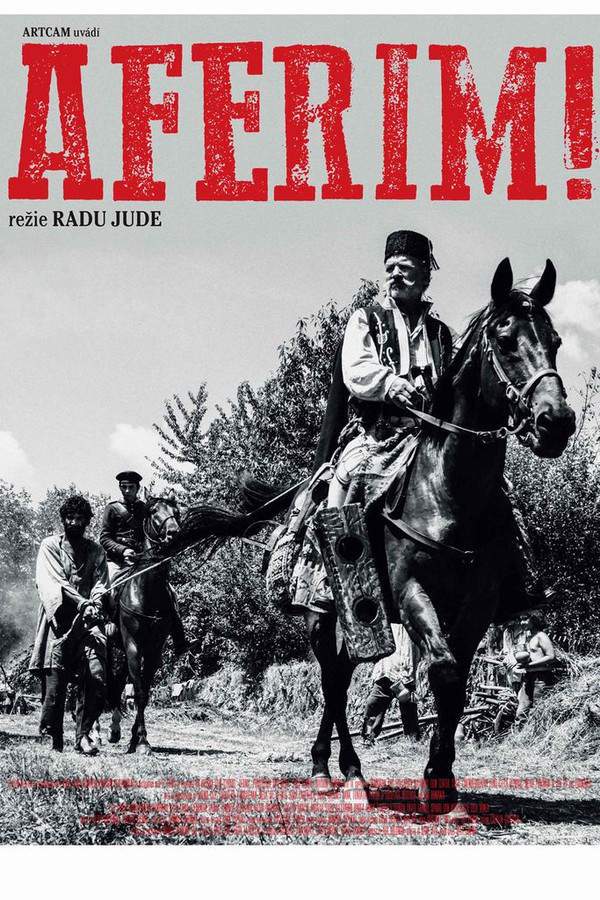
Aferim! 2016


Directed by

Radu Jude
Made by

Big World Pictures
Where to Watch Aferim!
See current US streaming, rental, and purchase options for Aferim! (2016) via JustWatch.

OVID
SD
Kanopy
HD
Apple TV Store
HD
Fandango At Home
SD Streaming availability powered by 
Aferim! Plot Summary
Read the complete plot summary and ending explained for Aferim! (2016). From turning points to emotional moments, uncover what really happened and why it matters.
In 1835 Wallachia, Costandin, an aging constable, is tasked with locating Carfin, a Roma slave accused of stealing from his master, the boyar Iordache. He sets out across the countryside with his son Ioniță and the deputy, traversing a landscape dotted with monasteries, Roma gold-panners, a priest prone to spouting stereotypes, and travellers who bear the marks of hajduk violence. Their search leads them through a tapestry of life on the margins, where trust is scarce and power is often exercised with little mercy. After bribing a constable in a neighboring county for information, Costandin manages to narrow the net and track down Carfin at the home of a peasant craftsman. In the same sweep, they also take into custody Țintiric, a child slave who has run away from a brutal master.
Carfin speaks with quiet dignity about the forces that pushed him to flee. He reveals that his flight was prompted by being drawn to Sultana, the boyar’s wife, and on the journey back he paints a stark picture of his hardships, begging the lawmen to take him as their slave rather than see him harmed. Costandin, moved by the tale, remains pragmatic and cautious, warning that the outcome would likely be a harsh beating rather than any real mercy. The group faces a morally fraught choice: they decide to sell Țintiric to a nobleman at a market, a decision made despite the boy’s protests and the personal cost to him.
That night they lodge at an inn, and Costandin reflects on a long memory from his past—his service under Tudor Vladimirescu during the Wallachian uprising of 1821. The mood grows heavier as Ioniță is sent to sleep with a prostitute while Costandin himself lies with the same woman, revealing a pattern of survival through complicity in a world governed by power and hard choices. Ioniță privately suggests releasing Carfin, but Costandin firmly rejects the idea, insisting on adherence to the letter of the law and uttering a grim, almost fatal line: you can’t feed the wolf and save your lambs.
The following day brings the stark reality of Iordache’s household. At the boyar’s residence, Costandin learns of the abuses Sultana has suffered at the hands of her husband, deepening the film’s meditation on cruelty and control. After receiving his pay, Costandin pleads for leniency toward Carfin, a request that is bluntly denied. The boyar’s response is brutal and public: Carfin is castrated, paraded around town, and the act is further taunted by throwing his testicles at Sultana. The moment marks a bitter turning point, and the four men depart quickly, each carrying the weight of what they have witnessed. Costandin voices a quiet sorrow for the world’s unwillingness—or perhaps its inability—to change, while reaffirming to Ioniță that a future on the military path could offer some measure of improvement and purpose, even if the present remains harsh and unyielding.
Aferim! Timeline
Follow the complete movie timeline of Aferim! (2016) with every major event in chronological order. Great for understanding complex plots and story progression.
Costandin leads the search across Wallachia
Costandin, an aging constable, sets out with his son Ioniță and the deputy to locate Carfin, a Roma slave. They traverse a patchwork landscape of monasteries, travelers marked by hajduk violence, and the margins of society that survive under harsh power. The journey establishes the moral tension that will define the case.
Bribe to a neighboring constable
To gain a lead, Costandin and his companions bribe a constable in a neighboring county for information. The move reveals a world where corruption and leverage shape outcomes more than law alone. The search tightens as a result.
Carfin and Țintiric are tracked down
The search culminates at the home of a peasant craftsman, where Carfin is found and Țintiric is seized as another runaway slave. Carfin speaks with quiet dignity about the forces that pushed him to flee. The moment marks a blunt collision between mercy and the letter of the law.
Carfin explains his flight
Carfin recounts that his flight was prompted by his attraction to Sultana, the boyar's wife, and the hardships he faced on the journey home. He begs the lawmen to take him as their slave rather than see him harmed. The tale deepens the film's meditation on power, cruelty and dignity.
Costandin's caution and hard justice
Costandin remains pragmatic, warning that mercy will likely amount to a harsh beating rather than mercy. He speaks of the brutal reality of the world they inhabit and the limits of the law. The exchange sets up the moral dilemma that follows.
Selling Țintiric at the market
The quartet resolves to sell Țintiric to a nobleman at a market, a decision taken despite the boy's protests and personal cost to him. The act underscores a society that trades human beings for status and power. The group carries the weight of this choice into the night.
A night at the inn
That night they lodge at an inn, and Costandin reflects on a long memory from his past service under Tudor Vladimirescu. The mood grows heavier as personal survival blends with complicity in a harsh system. Ioniță is sent to sleep with a prostitute, mirroring the compromises of their world.
Ioniță suggests releasing Carfin
Ioniță privately suggests releasing Carfin, seeing some mercy in the act. Costandin rejects the idea, insisting on adherence to the letter of the law and warning of consequences. The exchange sharpens the film's central conflict between empathy and duty.
Visit to the boyar's household
The next day they arrive at the boyar Iordache's residence, where Costandin learns of the abuse Sultana has suffered. The account widens the film's critique of power dynamics and cruelty in domestic life. The journey becomes a meditation on who enforces justice and who bears its scars.
Pay and the request for leniency
Costandin, after receiving his pay, pleads for leniency toward Carfin, a plea bluntly denied by the boyar. The denial seals the trajectory toward a brutal, public punishment. The moment cements Costandin's sense that mercy has a narrow window in a rigged system.
Carfin's brutal punishment
Carfin is castrated and paraded around town, a cruel spectacle that culminates in taunts aimed at Sultana. The act becomes a bitter turning point that exposes the cost of power without mercy. The four men depart the scene weighed down by the violence they've witnessed.
A somber departure and wary future
As they leave, Costandin voices sorrow for a world unwilling or unable to change, while hinting that Ioniță's future might lie along a military path that offers some purpose. The moment frames survival as compromise, and the film closes on the heavy realisation that the wheel of power grinds on. The journey has revealed a tapestry of life on the margins, where trust is scarce and mercy rarer still.
Aferim! Characters
Explore all characters from Aferim! (2016). Get detailed profiles with their roles, arcs, and key relationships explained.
Costandin (Teodor Corban)
An aging Wallachian constable who navigates the countryside with a blend of pragmatism and wary memory. He is cautious, calculating, and deeply aware of the costs of mercy within a harsh social order. His past service in the 1821 uprising informs a hesitant but enduring loyalty to the law, even as he accepts morally dubious choices to survive.
Ioniță (Mihai Comanoiu)
Costandin’s son, a young observer who is torn between idealism and survival. He privately suggests releasing Carfin, hinting at a more hopeful future, but is drawn into the family’s world of compromise. His presence foregrounds the generational tension between justice and expediency.
Carfin (Toma Cuzin)
A Roma slave accused of theft who speaks with quiet dignity about the forces that compelled his flight. He reveals his attraction to Sultana and the brutal real-world consequences of entering the master’s world. His plight exposes the cruelty of social rules and the humanity that exists within resistance.
Țintiric (Alexandru Dabija)
A runaway child slave captured in the sweep with Carfin. His protests are muted by the system that treats him as property. His predicament highlights the brutal routine of the market and the human cost of enforcing law through subtraction and punishment.
Aferim! Settings
Learn where and when Aferim! (2016) takes place. Explore the film’s settings, era, and how they shape the narrative.
Time period
1835
Set in 1835 Wallachia, a society of boyar estates and provincial towns. The era sits between uprisings and reforms, where law enforcement blends with customary punishment and mercy is rare. The journey and trials reveal a world where time moves slowly and survival depends on navigating power.
Location
Wallachia
The story unfolds across the rural interior of Wallachia. The landscape features monasteries, peasant homesteads, and markets where travellers mingle with Roma communities and enslaved people. Power and social hierarchy shape daily life, with the scars of hajduk violence lingering on the roads and in taverns.
Aferim! Themes
Discover the main themes in Aferim! (2016). Analyze the deeper meanings, emotional layers, and social commentary behind the film.
⚖️
Justice
The film probes the friction between the letter of the law and true mercy. Costandin’s cautious pragmatism clashes with the victims’ pleas, highlighting how systemic power dictates outcomes. The decision to sell Țintiric exposes how justice becomes a tool of social control rather than moral resolution.
🕯️
Moral Ambiguity
Characters operate in a world where good and bad lie along a murky line. Even Costandin’s nostalgia and loyalty are tempered by necessity, showing how survival forces compromises. There are no clear heroes, only people negotiating harsh realities.
🪙
Slavery
Carfin’s status as Roma slave and Țintiric’s status as a runaway child expose a society built on subjugation. The narrative foregrounds dehumanization as a mechanism of control and humiliation. The brutal acts reveal how power preserves itself through violence.
🏛️
Power
The boyar class wields public authority and personal brutality to enforce dominance, as seen in Carfin’s castration and public taunting. The travelers and officials move through a system where status and wealth dictate both fate and mercy. The film scrutinizes how hierarchies sustain oppression.

Coming soon on iOS and Android
The Plot Explained Mobile App
From blockbusters to hidden gems — dive into movie stories anytime, anywhere. Save your favorites, discover plots faster, and never miss a twist again.
Sign up to be the first to know when we launch. Your email stays private — always.
Explore the mobile appAferim! Spoiler-Free Summary
Discover the spoiler-free summary of Aferim! (2016). Get a concise overview without any spoilers.
In the harsh winter of 1835 Wallachia, the landscape stretches across rolling hills and secluded villages, each bearing the weight of old customs and unspoken hierarchies. The film invites us into a world where the clatter of horse hooves and the distant echo of church bells form a rhythm that both comforts and constricts those who live within it. Amid this austere setting, a rigid gendarme is tasked with a delicate pursuit that promises to stir the quiet tensions of the countryside.
The story follows Costandin, a seasoned constable whose stern demeanor masks a lifetime of service and sacrifice, and his thoughtful son, who travels beside him as both apprentice and companion. Alongside them rides the eager deputy Ioniță, whose youthful perspective often clashes with the older man’s measured resolve. Their trio moves through a mosaic of communities—monasteries, peasant homes, and wandering travelers—each encounter reflecting the deep‑seated prejudices and unexamined values that linger beneath the surface of everyday life.
Their mission centers on locating a Roma slave rumored to be entangled in a scandal that reaches the highest echelons of local nobility. This pursuit becomes more than a simple chase; it turns into a quiet examination of loyalty, justice, and the fragile bond between father and son. As they navigate the rugged terrain, the film balances the stark realism of historical hardship with moments of dark humor and lingering melancholy, hinting at the profound changes that may arise when long‑held beliefs are quietly challenged.
Featured on this page

What's After the Movie?
Not sure whether to stay after the credits? Find out!
Check out our other apps:

SAT Sphere
Build confidence for the Digital SAT.

Mori Atlas
Discover wild places worth protecting.

Luntero
Search smarter for a home in Amsterdam.

Plot Explained
Unravel movie endings and hidden clues.

Pokechamp
Dive into Pokémon data and battle logic.

Driving Theory
Get ready for your European theory test.

Movie Dust
Plan your next cinema trip with ease.

Musemap
Find art and culture as you travel.

Selkobase
Compare credentials before committing.

Local Manual
Turn an unfamiliar country into practical next steps.

Lernavi
Compare school systems before your next move.

GymRoam
Find a workout stop wherever your plans take you.
Explore Our Movie Platform
New Movie Releases (2026)
Famous Movie Actors
Top Film Production Studios
Movie Plot Summaries & Endings
Major Movie Awards & Winners
Best Concert Films & Music Documentaries
Movie Collections and Curated Lists
© 2026 What's After the Movie. All rights reserved.
Privacy Policy