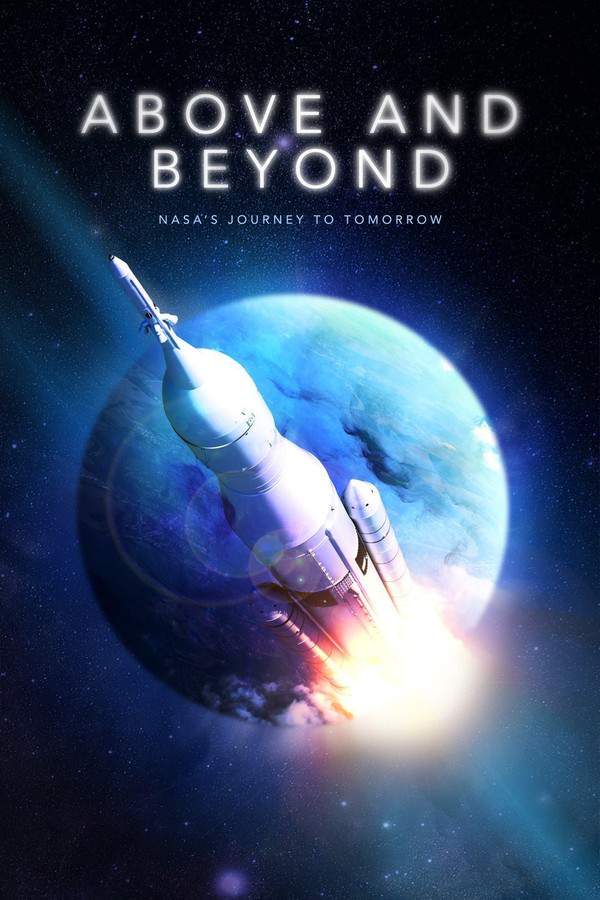
Above and Beyond: NASA's Journey To Tomorrow 2018

Directed by

Rory Kennedy
Made by

Discovery Channel
Where to Watch Above and Beyond: NASA's Journey To Tomorrow
See current US streaming, rental, and purchase options for Above and Beyond: NASA's Journey To Tomorrow (2018) via JustWatch.








Above and Beyond: NASA's Journey To Tomorrow Plot Summary
Read the complete plot summary and ending explained for Above and Beyond: NASA's Journey To Tomorrow (2018). From turning points to emotional moments, uncover what really happened and why it matters.
ABOVE AND BEYOND: NASA’S Journey To Tomorrow delves into the incredible impact NASA has not only on the United States but also on our planet as a whole. Spanning over sixty years of history and future aspirations, this documentary honors past achievements, explores ongoing projects, and looks ahead to what lies beyond the horizon. It takes us on a journey through the cosmos—from the moon to the surface of Mars and even to the farthest corners of our solar system—while always returning to our precious home, Earth.
Flashback to 1961, when President Kennedy inspired a nation by announcing the ambitious moon landing mission, declaring, “We have given this program a high national priority. Even though I realize that this is in some measure an act of faith and vision, for we do not now know what benefits await us.” This thought-provoking documentary asks an essential question: what has transpired from President Kennedy’s faith in human innovation, his profound vision, and his aspirations for the future?
The act of exploration, after all, embodies a profound act of faith and vision; the rewards often remain hidden in the shadows of the unknown. It is this very curiosity that defines NASA’s mission—the relentless drive to explore, discover, and uncover secrets long hidden from our view. NASA stands apart as a beacon of discovery, channeling humanity’s quest for answers that could one day safeguard our very survival.
Now, six decades later, amid intense discussions about NASA’s value and relevance, ABOVE AND BEYOND reflects on the agency’s monumental contributions to humankind. It captures our awe and respect as we witness not only the gifts NASA has bestowed upon us but also its critical role in shaping the future of humanity.
As the narrative unfolds, we accompany NASA on its quest to search for extraterrestrial life within our solar system and the discovery of potentially habitable planets orbiting nearby stars. Through the Hubble Space Telescope, we gaze upon tens of thousands of previously hidden galaxies, all while NASA remains steadfast in its commitment to monitor our home planet. The agency tirelessly scrutinizes the earth’s oceans and skies, snows and sands, building an unparalleled reservoir of knowledge about our world.
Perhaps one of the most unexpected revelations that ABOVE AND BEYOND brings forth is the dual role NASA plays: as it reaches further into the cosmos, it also keeps a watchful eye on Earth, working diligently to understand our environmental systems and maintain the balance of our home. While telescopes gaze into the vastness of space, NASA simultaneously keeps track of crucial locations such as Antarctica, the Great Barrier Reef, and the rising sea levels in the Atlantic Ocean, monitoring water temperatures in the Gulf of Mexico.
Through its exploration of both space and Earth, NASA aspires to gain an in-depth understanding of our place within the universe. This understanding allows us to appreciate our planet—a fragile, little blue marble adrift in the vast, silent void of space—unique in its ability to support life as we know it.
Above and Beyond: NASA's Journey To Tomorrow Timeline
Follow the complete movie timeline of Above and Beyond: NASA's Journey To Tomorrow (2018) with every major event in chronological order. Great for understanding complex plots and story progression.
President Kennedy's Announcement
In 1961, President John F. Kennedy delivered a pivotal speech announcing the ambitious goal of a moon landing. He emphasized the need for a high national priority on the program, highlighting both the unknown benefits and the faith in human innovation this effort entailed.
Formation of NASA
Established in 1958, NASA was formed to lead the United States into the space age. Recognizing the crucial role of space exploration, the agency has since become a beacon of discovery, inspiring countless innovations and advancements over the decades.
The Apollo Missions
The Apollo missions, culminating in the historic Apollo 11 landing in 1969, marked a monumental achievement for NASA and humanity. These missions showcased America's capabilities in space exploration, pushing boundaries and igniting public interest in science and technology.
Exploration of Mars
Over the years, NASA embarked on a series of missions to study Mars, including the Pathfinder and Curiosity rovers. These endeavors aimed to understand the planet's environment and assess its potential for past or present life, signaling humanity's quest for extraterrestrial understanding.
Hubble Space Telescope Launch
Launched in 1990, the Hubble Space Telescope opened a new frontier in astronomy by providing stunning images and unprecedented data about the universe. It has allowed scientists to study galaxies, star formation, and cosmic phenomena, revealing the vastness of space.
Search for Extraterrestrial Life
NASA's ongoing projects include searching for signs of extraterrestrial life within our solar system and beyond. These initiatives are driven by an innate curiosity, pushing the boundaries of knowledge and exploring potentially habitable planets orbiting distant stars.
Monitoring Earth's Environment
In conjunction with its space missions, NASA continuously monitors Earth's environmental systems. Utilizing advanced satellite technology, the agency investigates changes in oceans, atmosphere, and ecosystems to provide vital data that informs strategies for climate change mitigation.
Analysis of Antarctica
One key focus for NASA has been Antarctica, where researchers study ice mass loss and its implications for global sea levels. This research is crucial for understanding climate patterns and their impact on the planet's systems, emphasizing the importance of Earth science.
Great Barrier Reef Research
NASA has conducted extensive studies on the Great Barrier Reef, tracking changes in water temperature and coral health. This research provides insights into the effects of climate change on marine ecosystems, highlighting the urgent need for conservation efforts.
Rising Sea Levels
Amidst the ongoing climate crisis, NASA actively monitors rising sea levels, using satellite data to predict future changes. This information is essential for global coastal management and helps nations prepare for the potential impacts of climate change.
Understanding Our Place in the Universe
As NASA reaches for the stars, it simultaneously fosters a deeper understanding of Earth and its unique characteristics. This dual role enhances humanity's appreciation of our planet, emphasizing the delicate balance necessary to sustain life in our universe.
Future Aspirations
With a vision for the future, NASA aims to extend its reach beyond the solar system. Ongoing research and technological developments aspire to unlock the mysteries of distant worlds and the possible existence of life beyond Earth, furthering the quest for knowledge.
Continued Public Engagement
As NASA reflects on its past contributions, it also prioritizes public engagement to inspire future generations. Educational programs and outreach initiatives aim to ignite curiosity, fostering a new wave of innovation driven by the spirit of exploration.
Legacy and Impact
Reflecting on over sixty years of achievements, NASA's legacy is built on its relentless pursuit of knowledge and understanding. The documentary 'Above and Beyond' encapsulates this journey, celebrating the agency's role in shaping a better future for humanity.
Above and Beyond: NASA's Journey To Tomorrow Settings
Learn where and when Above and Beyond: NASA's Journey To Tomorrow (2018) takes place. Explore the film’s settings, era, and how they shape the narrative.
Time period
1961, Present Day
The documentary begins with a flashback to 1961, highlighting President Kennedy's ambitious vision for space exploration. It then progresses to the present day, reflecting on six decades of NASA's achievements and aspirations, addressing both historical milestones and ongoing projects in space and Earth monitoring.
Location
Earth, Moon, Mars, Antarctica, Great Barrier Reef
The movie takes viewers on a journey from Earth to the Moon and Mars, showcasing NASA's exploration of the cosmos. It highlights significant locations like Antarctica and the Great Barrier Reef, emphasizing their importance in understanding our planet's environmental systems. These places are known for their unique ecosystems and serve as critical areas for NASA's research and monitoring efforts.
Above and Beyond: NASA's Journey To Tomorrow Themes
Discover the main themes in Above and Beyond: NASA's Journey To Tomorrow (2018). Analyze the deeper meanings, emotional layers, and social commentary behind the film.
🔭
Exploration
Exploration is a central theme of the documentary, showcasing NASA's relentless pursuit of knowledge about the universe. It emphasizes humanity's innate curiosity and desire to uncover the mysteries of space, which drives the mission of NASA. This theme resonates throughout the film as it demonstrates the dual journey of looking outward while also caring for Earth.
🌌
Discovery
The theme of discovery is woven into the narrative as the film traces NASA’s achievements, from historic moon landings to the search for extraterrestrial life. The documentary highlights the critical discoveries that have significantly contributed to our understanding of both the cosmos and our own planet. It captures the awe and respect for the scientific pursuits that define NASA.
🌿
Environmental Awareness
Another theme is environmental awareness, stressing NASA's role in monitoring Earth's ecological health. The film explores how space exploration and the study of our planet are interconnected, emphasizing the importance of safeguarding Earth's fragile ecosystems. It demonstrates NASA's commitment to understanding and protecting our environment.

Coming soon on iOS and Android
The Plot Explained Mobile App
From blockbusters to hidden gems — dive into movie stories anytime, anywhere. Save your favorites, discover plots faster, and never miss a twist again.
Sign up to be the first to know when we launch. Your email stays private — always.
Explore the mobile appAbove and Beyond: NASA's Journey To Tomorrow Spoiler-Free Summary
Discover the spoiler-free summary of Above and Beyond: NASA's Journey To Tomorrow (2018). Get a concise overview without any spoilers.
In a sweeping portrait that feels both a tribute and a blueprint for the future, the film follows the arc of humanity’s most daring enterprise: the quest to understand what lies beyond our world. Beginning with the bold vision sparked in the early 1960s, it asks what the relentless curiosity of a nation can achieve when paired with science, imagination, and the willingness to stare into the unknown. The premise is simple yet profound—show how a single agency has become a catalyst for discovery, innovation, and a deeper appreciation of the fragile planet we call home.
The world the documentary opens for us is one where the vastness of space is rendered intimate, and the Earth’s own delicate systems are placed under a microscope. Through sweeping vistas of the moon’s cratered surface, the red dust of Mars, and the glittering tapestry of distant galaxies, the film balances awe‑inspiring grandeur with quiet, data‑driven moments that reveal how every orbiting telescope and wandering rover feeds back into our understanding of climate, oceans, and ecosystems. The tone is both reverent and investigative, inviting viewers to feel the exhilaration of launch pads and the quiet responsibility of watching our own atmosphere change.
Guided by the steady hand of Rory Kennedy, whose direction weaves together interviews, archival footage, and stunning modern visuals, the narrative is anchored by the voices of those who have built and shaped the agency—engineers, scientists, and the astronauts who have ventured into the void. Their collective story forms the heart of the documentary, portraying NASA not just as a collection of missions but as a living, breathing beacon of human ambition. The film’s style blends lyrical narration with crisp, scientific clarity, creating a mood that is both hopeful and contemplative, urging us to wonder about the next frontier while reminding us of the precious blue marble we already inhabit.
Featured on this page

What's After the Movie?
Not sure whether to stay after the credits? Find out!
Check out our other apps:

SAT Sphere
Build confidence for the Digital SAT.

Mori Atlas
Discover wild places worth protecting.

Luntero
Search smarter for a home in Amsterdam.

Plot Explained
Unravel movie endings and hidden clues.

Pokechamp
Dive into Pokémon data and battle logic.

Driving Theory
Get ready for your European theory test.

Movie Dust
Plan your next cinema trip with ease.

Musemap
Find art and culture as you travel.

Selkobase
Compare credentials before committing.

Local Manual
Turn an unfamiliar country into practical next steps.

Lernavi
Compare school systems before your next move.

GymRoam
Find a workout stop wherever your plans take you.
Explore Our Movie Platform
New Movie Releases (2026)
Famous Movie Actors
Top Film Production Studios
Movie Plot Summaries & Endings
Major Movie Awards & Winners
Best Concert Films & Music Documentaries
Movie Collections and Curated Lists
© 2026 What's After the Movie. All rights reserved.
Privacy Policy