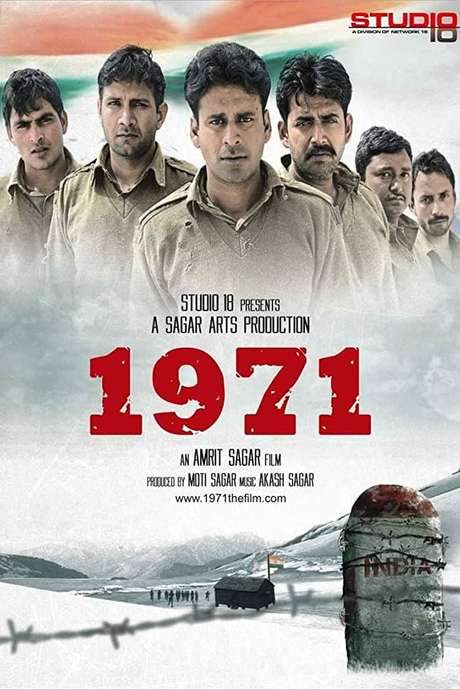
1971 2007

Directed by

Amrit Sagar Chopra
Made by

Sagar Pictures Entertainment
1971 Plot Summary
Read the complete plot summary and ending explained for 1971 (2007). From turning points to emotional moments, uncover what really happened and why it matters.
In 1977, Pakistan becomes the setting for a tense chapter in the lives of Indian POWs, six years after the 1971 Indo-Pakistani War. The camp houses veterans from both conflicts, with the 1971 POWs appearing comparatively healthier while the 1965 prisoners have drifted into despair. Among the inmates, Subedar Ahmed, Captain Kabir, Captain Jacob, and Major Suraj Singh reflect on the camp’s supposedly good facilities and the strange comfort they’ve found in a place uprooted from normal life. They’ve been relocated here from a string of Pakistani jails, a detail that underscores the fragile line between survival and surrender.
When dawn breaks, an army truck rolls toward the camp carrying a handful of new prisoners. Among them are Flight Lt. Ram, Flight Lt. Gurtu, and Col. Puri. The group soon realizes they are not far from the Indian frontier, their location pinpointed at Chaklala, a fact that will shape every decision to come. The arrival of Colonel Shakoor at Chaklala adds another layer of command and menace to the unfolding plan, as he informs the POWs that repatriation is the order of the day. He even allows them to watch any movie, a small concession that later triggers a harsher truth—Ahmed seizes a newspaper and discovers the truth behind the “repatriation”—that it’s a fabrication used to hide the prisoners from the Red Cross.
A Ghazal singer is invited to the camp as part of the supposed celebration of 14 August, and the prisoners seize the moment to stage an audacious escape. They forge fake IDs and obtain Pakistani uniforms, using the event as cover for their covert operation. In the ensuing act of sacrifice, Subedar Ahmed sacrifices himself to blow up both the ammunition room and the electrical room, dying in the blast. With Ahmed gone, the remaining five—Captain Kabir, Captain Jacob, Major Suraj Singh, Flight Lt. Ram, and Flight Lt. Gurtu—manage to escape with the singer, who is later revealed to be part of a Pakistani human rights commission. They leave behind a scene of chaos as the Pakistanis mount a massive manhunt, recasting the escaped as common criminals to obscure the truth from the Red Cross.
The hunt intensifies even as the human rights leader and the Red Cross arrive, pressing questions about the missing prisoners. The escapees’ fate weighs heavily: Captain Jacob shoots himself after a grave injury sustained in a hideout, while Flight Lt. Ram shoots Colonel Shakoor and detonates a grenade on himself to destroy more search-party vehicles, enabling the others to slip away. The mission’s moral complexity deepens as the leaders’ deception is revealed to the Red Cross, who find themselves blocked from meaningful progress.
Tragedy punctuates the escape: Captain Kabir sustains a mangled leg while riding a captured motorcycle, only to succumb to frostbite and die peacefully near the Indian border. Major Suraj Singh is killed as he nears the border, his body taken by the Pakistanis, and Flight Lt. Gurtu witnesses Suraj’s death before being recaptured offscreen. The escapees’ status becomes a lingering mystery tied to the wider fate of Indian POWs.
Fast forward to 2007, and the story shifts to Multan Jail in Pakistan. Here, an elderly inmate—revealed to be Flight Lt. Gurtu—tends to five small mounds of earth in the prison yard, placing flowers beside them. He reflects on the sustaining power of hope, insisting that he remains alive because of it. The film closes with a sobering tally: there are still 54 Indian POWs from 1971 unaccounted for in Pakistani jails, their last known status dated back to 1988, a haunting reminder of the unresolved fates that followed the conflict. The narrative leaves the viewer with a quiet, stubborn sense of resilience—hope as a constant undercurrent amid the long shadows of war and captivity.
1971 Timeline
Follow the complete movie timeline of 1971 (2007) with every major event in chronological order. Great for understanding complex plots and story progression.
Arrival at Chaklala POW camp
Six years after the 1971 war, Indian POWs are moved to Chaklala in Pakistan. Major Suraj Singh and the other officers discuss the camp's good facilities, noting a relative comfort compared with earlier jails. The 1965 POWs, in contrast, have gone insane with despair.
New prisoners arrive at Chaklala
An army truck arrives with Ram, Gurtu, and Colonel Puri. The prisoners steal a guard's wallet and obtain a Pakistani ID card on the way, helping them blend in. They realize they are less than 200 km from the Indo-Pak border.
Shakoor announces repatriation and privileges
Colonel Shakoor informs that all POWs will be repatriated. He also allows Indian POWs to watch any movie, a small privilege that hints at the camp being easier than expected.
Ahmed uncovers the cover story and begins planning
During the movie day, Ahmed steals a newspaper and discovers that the supposed repatriation is a lie designed to hide Indian prisoners from the Red Cross. He begins to organize an escape plan with the others.
Disguises and cover for the escape
The prisoners forge fake IDs and obtain Pakistani uniforms to blend in. They stage the Ghazal singer's appearance during a camp celebration as a cover for their escape.
Escape attempt begins during the 14 August celebration
As the celebration unfolds, Ahmed sacrifices himself by blowing up the ammunition room and the electrical room. The five escapees, using their disguises and the singer as cover, slip away while the singer is allowed to go.
Escapees go on the run and the manhunt starts
The five fugitives hide their identities as they move away from the camp and the search escalates. The Pakistani authorities begin a massive manhunt, insisting the men are common criminals rather than Indian POWs.
Jacob and Ram strike back
Jacob, wounded during a hideout, shoots himself rather than be captured. Ram shoots Shakoor and then detonates a grenade on himself to destroy several pursuit vehicles, aiding his comrades.
Human rights inquiry meets resistance
A Pakistani human rights leader and the Red Cross arrive to investigate the missing POWs but are blocked from finding any results. The singer is revealed to be part of a Pakistani human rights commission and reports the deception to its leader.
Kabir is gravely injured and dies
Kabir loses a leg while driving a captured motorcycle and suffers frostbite as they push toward the border. He dies peacefully in his sleep as the group nears India.
Suraj's death at the border and Gurtu's recapture
Suraj is shot and killed just as they are about to cross into India, and his body is taken away by Pakistani troops. Gurtu is recaptured by the Pakistanis offscreen.
2007 Multan Jail reveal and final note on hope
In 2007, an elderly Gurtu tends five mounds of earth in the prison yard and places flowers on them. He reads Major Suraj Singh's prison diary and explains that living without hope is impossible. He reveals that there are still 54 Indian POWs from 1971 held in Pakistani jails, last seen alive in 1988.
1971 Characters
Explore all characters from 1971 (2007). Get detailed profiles with their roles, arcs, and key relationships explained.
Major Suraj Singh — Manoj Bajpayee
A seasoned and principled leader among the Indian POWs, Suraj Singh serves as the group’s tactical mind. He prioritizes his men's safety, balancing courage with caution as plans unfold. His fate is sealed when he is killed while resisting capture, underscoring the high stakes of the mission.
Captain Kabir — Kumud Mishra
Kabir is a pragmatic, loyal officer who supports the escape effort. He endures a mangled leg as the plan progresses and continues to fight through adversity. His character embodies resilience and duty in the face of overwhelming odds.
Captain Jacob — Ravi Kishan
Jacob is a fellow POW who confronts pain with stoicism, ultimately taking his own life after being injured. He acts as a steady presence among the group, whose choices are influenced by the harsh realities of captivity.
Subedar Ahmed — Chittaranjan Giri
Ahmed is the spark that ignites the escape plan, leveraging forged IDs and surprise to threaten the status quo. He embodies calculated risk-taking and self-sacrifice, ultimately blowing up key facilities to enable the escape.
Flight Lt. Ram — Manav Kaul
Ram is a bold, improvisational figure within the group, willing to take decisive action to save his comrades. He ends up shooting Shakoor and detonating a grenade to cover their escape, sealing his role as a dedicated ally.
Flight Lt. Gurtu — Deepak Dobriyal
Gurtu serves as a wary witness who endures captivity and later recaptivity, carrying the memory of Suraj Singh. He becomes the silent link to the past as the film revisits the moral costs of escape.
Colonel Puri — Gyan Prakash
Col. Puri is the pragmatic intermediary who questions the timing of an escape. His decision to overrule the plan underscores the tension between immediate salvation and potential mass risk, illuminating the political calculations behind repatriation.
Colonel Shakoor — Bikramjeet Kanwarpal
Shakoor is the stern Pakistani commander who negotiates repatriation and leads the manhunt after the breakout. He embodies a mix of discipline and ruthlessness, enforcing captivity even as the war’s implications unfold.
1971 Settings
Learn where and when 1971 (2007) takes place. Explore the film’s settings, era, and how they shape the narrative.
Time period
1977 and 2007
The narrative begins in 1977, six years after the 1971 war, in a Pakistani POW camp near the border. It shifts to 2007, when an elderly Gurtu reflects from Multan Jail on the fate of the remaining POWs. The two periods frame a tale of memory, endurance, and the elusive promise of repatriation.
Location
Chaklala, Multan Jail
Chaklala POW camp near the Indo-Pak border hosts Indian soldiers after the 1971 war. The film also shows Multan Jail decades later, anchoring the narrative in a real Pakistani penitentiary setting. The place is depicted as a controlled military environment with limited freedoms, underscoring the constraints of captivity.
1971 Themes
Discover the main themes in 1971 (2007). Analyze the deeper meanings, emotional layers, and social commentary behind the film.
🕯️
Hope
Hope threads through the prisoners' struggle, sustaining plans for escape and the belief that they will one day return home. The characters weigh the risks of rebellion against the chance of safe release. The diary and memories of fallen comrades reinforce that resilience is the only way to endure captivity. Hope is presented as both a personal lifeline and a collective duty.
🤝
Friendship
The prisoners rally around shared hardship, forming a makeshift brotherhood under pressure. Cooperation becomes essential for survival, especially during the careful assembly of forged IDs and disguises. Trust is tested as fear and deception threaten to break unity. The escape plan stands as a testament to solidarity beyond borders.
⚖️
Truth and Justice
The film contrasts official narratives with the reality of captivity, exposing lies about repatriation. The presence of a human rights leader and Red Cross adds pressure for accountability, challenging the state’s secrecy. Deception and propaganda are central obstacles the characters must navigate. The eventual inquiry underscores the pursuit of truth, even when outcomes remain uncertain.

Coming soon on iOS and Android
The Plot Explained Mobile App
From blockbusters to hidden gems — dive into movie stories anytime, anywhere. Save your favorites, discover plots faster, and never miss a twist again.
Sign up to be the first to know when we launch. Your email stays private — always.
Explore the mobile app1971 Spoiler-Free Summary
Discover the spoiler-free summary of 1971 (2007). Get a concise overview without any spoilers.
In the sweltering heat of 1970s Pakistan, a secluded military detention camp holds a group of Indian soldiers far from home. The film paints the stark, wind‑swept landscape and the claustrophobic routine of captivity with a muted, almost tactile realism, letting the audience feel the oppressive weight of walls that are both physical and psychological. A lingering sense of unfinished business hangs in the air, underscored by the quiet hum of distant artillery and the faint hope that every sunrise might bring a chance at redemption.
Among the prisoners, Subedar Ahmed commands quiet respect, his steady demeanor balancing the raw nerves of younger officers. Captain Kabir and Captain Jacob bring contrasting leadership styles—one measured, the other impetuous—while Major Suraj Singh embodies disciplined resolve rooted in a deeper sense of duty. The youngest souls, Flight Lt. Ram and Flight Lt. Gurtu, carry the restless energy of those who have not yet been broken by years of confinement. Their interactions crackle with a mixture of camaraderie, quiet rivalry, and shared longing, each character revealing a fragment of the larger story of honor and sacrifice that binds them.
Against this backdrop, the camp becomes more than a holding cell; it is a crucible where loyalty is tested and the instinct to survive merges with a fierce patriotic yearning. Whispers of a possible return to the Indian frontier stir the men’s imaginations, prompting them to contemplate a daring course of action that could alter their fates forever. The tone remains tense yet hopeful, teasing the audience with the promise of an audacious plan born from collective bravery, while the ever‑present danger of the surrounding terrain keeps the stakes palpable. The film invites viewers to sit with the soldiers’ resolve, feeling the pull between duty and yearning as they contemplate the thin line between freedom and captivity.
Movies with Similar Twists and Themes
Uncover films that echo the narrative beats, emotional arcs, or dramatic twists of the one you're exploring. These recommendations are handpicked based on story depth, thematic resonance, and spoiler-worthy moments — perfect for fans who crave more of the same intrigue.





Featured on this page

What's After the Movie?
Not sure whether to stay after the credits? Find out!
Check out our other apps:

SAT Sphere
Build confidence for the Digital SAT.

Mori Atlas
Discover wild places worth protecting.

Luntero
Search smarter for a home in Amsterdam.

Plot Explained
Unravel movie endings and hidden clues.

Pokechamp
Dive into Pokémon data and battle logic.

Driving Theory
Get ready for your European theory test.

Movie Dust
Plan your next cinema trip with ease.

Musemap
Find art and culture as you travel.

Selkobase
Compare credentials before committing.

Local Manual
Turn an unfamiliar country into practical next steps.

Lernavi
Compare school systems before your next move.

GymRoam
Find a workout stop wherever your plans take you.
Explore Our Movie Platform
New Movie Releases (2026)
Famous Movie Actors
Top Film Production Studios
Movie Plot Summaries & Endings
Major Movie Awards & Winners
Best Concert Films & Music Documentaries
Movie Collections and Curated Lists
© 2026 What's After the Movie. All rights reserved.
Privacy Policy