Sisu: Road to Revenge 2025


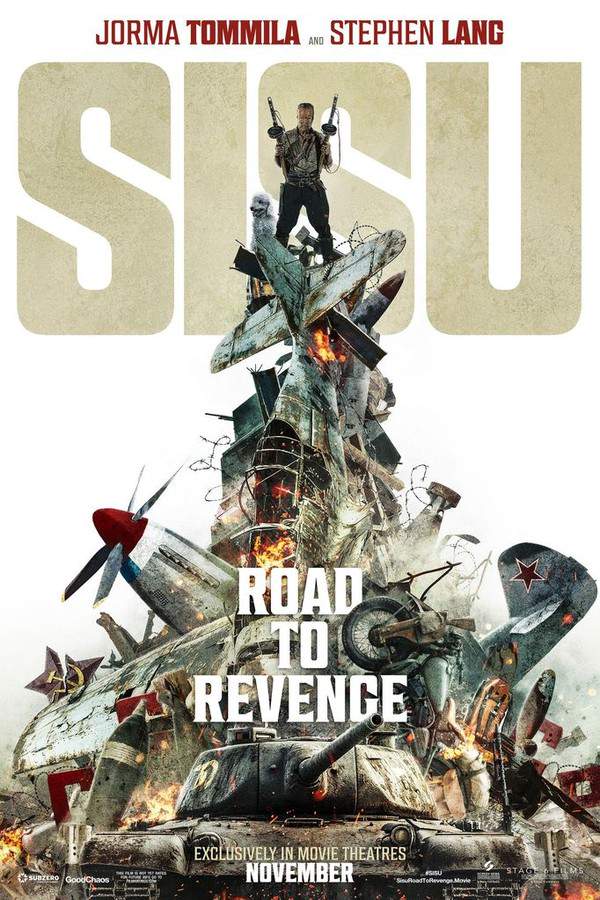
Returning to the house where his family was brutally murdered during the war, the “man who refuses to die” (Jorma Tommila) dismantles the ruined home, loads its remnants onto a truck, and vows to rebuild it in a safe place as a tribute. When the Red Army commander responsible for the massacre (Stephen Lang) returns, determined to finish the job, a relentless showdown ensues.


Does Sisu: Road to Revenge have end credit scenes?
No!
Sisu: Road to Revenge does not have end credit scenes. You can leave when the credits roll.
Where to Watch Sisu: Road to Revenge
See current US streaming, rental, and purchase options for Sisu: Road to Revenge (2025) via JustWatch.

Netflix
4K
Netflix Standard with Ads
HD
Amazon Video
4K
Apple TV Store
4K
Fandango At Home
4K
FlixFling
HD
Google Play Movies
SD
YouTube
SD Streaming availability powered by 
Meet the Full Cast and Actors of Sisu: Road to Revenge
Explore the complete cast of Sisu: Road to Revenge, including both lead and supporting actors. Learn who plays each character, discover their past roles and achievements, and find out what makes this ensemble cast stand out in the world of film and television.



External Links and Streaming Options
Discover where to watch Sisu: Road to Revenge online, including streaming platforms, rental options, and official sources. Compare reviews, ratings, and in-depth movie information across sites like IMDb, TMDb, Wikipedia or Rotten Tomatoes.








Ratings and Reviews for Sisu: Road to Revenge
See how Sisu: Road to Revenge is rated across major platforms like IMDb, Metacritic, and TMDb. Compare audience scores and critic reviews to understand where Sisu: Road to Revenge stands among top-rated movies in its genre.

The Movie Echo Score
Road to Revenge delivers a high‑octane sequel that leans heavily on relentless action and exaggerated violence. Critics acknowledge competent direction and inventive stunt work, while noting a sagging middle and thin narrative depth. User commentary mirrors this split, praising the spectacle and performances but criticizing plot coherence. The film’s sensory assault and bold choreography make it engaging for genre fans, yet the story’s shortcomings limit broader appeal. Consequently, the movie offers a solid, if uneven, viewing experience.
The Movie Echo Score Breakdown for Sisu: Road to Revenge

Art & Craft
Artistic execution centers on Jalmari Helander’s brisk direction and tight editing that sustain the film’s kinetic pulse. Critics commend the crisp cutting and inventive staging of violent set pieces, while users note effective stunt choreography and competent CGI. Some reviewers find the visual style overly gratuitous, yet the craftsmanship generally supports the relentless tone. Overall, the art and craft are solid and contribute to the movie’s momentum.

Character & Emotion
When assessing character work, the lead performance by Jorma Tommila receives praise for its physical intensity, and Stephen Lang’s villain is highlighted as a standout. Critics, however, point out minimal dialogue and limited emotional depth, describing the portrayals as functional rather than nuanced. User feedback echoes this split, enjoying the charisma of the protagonists while noting thin character development. In sum, performances are strong in presence but lack depth.

Story & Flow
The narrative follows a straightforward revenge premise propelled by nonstop action. Critics acknowledge the film’s brisk, spaghetti‑western pacing but criticize a middling slump and a thin plot that leans on spectacle over substance. Users echo this, praising the fun premise yet lamenting incoherence compared to the original. The story’s originality is limited, but its relentless drive keeps engagement alive for viewers seeking adrenaline. Overall, the plot is serviceable but uneven.

Sensory Experience
Sensory execution leans into exaggerated gore, kinetic choreography, and a pulsing soundtrack that accentuates the film’s chaotic energy. Critics lavish praise on the over‑the‑top violence, describing it as both comic and brutal, while noting the inventive baddie‑splattering and effective sound design. Users highlight well‑executed stunt work, competent CGI, and the film’s vivid visual style. Although some find the constant bloodshed excessive, the overall sensory package delivers a memorable, adrenaline‑charged experience.

Rewatch Factor
Rewatch potential hinges on the film’s relentless action and its ability to entertain despite a thin narrative. Critics note the steady rhythm and escalating set pieces reward repeat viewings, though the novelty of gore may fade. Users echo this, many expressing high enjoyment and a wish to revisit the spectacle, while a few cite lack of depth. Overall, it offers solid repeat value for fans of high‑energy thrills.

76
Metascore
6.4
User Score


93%
TOMATOMETER

87%
User Score

73
%
User Score
Full Plot Summary and Ending Explained for Sisu: Road to Revenge
Read the complete plot summary of Sisu: Road to Revenge, including all major events, twists, and the full ending explained in detail. Explore key characters, themes, hidden meanings, and everything you need to understand the story from beginning to end.
The film opens with a quiet, somber narration about the end of World War II, when Finland is compelled to cede Karelia to the Soviet Union. This political shift uproots families and sends many Finns, including those who still dream of home, to the Finnish side of the border. At the center of this upheaval is Aatami Korpi, a man who trudges back toward his old life with his loyal dog by his side, carrying the physical remnant of a lost past: wood from the home he used to share with his wife and two sons. He moves with a stubborn resolve, breaking down the timber and gathering it up, determined to rebuild his life on the Finnish side even as the memory of what was taken haunts him.
Elsewhere, in a stark contrast of fates, a Soviet Red Army commander named Igor Draganov sits in a Siberian prison and is freed. A KGB officer, played by Richard Brake, recognizes that Draganov is the man behind the murder of Aatami’s family. This brutal act has forged Draganov into a relentless killing machine known as Koschei, and the officer offers a dark incentive—payment to track down Aatami and finish what was begun years earlier.
Back on the Finnish side, Aatami’s return with the salvaged wood triggers a deadly pursuit. Draganov and his men close in, intent on a decisive kill. In a tense sequence aboard the truck, Aatami fights for his life, turning his machine into a weapon of escape and retribution. He shoots and sabotages, managing to decimate several of his attackers in a brutal display of improvisation and ferocity. For a moment, the hunter and the hunted lock eyes, and Draganov’s menacing presence hints at an inevitable confrontation to come.
The pursuit escalates into a ferocious motor onslaught. Motorcycles roar into the chase, and Aatami’s response is a brutal ballet of violence: crushing, blasting, and outsmarting his pursuers with ruthless efficiency. Aatami’s dog remains by his side, faithful and fearless, as the battle spills into every corner of the land he seeks to protect. The chase detonates into chaos as explosions ripple through the landscape, and Draganov doubles down, ordering reinforcements to unleash an unholy hell on the road.
A new danger arrives in the form of fighter jets streaming in to finish the job. Aatami slips into a barn to hide, but once the air strikes lift, he charges forward again with cold, calculated resolve. He is able to down one jet in a wood-filled snare, tearing at the wing and sending the pilot to a fiery crash. The air war intensifies as another jet appears along a cliff, and the pilot ejects, steering the doomed aircraft toward Aatami’s truck. Aatami cleverly pulls a few pieces of wood forward to conjure a ramp, sending the jet hurtling back into a fatal blaze. Surviving the barrage, he pushes on, only to see the third wave strike and drive him toward a cliff edge. The vehicle plunges into a river, taking wood and dog with it. Yet fortune smiles as Aatami and his companion emerge from the water in a makeshift raft, drifting toward a waiting tank ahead.
From that moment, a dramatic gambit unfolds. Aatami arms himself with an abundance of explosives and drives the tank toward the Soviet border where Draganov and his goons lie in wait. The plan is audacious: he detonates the fuel, sends the tank careening past the boundary, and races toward the threat that has haunted him for years. The tank collapses as it crosses the border, and the pursuit reaches a fever pitch as Aatami is captured, the KGB eager to keep him alive for a final accounting.
On a brutal train ride back to Siberia, Draganov brutalizes Aatami as punishment and as a reminder of the past. Draganov reveals he is the monster Aatami believes him to be, recounting the night his family was torn apart and boasting of the grisly details that forged his legend. The memory of his fallen son becomes a blood-stirring fire in Aatami, and when a guard’s distraction leaves an opening, Aatami uses a hidden knife to cut free himself, slashing and slicing through the car as guards fall one by one. A violent struggle explodes through the train, and a violent misstep by fate sends one guard into a tree, ending another thread in the bloodied chain of events.
In the final, most brutal stretch, Aatami charges toward revenge with a single-minded fury. He fights his way through the sleeping soldiers in the train cars, employing a mix of stealth, brutal force, and resourcefulness. He encounters a brutal confrontation with Draganov in the same car, where the two face off in a life-or-death struggle over a colossal missile. Draganov lunges to seize a chance at escape, but Aatami seizes the moment: he snatches a bolt from the missile, and the weapon becomes a raging instrument of justice. The missile detaches and tears toward Draganov’s cart, its explosive power ending the chase in a blaze of glory.
At the border, Aatami returns with his recovered wood and a sense of hard-won closure. A border guard recognizes him, saluting as a quiet acknowledgment of the long road he has traveled and the home he has finally won back. The final image is one of tentative peace and stubborn resilience as Aatami begins to rebuild his life, and a hopeful sense of community returns. With his dog by his side and his shelter restored, he is greeted by neighbors bearing tools and a willingness to help; the shared effort signals a future where healing can begin, even after a history of loss.
In the end, the story leaves Aatami Korpi standing at the threshold of a new home, his past answered with a fierce and unwavering resolve, his path forward lit by a stubborn, steady hope.

Coming soon on iOS and Android
The Plot Explained Mobile App
From blockbusters to hidden gems — dive into movie stories anytime, anywhere. Save your favorites, discover plots faster, and never miss a twist again.
Sign up to be the first to know when we launch. Your email stays private — always.
Explore the mobile appWatch Trailers, Clips & Behind-the-Scenes for Sisu: Road to Revenge
Watch official trailers, exclusive clips, cast interviews, and behind-the-scenes footage from Sisu: Road to Revenge. Dive deeper into the making of the film, its standout moments, and key production insights.
Sisu: Road to Revenge Other Names and Titles
Explore the various alternative titles, translations, and other names used for Sisu: Road to Revenge across different regions and languages. Understand how the film is marketed and recognized worldwide.
Quick Links: Summary, Cast, Ratings, More

What's After the Movie?
Not sure whether to stay after the credits? Find out!
Check out our other apps:

SAT Sphere
Build confidence for the Digital SAT.

Mori Atlas
Discover wild places worth protecting.

Luntero
Search smarter for a home in Amsterdam.

Plot Explained
Unravel movie endings and hidden clues.

Pokechamp
Dive into Pokémon data and battle logic.

Driving Theory
Get ready for your European theory test.

Movie Dust
Plan your next cinema trip with ease.

Musemap
Find art and culture as you travel.

Selkobase
Compare credentials before committing.

Local Manual
Turn an unfamiliar country into practical next steps.

Lernavi
Compare school systems before your next move.

GymRoam
Find a workout stop wherever your plans take you.
Explore Our Movie Platform
New Movie Releases (2026)
Famous Movie Actors
Top Film Production Studios
Movie Plot Summaries & Endings
Major Movie Awards & Winners
Best Concert Films & Music Documentaries
Movie Collections and Curated Lists
© 2026 What's After the Movie. All rights reserved.
Privacy Policy