
Rocketry: The Nambi Effect (2022): Cast, Ratings & Where to Watch
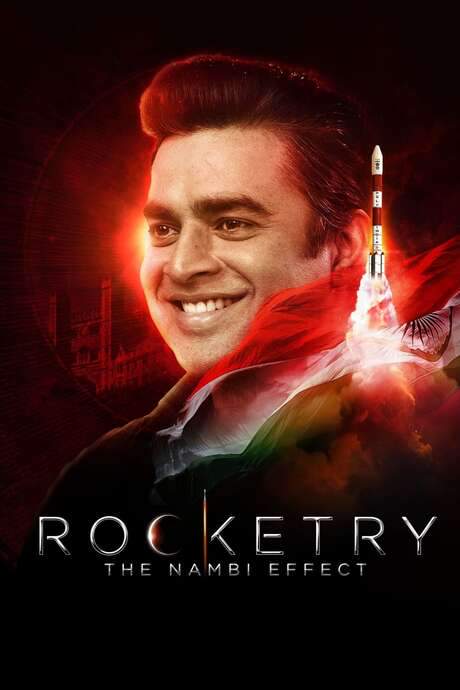
Rocketry: The Nambi Effect is a 2022 historical drama starring R. Madhavan as Nambi Narayanan, Misha Ghoshal and Shyam Renganathan. It runs 2 hours 34 minutes and earned $398,615 worldwide on a $7.9 million budget. Its Echo Score is 83/100. Stream it on Amazon Prime Video and Kanopy, or rent or buy it on Amazon Video and Apple TV Store.
- Released
- Runtime
- 2h 34m (154 min)
- Original language
-
 Tamil
Tamil - Studio
- Tricolor Films
- Budget
- $7.9M
- After the credits
- No No extra scene
What Is Rocketry: The Nambi Effect About?
The premise of Rocketry: The Nambi Effect without spoilers. The whole story is in the plot summary further down.
It chronicles the life of Indian rocket scientist Shri Nambi Narayanan, a dedicated patriot whose distinguished career was abruptly shattered when he was falsely charged with treason, instantly recasting him in the public eye as a villain in a tragic turn of events.
Rocketry: The Nambi Effect Themes & Keywords
· 40 tags- police
- rocket
- rocket scientist
- isro
- shahrukh khan
- tamil
- russia
- anger
- torture
- espionage
- engineer
- aerospace
+28 more Show fewer
- princeton
- university
- trilingual
- spy
- cruelty
- archive footage
- intermission
- change of aspect ratio
- speaking french
- violence
- brutality
- framed
- directed by lead actor
- race against time
- telephone call
- trauma
- husband wife relationship
- cameo appearance by real life subject
- ends with real life footage
- investigation
- nasa
- rocket science
- actor playing himself
- interview
- flashback
- false accusation
- apology
- based on true story
Where to Watch Rocketry: The Nambi Effect
Stream it on Amazon Prime Video and Kanopy, or rent or buy it from Amazon Video and Apple TV Store. US availability and prices from JustWatch.
 Amazon Prime Video
  Amazon Prime Video with Ads
  Kanopy
  Tubi TV



Streaming availability in the US, powered by 
Rocketry: The Nambi Effect Cast & Characters
R. Madhavan leads the cast as Nambi Narayanan, with Misha Ghoshal as Geeta Narayanan and Shyam Renganathan as Shankar Narayanan.
- R. Madhavan as Nambi Narayanan
- Misha Ghoshal as Geeta Narayanan
- Shyam Renganathan as Shankar Narayanan
- Gulshan Grover as A. P. J. Abdul Kalam
Also Starring in Rocketry: The Nambi Effect
· 22 more- Vincent Riotta Luigi Crocco
- Jack Dimich Professor Eugene Scott
- Ravi Raghavendra Vikram Sarabhai
- Simran Meena
- Shah Rukh Khan Interviewer (Hindi version)
- Suriya Interviewer (Tamil version)
- Dinesh Prabhakar L. D. Gopal
- Mohan Raman Udupi Ramachandra Rao
- Phyllis Logan Mrs Cleaver
- Jagan Scientist
- James Eliya Unni's Father in law
- Ron Donachie Col. Cleaver
- Bijou Thaangjam Studio Personnel
- Karthik Kumar P. M. Nayar
- Rajeev Ravindranathan Param
- Karina Matas Piper Michelle
Show all 26 cast members Show fewer cast members
- Sam Mohan Unni
- Abhirami Venkatachalam
- Muralidaran Arunan
- Sriram Parthasarathy Barry Amaldev
- Gaurav Venkatesh Studio Personnel
- Bhawsheel Singh Sahni Sartaj
Rocketry: The Nambi Effect Reviews & Ratings
Our Echo Score gives it 83/100, strongest in character & emotion (86) and weakest in art & craft (68).
Rocketry: The Nambi Effect Echo Score Breakdown
Rocketry: The Nambi Effect delivers a compelling portrait of a pioneering scientist, anchored by R. Madhavan’s nuanced performance and robust supporting work. Critics acknowledge the film’s ambition and moving moments, yet note uneven direction, a linear narrative punctuated by ornamental flash‑forwards, and occasional stodgy writing. Audience reactions are overwhelmingly positive, praising cinematography, score, and emotional resonance. The biopic thus succeeds in engaging viewers and honoring its subject, though technical inconsistencies prevent it from achieving full narrative cohesion.
Our own 0–100 rating, built from five aspects: art, character, story, the sensory experience and how well a film rewatches.
- Art & Craft 68
In terms of direction and visual execution, the film exhibits moments of strong composition, particularly in its cinematography, which users describe as exceptional. Critics, however, point to an uneven pacing and ornamental flash‑forwards that disrupt narrative flow, and note that editing sometimes feels disjointed. Overall, the craft shows competence with notable highlights but is marred by inconsistency.
- Character & Emotion 86
When analyzing character portrayal, Madhavan’s embodiment of Nambi Narayanan is repeatedly highlighted as layered and convincing, with supporting actors offering complementary depth. Critics commend the authenticity of performances, citing the physical and emotional range displayed across decades. While a few note occasional script stiffness, the collective assessment emphasizes a robust emotional core.
- Story & Flow 78
The narrative structure blends biographical chronology with flash‑forward sequences intended to heighten tension. Critics are divided: some appreciate the culminating rousing final act, while others criticize the overall linearity and occasional stodgy writing. Audience feedback, however, praises the story’s inspirational arc and its ability to sustain engagement despite pacing irregularities.
- Sensory Experience 80
Auditory and visual elements receive commendation, with users noting a compelling score and striking cinematographic choices that enhance the period setting. Critics provide limited commentary on sound design, focusing instead on narrative aspects, leaving the sensory experience largely unchallenged. Consequently, the film’s sensory dimension is regarded as a strong supporting layer.
- Rewatch Factor 85
The film’s thematic resonance and emotive performances foster a desire for repeat viewings among audiences, many citing its inspirational message and detailed portrayal as reasons to revisit. Critics acknowledge the final act’s impact but point to structural flaws that may diminish long‑term appeal. Overall, rewatch potential remains high, driven chiefly by its uplifting conclusion.
Rocketry: The Nambi Effect Plot Summary
What happens in Rocketry: The Nambi Effect from start to finish, spoilers included, with a timeline of 13 key events. The opening is below; the full summary is a 3-minute read.
Spoilers ahead
During a televised interview, Nambi Narayanan walks viewers through the incredible journey of his life, from his early days as a talented engineer to the harrowing experience of facing false charges of espionage and treason. He recounts his initial work at the Thumba Equatorial Rocket Launching Station, where he heroically saved A. P. J. Abdul Kalam, a fellow scientist, from a severe injury during a critical experiment. This event marked a significant milestone in his career, showcasing his dedication and technical skill.
Full summary
The whole story of Rocketry: The Nambi Effect, scene by scene
Rocketry: The Nambi Effect Box Office & Budget
Rocketry: The Nambi Effect grossed $398,615 worldwide on a $7.9 million budget, 5% of what it cost.
Worldwide gross
$398.6K
5% of its budget back
- International
- $398.6K
- Budget
- $7.9M
Rocketry: The Nambi Effect Trailers & Videos
The trailer of Rocketry: The Nambi Effect.
How Well Do You Know Rocketry: The Nambi Effect?
9 questions about the story, each with a hint if you get stuck. Pick an answer to see whether you were right.
Question 1 of 9
- Question 1: not answered
- Question 2: not answered
- Question 3: not answered
- Question 4: not answered
- Question 5: not answered
- Question 6: not answered
- Question 7: not answered
- Question 8: not answered
- Question 9: not answered
Where did Nambi Narayanan complete his MSE in chemical rocket propulsion?
Seen Rocketry: The Nambi Effect?
Movies Like Rocketry: The Nambi Effect
Films with a similar story, tone or audience, including Rocket Attack U.S.A., Rocket Singh: Salesman of the Year and RocketMan.






Rocketry: The Nambi Effect FAQ: Where to Watch & Cast
Runtime, release date, cast, where to watch, box office, post-credit scenes and language of Rocketry: The Nambi Effect, each answered in a sentence.
How long is Rocketry: The Nambi Effect?
Rocketry: The Nambi Effect runs 2 hours 34 minutes (154 minutes).
When was Rocketry: The Nambi Effect released?
Rocketry: The Nambi Effect was released on July 1, 2022.
Who is in the cast of Rocketry: The Nambi Effect?
Rocketry: The Nambi Effect stars R. Madhavan as Nambi Narayanan, Misha Ghoshal as Geeta Narayanan and Shyam Renganathan as Shankar Narayanan, among 26 credited actors.
Where can I watch Rocketry: The Nambi Effect?
In the US, Rocketry: The Nambi Effect is streaming on Amazon Prime Video, Kanopy and Tubi TV and available to rent or buy on Amazon Video, Apple TV Store and Google Play Movies (availability from JustWatch).
How much did Rocketry: The Nambi Effect make at the box office?
Rocketry: The Nambi Effect grossed $398,615 worldwide on a budget of $7.9 million.
Does Rocketry: The Nambi Effect have a post-credit scene?
No. Rocketry: The Nambi Effect has no extra scene during or after the credits.
What language is Rocketry: The Nambi Effect in?
The original language of Rocketry: The Nambi Effect is Tamil.
Coming soon to your phone
The Plot Explained Movie Summary App
From blockbusters to hidden gems: plot summaries, endings explained and timelines on your phone. Save your favorites and never miss a twist again.
Be the first to know when it launches. Your email stays private, always. Learn more about the app
