Blackout 1986

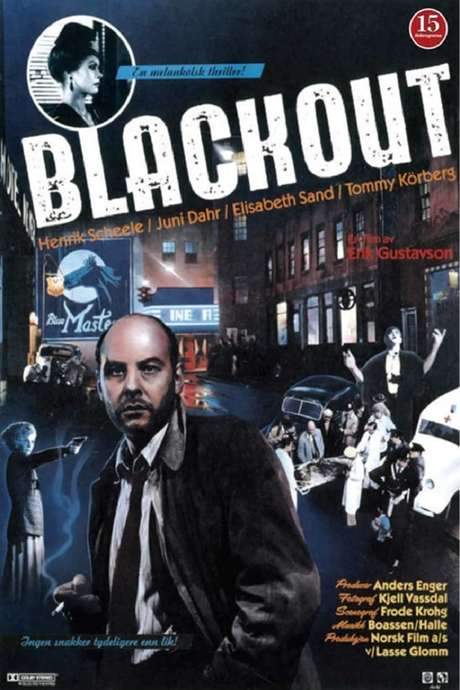
Corpses speak the clearest truth, and private investigator Werner gets a cryptic case. The affluent and striking Stella Hvidsteen arrives at his rundown office, pleading for help locating her missing sister Evy, a red‑haired woman who vanished without a trace. Werner takes the case, beginning an investigation into Evy's disappearance.


Does Blackout have end credit scenes?
No!
Blackout does not have end credit scenes. You can leave when the credits roll.
Where to Watch Blackout
See current US streaming, rental, and purchase options for Blackout (1986) via JustWatch.



Streaming availability powered by 
Meet the Full Cast and Actors of Blackout
Explore the complete cast of Blackout, including both lead and supporting actors. Learn who plays each character, discover their past roles and achievements, and find out what makes this ensemble cast stand out in the world of film and television.

Juni Dahr
Stella Hvidtsteen
Svein Tindberg
Teddys stemme
Anders Hatlo
Franks stemme
Sverre Horge
Scenearbeider
Terje Strømdahl
Mogens Beck
Tone Danielsen
Mor i rettssal
Elisabeth Sand
Lill
Kim Haugen
Redersekretær
Henrik Scheele
Werner
Tommy Körberg
Max
Aamund Johannesen
Barkeeper
Rannov Nilsen
Rettsmedisiner
Ella Hval
Fru Werner
Johan Fillinger
Riksadvokaten
Kalle Øby
Nagell Beck
Peter Lindbæk
Von Krogh, advokat
Bernt Erik Larssen
Holm
Eric Malm
Politiassistent
Per Bronken
Politiinspektøren
Hans Jacob Sand
Gutt
Espen Dekko
Teddy
Pål Skjønberg
Hvidtsteen, reder
Ramon Gimenez
Spanjolen
Dag Moe
Johannes Werner
Monica Mortensen
Evy Hvidtsteen
Franklin Farr
Død gutt
Ketil Siem
Politiassistent
Bente Tovik
Prostituert
Tord Nygård
Ung gutt
External Links and Streaming Options
Discover where to watch Blackout online, including streaming platforms, rental options, and official sources. Compare reviews, ratings, and in-depth movie information across sites like IMDb, TMDb, Wikipedia or Letterboxd.





Take the Ultimate Blackout Movie Quiz
Challenge your knowledge of Blackout with this fun and interactive movie quiz. Test yourself on key plot points, iconic characters, hidden details, and memorable moments to see how well you really know the film.
Blackout (1986) Quiz: Test your knowledge of the 1986 thriller Blackout with these ten questions ranging from easy to difficult.
What is the profession of Joe Steiner?
Full Plot Summary and Ending Explained for Blackout
Read the complete plot summary of Blackout, including all major events, twists, and the full ending explained in detail. Explore key characters, themes, hidden meanings, and everything you need to understand the story from beginning to end.
A tense, intricate thriller that weaves memory, deception, and danger into a riveting cat-and-mouse drama. The story opens with a brutal mass murder in Ohio: Lucy Vincent and her three children are found slain after a birthday party, and Lucy’s husband, Ed Vincent, vanishes, presumed the killer. A seasoned homicide detective named Joe Steiner is assigned to the case, but with the husband missing, the investigation stalls and eventually goes cold. The focal point shifts to a separate, later tragedy in California: a fiery crash leaves two men involved—one dead in the wreck and the other disfigured but alive, suffering from amnesia. The authorities initially believe the survivor could be the hitchhiker, and identification remains elusive since the body is burned and the survivor has no memory.
As the survivor fights to reclaim his past, he undergoes a long sequence of facial reconstructive surgeries over the course of a year. Along the way, he forms a bond with a nurse who treated him, and their relationship blossoms into love. Six years pass, and the couple is now happily married with children. The man has built a successful life as a real estate agent, while his wife stays at home to raise their family. Yet the shadow of the Vincent murders continues to loom, and Steiner—though retired from active duty—keeps digging for any hint that connects the Devlin case to what happened in Ohio. A tip arrives in the form of a newspaper article about the Devlin family, suggesting that the surviving man bears a strong resemblance to Ed Vincent and may in fact be the murderer they’ve been pursuing.
Driven by suspicion, Steiner travels to California to dig deeper. He confronts the man and publicly questions whether he could indeed be Ed Vincent. The local police chief, who has his own complicated history with the case, urges Steiner to drop the investigation, but Steiner remains convinced that there is more to the story. He becomes convinced that the survivor might be living with a dangerous split personality, one that is rooted in a subconscious drive to be caught for past killings.
To bolster his case, the survivor hires a private investigator to help him verify his identity. The investigator traces a crucial lead to a man who lent the vehicle involved in the crash, a person who could shed light on the survivor’s past. When the investigator attempts to obtain a confession or confirmation, the other side of the mystery resists, and a tense negotiation ensues. Meanwhile, disturbing phone calls with a distorted voice begin to haunt the survivor’s wife, casting doubt on the stability of their domestic life and hinting at connections to the past murders.
A violent pattern emerges as a woman is attacked in a park by a man wearing a black leather mask. Steiner recognizes this attack as part of a string of similar assaults that halted only when the Vincent murders occurred, reinforcing the possibility that the killer is linked to both cases. The shadowy thread tightens as the private investigator is found murdered, and the search of the survivor’s home yields nothing conclusive. Another attack follows, and the wife receives another ominous call. In a panic, she discovers a leather mask in the house and, under the pressure of protecting her children, confronts her husband. He admits himself to a psychiatric hospital, suggesting that the crisis may be more complicated than anyone realizes.
As the investigation resumes, Steiner and the police chief exchange troubling theories. Steiner discovers a mural of photographs in the chief’s home, which deepens the suspicion that a more personal motive is at play. The chief reveals his own vulnerability, confessing love for the wife and admitting that he had sent the newspaper article—but he denies making the threatening calls. Steiner grows convinced that the whole Devlin case may have been a deliberate construction designed to rupture the marriage and to advance the chief’s own romantic ambitions.
With the suspect now under observation, a new arrest appears to confirm Steiner’s worst fears: a rapist wearing a leather mask is caught, seemingly tying together the park attacks and the earlier Cincinnati-OHIO incidents. The survivor is released from psychiatric care as the case against him weakens, and life for the wife and her husband appears to return to a fragile normality. Yet the tension remains high, and the story races toward its shocking, irreversible twist.
On the night when the family prepares for a birthday party, the wife is attacked again, this time more aggressively. She manages to wrest control of the situation long enough to pull off the mask, revealing the attacker to be her husband. He is, in fact, Ed Vincent, and the man who died in the car crash had been the real Allen Devlin. The revelation shatters the wife’s trust, and she hides in her vehicle as her husband/labeled killer regains his footing. The detective, driven by a fierce sense of duty, arrives at the last moment and shoots the husband, preventing a possible murder of the wife and their children.
In the days that follow, the wife visits the detective to express gratitude for saving her family. The case closes with a hard-won sense of relief, tempered by the knowledge that memory, identity, and the past can collide in devastating ways. The film leaves viewers with a stark reminder: truth can be elusive, and the line between victim and perpetrator can blur when fear and deception govern a person’s actions.
This taut, character-driven thriller builds its suspense through carefully staged misdirections, psychological conflict, and a mounting sense that someone from the past has been living a double life right beneath the surface of a quiet, ordinary family life. The result is a chilling meditation on how memory can both protect and imprison, and how the pursuit of truth can collide with the protective instincts that bind a family together.

Coming soon on iOS and Android
The Plot Explained Mobile App
From blockbusters to hidden gems — dive into movie stories anytime, anywhere. Save your favorites, discover plots faster, and never miss a twist again.
Sign up to be the first to know when we launch. Your email stays private — always.
Explore the mobile appDiscover Film Music Concerts Near You – Live Orchestras Performing Iconic Movie Soundtracks
Immerse yourself in the magic of cinema with live orchestral performances of your favorite film scores. From sweeping Hollywood blockbusters and animated classics to epic fantasy soundtracks, our curated listings connect you to upcoming film music events worldwide.
Explore concert film screenings paired with full orchestra concerts, read detailed event information, and secure your tickets for unforgettable evenings celebrating legendary composers like John Williams, Hans Zimmer, and more.


Cars Featured in Blackout
Explore all cars featured in Blackout, including their makes, models, scenes they appear in, and their significance to the plot. A must-read for car enthusiasts and movie buffs alike.
Blackout Themes and Keywords
Discover the central themes, ideas, and keywords that define the movie’s story, tone, and message. Analyze the film’s deeper meanings, genre influences, and recurring concepts.
Blackout Other Names and Titles
Explore the various alternative titles, translations, and other names used for Blackout across different regions and languages. Understand how the film is marketed and recognized worldwide.
Similar Movies To Blackout You Should Know About
Browse a curated list of movies similar in genre, tone, characters, or story structure. Discover new titles like the one you're watching, perfect for fans of related plots, vibes, or cinematic styles.


Quick Links: Summary, Cast, Ratings, More

What's After the Movie?
Not sure whether to stay after the credits? Find out!
Check out our other apps:

SAT Sphere
Build confidence for the Digital SAT.

Mori Atlas
Discover wild places worth protecting.

Luntero
Search smarter for a home in Amsterdam.

Plot Explained
Unravel movie endings and hidden clues.

Pokechamp
Dive into Pokémon data and battle logic.

Driving Theory
Get ready for your European theory test.

Movie Dust
Plan your next cinema trip with ease.

Musemap
Find art and culture as you travel.

Selkobase
Compare credentials before committing.

Local Manual
Turn an unfamiliar country into practical next steps.

Lernavi
Compare school systems before your next move.

GymRoam
Find a workout stop wherever your plans take you.
Explore Our Movie Platform
New Movie Releases (2026)
Famous Movie Actors
Top Film Production Studios
Movie Plot Summaries & Endings
Major Movie Awards & Winners
Best Concert Films & Music Documentaries
Movie Collections and Curated Lists
© 2026 What's After the Movie. All rights reserved.
Privacy Policy