What's After the Movie
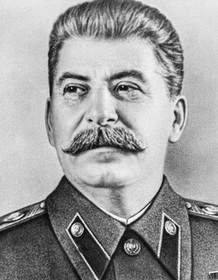
Joseph Stalin
Joseph Vissarionovich Stalin (born Ioseb Besarionis dze Jughashvili on 1878-12-18 in Gori, then part of the Russian Empire) rose from a humble Georgian shoemaker's family to become the longest‑ruling leader of the Soviet Union, holding power from the mid‑1920s until his death in 1953. After a turbulent early life marked by poverty, a smallpox scar and a partially crippled left arm, he enrolled at the Tiflis Theological Seminary before abandoning clerical studies to join the Marxist‑oriented Russian Social Democratic Labour Party, where he earned the revolutionary nickname “Koba.” His early revolutionary activity involved organizing strikes, bank robberies, and armed “battle squads” in Baku and Tiflis, leading to multiple arrests and Siberian exiles that forged his reputation for brutality and resilience. In 1912 Stalin was co‑opted onto the Bolshevik Central Committee and secret‑ly edited the party newspaper Pravda, a role that cemented his organisational skills and gave him control over party communications. Following the October Revolution he served as People’s Commissar for Nationalities, where he oversaw the controversial granting of limited autonomy to ethnic minorities and the controversial separation of Finland. By 1922 he had been appointed General Secretary of the Communist Party, a position originally intended as a bureaucratic post, yet he used it to place loyalists throughout the party apparatus, marginalising rivals such as Trotsky, Zinoviev and Kamenev. After Lenin’s death in 1924 Stalin consolidated absolute authority, launching the first Five‑Year Plan in 1928, forcing rapid industrialisation, collectivising agriculture, and precipitating the devastating famine of 1932‑33 that claimed millions of lives. His reign is infamous for the Great Purge (1936‑38), during which hundreds of thousands of party members, military officers and ordinary citizens were executed or sent to Gulag camps, creating a climate of pervasive terror. Internationally, Stalin navigated a complex diplomatic landscape, signing the Molotov‑Ribbentrop Pact with Nazi Germany in 1939, then leading the Soviet war effort after Operation Barbarossa in 1941; under his command the Red Army repelled the German invasion, secured the victory at Stalingrad, and captured Berlin in 1945, establishing the USSR as a superpower and spawning the Cold War. Stalin’s legacy remains deeply polarised: revered by some as the architect of Soviet industrial might and victory over fascism, condemned by many for orchestrating mass repression, forced collectivisation, and a cult of personality that inflicted suffering on an estimated tens of millions of people.
Biography, Career & Filmography
Learn more about Joseph Stalin, including a detailed biography, career timeline, personal life insights, and complete filmography. Discover how Joseph Stalin rose to fame, their major roles, industry impact, and personal milestones in the world of film.
Given Name: Ioseb Besarionis dze Jughashvili
Born: Gori, Russian Empire
Citizenship: Soviet Union
Birthday: December 18, 1878
Occupations: politician, revolutionary, statesman, dictator, military commander, editor
Years Active: 1899-1953
Children: 4
Spouses: Ekaterine Svanidze, Nadezhda Alliluyeva
External Links and Streaming Options
Explore more about on trusted external platforms like Metacritic, Rotten Tomatoes, TMDb or Wikipedia. Find additional details, reviews, and related content to deepen your understanding.





Movies Featuring Joseph Stalin
State Funeral
Reagan

Reza Shah

Hitler’s Girl

Winston Churchill: A Giant in the Century
Laissez-faire

1945: The Savage Peace

Imminent Threat

Lenin and the Other Story of the Russian Revolution

Stalin’s James Bond

Apocalypse: Stalin

Stalin’s Daughter

The Eagle and the Lion: Hitler vs Churchill

The Hitler–Stalin Pact

Korea: The Never-Ending War

State Funeral

Laboratory Greece

The Russian Revolution

Stalin: Man of Steel

Hitler & Stalin: Roots of Evil

Stalin, the Red Tyrant

Germany Year 90 Nine Zero

I Was Stalin’s Bodyguard

#UNFIT: The Psychology of Donald Trump

When the Wind Blows

The Long Breakup

Stalin and the Katyn Massacre

Big Data, Big Brother
-U4mLhRXBYSHf9g.jpg)
Apocalypse: Hitler Takes on The East (1941-1943)

Stalin and the Katyn Massacre

The Extraordinary Seaman

Three Songs About Lenin

The Girls

Jacques Brel Is Alive and Well and Living in Paris

Kino-Pravda No. 21: Lenin Kino-Pravda. A Film Poem About Lenin

Songs for After a War

Rita the Field Marshal

Life Begins Tomorrow

A Grin Without a Cat

World War II in Colour

To Arms, We Are Fascists!

Human Remains

Apocalypse: The Second World War

Cannibal Island

Island of the Dead

Mission to Moscow

Mao Tse-Tung and the Cultural Revolution
Beginning

The Society of the Spectacle

Life of a Shock Force Worker

Apocalypse: D-Day

Tolkien: The True Story of the Rings

In Memory of Sergo Ordzhonikidze

The Soviet Story

Russia, China, Iran: The Axis of Revenge
Career Timeline
Track the complete movie timeline of Joseph Stalin, including all film releases, career breakthroughs, and notable roles. Follow their journey from early performances to recent blockbusters and upcoming projects.
2024
Tolkien: The True Story of the Rings
Self - Politician (archive footage)
Russia, China, Iran: The Axis of Revenge
Self (archive footage)
2020
#UNFIT: The Psychology of Donald Trump
Self (archive footage)
The Long Breakup
Self - Politician (archive footage)
Stalin and the Katyn Massacre
Self (archive footage)
Big Data, Big Brother
Self - Politician (archive footage)
Stalin and the Katyn Massacre
Self (archive footage)
2019
The Hitler–Stalin Pact
Self (archive footage) (uncredited)
Korea: The Never-Ending War
Self (archive footage)
State Funeral
Self (archive footage)
Laboratory Greece
Self (archive footage)
2017
Lenin and the Other Story of the Russian Revolution
Self - Politician (archive footage)
Stalin’s James Bond
Self - Politician (archive footage)
The Eagle and the Lion: Hitler vs Churchill
Self - Politician (archive footage)
The Russian Revolution
Self (archive footage)
2015
Laissez-faire
Self (archive footage)
1945: The Savage Peace
Self (archive footage)
Imminent Threat
Self (archive footage)
Stalin’s Daughter
(archive footage)

Coming soon on iOS and Android
The Plot Explained Mobile App
From blockbusters to hidden gems — dive into movie stories anytime, anywhere. Save your favorites, discover plots faster, and never miss a twist again.
Sign up to be the first to know when we launch. Your email stays private — always.
Explore the mobile app
What's After the Movie?
Not sure whether to stay after the credits? Find out!
Check out our other apps:

SAT Sphere
Build confidence for the Digital SAT.

Mori Atlas
Discover wild places worth protecting.

Luntero
Search smarter for a home in Amsterdam.

Plot Explained
Unravel movie endings and hidden clues.

Pokechamp
Dive into Pokémon data and battle logic.

Driving Theory
Get ready for your European theory test.

Movie Dust
Plan your next cinema trip with ease.

Musemap
Find art and culture as you travel.

Selkobase
Compare credentials before committing.

Local Manual
Turn an unfamiliar country into practical next steps.

Lernavi
Compare school systems before your next move.

GymRoam
Find a workout stop wherever your plans take you.
Explore Our Movie Platform
New Movie Releases (2026)
Famous Movie Actors
Top Film Production Studios
Movie Plot Summaries & Endings
Major Movie Awards & Winners
Best Concert Films & Music Documentaries
Movie Collections and Curated Lists
© 2026 What's After the Movie. All rights reserved.
Privacy Policy