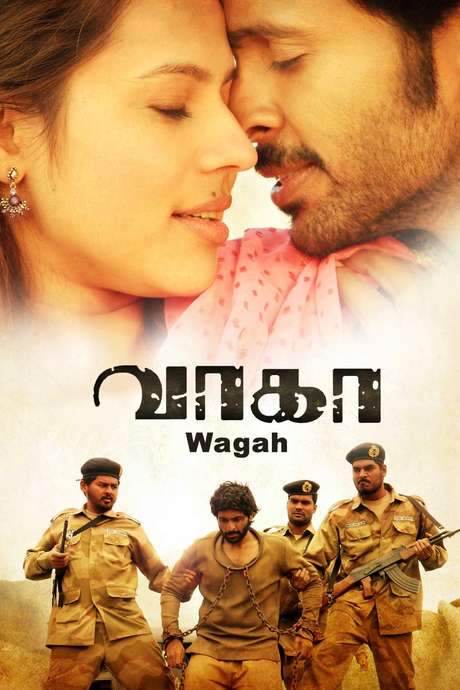
Wagah 2016

Directed by

G. N. R. Kumaravelan
Made by

Vijay Bhargavi Films
Where to Watch Wagah
See current US streaming, rental, and purchase options for Wagah (2016) via JustWatch.

Amazon Video
SD
Google Play Movies
SD
YouTube
SDStreaming availability powered by 
Wagah Plot Summary
Read the complete plot summary and ending explained for Wagah (2016). From turning points to emotional moments, uncover what really happened and why it matters.
The film opens with a broadcast announcing the brutal decapitation of two BSF jawans by the Pakistan Army, while a third, Vasu, remains missing. The scene then cuts to a Pakistan Army base where the wounded Vasu is held, and he begins to recount the chain of events that led to his capture.
Vasu is a young man from a small town in Tamil Nadu who joins the BSF after finishing college, choosing this path to avoid working in his father Raj Kapoor’s provision store. He is posted along the India–Pakistan border in Jammu and Kashmir, a region tense with conflict and daily risk. Early in his service, he encounters a shy and compassionate Kashmiri Muslim girl named Khanum Ranya Rao, and an instant pull develops between them. Khanum reciprocates his feelings, but she gently withdraws when he asks her to marry him, leaving Vasu with a mix of longing and uncertainty.
The next morning, the news of the two jawans’ decapitations spreads like wildfire, fueling anti-Pakistan sentiment and causing the Pakistani population in Kashmir to be urged to return homeland. Tasked with guiding and ensuring the safe return of all Pakistanis, Vasu is stunned to learn that Khanum is herself a Pakistani from Azad Kashmir who had come to India to visit her grandfather. When Khanum’s bus is set ablaze by protesters just a few kilometers from the border, she survives, and Vasu bravely escorts her to her home in PoK through an unguarded border crossing. Their journey takes a dangerous turn when Pakistani soldiers capture him, and he is imprisoned.
In the present day, Vasu discovers that he is not alone—there are twenty-three other BSF jawans being held prisoner. A brutal moment comes when he is forced to fight one of the fellow jawans, portrayed by Ajay Rathnam, and defeats him. Yet his victory is short-lived as he is dragged to a cliff to be shot. A compassionate Pakistan Army officer, whose daughter’s illness was cured by Indian doctors, secretly helps him escape, sparing his life.
Vasu and Khanum reunite in her village, where the danger intensifies as the ruthless anti-Indian commander Razzaq Ali Khan [Shaji Chaudhary] brutally wipes out Khanum’s family because he views her bond with an Indian soldier as treason. The two lovers flee toward the Indian border, pursued by Razzaq and the Pakistan Army. They confront the peril together, and Vasu ultimately subdues the pursuing force and defeats Razzaq without taking his life. Razzaq, defeated but unpersuaded, declares that his view of India and Indians will not change.
In a quiet rebuttal that underlines the film’s message, Vasu responds that, even as an Indian, he does not hate Pakistan or Pakistanis—he believes the cycle of hatred only deepens the conflict between the two nations. The pursuit eventually reveals a powerful truth: the 23 BSF jawans are alive in Pakistan, and Vasu helps secure their freedom. For his courage and humanitarian resolve, he is honored by both the President and the Prime Minister of India, a symbolic end that underscores the possibility of empathy crossing borders.
The film uses Vasu’s personal journey—rooted in duty, love, and restraint—to explore broader themes of national identity, forgiveness, and the human cost of war. The action builds steadily from a grounded border story to a larger, hopeful closing, where acts of mercy become a bridge between enemies and a reminder that courage can be defined by compassion as much as by combat.
Wagah Timeline
Follow the complete movie timeline of Wagah (2016) with every major event in chronological order. Great for understanding complex plots and story progression.
Opening news: decapitations and missing jawan
The film opens with a news broadcast reporting two BSF jawans decapitated by the Pakistan Army and the disappearance of Vasu. The border mood heats up as India searches for answers. This opening scene establishes the high-stakes tension that runs through the story.
Vasu's background and posting
Vasu, a young BSF jawan from Tamil Nadu, joined the force to avoid his father's provision store. He is posted at the India–Pakistan border in Jammu and Kashmir. His background helps explain his sense of duty and the personal stakes in the later romance.
First meeting with Khanum
Vasu meets Khanum, a Kashmiri Muslim girl, and is instantly attracted to her. She reciprocates his feelings, but she walks away when he asks her to marry. The moment seeds a personal conflict that intersects with the larger border crisis.
Border unrest and Pakistani withdrawal
The next morning, two jawans are decapitated, sparking a wave of anti-Pakistan sentiment. All Pakistanis in Kashmir are ordered to return to Pakistan, escalating fear and disruption. Vasu is tasked with facilitating the safe return of those Pakistanis.
Khanum revealed as Pakistani visitor
Vasu learns that Khanum is actually from Azad Kashmir and had come to India to visit her grandfather. The revelation complicates his personal feelings as duty pulls him toward his mission. The two characters' worlds become entangled in a conflict they can't easily escape.
Khanum's bus attacked; survival
Khanum's bus is burnt by protesting mobs just a few kilometers from the border, but Khanum survives the attack. Vasu helps her reach safety, underscoring a personal bond amid chaos. The incident intensifies the danger of their cross-border ties.
Escape attempt into PoK and imprisonment
Vasu escorts Khanum to her home in PoK via an unguarded border crossing, hoping for safety. He is soon captured by the Pakistan Army and imprisoned, becoming one more prisoner alongside 23 others. His captivity frames the 'present-day' portion of the story.
Present-day prison and the forced duel
In the present, Vasu learns there are 23 other BSF jawans imprisoned with him. He is forced to fight one of the captured jawans, Ajay Rathnam, and defeats him. A sympathetic Pakistan Army officer, moved by his cause, allows him to escape.
Journey to Khanum's village and tragedy
Vasu travels to Khanum's village only to witness her family being killed by Razzaq Ali Khan, a cruel anti-Indian commander who brands Khanum a traitor. He rescues Khanum and they plan to escape together. The personal vendetta against Khanum becomes a fight for safety and freedom.
Pursuit and confrontation with Razzaq
Razzaq and Pakistan Army pursue them as they head toward the Indian border. Vasu subdues the army men and Razzaq but chooses not to kill him, choosing mercy over vengeance. Razzaq's taunt about his unchanging views contrasts with Vasu's belief in humanity.
The moral resolution
Vasu declares that he does not hate Pakistan or Pakistanis, arguing that misguided hatred only worsens the conflict. He embodies a message of cross-border empathy amid war. The struggle culminates in his commitment to freeing the imprisoned jawans.
Final honor and release of prisoners
Vasu reveals the 23 jawans held in Pakistan and ensures their freedom, a dramatic act that leads to national recognition. He is honored by both the President and the Prime Minister of India for his courage. The film closes on a note of reconciliation and hope.
Wagah Characters
Explore all characters from Wagah (2016). Get detailed profiles with their roles, arcs, and key relationships explained.
Vasu (Vikram Prabhu)
A young BSF jawan from a small Tamil Nadu town who joined the force to avoid his father’s provision store. He falls for Khanum, showing romantic idealism amid the brutality of border politics. Vasu fights to protect others, escapes captivity with Khanum, and ultimately works to free the 23 captured jawans, choosing mercy over vengeance.
Khanum
A Kashmiri Muslim woman who forms a connection with Vasu and survives a violent bus attack. Her presence humanizes the conflict and motivates Vasu to defy rigid loyalties. She endures tragedy, witnesses her family’s death, and travels with Vasu toward safety and peace.
Razzaq Ali Khan
A cruel Pakistan Army commander who views Khanum as a traitor for loving an Indian. He embodies antagonism and ideological rigidity, pursuing Vasu and Khanum with determination. Even in defeat, his stubborn stance on India-Pakistan enmity remains unshaken.
Terrorist Captive
A captive figure encountered by Vasu and a fellow prisoner portrayed by Ajay Rathnam. He represents the broader conflict’s human cost and the occasional dehumanization that war can entail. His presence, though brief, underscores the perils prisoners face in frontline tensions.
Wagah Settings
Learn where and when Wagah (2016) takes place. Explore the film’s settings, era, and how they shape the narrative.
Time period
Contemporary
The events occur in the present era, reflecting ongoing India-Pakistan security concerns. The inciting violence and border tensions mirror current geopolitical dynamics rather than a historical period. The modern setting allows themes of duty, resilience, and cross-border empathy to resonate.
Location
Jammu and Kashmir (India), PoK (Pakistan-administered Kashmir), Pakistan
The story unfolds along the India-Pakistan border in the Jammu and Kashmir region, with scenes set at border posts, villages near the line of control, and in PoK. The setting emphasizes the militarized frontier and the communities living under the strain of cross-border politics. Locations alternate between Indian BSF posts and Pakistani army areas, highlighting the proximity of conflict and humanity.
Wagah Themes
Discover the main themes in Wagah (2016). Analyze the deeper meanings, emotional layers, and social commentary behind the film.
🕊️
Hope and Humanity
Despite military hostility, the film centers on acts of mercy that bridge enemies. Vasu's choice to help Khanum and to spare Razzaq underscores a belief in shared humanity over entrenched animosity. The narrative repeatedly shows compassion as a force stronger than conflict.
🛡️
Duty and Sacrifice
Vasu embodies duty as a BSF jawan, risking his life to secure fellow soldiers and innocent villagers. The story pits personal risk against political narratives, highlighting the sacrifices demanded by border security. soldiers are elevated from mere pawns to protectors of life beyond national lines.
🌐
Conflict and Reconciliation
The film tackles the cycle of hostility between India and Pakistan while pushing for reconciliation through human connections. It portrays how misperceptions fuel hatred, yet cross-border relationships and shared crises can foster empathy. The resolution—revealing imprisoned jawans and honoring Vasu—advocates dialogue over perpetual conflict.

Coming soon on iOS and Android
The Plot Explained Mobile App
From blockbusters to hidden gems — dive into movie stories anytime, anywhere. Save your favorites, discover plots faster, and never miss a twist again.
Sign up to be the first to know when we launch. Your email stays private — always.
Explore the mobile appWagah Spoiler-Free Summary
Discover the spoiler-free summary of Wagah (2016). Get a concise overview without any spoilers.
In the rugged frontier where the Himalayas meet the contested line between India and Pakistan, daily life is a fragile balance of duty and distrust. The borderlands pulse with a tense rhythm—military patrols, whispered rumors, and the ever‑present hum of uneasy cease‑fire. Within this charged atmosphere, the film paints a stark, grounded portrait of a region where politics and personal lives collide, using a sober visual palette that feels both immediate and timeless.
Vasu arrives from a modest Tamil‑Tamil Nadu town, having chosen the Border Security Force over his family’s modest provision shop. Fresh from college, he carries the optimism of youth tempered by the harsh realities of a post‑colonial frontline. As a soldier, his routine is marked by vigilance, yet his heart finds an unexpected resonance when he meets Khanum, a shy Kashmiri girl whose quiet compassion hints at a world beyond the barbed wire. Their budding connection offers a fleeting glimpse of hope, suggesting that even in the most contested spaces, ordinary people can discover shared humanity.
When a sudden escalation pulls Vasu across the line into an illegal detention camp operated by enemy forces, the story shifts from routine patrol to a desperate quest for freedom. The captivity sets the stage for a tense, claustrophobic contrast to the open vistas of the border, emphasizing the personal stakes that accompany broader geopolitical conflict. At its core, the narrative asks whether love and loyalty can survive the pull of opposing national narratives, and what lengths a soldier will go to protect those he holds dear.
The film’s tone remains measured, balancing moments of quiet intimacy with an undercurrent of looming danger. Its style leans on realistic portrayals of life on the edge, inviting viewers to contemplate the human cost of division while hinting at the possibility of reconciliation through empathy and courage.
Featured on this page

What's After the Movie?
Not sure whether to stay after the credits? Find out!
Check out our other apps:

SAT Sphere
Build confidence for the Digital SAT.

Mori Atlas
Discover wild places worth protecting.

Luntero
Search smarter for a home in Amsterdam.

Plot Explained
Unravel movie endings and hidden clues.

Pokechamp
Dive into Pokémon data and battle logic.

Driving Theory
Get ready for your European theory test.

Movie Dust
Plan your next cinema trip with ease.

Musemap
Find art and culture as you travel.

Selkobase
Compare credentials before committing.

Local Manual
Turn an unfamiliar country into practical next steps.

Lernavi
Compare school systems before your next move.

GymRoam
Find a workout stop wherever your plans take you.
Explore Our Movie Platform
New Movie Releases (2026)
Famous Movie Actors
Top Film Production Studios
Movie Plot Summaries & Endings
Major Movie Awards & Winners
Best Concert Films & Music Documentaries
Movie Collections and Curated Lists
© 2026 What's After the Movie. All rights reserved.
Privacy Policy