
What Is W. About?
The premise of W. in 288 words, with nothing given away. The full story follows below.
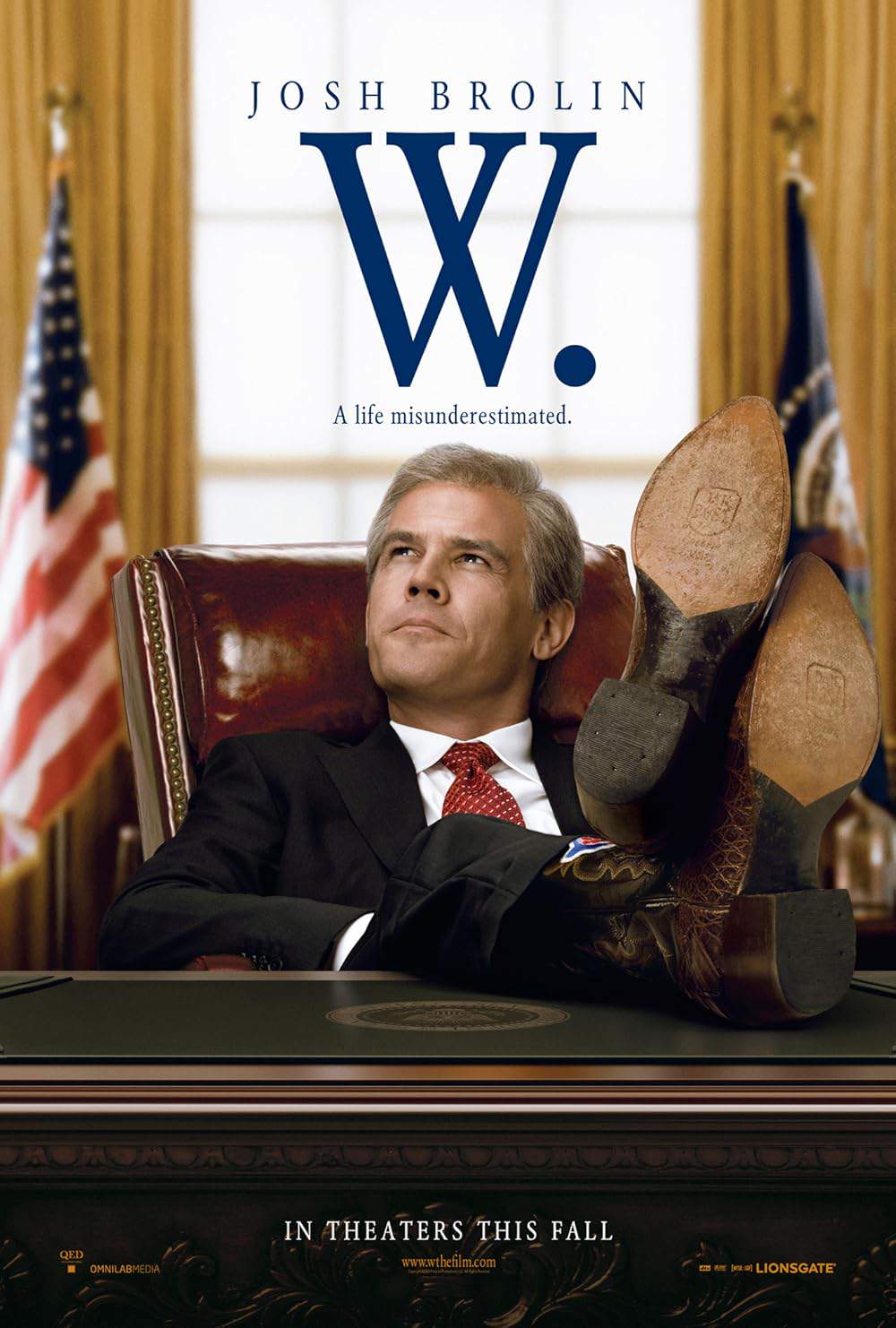
In a sweeping biographical portrait, W. examines the life of one of the most debated figures in modern American history, George W. Bush, tracing his journey from privileged roots to the highest office in the land. The film approaches its subject with an unflinching yet nuanced gaze, refusing easy judgments while digging into the formative experiences that shaped a man long before the world came to know his name. Set against the backdrop of a changing America, the story moves through decades of personal reinvention, ambition, and political awakening.
The narrative weaves between intimate moments of self-discovery and the larger currents of family legacy, faith, and public expectation. Bush is portrayed not as a caricature but as a complex figure navigating the pressure of a famous surname while seeking his own identity. His relationships with his father, his wife Laura, and the political mentors who believed in his potential form the emotional scaffolding of the story, hinting at the personal stakes behind every public decision.
As the film progresses into his time in office, it confronts the weighty responsibilities and moral ambiguities of leadership during turbulent times. The tone remains thoughtful and provocative, inviting viewers to consider how a man of modest political beginnings came to shape history in ways that continue to spark debate. The world of Washington politics, with its advisors, strategists, and entrenched powers, emerges as a force both alluring and daunting.
Ultimately, W. offers less a verdict than an invitation to look closer, painting a portrait of ambition, faith, and consequence. The film lingers on the gap between private conviction and public consequence, leaving the audience to wrestle with questions of legacy, identity, and the unpredictable paths that lead ordinary individuals into extraordinary circumstances.
What Happens in W.?
The complete story of W., from the first scene to the last, in 684 words (about 3 minutes). Spoilers throughout.
Spoilers ahead
In 1966, George W. Bush endures an initiation by his fellow Yale University students as a Delta Kappa Epsilon pledge. During the hazing, Bush successfully recalls the names and nicknames of many of the fraternity members, and states that his family’s political legacy is one in which he has no interest. After Bush is jailed in New Jersey for rowdiness following a football game, his father, George H. W. Bush states that he will help him, but for the last time. Following his graduation from Yale, Bush takes a job at an oil patch back in Texas, but he quits after a few weeks.
In 1971, “Junior” reveals his real aspirations in a father-son talk: working in professional baseball. Bush is accepted into Harvard Business School with the help of his father. After a night of heavy drinking, Bush crashes his car into his family estate and challenges his father to a fistfight. His younger brother, Jeb, stops the fight.
In 1977, Bush announces he will run for Congress to represent Texas’s 19th district. At a barbecue, Bush meets his future wife, Laura Lane Welch. During a debate, Bush is criticized by his Democratic opponent, Kent Hance, who says that Bush is not a real Texan and has spent campaign contributions to throw an alcohol-fueled party for underage Texas Tech University students. Bush fares poorly in the debate and loses the election, but nevertheless receives the highest number of votes for a Republican candidate in Texas’s 19th district in the state’s history.
In 1986, Bush becomes a born-again Christian, gives up alcohol, and mends his relationship with his father. The elder Bush invites him to assist with what becomes his 1988 presidential campaign, although Bush himself suspects that he only was asked because Jeb was busy. Bush’s political advisor, Karl Rove, tells him that he has the potential to make a name for himself, but that he has not yet done anything with his life. Bush becomes a front office executive of the Texas Rangers baseball team, while his father oversees the victory of the Gulf War. Although Allied forces liberate Kuwait within 100 hours of their ground invasion, the elder Bush decides not to invade Iraq to depose Saddam Hussein. After his father loses the 1992 presidential election to Bill Clinton, Bush blames the loss on his decision not to depose Saddam.
In 1994, Bush runs for governor of Texas. Despite his parents’ objection to him entering the race, he secures a victory in the election, becoming the 46th governor of Texas on January 17, 1995. In 2000, he makes a successful bid to become president. Following the September 11 attacks in 2001, Bush labels Iran, Iraq, and North Korea as the “axis of evil”. In 2002, Bush searches for evidence that Saddam was creating nuclear weapons, and has the army prepared. All of Bush’s White House staff supports him except Secretary of State Colin Powell, who states that invading Iraq would destabilize the country. Powell is generally overruled by Vice President Dick Cheney and Secretary of Defense Donald Rumsfeld, who insist that the war would secure the United States’ status as sole global superpower while spreading democracy throughout the Middle East.
In March 2003, the U.S. invades Iraq. The war appears to be a success, and Bush soon gives his “Mission Accomplished” speech on an aircraft carrier. Shortly afterward the Iraqi insurgency begins and when it becomes clear that there are no weapons of mass destruction within Iraq, Bush learns that the responsibility for finding them had been relegated far down the chain of command. Bush discovers that Saddam gambled his regime and his life on the assumption that Bush was bluffing. Bush is asked in a White House press conference what mistakes he made as President, a question that leaves him flustered and speechless. That night, Bush has a nightmare in which his father accuses him of ruining his family’s legacy, which the elder Bush claims was intended for Jeb. Bush dreams of himself playing center field at a baseball game. Bush attempts to catch a pop fly, but it disappears.
Who Are the Main Characters in W.?
George W. Bush (Josh Brolin): who they are and the part they play in the story. The profile links to the actor’s page.
-

George W. Bush (Josh Brolin)
Played by Josh Brolin
George W. Bush is portrayed as a conflicted individual shaped by familial expectations and personal struggles. He evolves from a carefree youth to a contentious political figure, influenced by his relationship with his father and his quest for identity. Bush's journey reflects the challenges of leadership under immense scrutiny.
- 👔 Politics
- 🍂 Transformation
- 💔 Family
Where and When Is W. Set?
W. is set in Yale University, Texas and Iraq (1966, 1971, 1977, 1986, 1994, 2000, 2001, 2002, 2003). Here is why the time and place matter to the story.
When
1966, 1971, 1977, 1986, 1994, 2000, 2001, 2002, 2003
The film spans several decades, beginning in the mid-1960s and culminating in the early 2000s. This period witnessed significant events in American history, including the Vietnam War's lingering effects, the rise of the Republican Party, and the complexities of the War on Terror following the September 11 attacks. The socio-political landscape of America changes drastically during these years, influencing Bush's personal and political journey.
Where
Yale University, Texas, Iraq
The movie features key locations such as Yale University, known for its prestigious education and fraternity culture. Texas serves as the backdrop for George W. Bush's political aspirations and personal development, reflecting the state's unique cultural and political landscape. Iraq becomes central to the narrative during the U.S. invasion, illustrating the complexities of foreign policy and military intervention.
- 🎓 Education
- 🌵 Texas
- 🇨🇮 War
What Are the Themes of W.?
3 ideas the story keeps returning to, among them Political Legacy, Struggles with Addiction and War and Responsibility.
-
01
Political Legacy
The theme of political legacy is prominent, as George W. Bush grapples with the expectations of his family's political background. His journey reflects the challenges of stepping out of a parent's shadow while pursuing personal ambitions. The film explores the weight of legacy on identity and decision-making.
-
02
Struggles with Addiction
Bush's struggles with alcohol and personal behavior are depicted, shedding light on the challenges faced before his transformation into a responsible adult. This theme highlights the impact of addiction on personal relationships and political ambitions. Bush's journey toward sobriety marks a pivotal shift in his life.
-
03
War and Responsibility
The theme of war and responsibility emerges as Bush navigates the complexities of leading a nation into conflict. It emphasizes the moral dilemmas and repercussions of wartime decisions. The film raises questions about leadership, accountability, and the true cost of political ambitions.
What Kind of Film Is W.?
Bittersweet in tone, with steady pacing and a complex story, going by the plot summary.
- Tone
- Bittersweet
- Pacing
- Steady
- Story
- Complex
- Intensity
- Medium
- Ending
- Ambiguous
A cerebral political biography that traces one man's journey from privileged scoundrel to wartime president, weighing personal failings against historical consequence with a melancholic, contemplative tone.
- contemplative
- cerebral
- somber
- melancholic
- reflective
- introspective
- political biography
- war and conflict
- family legacy
- faith and redemption
Content notes: war violence, substance abuse, political manipulation, family conflict.
Where to Watch W.
Stream it on Hoopla and Kanopy, or rent or buy it from Amazon Video and Apple TV Store. US availability and prices from JustWatch.
 Hoopla
  Kanopy
  Lionsgate+ Amazon Channel
  Tubi TV
  YouTube Free




Streaming availability in the US, powered by 
