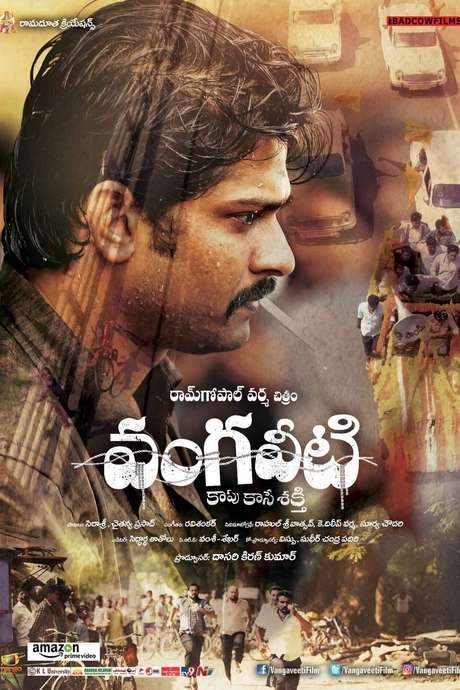



Where to Watch Vangaveeti
See current US streaming, rental, and purchase options for Vangaveeti (2016) via JustWatch.


Streaming availability powered by 
Vangaveeti Plot Summary
Read the complete plot summary and ending explained for Vangaveeti (2016). From turning points to emotional moments, uncover what really happened and why it matters.
Set in the 1970s in Vijayawada, this sprawling political saga centers on Ratna Kumari [as the wife of Vangaveeti Ranga] w/o Vangaveeti Ranga, a figure whose life becomes entangled with the city’s ruthless street politics. The story follows the rise of Radha, also known as “Bustand Radha,” who forges an alliance with the Communist Party of India and quickly embeds himself within the local power structure, working alongside Vijayawada’s party secretary Venkata Rathnam. As the years pass, a grinding power struggle unfolds over control of the crucial Vijayawada transport network, a resource that both sides crave and weaponize to expand their influence.
In a brutal turn of events, the year 1972 sees Venkata Rathnam murdered by Vangaveeti Radha and his supporters, igniting a fierce retaliation that culminates in the retaliation group’s murder of Radha himself. With Radha dead, Mohana Ranga steps forward to lead the United Independent Organization, drawing backing from student leaders Devineni Gandhi and Devineni Nehru. The power dynamics within this alliance prove unstable, and internal rivalries fracture the organization, paving the way for bitter feuds that splinter the political movement.
The fracture deepens when Mohana Ranga’s circle kills Devineni Gandhi in 1979, a blow that signals the dangerous shift from internal strife to raw political maneuvering. Mohana Ranga’s ascent continues into the early 1980s, as he launches a municipal campaign in 1981 after the Indian National Congress withdraws its official candidate in his favor. Meanwhile, Nehru becomes a rival voice, backed by the Telugu Desam Party (TDP), a group strongly associated with the Kamma caste, while Ranga cultivates a base among the Kapu community and frames himself as a champion of the downtrodden.
By 1985, Ranga is an MLA for the Congress Party, while Nehru secures a TDP seat and rises to ministerial power. The conflict intensifies in the early to mid-1980s as both leaders become deeply entangled in gang warfare, with the clash between Kamma and Kapu factions shaping the political map of the region during N. T. Rama Rao’s tenure as the first Kamma chief minister of Andhra Pradesh. The violence persists into 1988, when Devineni Nehru’s younger brother, Devineni Murali, is killed by Mohana Ranga’s associates in retaliation for earlier killings of Ranga supporters.
Tensions peak during a hunger strike in support of farmers, when a night-time attack on Mohana Ranga’s camp on December 25, 1988, is carried out by a group of rivals. The film traces how these titanic feuds—driven by shifting loyalties, caste dynamics, and shifting political allegiances—reshape local power and leave an enduring mark on the city’s history.
The film features performances by [Shri Tej], [Sandeep Madhav], and [Vamsee Chaganti], bringing the complex web of relationships and loyalties to life with contemporary energy and a sense of realism. The cast forms a backdrop to the central narrative, helping to illuminate how personal ambition, community identity, and political strategy intersect in a volatile era of Andhra Pradesh politics.
Vangaveeti Timeline
Follow the complete movie timeline of Vangaveeti (2016) with every major event in chronological order. Great for understanding complex plots and story progression.
Radha aligns with CPI and rises in Vijayawada politics
In the early 1970s, Vangaveeti Radha aligns with the Communist Party of India and serves as secretary for Vijayawada under Venkata Rathnam. This alliance places him at the center of the city's power struggles over the transport business and local influence. The partnership foreshadows the violent clashes to come over control of Vijayawada's networks.
Murder of Venkata Rathnam
In 1972, Venkata Rathnam is murdered by Radha and his supporters as they vie for control of the Vijayawada transport routes. The killing triggers retaliatory violence from rival factions across the city. This act marks a turning point that draws Radha deeper into a cycle of vengeance.
Retaliation defeats Radha
Following Rathnam's death, a rival group's retaliation targets Radha, resulting in his own murder. The assassination intensifies the city’s gangland feuds and polarizes local politics. The violence solidifies the power of Radha's followers in the ensuing power struggles.
Mohana Ranga assumes leadership of UIO
After Radha's death, Mohana Ranga takes over the United Independent Organization with support from student leaders Devineni Gandhi and Devineni Nehru. The UIO becomes a major force in Vijayawada, blending political influence with intimidation. This marks the rise of a new power axis in the region.
UIO splits and Gandhi is murdered
Internal power struggles within the UIO lead to a split, and Mohana Ranga's associates murder Devineni Gandhi in 1979. The killing further fragments alliances and escalates violence linked to political factions. The event deepens the rift between Mohana Ranga's camp and its rivals.
Mohana Ranga enters municipal politics
In 1981, Mohana Ranga contesting the municipal election after the Congress withdraws its official candidate in his favor. This marks a transition from gang leadership to formal political office. His move signals the growing influence of the former crime-linked factions in official politics.
Nehru aligns with TDP; Ranga wins support as Kapu leader
Around the early 1980s, rival Nehru secures sponsorship from the Telugu Desam Party (TDP), driven by caste-based politics, while Mohana Ranga positions himself as a Kapu leader advocating for the downtrodden. The two camps increasingly define district politics along caste and party lines.
Ranga becomes Congress MLA; Nehru becomes TDP MLA
In 1985, Ranga wins a seat as a Congress MLA, while Nehru becomes a TDP MLA and eventually a minister. Their electoral successes crystallize the split between their factions and solidify parallel power structures within the region. The rivalry moves from street battles to formal legislative competition.
Gang warfare escalates amid Kamma-Kapu tensions
Starting in 1983, both leaders are implicated in ongoing gang warfare fueled by Kamma-Kapu caste rivalry, coinciding with N.T. Rama Rao's tenure as the first Kamma chief minister of Andhra Pradesh. The conflict Seeps into municipal and state politics, shaping alliances and policy.
Devineni Murali is murdered
In 1988, Devineni Nehru's younger brother Devineni Murali is murdered by Mohana Ranga's associates in retaliation for earlier killings of Ranga's allies. The assassination intensifies the vendetta between the rival camps and escalates the cycle of violence.
Attack on Mohana Ranga's camp during a hunger strike
While Mohana Ranga is on a hunger strike to support farmers, rival groups attack his camp in the early hours of 25 December 1988. The assault highlights how political violence and caste-based enmities disrupt even protest movements. The incident leaves a lasting mark on the regional power struggle.
Ranga's era leaves a lasting political scar
The sequence of assassinations, shifting loyalties, and continuous gang warfare reshapes Vijayawada's political landscape, influencing party strategies, security approaches, and caste dynamics for years to come. The conflicts become a defining backdrop for the region's late 1980s to early 1990s politics.
Vangaveeti Characters
Explore all characters from Vangaveeti (2016). Get detailed profiles with their roles, arcs, and key relationships explained.
Ratna Kumari (Naina Ganguly)
The wife of Vangaveeti Ranga, Ratna Kumari represents the personal cost of the era's violence and political ambition. While her husband leads a volatile power base, she navigates the dangers surrounding him and the community's loyalties. Her perspective offers a human counterpoint to the factional storyline.
Vangaveeti Settings
Learn where and when Vangaveeti (2016) takes place. Explore the film’s settings, era, and how they shape the narrative.
Time period
1970s-1980s
Set across the 1970s and into the late 1980s, the film traces a period of intense political upheaval in Andhra Pradesh. The era saw rising caste-based mobilization, shifting party loyalties, and violent clashes orchestrated by local leaders. Real events from that period echo in the film's depiction of assassinations, hunger strikes, and shifting alliances.
Location
Vijayawada, Andhra Pradesh, India
Vijayawada, a major urban center in Andhra Pradesh, serves as the nerve center for the film's power struggles. The city is depicted as a hub of transport networks, political factions, and street-level conflicts that shape the fate of its leaders. This setting provides a backdrop where gang rivalries and political ambitions collide, driving the dramatic events of the story.
Vangaveeti Themes
Discover the main themes in Vangaveeti (2016). Analyze the deeper meanings, emotional layers, and social commentary behind the film.
⚖️
Power & Caste
Power dynamics in the film are framed through caste identities and political leverage. Rival leaders court support from their respective communities, shaping who leads the municipal and regional stages. The film highlights how caste lines influence loyalty, policy, and even violence. It shows the cost of ambition as communities are pulled into factional warfare.
💥
Violence & Revenge
Violence drives the plot, with killings triggering cycles of retaliation that mirror real-world gang warfare. Assassinations, hunger strikes, and street clashes intensify the stakes for every faction. The story portrays how retribution consolidates power while eroding trust. The consequences ripple through families and communities, underscoring the human cost of political conflict.
🏛
Political Rise
Character arcs center on leadership emergence from within marginalized groups. The narrative traces how leaders leverage populist appeal to gain electoral power. The shifting alliances reflect strategic calculations beyond ideology. The rise and fall of figures show how political capital is built and destroyed in a volatile environment.

Coming soon on iOS and Android
The Plot Explained Mobile App
From blockbusters to hidden gems — dive into movie stories anytime, anywhere. Save your favorites, discover plots faster, and never miss a twist again.
Sign up to be the first to know when we launch. Your email stays private — always.
Explore the mobile appVangaveeti Spoiler-Free Summary
Discover the spoiler-free summary of Vangaveeti (2016). Get a concise overview without any spoilers.
In the bustling streets of 1970s Vijayawada, the city’s lifeblood hums through an intricate web of transport routes, market stalls, and political rally cries. The film paints a gritty portrait of a metropolis where every bus line and truck lane doubles as a conduit for influence, and where community loyalties pulse as powerfully as the engines that thunder down its roads. Against this backdrop the tone is unflinching and grounded, inviting the audience to feel the city’s restless energy and the ever‑present undercurrent of ambition.
At the heart of the story stands Vangaveeti Mohan Ranga Rao, a charismatic figure whose rise from the local neighborhood to the halls of legislative power is driven by a fierce desire to champion the marginalized. Beside him, Ratna Kumari offers both emotional anchor and quiet resolve, embodying the personal stakes that intertwine with the public arena. Their world collides with that of Radha, known locally as “Bustand Radha,” a street‑wise organizer whose ties to the Communist Party of India give him a distinct edge in the city’s power play.
The narrative expands to include a cast of influential players: the seasoned party secretary Venkata Rathnam, whose strategic mind shapes the political landscape; the idealistic student leaders Devineni Gandhi and Devineni Nehru, each pulling the tides of youth activism and regional allegiance. Caste identities flicker across the canvas—Kapu and Kamma communities vie for representation, while the looming presence of N. T. Rama Rao’s administration adds a layer of statewide intrigue. Together these forces create a volatile mix of loyalty, rivalry, and aspiration that colors every interaction.
Rendered with a realistic aesthetic and a palpable sense of urgency, the film immerses viewers in a world where personal ambition and communal duty constantly clash. The atmosphere crackles with the promise of shifting alliances and hidden agendas, leaving the audience poised on the edge of a political saga that feels both intimate and monumental.
Featured on this page

What's After the Movie?
Not sure whether to stay after the credits? Find out!
Check out our other apps:

SAT Sphere
Build confidence for the Digital SAT.

Mori Atlas
Discover wild places worth protecting.

Luntero
Search smarter for a home in Amsterdam.

Plot Explained
Unravel movie endings and hidden clues.

Pokechamp
Dive into Pokémon data and battle logic.

Driving Theory
Get ready for your European theory test.

Movie Dust
Plan your next cinema trip with ease.

Musemap
Find art and culture as you travel.

Selkobase
Compare credentials before committing.

Local Manual
Turn an unfamiliar country into practical next steps.

Lernavi
Compare school systems before your next move.

GymRoam
Find a workout stop wherever your plans take you.
Explore Our Movie Platform
New Movie Releases (2026)
Famous Movie Actors
Top Film Production Studios
Movie Plot Summaries & Endings
Major Movie Awards & Winners
Best Concert Films & Music Documentaries
Movie Collections and Curated Lists
© 2026 What's After the Movie. All rights reserved.
Privacy Policy