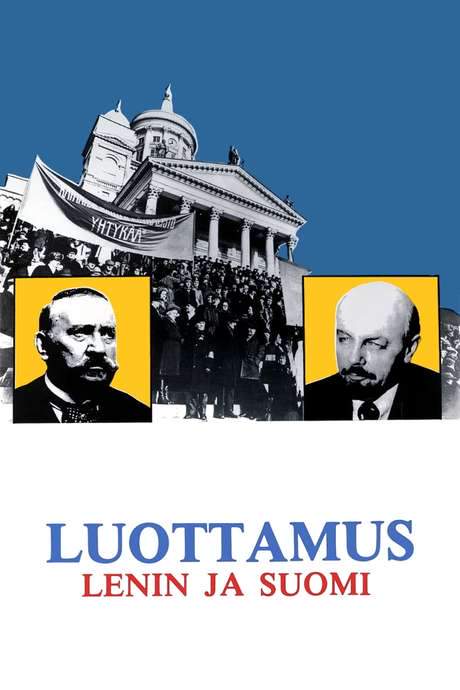
Trust 1976

Directed by

Edvin Laine
Made by

Fennada-Filmi
Trust Plot Summary
Read the complete plot summary and ending explained for Trust (1976). From turning points to emotional moments, uncover what really happened and why it matters.
Trust unfolds at the end of December 1917, when the Finnish delegation travels to St. Petersburg to seek recognition for Finland’s independence. Finnish Prime Minister P. E. Svinhufvud, Vilho Siivola, travels with diplomats Carl Enckell Yrjö Tähtelä and Gustaf Idman Yrjö Paulo to press Finland’s case, while Bolshevik leader Lenin, Kirill Lavrov, weighs how to respond to this bid and how it might shape his nationality policy and his personal stance toward Finland.
The film uses a rich tapestry of flashbacks to illuminate Finland’s path to autonomy and eventual independence, and to trace Lenin’s evolving relation to Finland across 1899–1917. It sketches a century of tension and negotiation, weaving together political pressure, ideological shifts, and personal entanglements that would influence both sides.
Among the pivotal moments it revisits are the rejection of the Great Petition in St. Petersburg in 1899, a dramatic episode that underscored Finland’s unresolved status under rule from Moscow. It recalls Eugen Schauman’s bold act in 1904, when Eugen Schauman shot Governor General Nikolai Bobrikov, an event that radiated through Finnish and Russian governance. The story then moves to 1907, when Lenin himself wanders the Turku archipelago after escaping Finland, an image that highlights the cross currents between exile, ideology, and national fate.
In 1910, Purishkevich delivers the infamous call in the Russian Duma:
Finis Finlandiae!
This moment underscores the volatile mood of the era and the unresolved political drama surrounding Finnish autonomy. The film also depicts the 1910 parliamentary scene, where the chamber led by P. E. Svinhufvud refuses to accept national legislation, signaling the endless back-and-forth that defined Finland’s struggle.
As 1917 unfolds, the narrative shows the Finnish Parliament, led by speaker Kullervo Manner, convening in the autumn despite dissolution orders. It then follows Lenin’s shadowy presence in Helsinki, where he hides with Kustaa Rovio Eero Salmi during the fall of 1917. The drama intensifies as Kullervo Manner, Yrjö Sirola Jarno Hiilloskorpi, and K. H. Wiik attend Lenin’s December speeches, movements that frame the Irreducible tug-of-war between revolutionary currents and national sovereignty.
Ultimately, Lenin’s government grants Finland’s recognition to the Svinhufvud delegation in December 1917, a milestone that comes after centuries of negotiation and conflict. The film closes with a brisk montage that connects this turning point to the future, ending with a clip from a 1975 Helsinki OSCE meeting, which situates the Finland of 1917 within a longer arc of European diplomacy and memory.
Throughout, the film keeps a measured, documentary tone, letting history breathe through its carefully arranged vignettes while anchoring the human stories in well-drawn characters and their real-world counterparts. This is a movie about endurance, negotiation, and the stubborn, hopeful thread of national self-determination that runs through a century of upheaval.
Trust Timeline
Follow the complete movie timeline of Trust (1976) with every major event in chronological order. Great for understanding complex plots and story progression.
Great Petition rejected in St. Petersburg
The Finnish delegation travels to St. Petersburg to demand recognition and autonomy. The Great Petition is presented but is rejected by the Tsarist authorities, stalling Finland's autonomy ambitions. The setback marks a turning point that intensifies the Finnish independence movement.
Assassination of Governor General Bobrikov (1904)
Eugen Schauman shoots Governor General Nikolai Bobrikov in 1904, in an act of nationalist protest. The assassination shocks the empire and escalates the Finnish struggle against Russian rule. The event becomes a symbol of resistance within a tense political climate.
Lenin's Turku archipelago wanderings (1907)
Lenin wanders in the Turku archipelago on weak ice after escaping Finland in 1907. This exile experience shapes his views on nationalism and Finland's future status. The episode is portrayed as a formative moment in Lenin's nationality policy.
Purishkevich proclaims 'Finis Finlandiae!' in the Duma (1910)
Purishkevich delivers the famous phrase in the Russian Duma, signalling a hostile stance toward Finnish self-rule. The outburst heightens tensions between Finland and the empire. It becomes a notable flashpoint in the struggle for Finnish autonomy.
Finnish Parliament rejects national legislation (1910)
The Finnish Parliament, led by Speaker Svinhufvud, refuses to accept national legislation in 1910. The decision demonstrates the limited autonomy under Russian rule and reinforces the path toward independence. It showcases the persistence of Finnish political leadership against imperial constraints.
Parliament convenes despite dissolution order (Fall 1917)
In fall 1917, the Finnish Parliament convenes despite an official dissolution order. The assembly presses forward with deliberations that foreshadow a break with Russia as the empire weakens. The move signals the rising readiness of Finland for full independence.
Lenin hides in Helsinki with Kustaa Rovio (Fall 1917)
Lenin hides in Helsinki with Kustaa Rovio during the volatile autumn of 1917. The clandestine arrangement underscores the tumult surrounding the Finnish crisis and the Bolsheviks' interest in the region. It highlights Lenin's close, secret presence in Finland at the time.
Finnish leaders attend Lenin's December speeches (1917)
Kullervo Manner, Yrjö Sirola, and K. H. Wiik attend Lenin's speeches in December 1917. The Finnish delegates listen as Lenin discusses national policy and Finland's future relationship to Russia. The scene illustrates the intersection of Finnish leadership with Lenin's evolving stance on nationality.
Lenin's government recognizes Finland's independence (December 1917)
Lenin's government recognizes Finland's independence and gives the document to the Svinhufvud delegation in December 1917. This formal recognition solidifies Finland's path to sovereignty as the Bolshevik regime asserts its legitimacy. The moment marks a historic milestone in Nordic independence.
Closing OSCE newsreel clip (1975)
At the film's end, a newsreel clip from the 1975 Helsinki OSCE meeting is shown. The sequence links Finland's revolutionary past to its postwar role in international diplomacy. It emphasizes the long arc from 1917 to present European cooperation.
Trust Characters
Explore all characters from Trust (1976). Get detailed profiles with their roles, arcs, and key relationships explained.
Vladimir Lenin (Kirill Lavrov)
A revolutionary leader whose stance toward Finland evolves across the film. Lenin weighs how Finland's independence bid might shape his nationality policy and his broader revolutionary project; his presence in Helsinki and St. Petersburg frames the tension between national self-determination and imperial strategy.
P. E. Svinhufvud (Vilho Siivola)
Finnish prime minister and parliamentary figure who navigates constitutional resistance and political strategy. He leads the delegation to St. Petersburg and chairs the autumn 1917 parliament, embodying steady resolve amid upheaval.
Carl Enckell (Yrjö Tähtelä)
Diplomat traveling with Svinhufvud and Idman to press Finland's case; a pragmatic mediator bridging Finnish aspirations with imperial politics.
Kullervo Manner (Esa Saario)
Speaker of the Finnish Parliament during the autumn 1917 session; a steady leader balancing revolutionary energy with constitutional procedure.
Nikolai Bobrikov (Innokentiy Smoktunovskiy)
Governor General whose oppressive governance triggers Finnish resistance and sets the stage for later negotiations.
Eugen Schauman (Göran Schauman)
Finnish nationalist who assassinates Governor General Bobrikov in 1904, an act that reverberates through Finnish and Russian governance.
Trust Settings
Learn where and when Trust (1976) takes place. Explore the film’s settings, era, and how they shape the narrative.
Time period
1899–1917
The narrative spans from the 1899 rejection of the Great Petition through the pivotal year 1917, when Finland seeks recognition of independence. It traces decades of imperial pressure, political shifting, and strategic negotiations between Finnish leaders and Russian authorities. The period culminates in December 1917, when Lenin’s government recognizes Finland’s delegation.
Location
St. Petersburg, Helsinki, Turku archipelago
The story unfolds across key locations in the late Tsarist empire and entrenched Finnish politics. St. Petersburg serves as the imperial center where Finland’s autonomy petition is rejected. Helsinki and the Turku archipelago feature as backdrops for Lenin’s activities and Finland’s political maneuvering during 1917.
Trust Themes
Discover the main themes in Trust (1976). Analyze the deeper meanings, emotional layers, and social commentary behind the film.
🕊️
Independence
Independence is the central arc, explored through Finland's persistent push for self-determination under Russian rule. The film highlights petitions, negotiations, and political courage required to claim sovereignty. Identity and national will evolve through a long, arduous process of compromise and legitimacy. Independence is presented as a sustained struggle rather than a single moment.
🏛️
Diplomacy
Diplomacy threads through the film’s key turns, from the Great Petition rejection to the 1917 Helsinki discussions. Finnish delegates balance national aims with imperial constraints, employing petitions, parliamentary leverage, and strategic alliances. The drama underscores the costs and trade-offs of negotiation across borders, time, and competing ideologies. Outcomes hinge more on political maneuvering than on force.
🧭
Ideology
Ideology drives Lenin’s evolving stance toward Finland, shaping both personal beliefs and state policy. Flashbacks reveal how revolutionary ideas intersect with Finnish autonomy and diplomacy. The film juxtaposes revolutionary fervor with pragmatic statecraft, creating tension between ideals and practical decisions. This dynamic illuminates how ideas influence real-world political outcomes.

Coming soon on iOS and Android
The Plot Explained Mobile App
From blockbusters to hidden gems — dive into movie stories anytime, anywhere. Save your favorites, discover plots faster, and never miss a twist again.
Sign up to be the first to know when we launch. Your email stays private — always.
Explore the mobile appTrust Spoiler-Free Summary
Discover the spoiler-free summary of Trust (1976). Get a concise overview without any spoilers.
In the frosty twilight of December 1917, a Finnish delegation journeys from a newly uneasy Helsinki to the tumultuous corridors of St. Petersburg. Their mission is as stark as it is historic: to ask the fledgling Bolshevik government to acknowledge Finland’s claim to self‑rule. The film opens on this fragile diplomatic venture, setting a world where shattered empires and nascent republics brush shoulders across icy railways and candle‑lit meeting rooms. A muted, documentary‑style lens tracks the quiet gravity of negotiations, while the ever‑present chill of the Russian winter mirrors the uncertainty that hangs over the continent.
At the heart of the delegation stands P. E. Svinhufd, the determined Finnish prime minister whose steady resolve anchors the group. Beside him, Carl Enckell brings a diplomatic finesse honed in years of quiet statecraft, and Gustav Idman offers a measured counsel that balances pragmatism with idealism. Across the border, Lenin looms as a paradoxical figure—revolutionary yet pragmatic—his presence felt through cautious deliberations rather than overt spectacle. Their interactions are framed by a restrained, almost reverent tone that lets history speak through measured dialogue and lingering glances.
Interwoven throughout the narrative are brief, impressionistic flashes to pivotal moments that have shaped the Finnish quest: the hushed protests of the Great Petition of 1899, Eugen Schauman’s desperate act against a Tsarist governor, and Lenin’s own youthful wanderings through the Turku archipelago. These vignettes are presented without fanfare, serving as quiet signposts that enrich the present‑day tension without dictating its outcome. The film’s visual palette—soft, grainy blues and siennas—conjures a sense of archival footage, reinforcing its documentary cadence while inviting viewers to feel the weight of a century’s struggle.
The atmosphere remains one of poised anticipation. As diplomats cross the frozen Neva and Bolshevik leaders weigh the implications of a new neighbour, the audience is drawn into a tableau of earnest hope, political calculation, and the subtle choreography of power. The story lingers on the delicate balance between bold ambition and cautious diplomacy, leaving the ultimate resolution to the unfolding pages of history rather than the screen.
Movies with Similar Twists and Themes
Uncover films that echo the narrative beats, emotional arcs, or dramatic twists of the one you're exploring. These recommendations are handpicked based on story depth, thematic resonance, and spoiler-worthy moments — perfect for fans who crave more of the same intrigue.


Featured on this page

What's After the Movie?
Not sure whether to stay after the credits? Find out!
Check out our other apps:

SAT Sphere
Build confidence for the Digital SAT.

Mori Atlas
Discover wild places worth protecting.

Luntero
Search smarter for a home in Amsterdam.

Plot Explained
Unravel movie endings and hidden clues.

Pokechamp
Dive into Pokémon data and battle logic.

Driving Theory
Get ready for your European theory test.

Movie Dust
Plan your next cinema trip with ease.

Musemap
Find art and culture as you travel.

Selkobase
Compare credentials before committing.

Local Manual
Turn an unfamiliar country into practical next steps.

Lernavi
Compare school systems before your next move.

GymRoam
Find a workout stop wherever your plans take you.
Explore Our Movie Platform
New Movie Releases (2026)
Famous Movie Actors
Top Film Production Studios
Movie Plot Summaries & Endings
Major Movie Awards & Winners
Best Concert Films & Music Documentaries
Movie Collections and Curated Lists
© 2026 What's After the Movie. All rights reserved.
Privacy Policy